
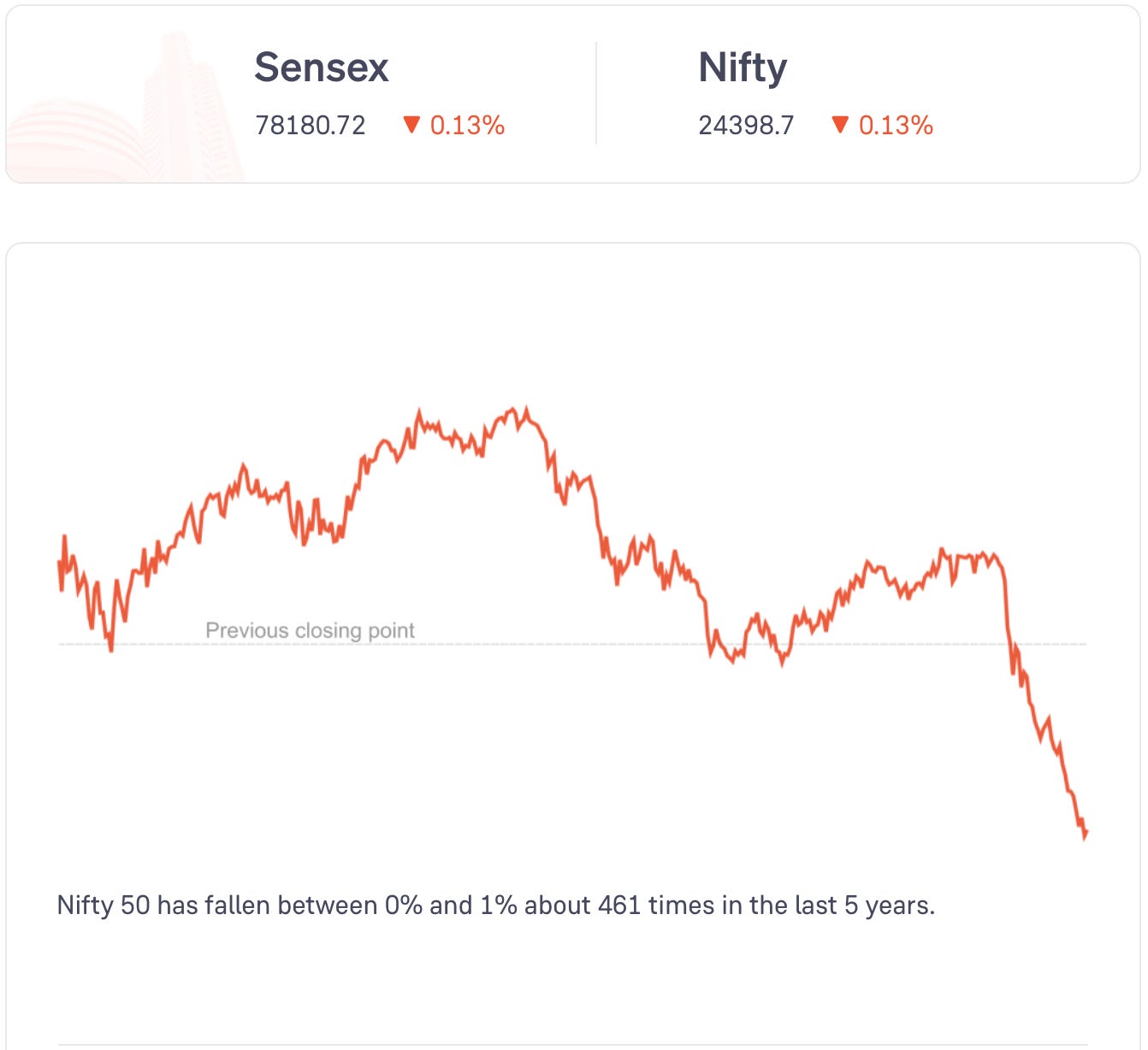
Markets closed below yesterday’s closing point.
Weak global markets affected Indian markets, especially after Asian markets fell sharply.
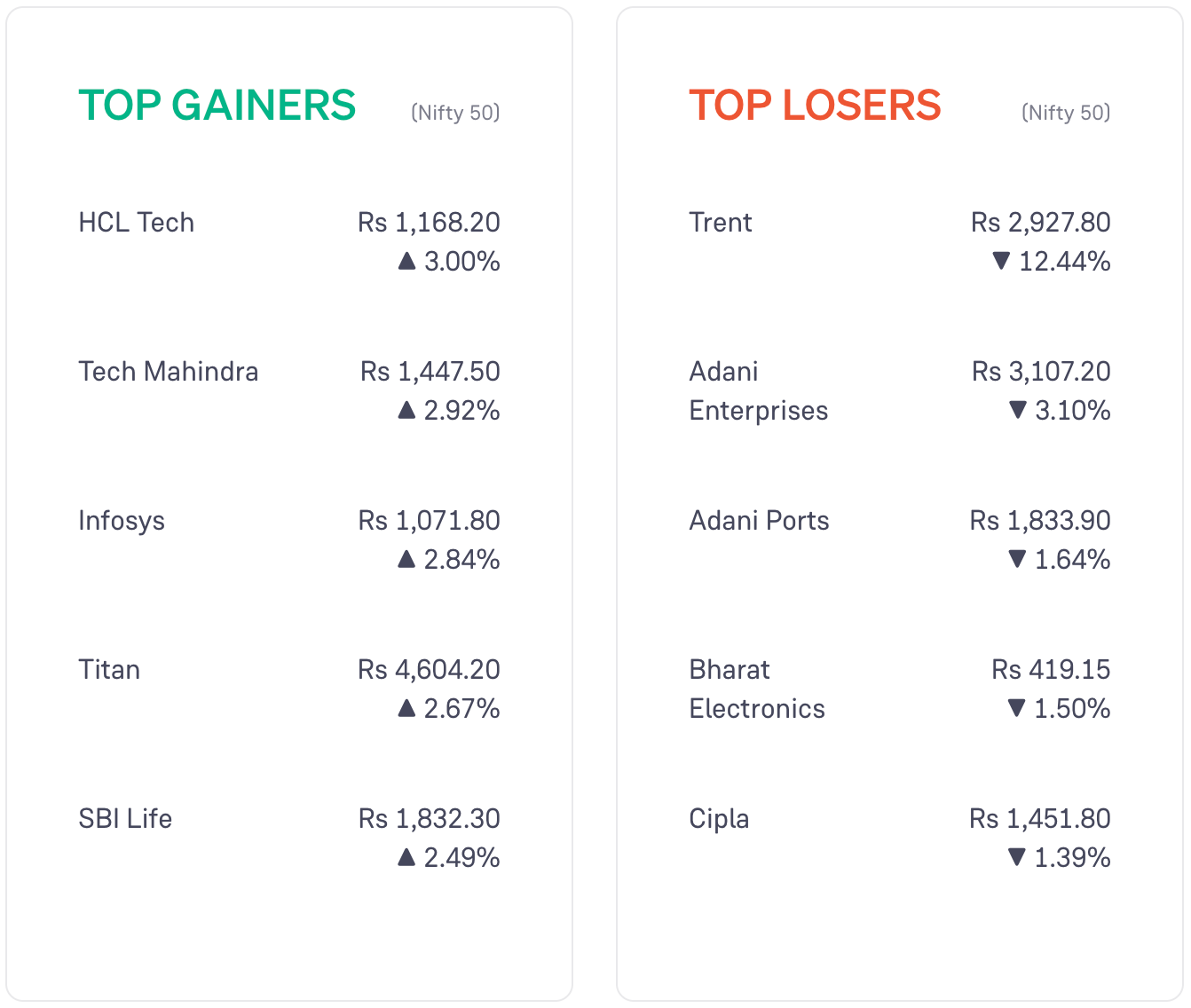
Realty stocks and metal stocks fell the most. Despite weak markets, IT stocks rose.
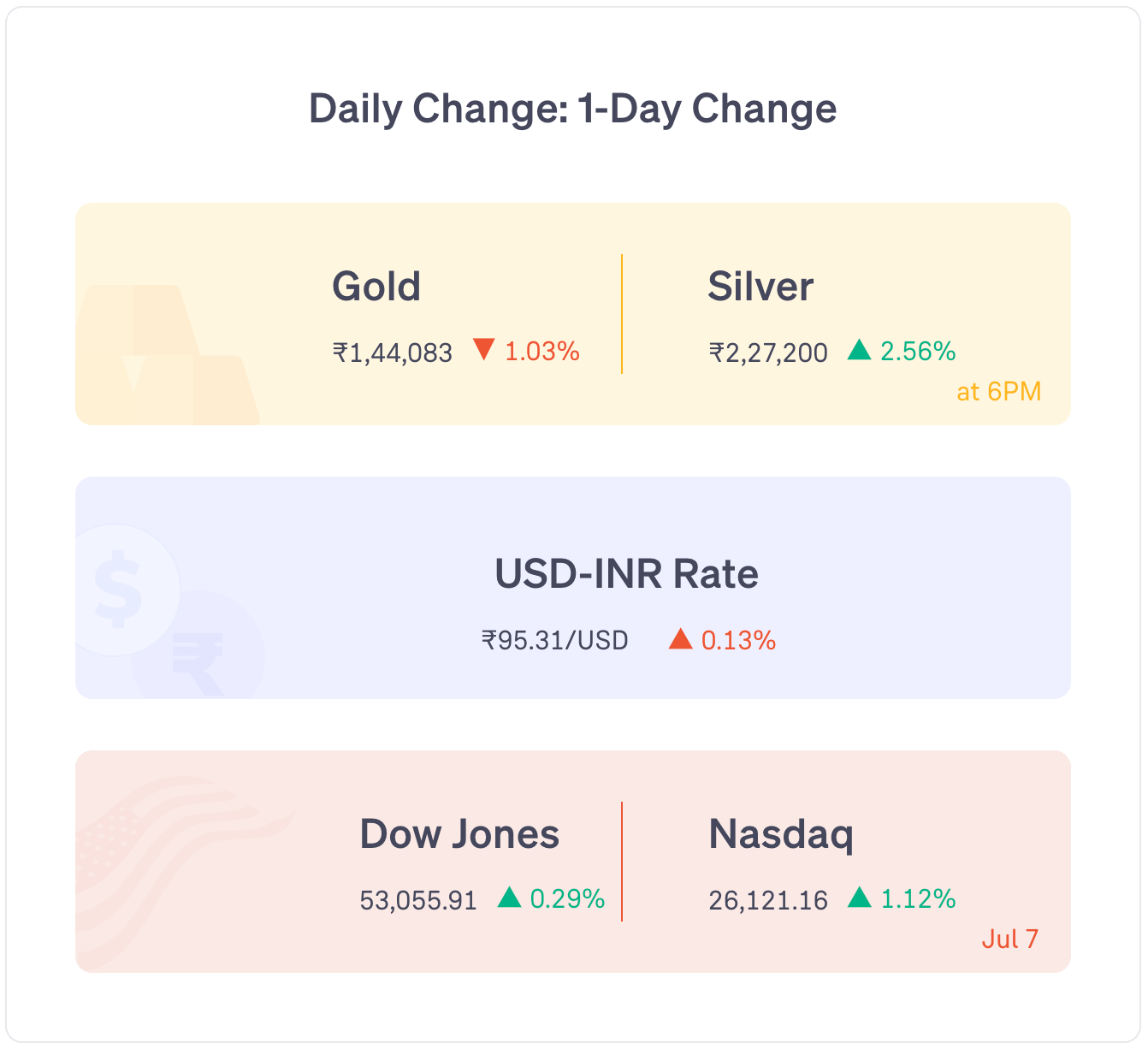
Global markets: US markets rose. Asian markets fell significantly, with South Korean markets falling the most. Most European markets fell (as of 6 pm IST).
News
India and Indonesia signed multiple MoUs including agreements on defense cooperation for BrahMos and Astra missile systems, critical minerals and steel supply chain technology, medical product regulation, disaster management, telecommunications, agriculture, etc.
Manipal Health has received SEBI’s approval for a Rs 8,000 crore IPO.
Cult.fit has filed draft papers with SEBI for a Rs 950 crore IPO.
Stocks Updates
L&T: Moody’s assigned the company a ‘Baa1’ long-term issuer rating with a Stable outlook, and gave the same rating to its subsidiary, Hydrocarbon Saudi Company.
Adani Enterprises: subsidiary Kutch Copper Ltd (KCL) received London Metal Exchange (LME) brand registration for ‘Adani Copper’ Grade-A cathodes, allowing its copper to be traded in international markets from 10 July 2026.
Tata Capital: allotted secured NCDs worth Rs 3,750 crore through separate private placements (Rs 1,000 crore at an 8.15% coupon and Rs 2,750 crore at a 7.88% coupon).
BHEL: signed a Strategic Collaboration Agreement (SCA) with thyssenkrupp nucera India Pvt Ltd for alkaline electrolyser systems used in green hydrogen projects, with plans to gradually localise their manufacturing in India.
Indian Hotels: signed 20 hotels and opened 11 hotels in the June quarter, taking its total portfolio to 645 hotels with over 66,000 keys.
Word of the Day
Retained Earnings
It is the part of a company’s profits that it keeps aside for future use
This usage might be for growth, R&D, expansion, future debt repayment, etc.
A company either retains its earnings or gives it back to its shareholders in the form of dividends.
6 Day Course
Theme: ROE & ROCE
Day 2: Tuesday
So, in the case of ROE, we compare the net profit against the shareholders’ equity.
Let’s understand what shareholders’ equity is.
Shareholders’ equity is the total assets of the company after the liabilities (debt, tax, etc) have been paid off.
In most companies, it is made up of the money the company received from selling shares to investors (like in case of fresh issue shares during the IPO, FPO, etc) and profits/earnings that are retained by the company for spending later.
It can also include additional paid-in capital and a few others.
Shareholders’ equity can also be negative. That would mean their company’s liabilities are greater than its assets (high debt).
Shareholders’ equity is also often called the net worth of the company.
Featured Question
Q. “What’s the difference between retail investor and NII investor”
In IPOs, an investor investing less than Rs 2 lakh is categorised as a retail investor.
An investor investing more than Rs 2 lakh is categorised as an NII.
There are two kinds of NIIs too:
-sNII (Small NII): investment amount more than Rs 2 lakh but less than Rs 10 lakh
-bNII (Big NII): investment amount more than Rs 10 lakh.
The information presented in this post has been compiled and prepared by Groww Invest Tech Pvt Ltd and is intended solely for informational purposes. It is not tailored to any specific investment objectives, financial situations, or needs of any individual investor. The content should not be construed as investment, financial, legal, or tax advice and should not be relied upon as a substitute for professional consultation.
Investing in securities markets involves inherent risks. Investors are advised to carefully review all relevant documents and consider their own risk tolerance before making any investment decisions.
Mutual fund investments are subject to market risks; please read all scheme-related documents carefully. Past performance of financial instruments, schemes, or markets is not indicative of future results.
Groww Invest Tech Pvt Ltd is registered with the Securities and Exchange Board of India (SEBI) under Registration No: INZ000301838, as a Research Analyst under No: INH200008662, as a Depository Participant under No: IN-DP-417-2019, and with the Association of Mutual Funds in India (AMFI) under ARN-111686.
SEBI registration details: View registered name and registration numbers
Research Analyst Disclaimer: View Research Analyst disclaimer
Did you like this edition?
Leave a feedback here!