
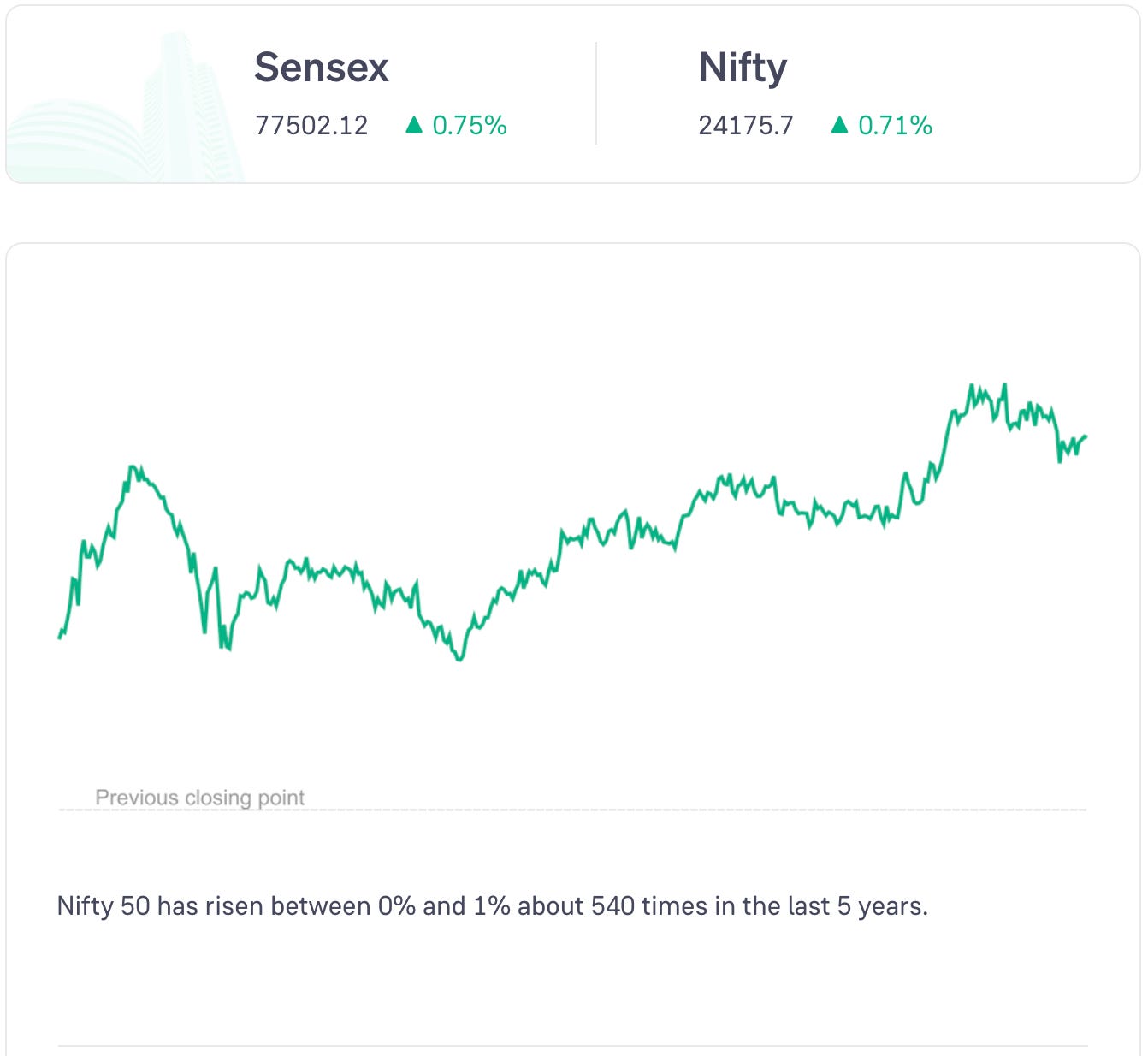
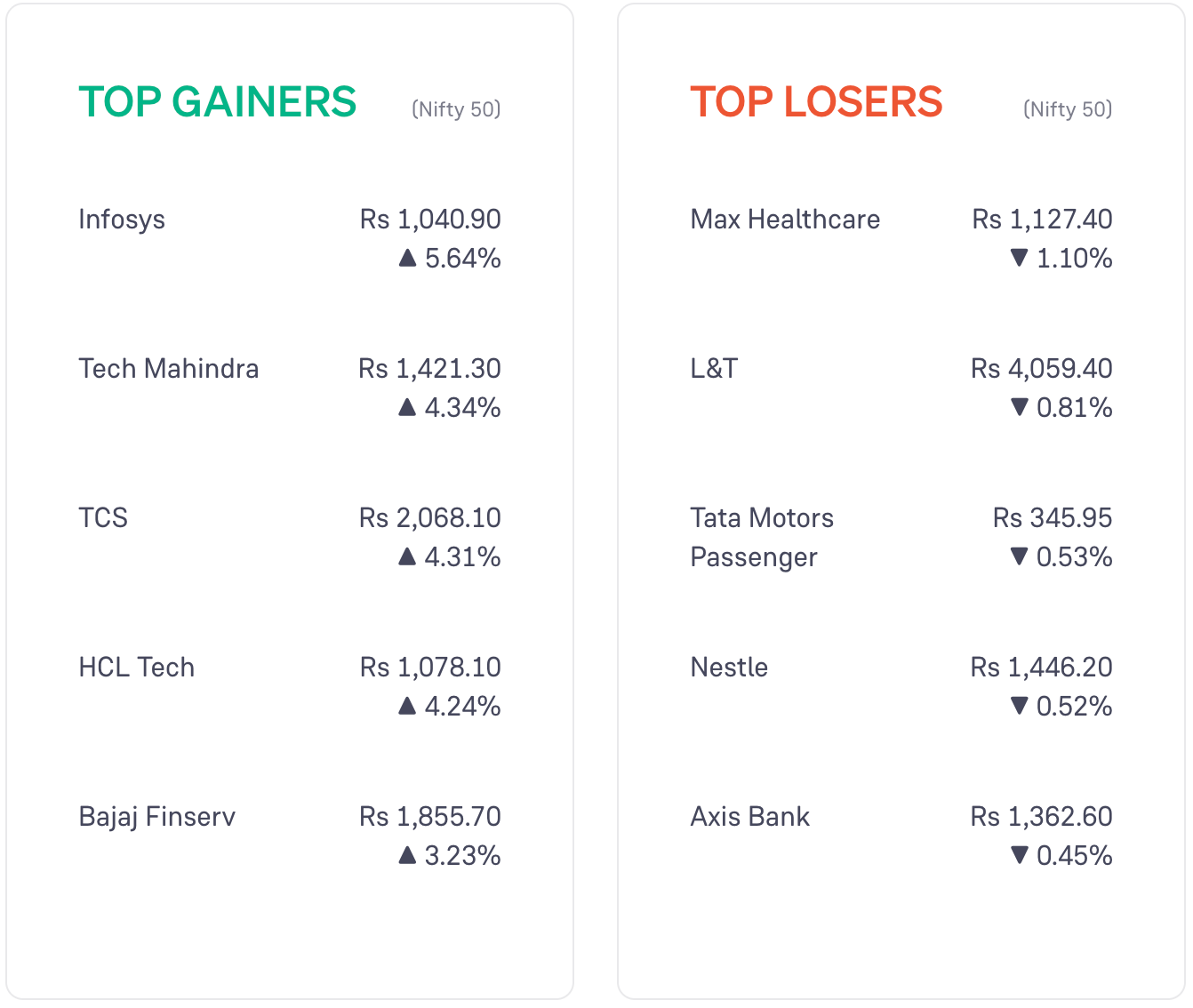
Markets opened above yesterday’s closing point.
All sectors’ stocks rose today except for the PSU Bank stocks. IT stocks and realty stocks rose the most.
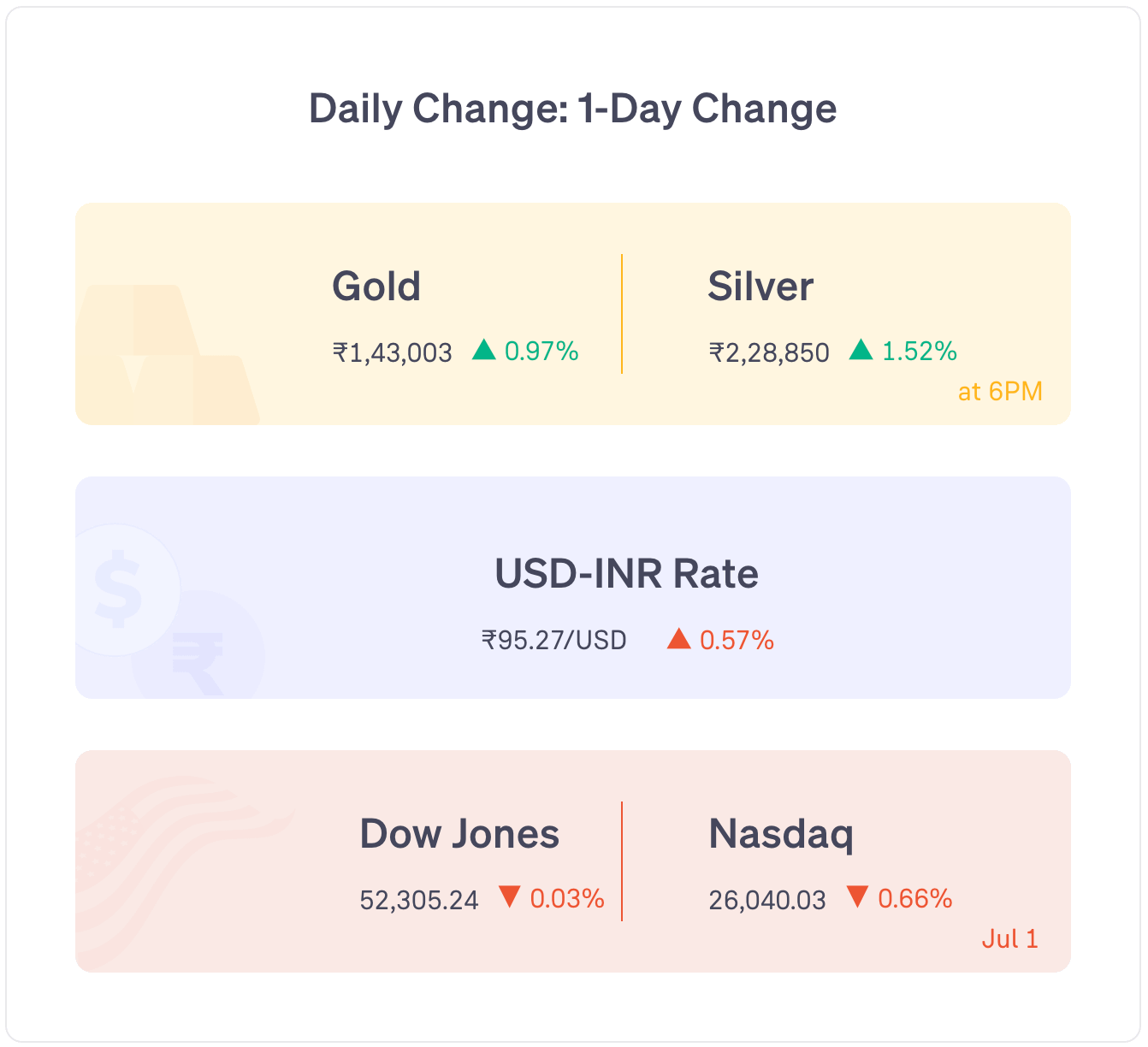
Global markets: US markets and most Asian markets fell. European markets rose (as of 6 pm IST).
News
India and Japan signed a Memorandum of Cooperation (MoC) with an investment of $10 billion in AI, semiconductors, clean energy, and economic security.
Carlsberg has filed draft papers with SEBI for an IPO through the confidential route.
CSM Technologies IPO listed on the stock exchanges at the issue price and closed 5% down at the end of the day.
Stocks Updates
Adani Enterprises: signed an MoU with the Odisha government for an $11.5 billion (around Rs 1.08 lakh crore) aluminium project through a 50:50 JV with IHC Group’s International Resources Holding.
Kotak Mahindra: acquired a loan portfolio worth Rs 9,587.62 crore from its wholly-owned subsidiary Kotak Mahindra Investments Ltd as part of group simplification and RBI compliance.
Varun Beverages: South Africa subsidiaries Beverage Company Proprietary Ltd (Bevco) and Twizza Proprietary Ltd approved the merger of Twizza into Bevco, subject to local laws.
Samvardhana Motherson: indirect wholly owned subsidiary Motherson DRSC Automotive Product Trading (Shanghai) Co Ltd was dissolved following voluntary closure. The company said the dissolution has no material financial impact.
Tech Mahindra: subsidiary Tech Mahindra Servicos De Informatica acquired 100% stake in Brazil-based Alyis Servicos Tecnicos for BRL 1.2 million (around Rs 2.21 crore).
Max Healthcare: received no-objection letters from BSE and NSE for the reclassification of Radiant Life Care Hospital Foundation from ‘Promoter Group’ to ‘Public’ category, effective immediately.
Lupin: received US FDA inspection report for its Somerset, New Jersey facility with Voluntary Action Indicated (VAI) classification. This was following an inspection conducted in April.
Lenskart: board approved the merger of wholly owned subsidiaries Dealskart Online Services and Lenskart Eyetech into the company to simplify its corporate structure and improve operational efficiencies. It also approved a 80:20 joint venture with China’s Mingfeng Glassesworld Ltd to manufacture metal spectacle frames in India.
Aurobindo Pharma: completed the transfer of its domestic branded generic pharmaceutical formulations business to wholly owned subsidiary Auropharm Ltd on a slump sale basis.
Word of the Day
Arbitration
Arbitration is a dispute resolution process in which parties resolve their dispute outside the regular court system
When two parties enter into an agreement, they may include an arbitration clause stating that future disputes will be referred to arbitration.
An arbitrator is a neutral person who listens to both parties, considers their arguments and evidence, and then gives a decision known as an arbitral award.
An arbitral award can be binding on the parties and may be enforceable through a court of law.
6 Day Course
Theme: value trap
Day 4: Thursday
One of the biggest risks that a company can have is too much debt.
It is possible that a company has good revenues, earnings, margins, etc but at the same time, has a high debt.
If the business continues the way it is, the company will continue running fine.
But the moment the revenue gets hit due to some external factor (bad sales seasons, competition, etc), the earnings will fall.
In such a period, the debt might become a massive headache for the company and might prevent it from growing. Most of its future earnings in such a case will go towards paying back debt.
This would prevent the company’s business from growing, therefore preventing its share price from rising.
This could potentially serve as a debt trap for the shareholders.
6 Day Course
Q. “What does it mean when a company says it will challenge the GST bill or penalty and why do they do it and what are the benefits of challenge the bill”
In many cases, the company feels it is right in its own calculation of tax. At the same time, the government agency may also feel they are right.
Since they cannot agree on this, they take the matter to court.
Sometimes, the courts rule in favour of the companies and sometimes, in favour of the government agencies. It depends on the case details.
In short, challenging the GST bill or penalty is a way for the dispute to be resolved.
The other option companies have in such cases is to simply pay the GST bill or penalty.
The information presented in this post has been compiled and prepared by Groww Invest Tech Pvt Ltd and is intended solely for informational purposes. It is not tailored to any specific investment objectives, financial situations, or needs of any individual investor. The content should not be construed as investment, financial, legal, or tax advice and should not be relied upon as a substitute for professional consultation.
Investing in securities markets involves inherent risks. Investors are advised to carefully review all relevant documents and consider their own risk tolerance before making any investment decisions.
Mutual fund investments are subject to market risks; please read all scheme-related documents carefully. Past performance of financial instruments, schemes, or markets is not indicative of future results.
Groww Invest Tech Pvt Ltd is registered with the Securities and Exchange Board of India (SEBI) under Registration No: INZ000301838, as a Research Analyst under No: INH200008662, as a Depository Participant under No: IN-DP-417-2019, and with the Association of Mutual Funds in India (AMFI) under ARN-111686.
SEBI registration details: View registered name and registration numbers
Research Analyst Disclaimer: View Research Analyst disclaimer
Did you like this edition?
Leave a feedback here!