
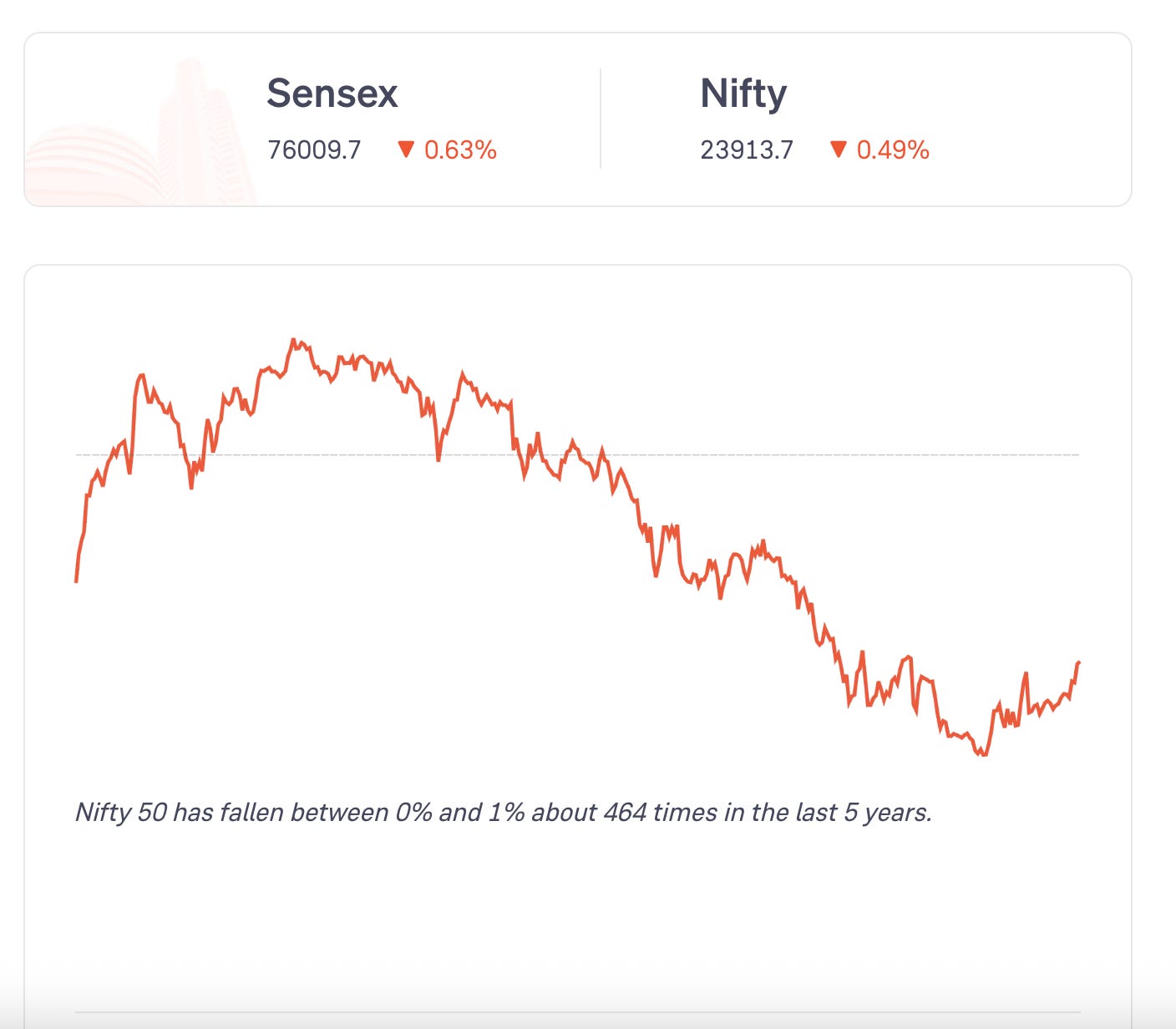
Markets opened below yesterday’s closing point.
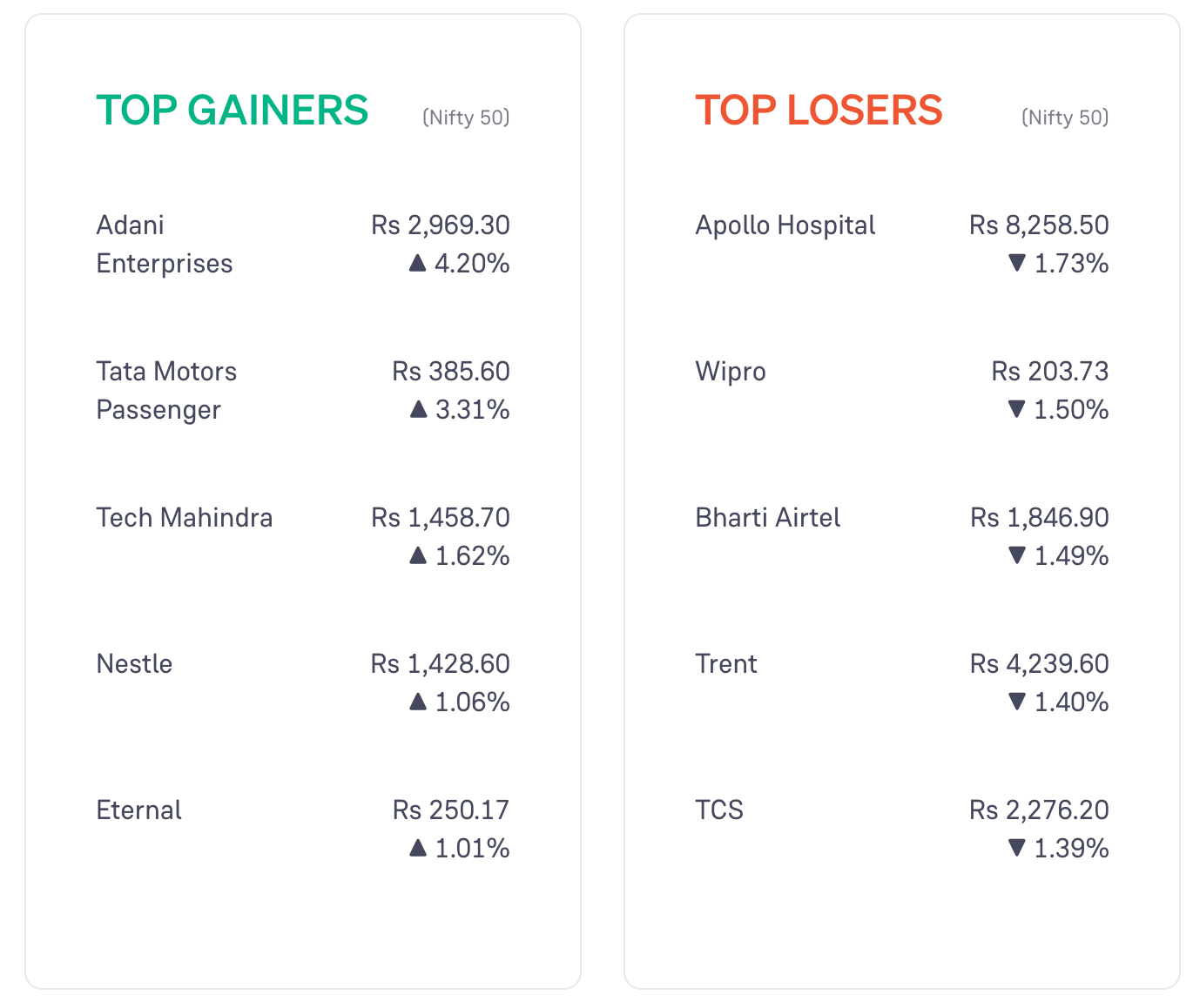
Metal stocks and chemicals stocks rose the most today. Consumer durables stocks and private bank stocks fell the most.
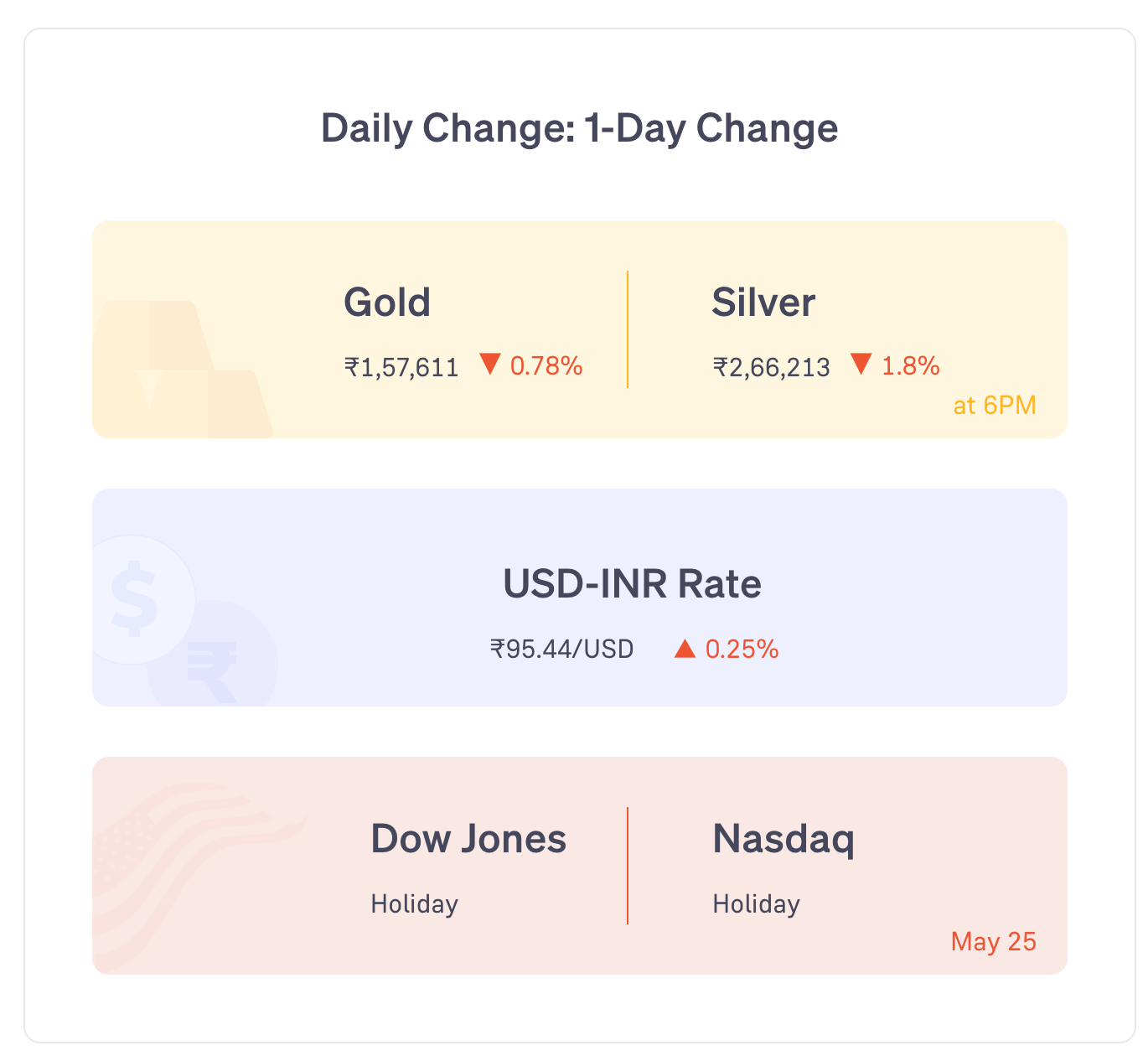
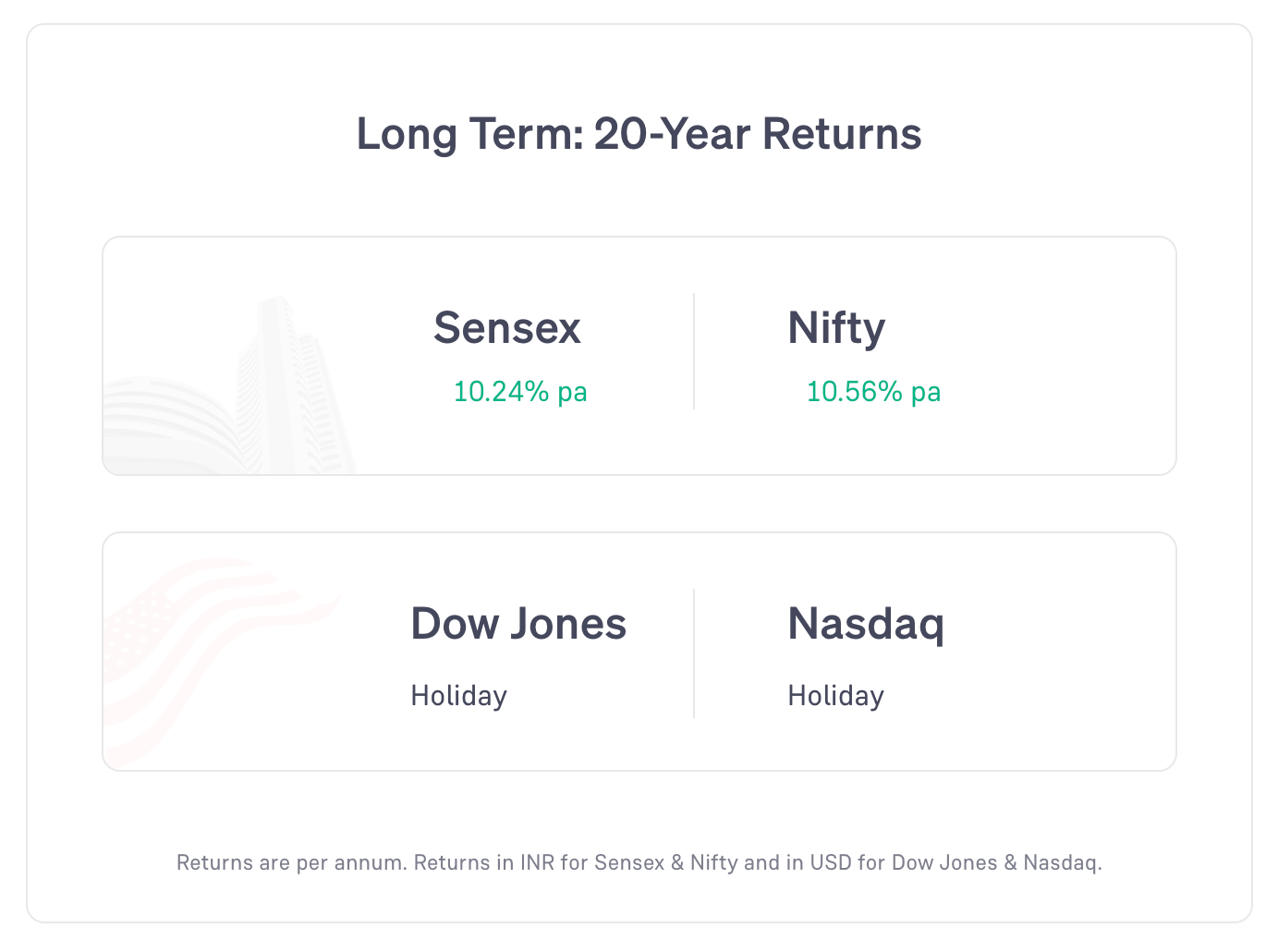
Global markets: US markets were closed today on account of ‘Memorial Day’. Most Asian markets fell. European markets showed a mixed trend (as of 6 pm IST).
News
Gas distributors in India have raised CNG prices across different cities by Rs 2 to Rs 5 per kg, the 4th hike in 11 days.
India and the US signed a bilateral Critical Minerals Framework to deepen cooperation across the critical minerals and rare earths supply chain for advanced technology and energy.
SEBI has proposed a standardized framework for stock exchanges to introduce new option strike prices in real-time during volatile market hours.
Stocks Updates
Hitachi Energy India: net profit rose 79.7% year-on-year to Rs 330.46 crore in the Jan-March quarter. Dividend announced: Rs 8 per share, with record date 21 Aug.
Siemens: net profit fell 36.4% year-on-year to Rs 370.4 crore in the Jan-March quarter. Dividend announced: Rs 18 per share.
Coal India: company has clarified over reports of coal shortage for power generation, stating it has adequate coal stocks for energy requirements.
Union Bank: company aims to raise Rs 8,000 crore via equity & debt modes to strengthen its base capital.
L&T: company’s wholly owned subsidiary L&T GeoStructure has received signifcant orders (Rs 1,000 cr - Rs 2,500 cr) from multiple clients including JSW Steel, and Inland Waterways of India.
Adani Green: has commissioned world’s largest single-location battery energy storage system outside China, with 3.37 GWh capacity.
Word of the Day
Foreign Portfolio Investment (FPI)
It is a way to invest in other countries’ economies.
Investors hold securities and other financial assets in a foreign country.
FPI is passive. Investors do not get ownership or control in the companies. This is different from FDI, where investors take direct control.
FPI brings more money into the country and supports financial markets.
But it can be risky. Foreign investors can quickly pull out if market conditions change.
6 Day Course
Theme: understanding alpha
Day 2: Tuesday
Comparing any investment against a benchmark is a common practice. It helps calculate the alpha.
In case of any investment, choosing the relevant benchmark is important.
The benchmark has to be a standard and easily available option from that category itself.
For example, a mutual fund investing in stocks cannot use FD rates as its benchmark. It should use the Nifty 50 index returns as the benchmark.
We have to compare the returns with a benchmark with similar risk, not vastly less or more.
This applies to all kinds of mutual funds and other investments.
A mutual fund that invests in large-cap stocks often uses Sensex 30 or Nifty 50 index fund returns as the benchmark.
Small-cap mutual funds often use Nifty Smallcap 250 TRI as their benchmark.
Not just mutual funds, but every investment fund uses some benchmark based on its investment style.
Featured Question
Q. “When we say IT stocks Underperformed Or when someone says media stock outperforms, compared to whom did this stocks Underperformed or outperformed. Who decides these parameters for performance.”Many Indian investment platforms offer investment in US stocks from India.
These are loosely used terms. There is no fixed format for this.
It depends on the expectations of different investors and how they choose to view the performance.
Often, it means those stocks or that sector underperformed compared to the broader market.
Example: the Nifty 50 was up 1.3% on a certain day but pharma stocks were up only 0.4%. Some might call this “underperformance”. Some might call it underperformance only if it had fallen.
Sometimes, a stock or sector that is doing very well tends to slow down a bit (while still doing quite well).
This may also be seen in a negative light by some high-expectation investors.
Example: the Nifty 50 was up 0.9% on a certain day but auto stocks were up 3%. On the previous day, the stocks were up 10%. Some might still call this “underperformance” compared to the previous day.
That said, strictly speaking, a sector is always compared to the larger index performance (Nifty 50 in case of India).
Similarly, a stock’s performance may be benchmarked against the sector’s performance. It may also be benchmarked against the Nifty 50’s performance.
The information presented in this post has been compiled and prepared by Groww Invest Tech Pvt Ltd and is intended solely for informational purposes. It is not tailored to any specific investment objectives, financial situations, or needs of any individual investor. The content should not be construed as investment, financial, legal, or tax advice and should not be relied upon as a substitute for professional consultation.
Investing in securities markets involves inherent risks. Investors are advised to carefully review all relevant documents and consider their own risk tolerance before making any investment decisions.
Mutual fund investments are subject to market risks; please read all scheme-related documents carefully. Past performance of financial instruments, schemes, or markets is not indicative of future results.
Groww Invest Tech Pvt Ltd is registered with the Securities and Exchange Board of India (SEBI) under Registration No: INZ000301838, as a Research Analyst under No: INH200008662, as a Depository Participant under No: IN-DP-417-2019, and with the Association of Mutual Funds in India (AMFI) under ARN-111686.
SEBI registration details: View registered name and registration numbers
Research Analyst Disclaimer: View Research Analyst disclaimer
Did you like this edition?
Leave a feedback here!