

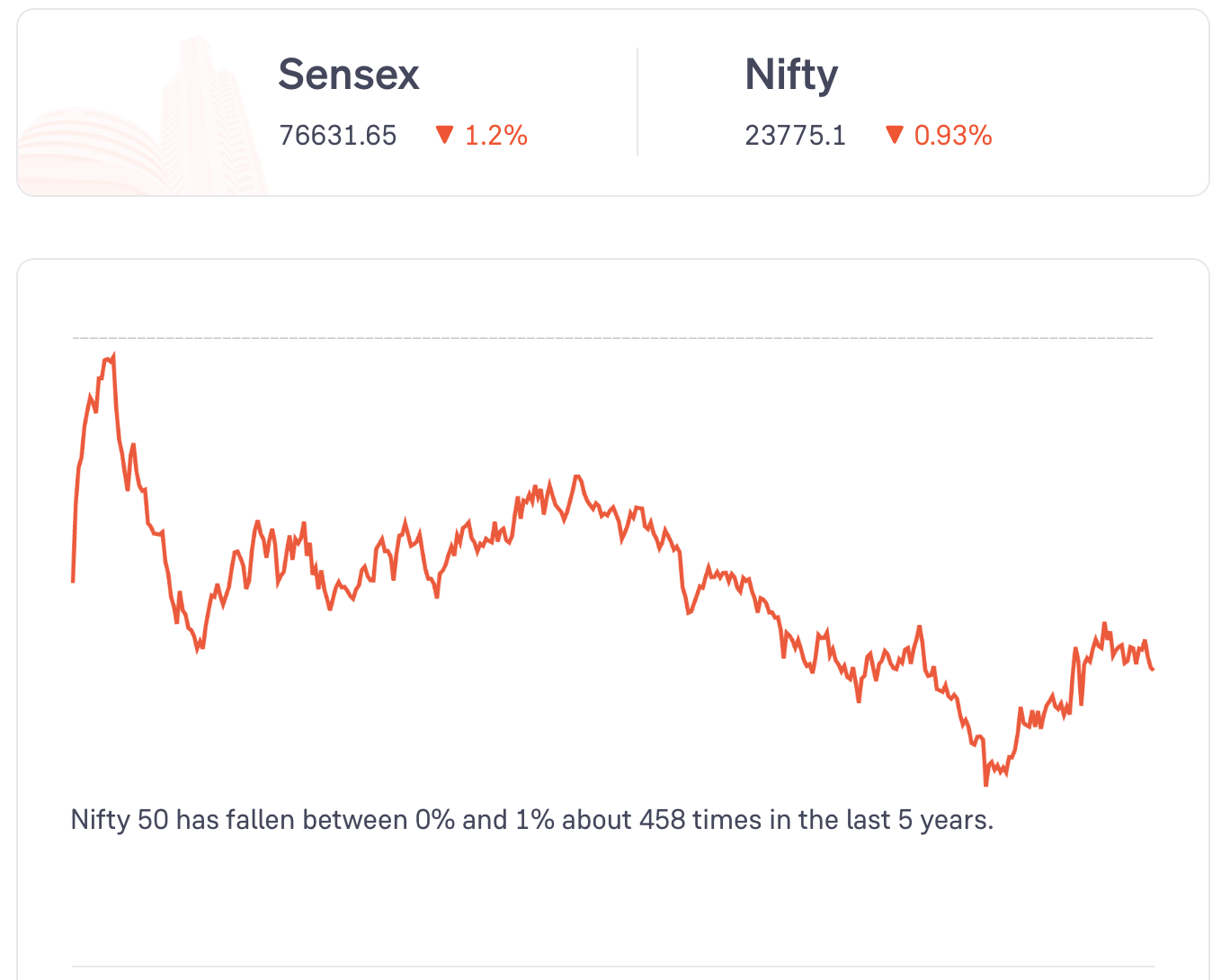
Markets opened below yesterday’s closing point.
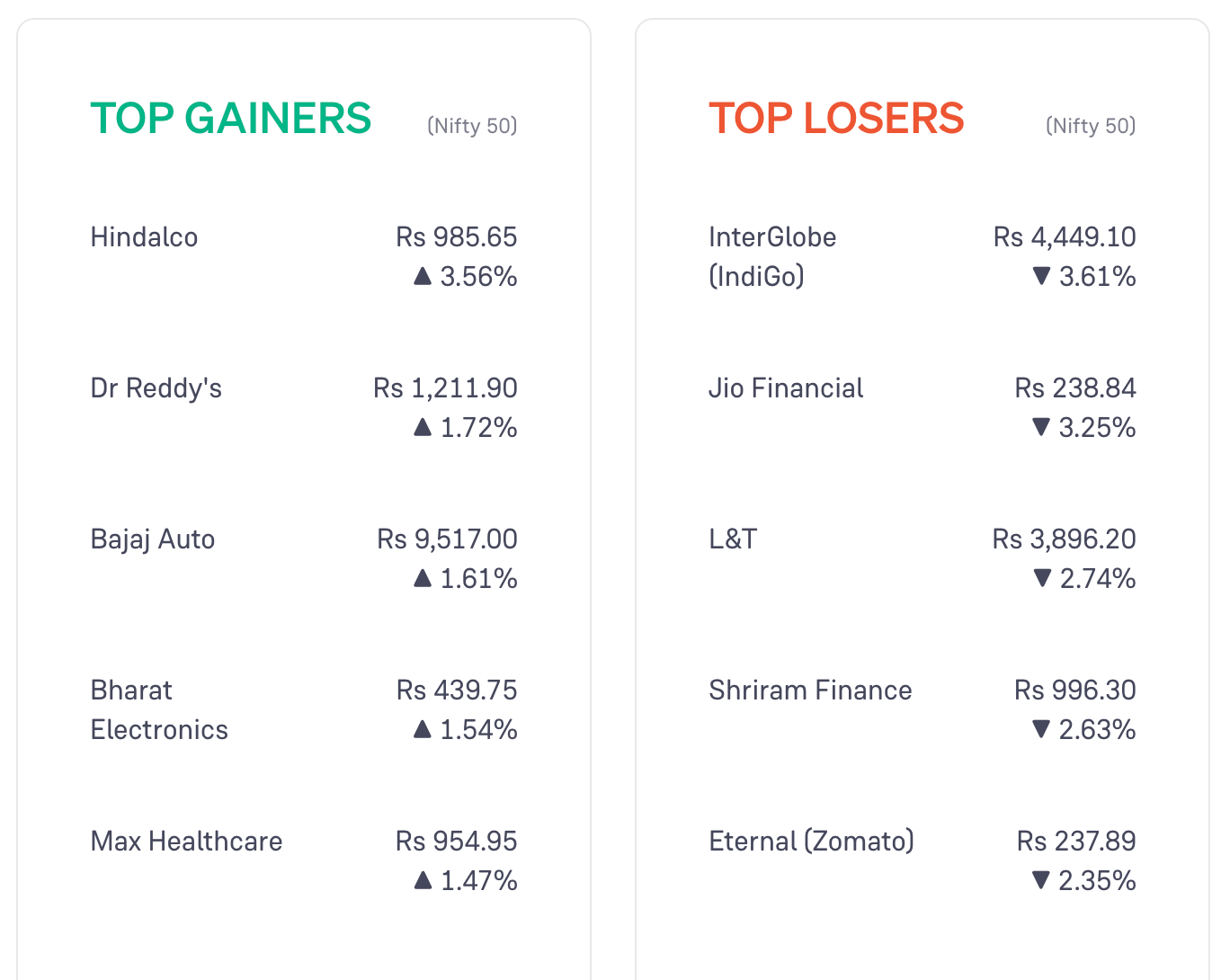
Metal stocks and healthcare stocks rose the most today. Private bank stocks and PSU bank stocks fell the most.
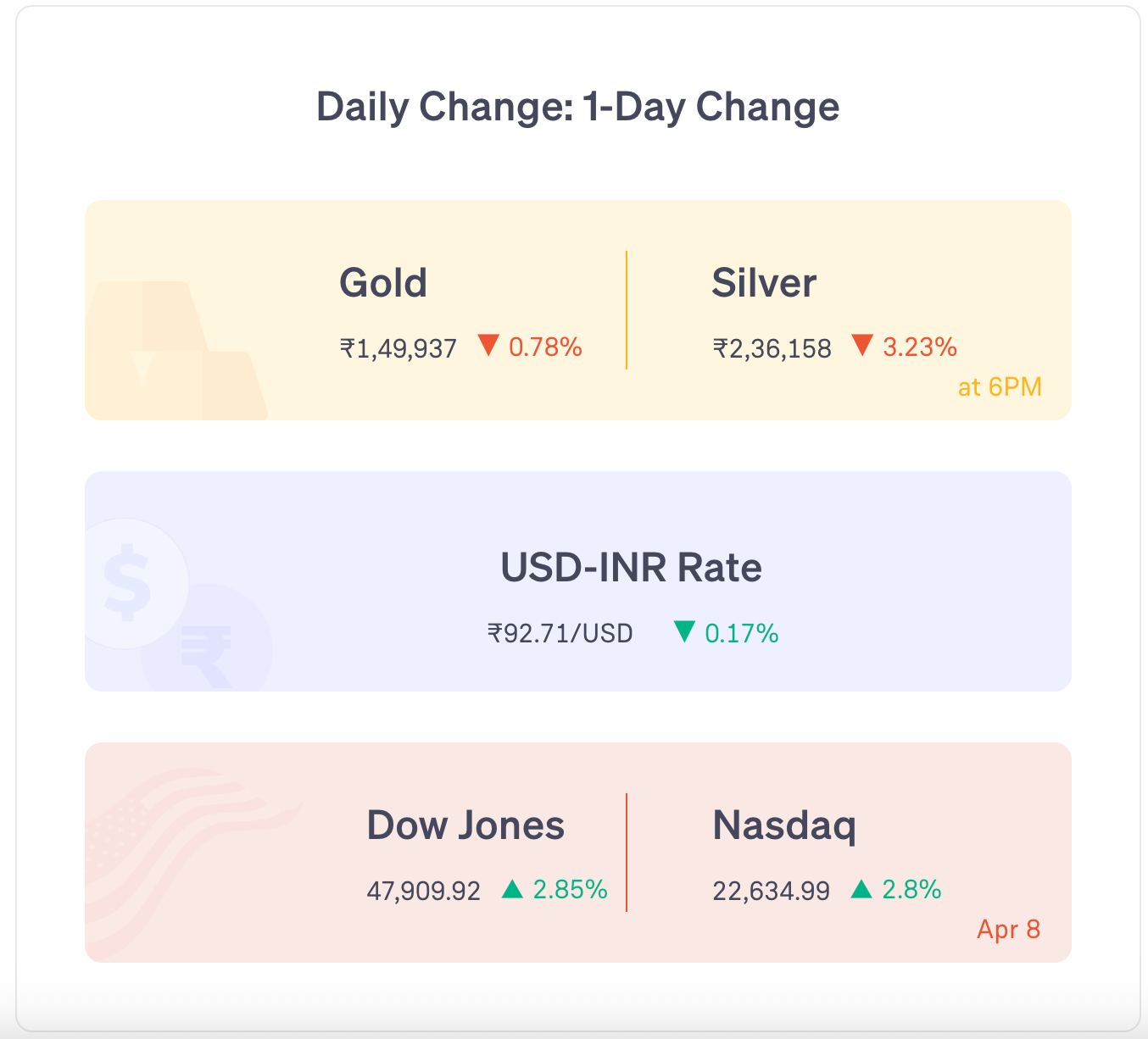
Global markets: US markets rose. Most Asian markets and European markets fell (as of 6 pm IST).
News
An Indian delegation will visit the US capital later in the month to discuss the trade deal which was put on hold due to the US-Iran conflict. India also announced the launch of the India-USA Trade Facilitation Portal to boost ties between the countries.
The government announced relief measures for domestic airlines, including a 25% cut in landing and parking charges for three months to reduce operational costs amid global disruptions.
Stocks Updates
TCS: net profits rose 12.2% year-on-year to Rs 13,718 crore in the Jan-March quarter. Dividend declared: Rs 31 per share.
Adani Green: company’s wholly owned subsidiary, Adani Renewable Energy Middle East Ltd, signed a JV with Minerva (wholly owned by UAE’s IHC Group) to develop renewable energy projects in India.
M&M: will acquire a 26% stake in its stepdown subsidiary Neon Hybren Pvt Ltd for around Rs 11.17 crore to use solar power from its upcoming 30 MW captive power plant in Punjab.
BHEL: signed a Technology Collaboration Agreement (TCA) with South Korea’s E2S Company Limited for excitation systems used in power equipment. This will help the company design, manufacture, install, and service these systems in India and globally.
BSE: received SEBI approval to launch derivatives contracts on the BSE Focused IT Index. This index tracks 14 major IT companies.
Word of the Day
Alternative Investment Fund (AIF)
It is an investment that differs from traditional assets like stocks, mutual funds, and bonds.
It is a privately pooled fund.
The minimum eligible investment amount is Rs 1 crore.
AIFs invest in various assets like real estate, private equity, infrastructure, hedge funds, etc.
They can offer high returns, but they come with higher risks. They also have a lock in period.
They have higher fees and might be harder to withdraw from quickly due to low liquidity.
6 Day Course
Theme: mutual fund AUM
Day 4: Thursday
Now, let’s get to the challenges of a large AUM.
While a very low AUM is often a question mark, a very big AUM can also become a challenge for a mutual fund.
Why?
Because the mutual fund’s manager has to invest all the money in the same manner.
If a mutual fund’s AUM grows too big, the fund manager has too much money on hand. Investing a very large amount of money becomes difficult for them.
Often, they start running out of opportunities to take advantage of. This can reduce their returns.
Extremely simplified example: you know there is a small company with extremely high future potential. Its total market cap is Rs 500 crore.
You have Rs 10 crore to invest. You will easily be able to invest in this small company.
But if you have Rs 5000 crore, you will only be able to invest a small portion of your total money. The rest of the money cannot be invested in this company since the company’s total size is smaller than the money you have.
This challenge can sometimes affect small-cap and mid-cap mutual funds since the companies in those segments are smaller.
Such mutual funds often stop taking money in situations like these.
This challenge is seen much less in the large-cap space because investment opportunity is much larger.
Featured Question
Q. “what is the first step a person with no financial education should take?”
The first step is to ensure you have an emergency fund.
This money is kept for a rainy day like a medical emergency or income-loss.
This money is usually kept in an extremely safe option. It could be kept in FD, liquid funds, overnight funds, or simply kept as cash in the bank account.
As a general rule of thumb, it is said that we should have 6 months worth of expenses as emergency money. You can increase/decrease this period based on individual factors.
This helps investors deal with unexpected shocks which can otherwise cause great pain.
The next step is getting insurance.
This includes health cover and other necessary insurance like term plans.
These two steps ensure unexpected situations are less harmful to our finances.
In short, we try to minimise our unexpected outflow of money before we think about growing it as the first step.
The information presented in this post has been compiled and prepared by Groww Invest Tech Pvt Ltd and is intended solely for informational purposes. It is not tailored to any specific investment objectives, financial situations, or needs of any individual investor. The content should not be construed as investment, financial, legal, or tax advice and should not be relied upon as a substitute for professional consultation.
Investing in securities markets involves inherent risks. Investors are advised to carefully review all relevant documents and consider their own risk tolerance before making any investment decisions.
Mutual fund investments are subject to market risks; please read all scheme-related documents carefully. Past performance of financial instruments, schemes, or markets is not indicative of future results.
Groww Invest Tech Pvt Ltd is registered with the Securities and Exchange Board of India (SEBI) under Registration No: INZ000301838, as a Research Analyst under No: INH200008662, as a Depository Participant under No: IN-DP-417-2019, and with the Association of Mutual Funds in India (AMFI) under ARN-111686.
SEBI registration details: View registered name and registration numbers
Research Analyst Disclaimer: View Research Analyst disclaimer
Did you like this edition?
Leave a feedback here!