
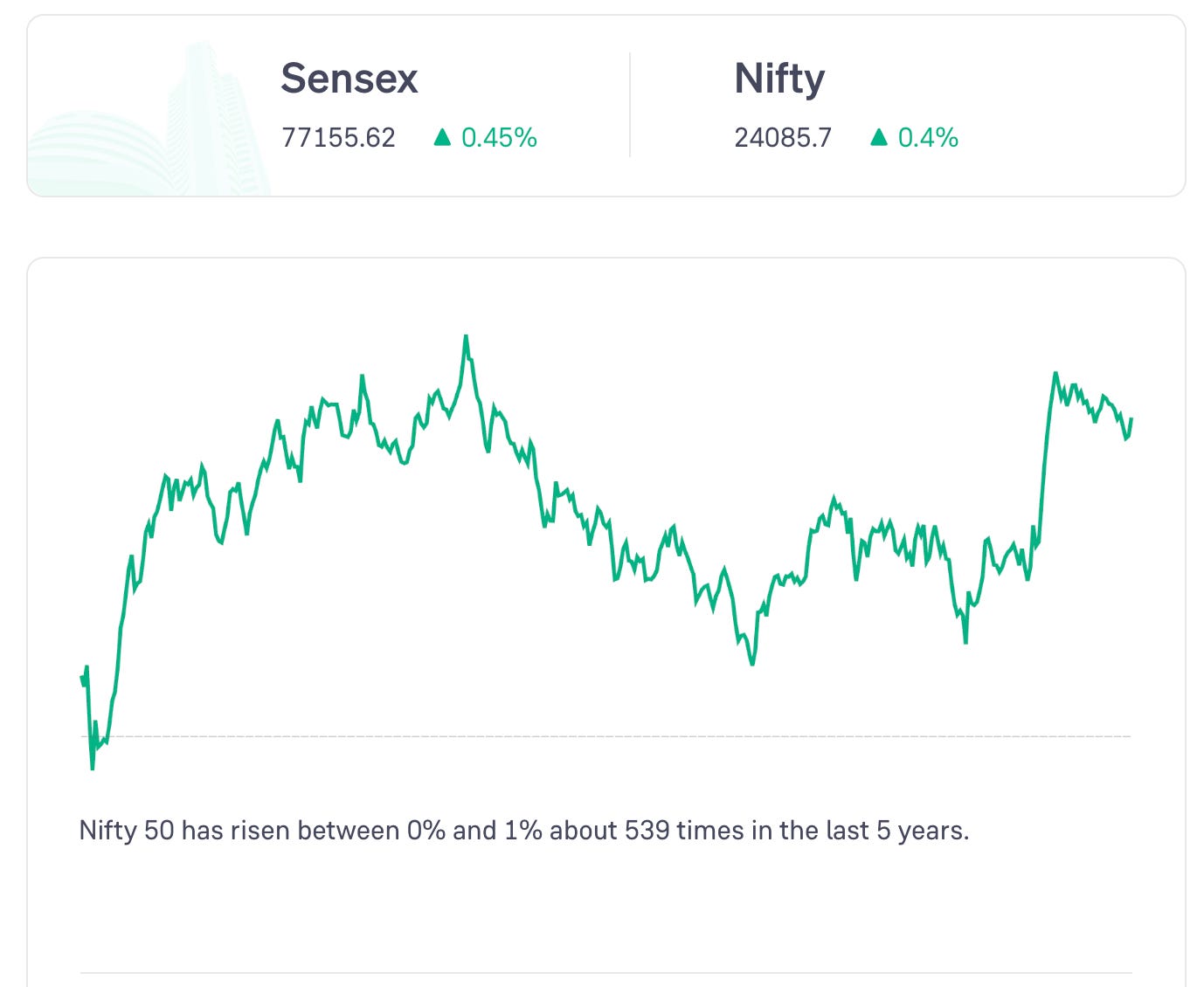
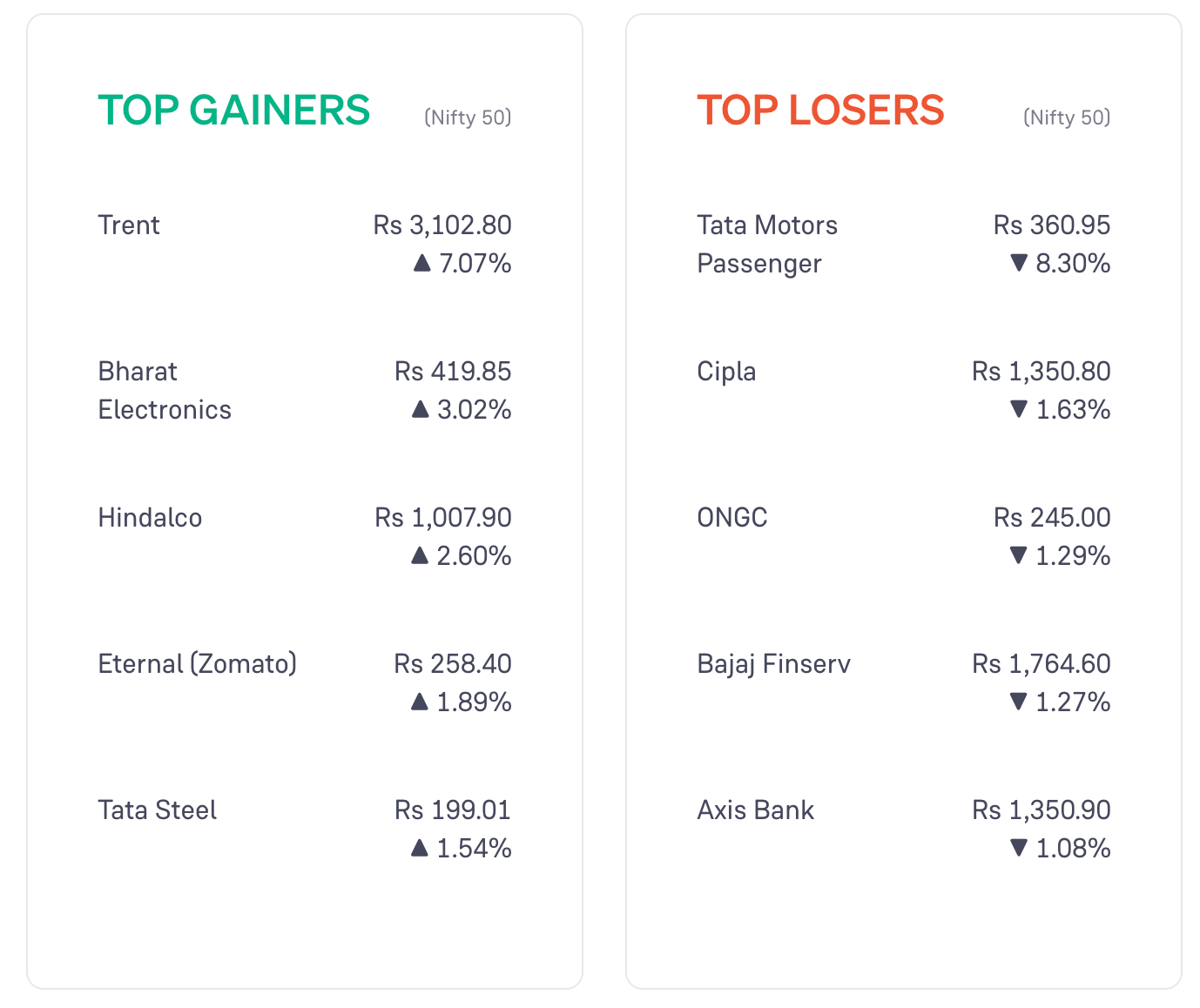
Markets opened above yesterday’s closing point.
Consumer durables stocks and PSU bank stocks rose the most today. Auto stocks and realty stocks fell the most.
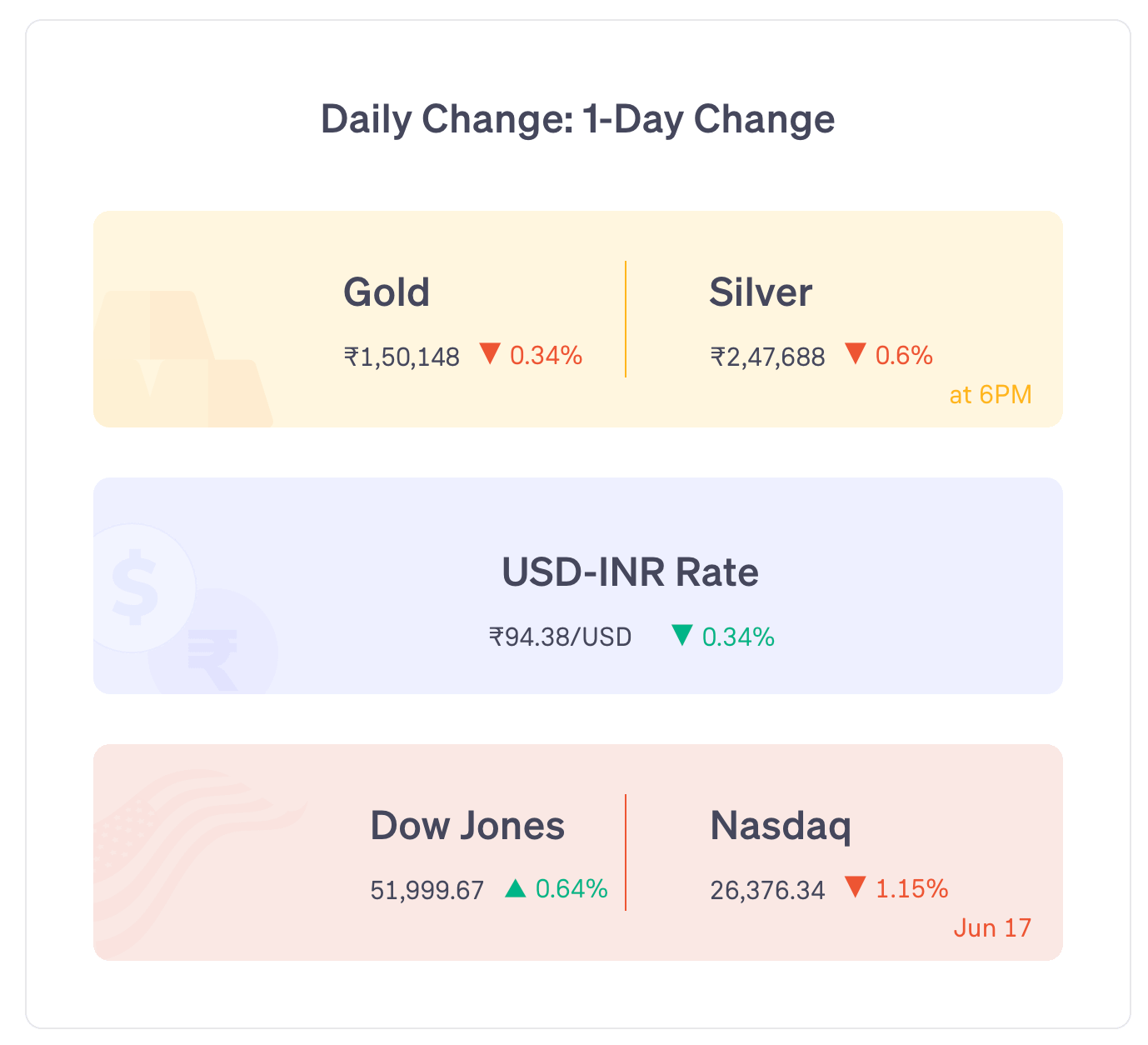
Global markets: Most US markets fell. Most Asian markets rose. European markets showed a mixed trend (as of 6 pm IST).
News
The sales of India’s listed private non-financial companies grew 13.9% year-on-year in the Jan-March quarter.
The government has increased the export duty on diesel to Rs 14 per liter and aviation turbine fuel (ATF) to Rs 12.5 per liter, while leaving petrol levies unchanged.
The Indian Railways approved multiple infrastructure projects including: Rs 493 crore for the doubling of the Adipur-Bhuj line in Gujarat, Rs 405 crore for upgradation across 32 Eastern Railway stations, Rs 172 crore for the Somtane-Chikhli chord line in Maharashtra, and Rs 139 crore to rebuild the Shastriya Road Over Bridge in Indore, Madhya Pradesh.
Stocks Updates
M&M: Mahindra Summit Agriscience (MSAL), a joint venture between Mahindra Agri Solutions and Japan’s Summit Agro, has issued new shares to Summit Agro. As a result, MSAL will cease to be a subsidiary and become an associate company/joint venture.
Power Grid: has been declared the successful bidder for the ‘WR-ER Inter-Regional Network Expansion Scheme Part-A’ project through the Tariff Based Competitive Bidding (TBCB) route. It involves setting up two new 765/400 kV substations in Jharkhand and Chhattisgarh.
Motherson: subsidiary SMR Automotive will acquire a 67.78% stake in China-based Shenzhen Autocruis Technology for about $22.6 million to strengthen its automotive vision systems business.
Tata Capital: board approved raising up to Rs 36,000 crore through NCDs, perpetual debt, green bonds and other debt instruments.
HDFC Life: allotted 1.45 crore equity shares to promoter HDFC Bank on a preferential basis, raising around Rs 1,000 crore.
Lupin: launched Azilsartan Medoxomil tablets used to treat hypertension in the US. The company has 180-day generic exclusivity for the product. The branded drug had annual US sales of around $53.5 million.
TCS: won a multi-year deal from Norway-based packaging company Elopak to transform and manage its global IT operations using AI and cloud technologies.
Word of the Day
Listing Gains
It refers to the profit earned when an IPO share lists on the stock exchange at a price higher than its issue price.
The issue price is the price at which shares were offered to investors in the IPO.
Listing gains occur when there is strong demand for the IPO and investors are willing to buy the shares at a higher price after listing.
Many investors apply for IPOs with the aim of benefiting from potential listing gains. However, listing gains are not guaranteed, and a stock can also list below its issue price.
6 Day Course
Theme: understanding FIIs
Day 3: Wednesday
FIIs tend to invest using US dollars. Which means, they convert their money from USD to INR and then invest.
This means that they tend to measure their returns in USD terms, not in INR terms.
So, let’s say their Indian investments were up 20% in value (when calculated in INR), but at the same time, USD-INR exchange rate changed by 5% where USD got stronger.
This will effectively mean that when they calculate their returns in USD, their Indian investment would have returned 15%, and not 20%.
The opposite can happen if the Rupee grows stronger.
So FIIs’ investment decisions are also greatly affected by the exchange rates.
India is a heavy crude oil importer. When the price of crude oil rises, India has to spend more money to import oil. This leads to the weakening of the INR.
Thus, crude oil prices heavily affect the exchange rates and therefore, crude oil prices also affect FII investors’ behaviour.
Featured Question
Q. “Do Foreign Institutional Investors (FIIs) face a lock-in period when investing in India? Additionally, if they have already invested in U.S. Treasury bonds, how can they withdraw their funds, and do those bonds have a lock-in period?”
The rules are the same for Indian individual investors and FIIs in this case of shares.
FIIs can buy and sell shares any time they want to.
They must pay the relevant taxes as per the investment period, but that’s it.
There are some lock-ins applied in case of IPO investment which can be up to 90 days.
Yes, bonds are held till maturity for getting the payout but bonds are also trade-able. Which means, bonds can be bought and sold before their maturity period also.
So, say you own a bond that matures in 10 years from now. But you need money today. So you can sell this bond to a willing buyer at a price you both can agree upon.
10 years later, the maturity amount will be received by the new owner of the bond.
Did you like this edition?
Leave a feedback here!