

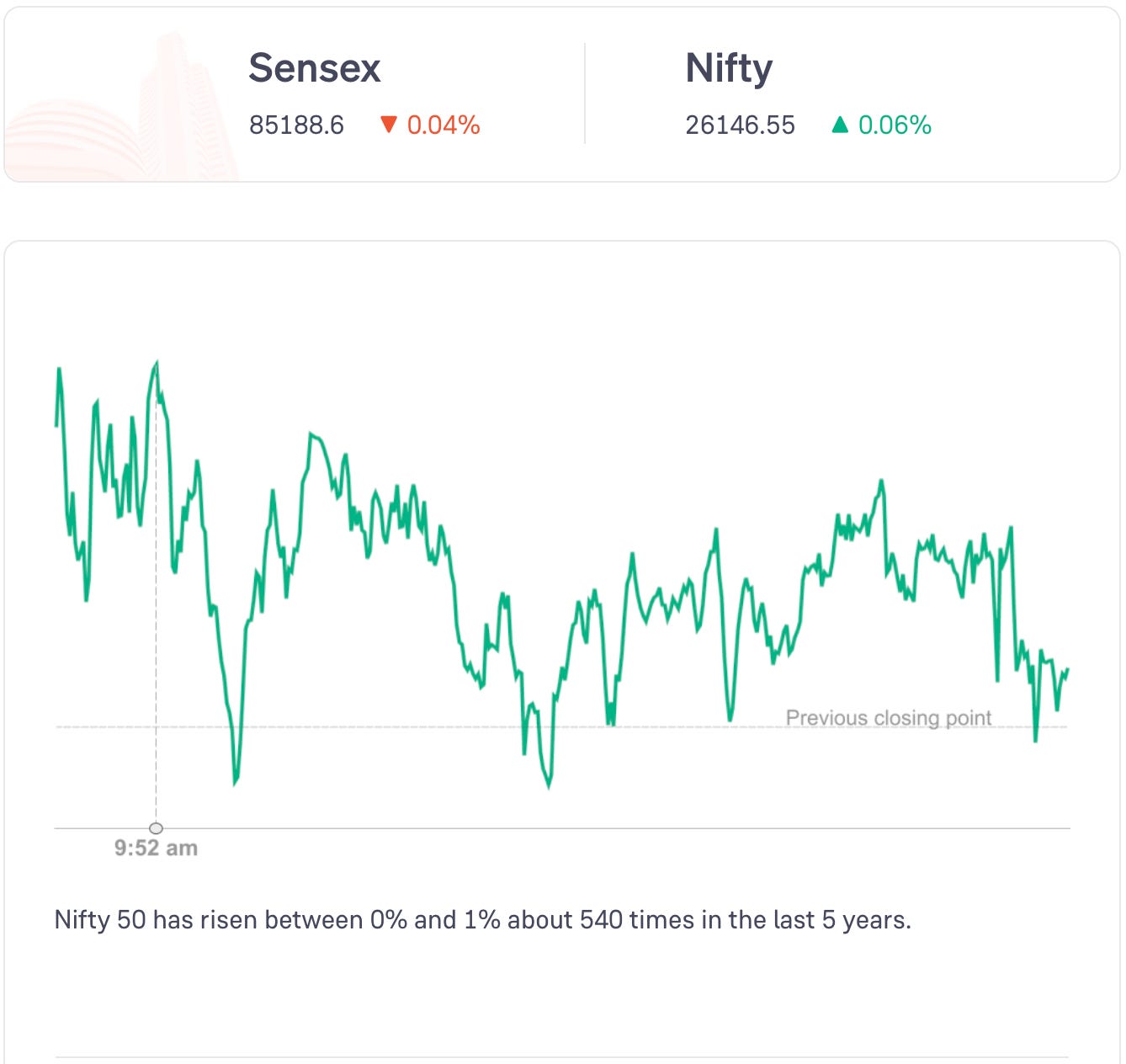
Markets opened above yesterday’s closing point.
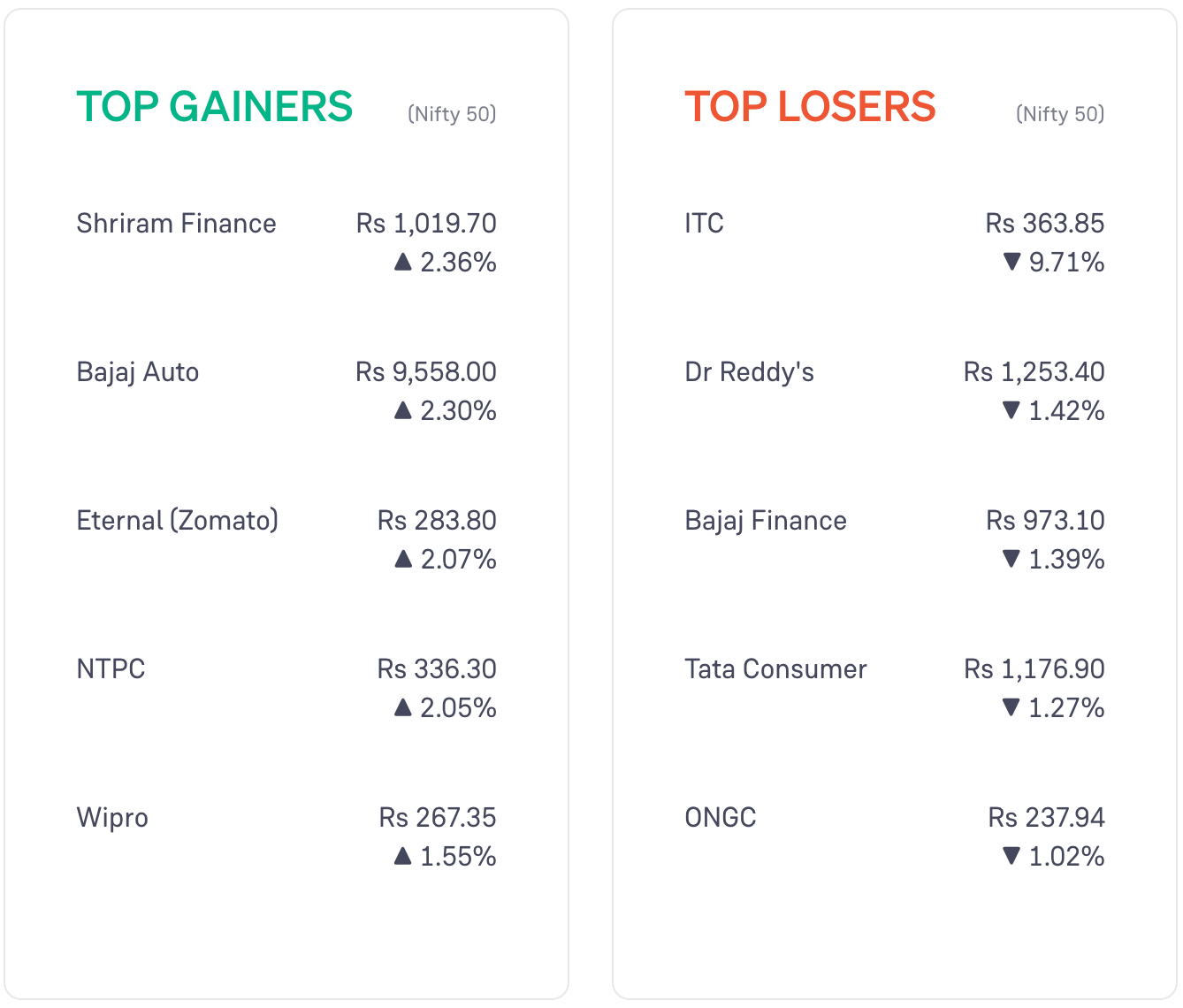
Auto stocks and realty stocks rose the most today. FMCG stocks and pharma stocks fell the most.
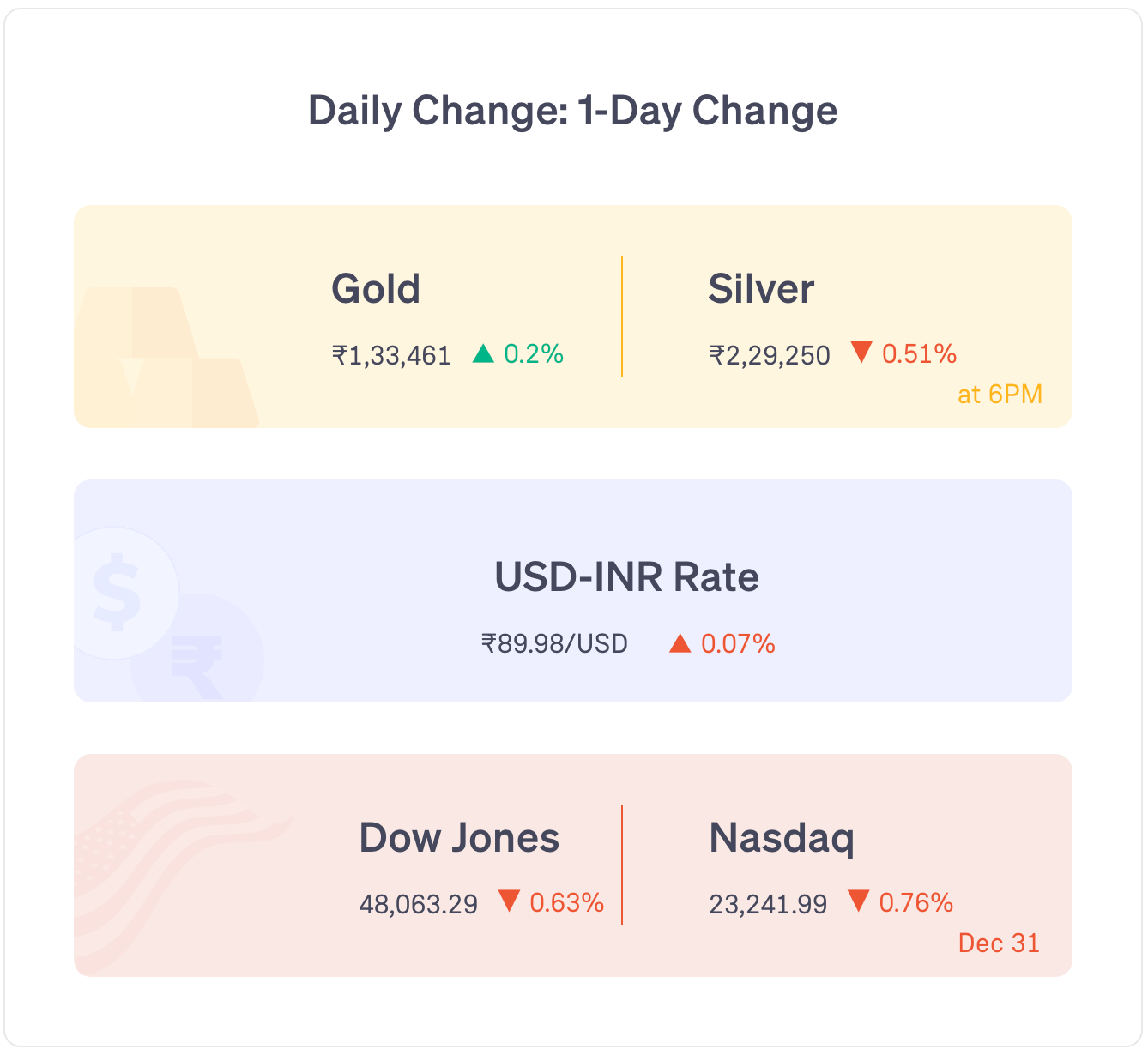
Global markets: US markets and most Asian markets fell. Most European markets fell (as of 6 pm IST).
News
The government notified that from 1 Feb 2026, an additional excise duty will be applied on tobacco and tobacco related items over and above the GST rates.
India’s 1st bullet train is expected to begin operations from 15 Aug 2027: Railways Minister Ashwini Vaishnav.
India’s gross GST collections rose 6.1% year-on-year to Rs 1.75 lakh crore in Dec (vs Rs 1.70 lakh crore in Nov). Net GST collections rose 2.2% year-on-year to Rs 1.45 lakh crore.
Prism, Oyo’s parent company, has applied for an IPO with SEBI through the confidential route.
Stocks Updates
Vodafone Idea (Vi): received a Rs 637.9 crore GST order from Ahmedabad authorities, which it will challenge.
Dr Reddy’s: the US FDA delayed approval of Dr. Reddy’s biosimilar AVT03 (used to treat bone-related issues) due to inspection issues at a partner’s manufacturing site.
Shriram Finance: received a GST demand order of around Rs 41.8 crore (tax, interest, and penalty) from Chennai tax authorities for FY18-19 violations.
Hyundai Motor India: announced ‘Mr. Tarun Garg’ as the company’s first Indian MD & CEO, effective from 1 Jan.
Bharat Electronics: received orders worth Rs 569 crore for the supply of communication equipment, medical electronics, instant fire detection & suppression system, etc.
Adani Enterprises: completed 2 acquisitions: a 39% stake in Flight Simulation Technique Centre (pilot training organization in India) for aviation services, and a 100% stake in Giridhari Build Estate Ltd (GBEL) for infrastructure development.
IRFC: sanctioned a Rs 5,000 crore loan to Maharashtra State Power Generation Co Ltd to support operational and financial obligations.
Tata Steel: completed its Rs 1,099.97 crore acquisition of an additional stake in Tata BlueScope Steel (manufactures coated steel products), increasing its total ownership to 99.99% and making it a subsidiary.
Word of the Day
Angel Investors
They are individual investors who invest their money in an early-stage startup
This is usually in exchange for some ownership of the company.
Apart from capital, angel investors can also offer mentorship and industry connections.
Startups at this stage are risky and often don’t qualify for bank loans or venture capital yet. Angel investors fill this gap.
It is a high-risk high-reward investment because most startups fail, but successful bets can deliver great returns.
6 Day Course
Theme: selling strategies
Day 4: Thursday
Another strategy is to use stop-loss.
With a stop-loss, the investor sets a price level at which the investment will be automatically sold.
So if the price goes up, it goes up. If it falls, the investment gets sold at a pre-determined price.
The problem with this is what if the price rises a lot, and then falls from there — but still doesn’t reach the level you had set the stop loss at?
The investor potentially lost some growth.
In such cases, investors try to use trailing-stop loss.
In this the stop loss follows the price up, but gets triggered when the price falls.
Example: sell 10% below peak price.
This way, the stop-loss price level keeps increasing if the price goes up. But if the price falls, the stop loss is triggered and the assets are sold.
Featured Question
Q. “How is NAV for Gold Mutual Funds are calculated with respect to the actual Gold prices in the market?”
Gold mutual funds usually invest in gold ETFs.
Those gold ETFs invest in the metal/physical gold.
So, gold mutual funds’ NAV price depends on the ETFs it is holding.
Usually, a gold mutual fund will invest in multiple gold ETFs.
The NAV you see is derived from the returns of each of those ETFs.
ETFs and mutual funds are managing investments and charge an expense ratio.
This is adjusted in the ETFs and gold funds’ returns.
This is why if you compare the returns of actual gold vs gold fund, there will be a slight difference.
The returns of the gold fund will be slightly lower.
The expense ratio is charged for maintaining the fund and managing the investments.
That said, the difference is tiny and the returns are more or less similar.
Did you like this edition?
Leave a feedback here!