
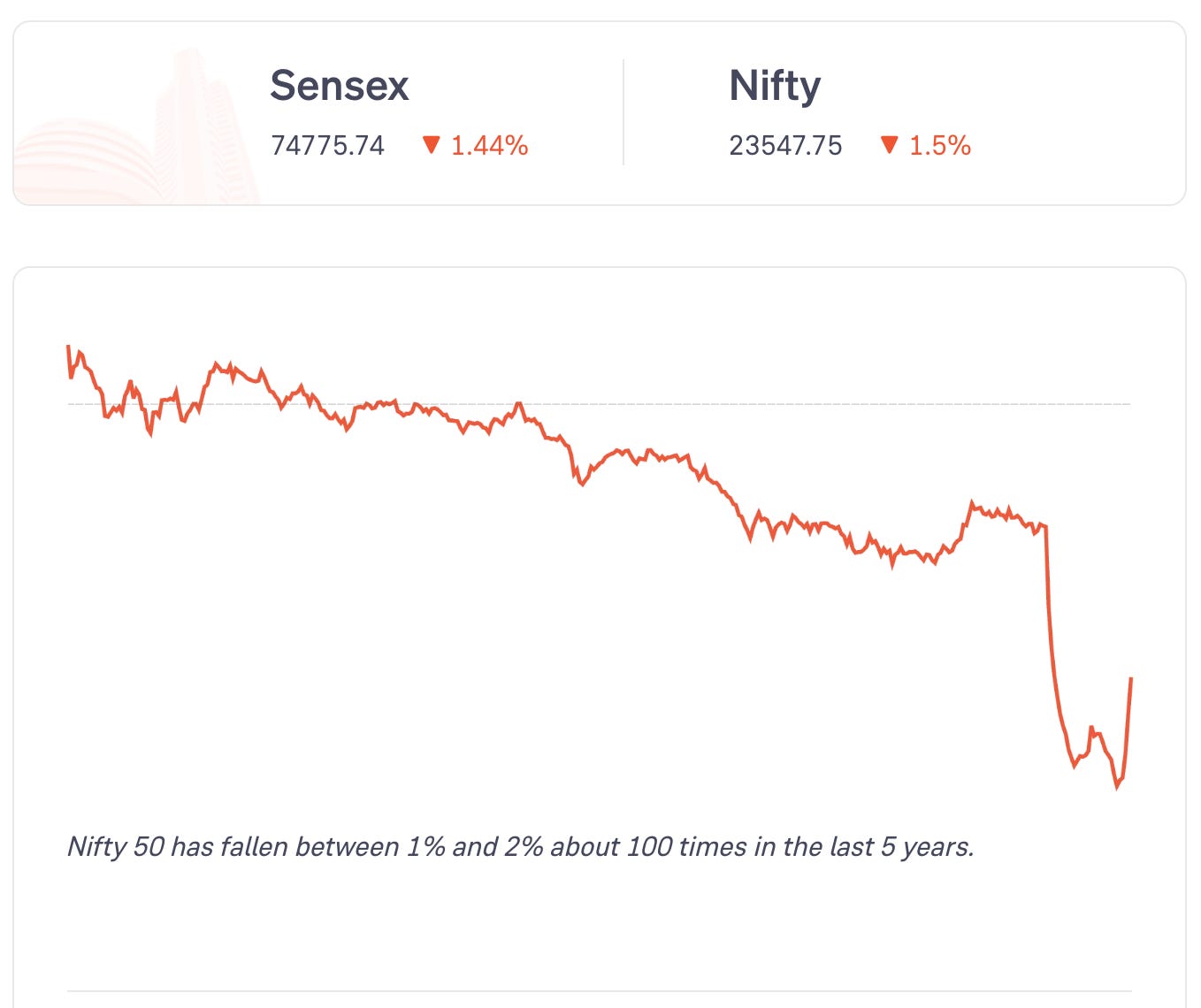
Markets opened above Wednesday’s closing point and stayed in a range until it fell sharply at the end of the day.
The fall can be attributed to heavy institutional outflows triggered by the MSCI Index rebalancing, sudden panic over the IMD’s monsoon forecast downgrade and continued tensions due to the US-Iran war.
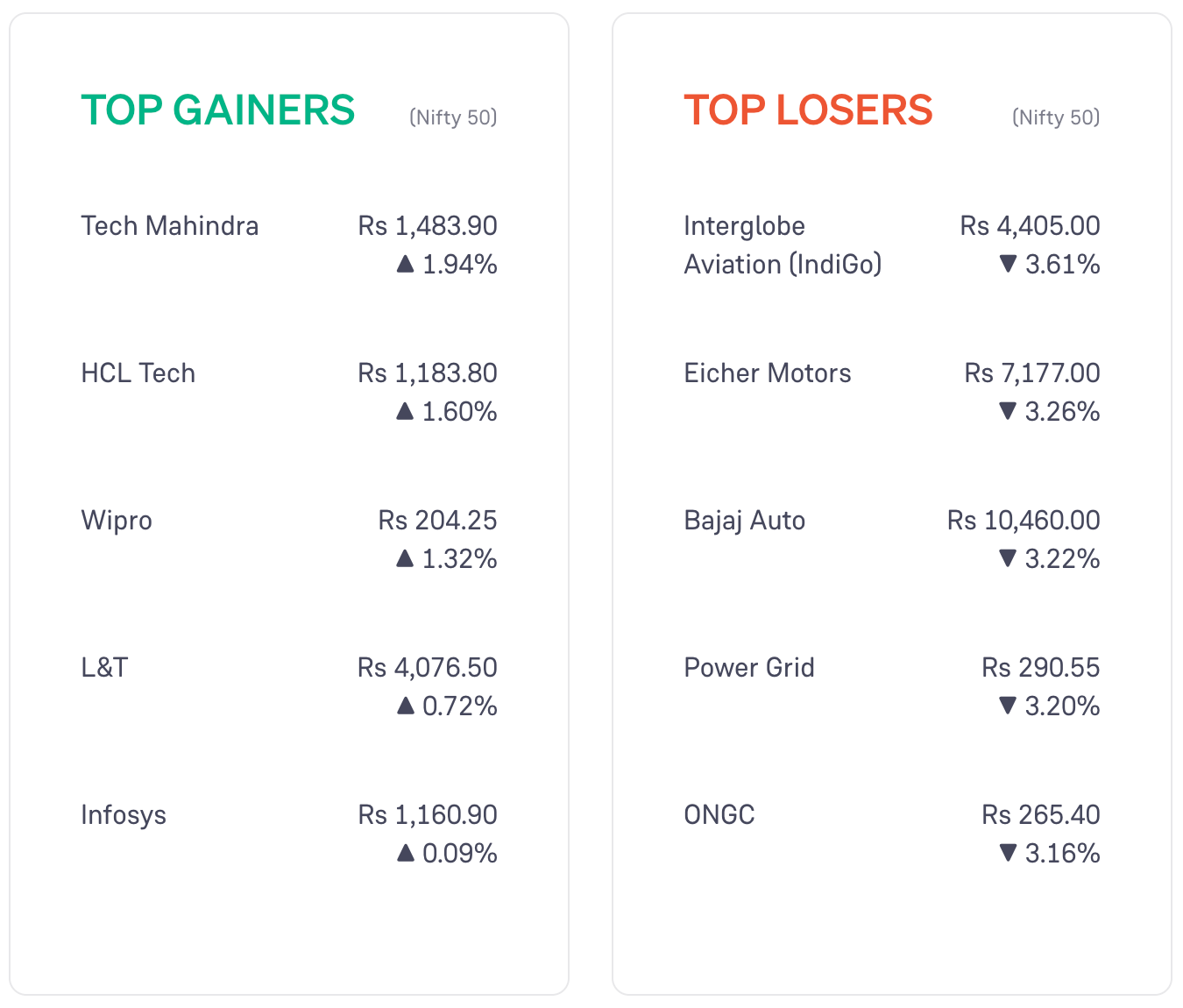
All sectors’ stocks fell today except for the IT stocks. Oil & gas stocks and metal stocks fell the most.
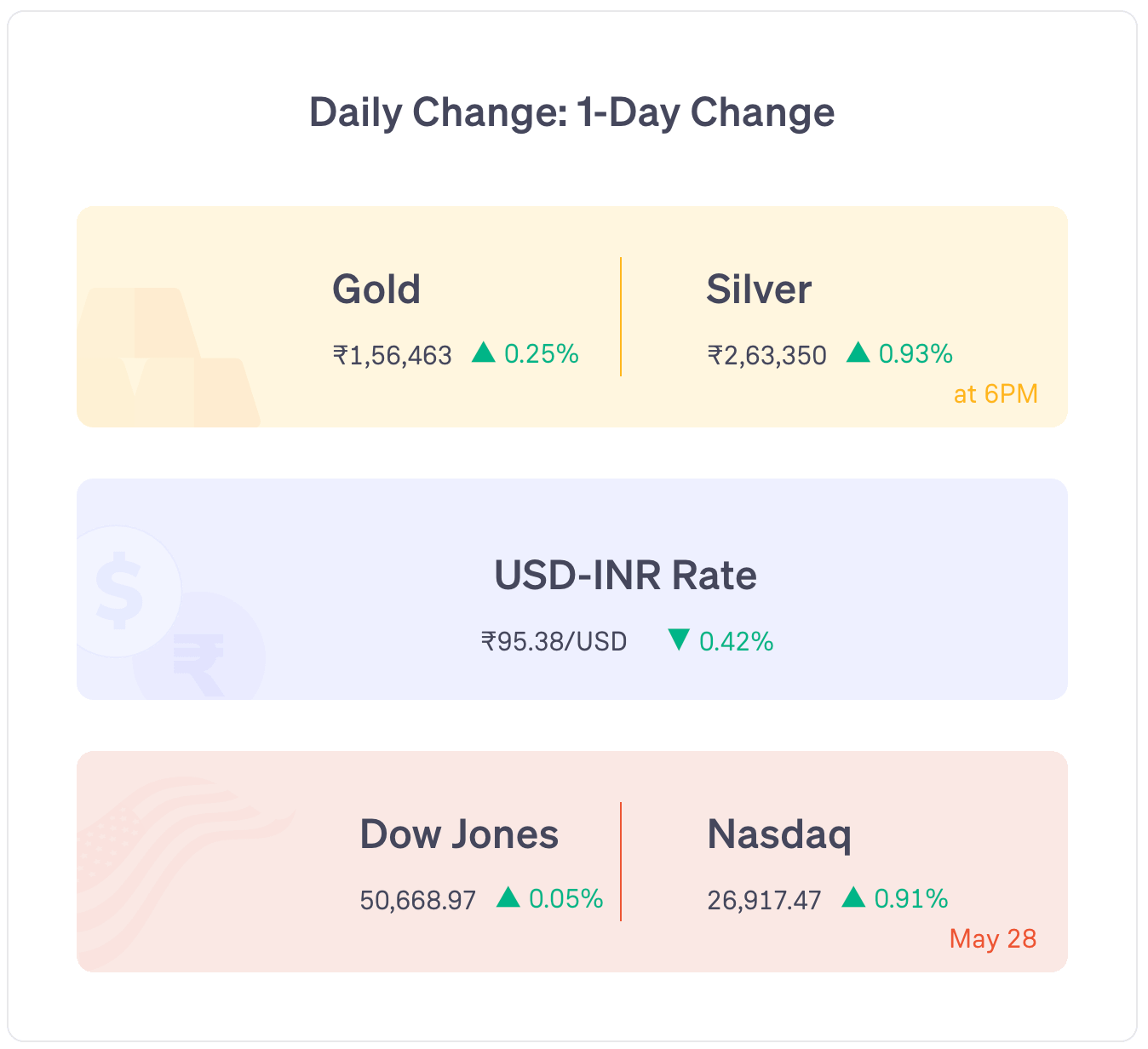
Global markets: US markets rose. Asian markets showed a mixed trend. European markets rose (as of 6 pm IST).
News
India’s forex reserves fell by $7.5 billion to $681.38 billion in the week that ended on 22 May.
India and Canada launched the Canada-India Trade and Investment Forum for new commercial partnerships and increased business engagement.
The government has directed state-run fuel retailers to increase their LPG storage capacity to meet 30 days of demand to build strategic emergency reserves amid the ongoing West Asia crisis: as per media reports.
Stocks Updates
Ashok Leyland: net profit rose 10.87% to Rs 1,381.32 crore year-on-year in the Jan-Mar quarter. Dividend announced for Rs 2.50 per share with record date 3 June, 2026.
InterGlobe Aviation: company reported a net loss of Rs 2,536.9 crore in the Jan-Mar quarter, vs a profit of Rs 3,067.5 crore previous year.
Asian Paints: net profit rose 69.16% to Rs 1,185.49 crore in the Jan-Mar quarter.
Dividend announced for Rs 23 per share, with record date 23 June, 2026.
Hindustan Zinc: company has appointed Mr. Amit Gupta as the new Chief Financial Officer of the company. He has been associated with the Vedanta Group since 2006.
SBI: company is borrowing $200 million via bonds from international investors
Word of the Day
Stagflation
It is the occurrence of slow growth, high unemployment, and inflation at the same time.
Normally, an economy with slow growth rate has lower inflation.
But in stagflation, even as the growth slows down, prices remain high.
It is a situation that a government finds hard to solve, as correcting one factor might lead the other to worsen.
6 Day Course
Theme: understanding alpha
Day 5: Friday
Flexibility: many times good opportunities are available in different parts of the markets (like for example, small-cap space, etc).
Unfortunately many larger funds are limited in how they can invest. They are sometimes not allowed to invest in certain ways. This prevents them from taking advantage of opportunities.
Many times, investors (in mutual funds) start withdrawing when markets fall.
Often the best buying opportunities are found during such periods. But since investors are withdrawing, the fund manager is unable to properly buy shares of these companies.
Similarly, if the markets are overvalued more often, an investor might not be able to buy their favourite stocks leading them to miss out on opportunities.
There are many reasons for not being able to make alpha.
But the fact remains, there are enough good investors and fund managers are still able to make alpha and get higher returns.
Featured Question
Q. “Are lower returns with higher Sharpe Ratio (Return to Volitality) better than higher return with lower Sharpe, objectively speaking?”
Sharpe ratio is a measure of risk-adjusted returns.
A higher Sharpe ratio means you earned more returns while suffering less volatility.
It does not mean you earned more returns alone.
Take two cases.
Case 1: 15% per annum returns, very volatile. So, Sharpe ratio is low
Case 2: 6% per annum returns, not volatile. So, Sharpe ratio is high
Which would you take?
The answer depends from investor to investor.
If you are a risk-taking investor and/or are comfortable with some volatility, you might be okay with dealing with a lower Sharpe ratio to make more money.
If you are not comfortable with volatility, you might be okay with lower returns (and higher Sharpe ratio).
A very ideal case would be high Sharpe ratio and high returns.
This means the returns are good and volatility is also low.
This is possible, yes. But not very common.
The information presented in this post has been compiled and prepared by Groww Invest Tech Pvt Ltd and is intended solely for informational purposes. It is not tailored to any specific investment objectives, financial situations, or needs of any individual investor. The content should not be construed as investment, financial, legal, or tax advice and should not be relied upon as a substitute for professional consultation.
Investing in securities markets involves inherent risks. Investors are advised to carefully review all relevant documents and consider their own risk tolerance before making any investment decisions.
Mutual fund investments are subject to market risks; please read all scheme-related documents carefully. Past performance of financial instruments, schemes, or markets is not indicative of future results.
Groww Invest Tech Pvt Ltd is registered with the Securities and Exchange Board of India (SEBI) under Registration No: INZ000301838, as a Research Analyst under No: INH200008662, as a Depository Participant under No: IN-DP-417-2019, and with the Association of Mutual Funds in India (AMFI) under ARN-111686.
SEBI registration details: View registered name and registration numbers
Research Analyst Disclaimer: View Research Analyst disclaimer
Did you like this edition?
Leave a feedback here!