

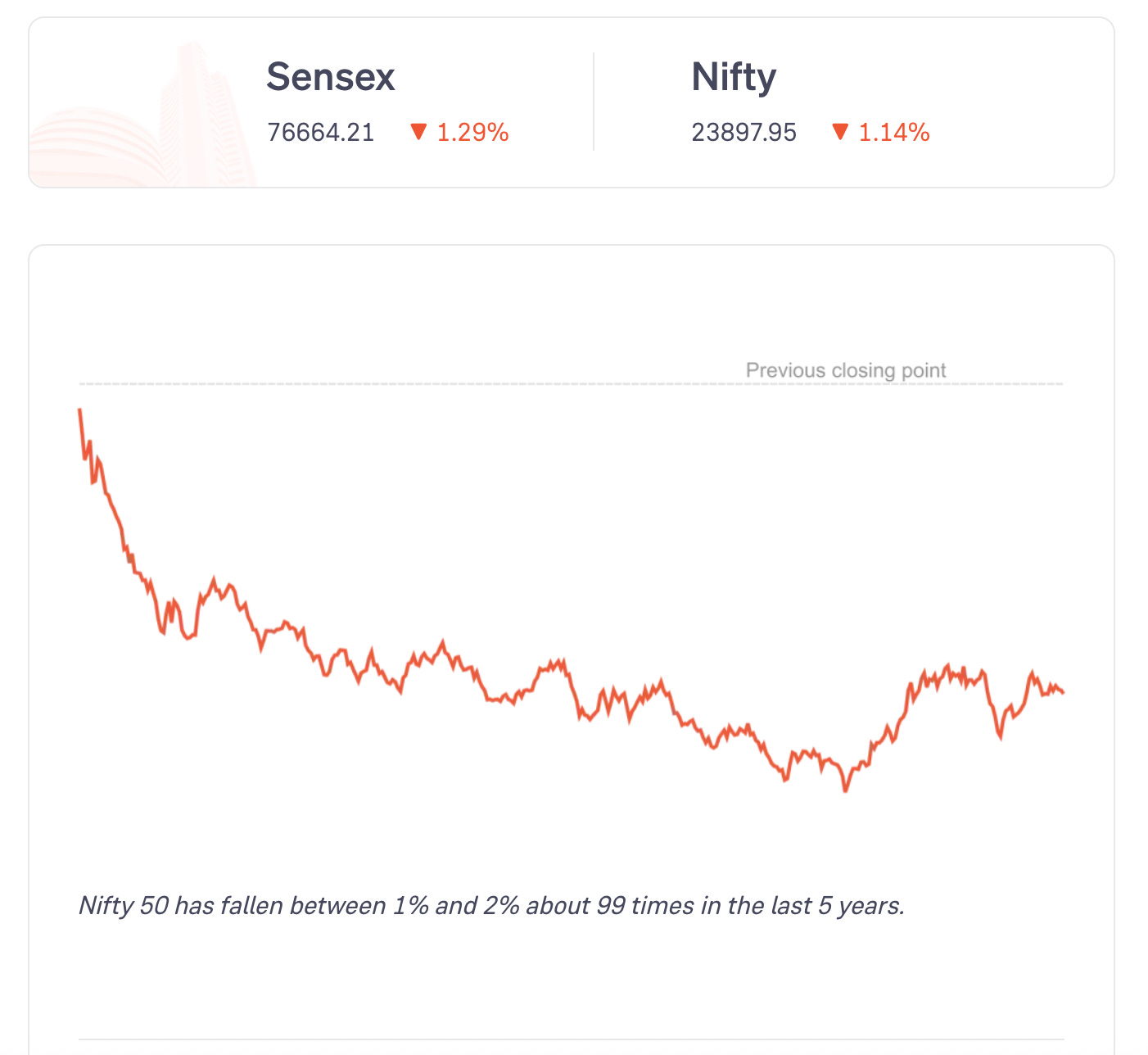
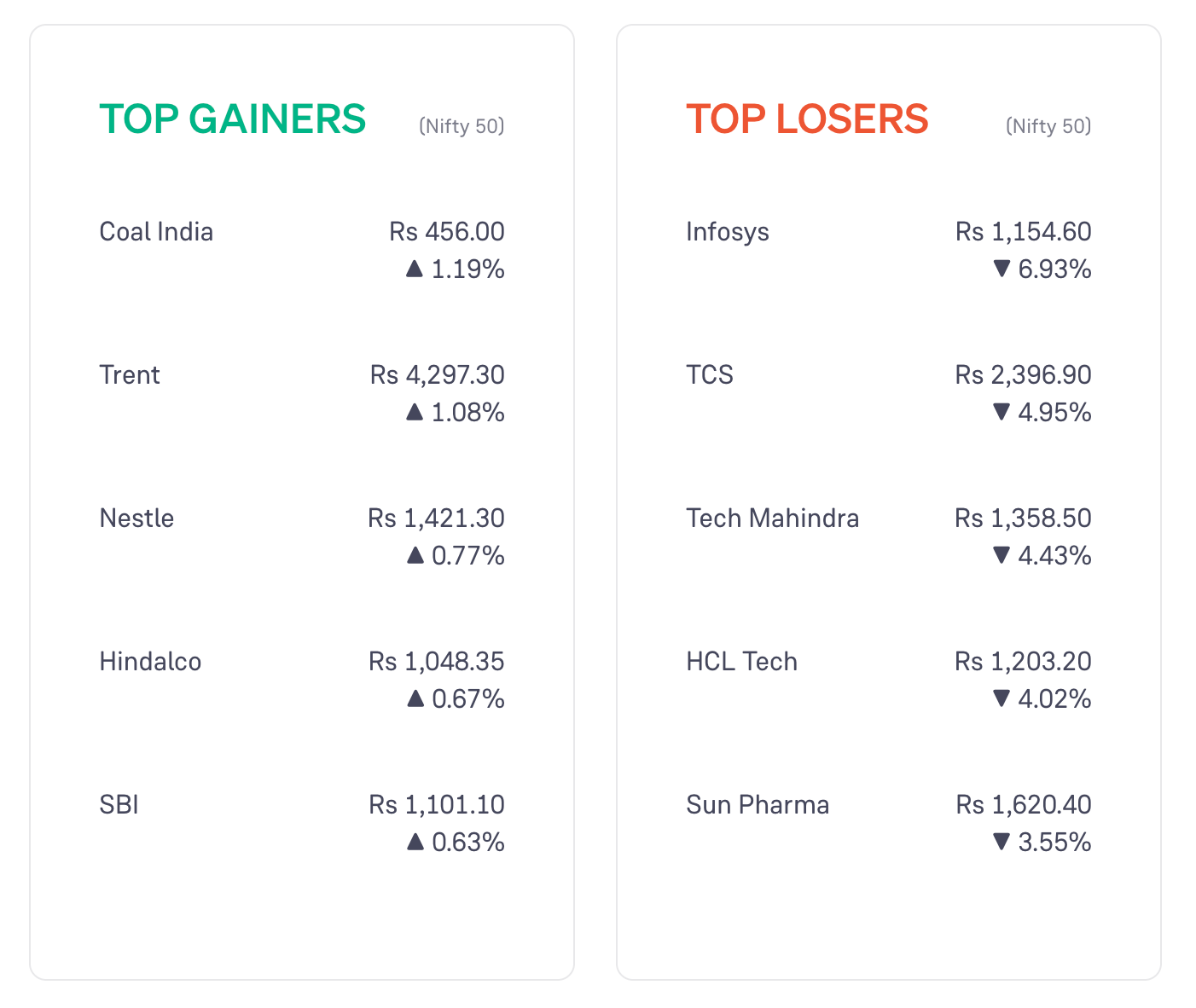
Markets opened below yesterday’s closing point. The fall is being attributed to the continued tensions between US and Iran and rising crude oil prices.
All sectors’ stocks fell today. IT stocks and pharma stocks fell the most.
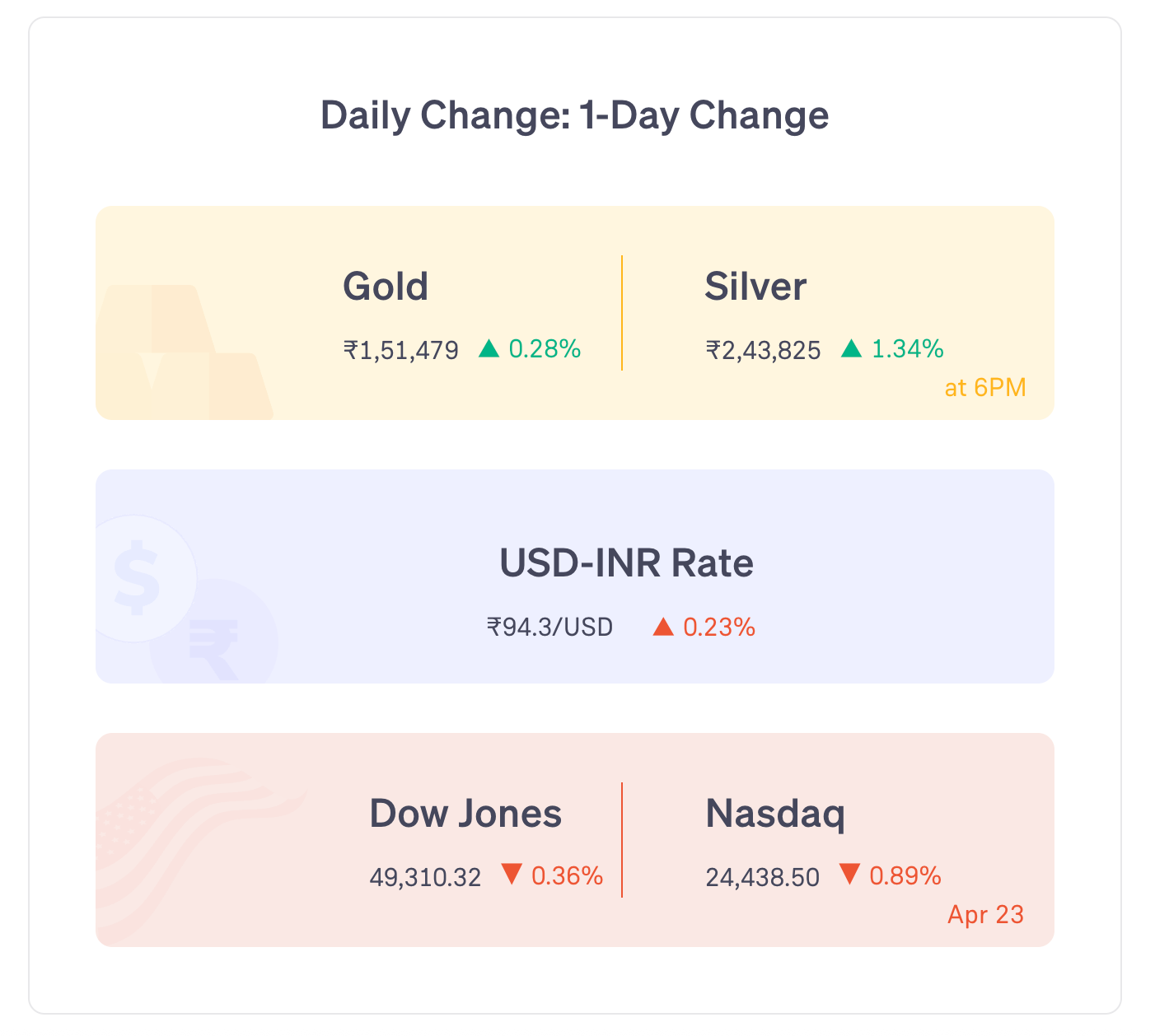
Global markets: US markets and most Asian markets fell. Most European markets fell (as of 6 pm IST).
News
India’s forex reserves rose by $2.36 billion to $703.31 billion in the week that ended on 17 April.
India and New Zealand are set to sign a Free Trade Agreement (FTA) on 27 April, with the aim to more than double bilateral trade to $5 billion in five years.
India’s net FDI turned positive to $4.6 billion in Feb after six months of outflows.
Stocks Updates
L&T: entered the B2B industrial electronics space with the commencement of manufacturing at its Coimbatore facility under a new vertical, L&T Electronic Products & Systems (LTEPS). It will include power electronics, industrial robotics, electronics systems design & manufacturing (ESDM), etc.
Sun Pharma: incorporated a new wholly owned subsidiary, Sun Pharma America, Inc, as a part of the company’s internal group structuring.
M&M: executed a Novation and Amendment Agreement with Manulife. Manulife transferred all its rights and obligations in their life insurance JV to its wholly owned subsidiary, Manulife Holdings (Bermuda) Ltd. Other terms of the JV remain unchanged.
JSW Steel: along with Japan’s JFE Steel Corporation formally unveiled their 50:50 joint venture JSW JFE Steel Ltd which will oversee integrated steel operations in Odisha.
BSE Limited: completed the merger of its wholly-owned subsidiaries, BSE Investments Ltd and BSE Administration & Supervision Ltd, with BSE Technologies Private Ltd. As part of the merger, BSE Ltd will receive 27.74 crore new equity shares of BSE Technologies Private Ltd, with a face value of Rs 1 per share.
Hindustan Zinc: net profit rose 67.6% year-on-year to Rs 5,033 crore during the Jan-March quarter. Dividend announced: Rs 11 per share, with 30 April as the record date.
Adani Green: net profit rose 34.4% year-on-year to Rs 514 crore during the Jan-March quarter.
Adani Energy Solutions: net profit rose 1.26% year-on-year to Rs 722.65 crore during the Jan-March quarter.
Shriram Finance: net profit rose 40.9% year-on-year to Rs 3,020.95 crore in the Jan-March quarter. Final dividend announced: Rs 6 per share, with 3 July as the record date.
Word of the Day
Dividend Payout Ratio
It is the percentage of a company’s profits that is paid out as dividends to shareholders.
A company earns profit and it may distribute a portion of these profits to shareholders as dividends.
A higher ratio means more dividends are paid out, while a lower ratio means the company is reinvesting more into the business.
For example: if a company earns Rs 1,000 and pays Rs 40 as dividends, its payout ratio is 4%.
6 Day Course
Theme: automation in investing
Day 5: Friday
Now that we are talking about software led automation, let’s discuss the various tools.
Investors and traders use APIs to read and process vast amounts of metrics and signals from different sources.
Based on these, they build information gathering tools that are then used to make buy/sell/track decisions.
In many cases, the software they build gathers various info and even suggests the trades to make. The investor would then simply have to approve the buy/sell order.
The final level of automation is where the investor simply builds a software model that takes entire decisions on its own. It does not take approvals from the investor.
These models are highly sophisticated and react extremely fast.
In such cases, the investor’s skill is not in using the software models but in building these models.
Most large institutional investors use such models.
Featured Question
Q. “How to deploy strategy using api”
This can be done using multiple ways.
You could have the code/model running on your computer. The code will run on your own device and use APIs to interact with the broker to place orders.
Another method which is considered more reliable is to use cloud services.
Investors build the software model and deploy it to a cloud server via a service like AWS, Azure, GCP, etc.
Some trading platforms also offer their own cloud servers for deploying traders’ code to ensure minimal lag.
The information presented in this post has been compiled and prepared by Groww Invest Tech Pvt Ltd and is intended solely for informational purposes. It is not tailored to any specific investment objectives, financial situations, or needs of any individual investor. The content should not be construed as investment, financial, legal, or tax advice and should not be relied upon as a substitute for professional consultation.
Investing in securities markets involves inherent risks. Investors are advised to carefully review all relevant documents and consider their own risk tolerance before making any investment decisions.
Mutual fund investments are subject to market risks; please read all scheme-related documents carefully. Past performance of financial instruments, schemes, or markets is not indicative of future results.
Groww Invest Tech Pvt Ltd is registered with the Securities and Exchange Board of India (SEBI) under Registration No: INZ000301838, as a Research Analyst under No: INH200008662, as a Depository Participant under No: IN-DP-417-2019, and with the Association of Mutual Funds in India (AMFI) under ARN-111686.
SEBI registration details: View registered name and registration numbers
Research Analyst Disclaimer: View Research Analyst disclaimer
Did you like this edition?
Leave a feedback here!
Sorry