

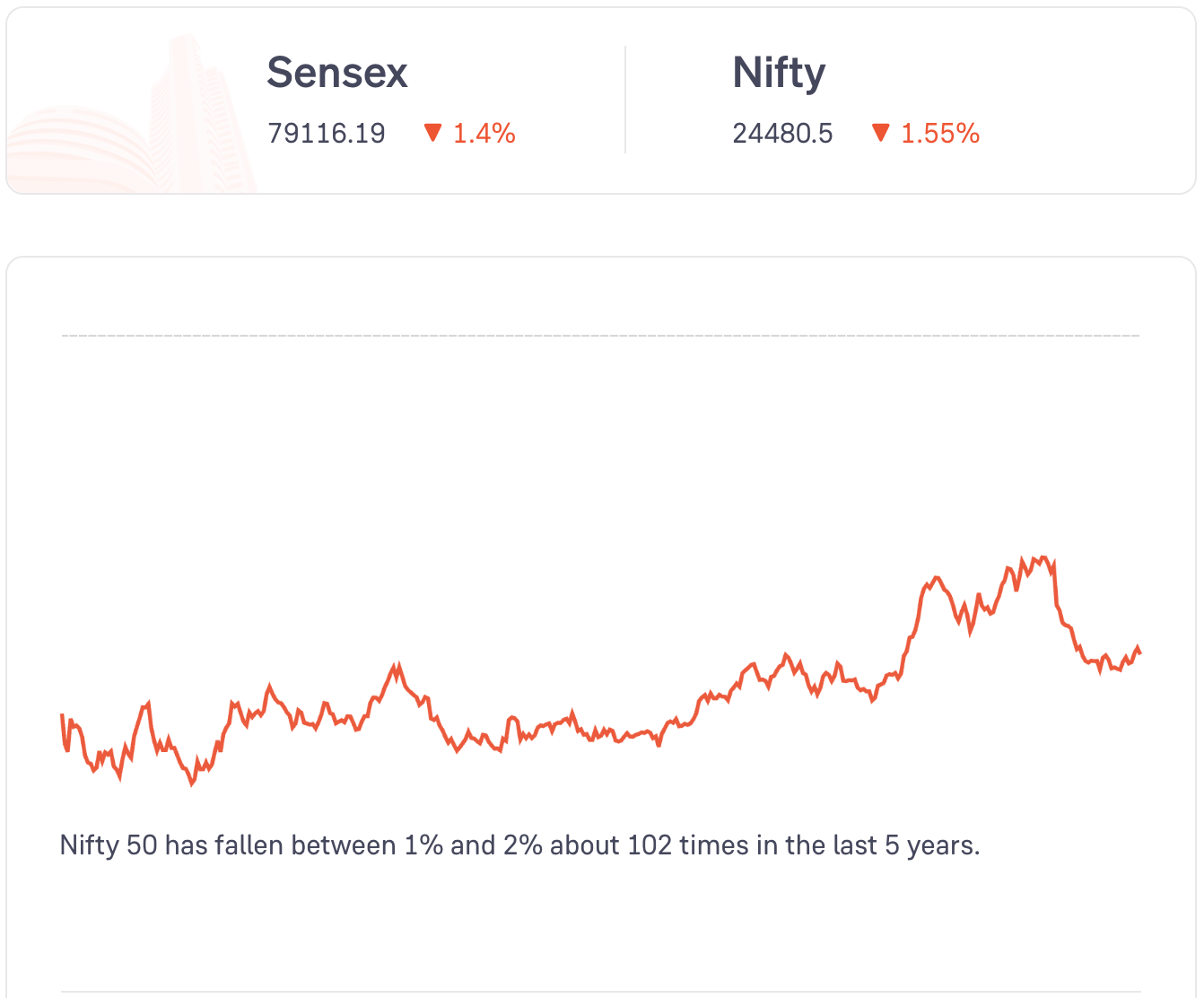
Markets opened below Monday’s closing point.
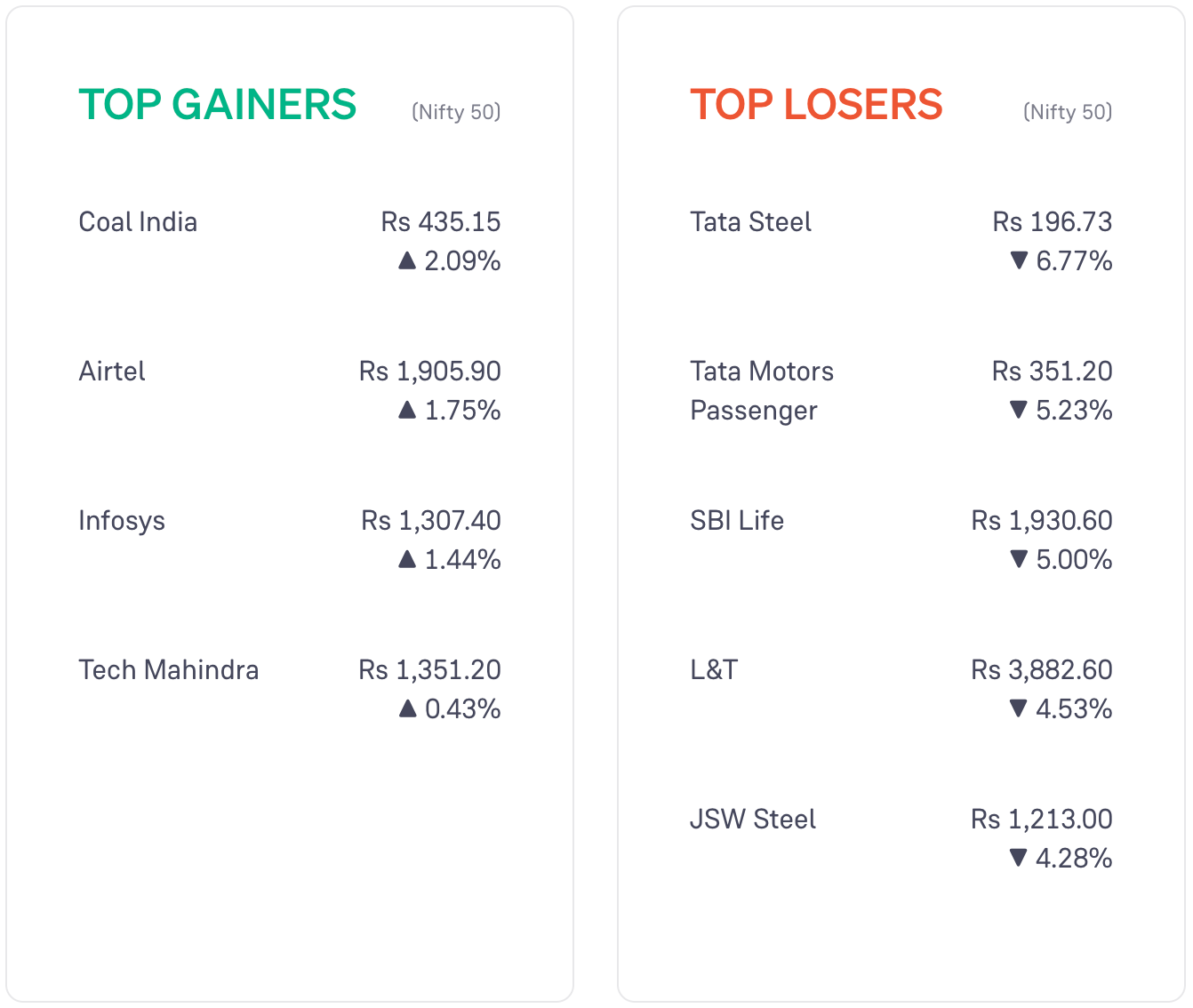
All sectors’ stocks fell today, except for the IT stocks. Metal stocks and PSU Bank stocks fell the most.
There are only 4 stocks in the Nifty 50 that rose today. Hence, there are only 4 stocks in ‘Top Gainers’ section.
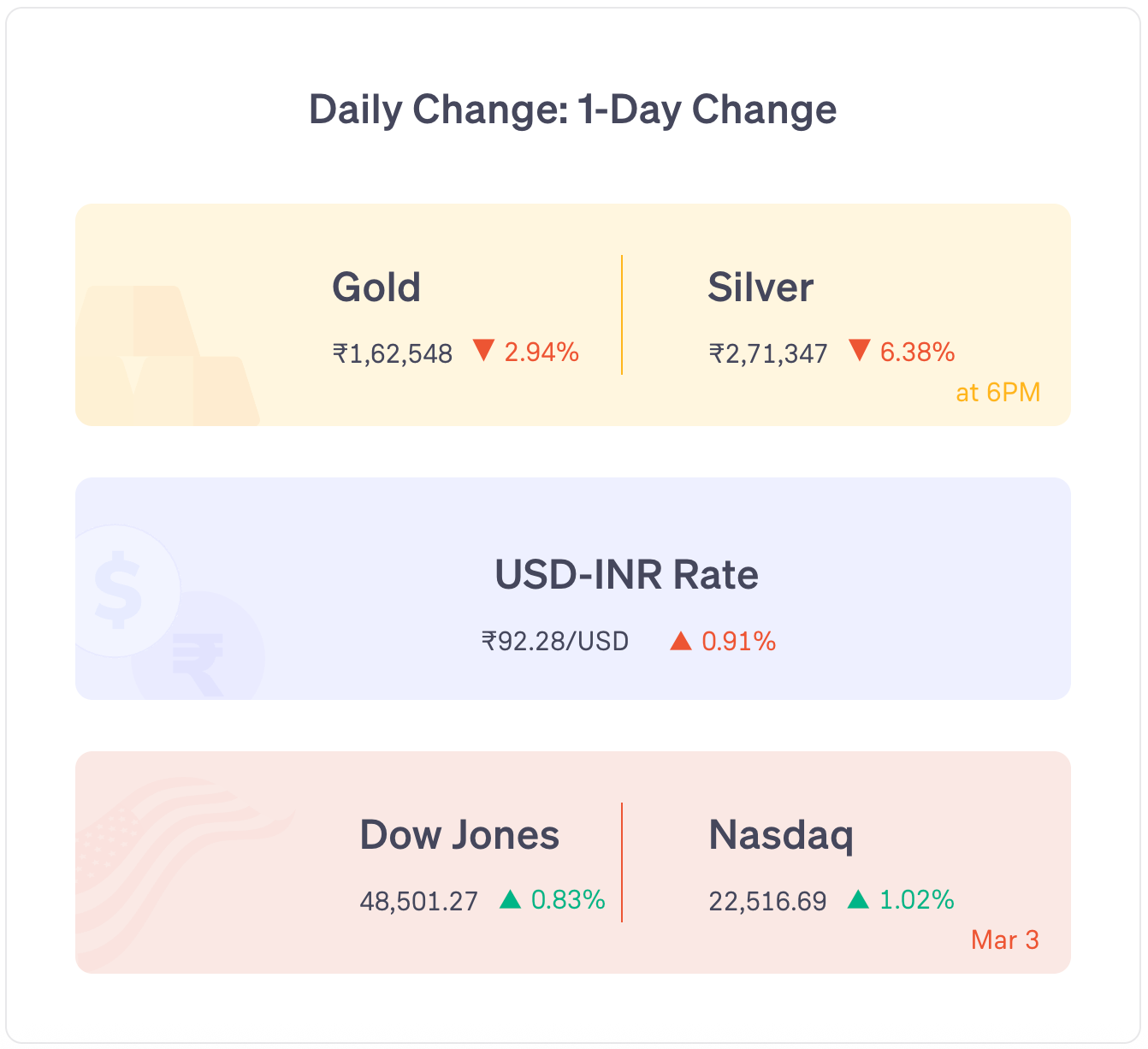
Global markets: US markets and Asian markets fell. European markets rose (as of 6 pm IST).
News
India’s composite PMI (manufacturing + services) rose to 58.9 in Feb (vs 58.4 in Jan). Services PMI fell to 58.1 (vs 58.5 in Jan). This means overall economic activity grew more in Feb than in Jan.
Sedemac Mechatronics IPO has been subscribed 0.27 times. Retail subscription: 0.03 times. IPO closes on 6 March.
Moneyview applied for a Rs 1,500 crore IPO with SEBI.
Stocks Updates
HAL: signed a Rs 2,901 crore contract with the MoD for supply of 6 ALH Mk-III (Maritime Role) helicopters to the Indian Coast Guard, along with operational equipment, engineering support and performance-based logistics support.
IndiGo: cancelled over 500 flights to the Middle East and selected international destinations between 28 Feb and 3 March due to evolving airspace restrictions over Iran and the region.
Infosys: and Intel have expanded their partnership to help companies use AI in real business operations. They will combine Infosys’ AI platform (Topaz) with Intel’s AI chips and hardware to deliver secure and cost-effective enterprise solutions.
ONGC: in response to a BSE query on unusual trading volumes, said that there is no undisclosed information impacting its share price and that the recent volume movement is due to market conditions and volatility in global oil and gas prices.
Tata Capital: allotted secured non-convertible debentures worth Rs 343 crore on a private placement basis at coupon rates of 7.66% and 7.6596%, maturing on 8 Feb 2034.
Polycab: received an income tax demand order of Rs 327.45 crore (interest + penalty) for FY23-24. The company plans to appeal the order.
Word of the Day
Amortization
It means gradually spreading out a cost over time, instead paying it all at once
Amortisation can be used in 2 cases: loans or business expenses.
Payments are made/recorded in regular installments until the full amount is covered.
Example: if a person takes a Rs 5 lakh loan, it can be paid in monthly installments of Rs 20,000 over a few years.
In the case of a company, if it buys a software license, it can spread the cost over the number of years the license is valid, rather than recording the entire expense in the first month.
6 Day Course
Theme: currency
Day 3: Wednesday
So in short, a country can print money.
This is both an advantage and a great risk.
In times of crisis, when everyone becomes cautious about spending, printing more money and increasing the supply of money in the economy leads to much higher economic activity.
Often, this leads to economic recovery that is much faster than otherwise possible.
We have seen the US do this during the 2008 recession and the 2020 pandemic.
On the other hand, too much printing of money erodes the value of money. One effect of this is higher inflation.
We saw post the pandemic how inflation shot up as too much money was available in the system.
In some countries, extreme printing of money has led to hyperinflation and the destruction of the country’s currency. One good example of this is Zimbabwe.
Featured Question
Q. “Investing in equity or in mutual fund, which is a better idea for long term wealth creation”
The answer to this is whatever works for you.
Many investors pick their own stocks and do not invest in mutual funds.
They do this because they are confident they can get returns higher than mutual funds.
If they are good investors and they are actually able to do that, they should continue with picking stocks.
Many investors pick stocks on their own and are able to get good returns — but not better returns than mutual funds.
Such investors must ask themselves if they want to continue to invest in stocks or if they should just invest in mutual funds.
Many newer investors are able to get lower returns than mutual funds but their returns pick up as they get better.
So in such cases, if the investor is on a learning curve, they might choose to stick with stocks investing.
Or, they might invest in both mutual funds and stocks.
If a stocks investor is not able to get better returns than mutual funds and does not have the time to learn more and get better at stock picking, it would be better to switch to mutual fund investing entirely.
Did you like this edition?
Leave a feedback here!