

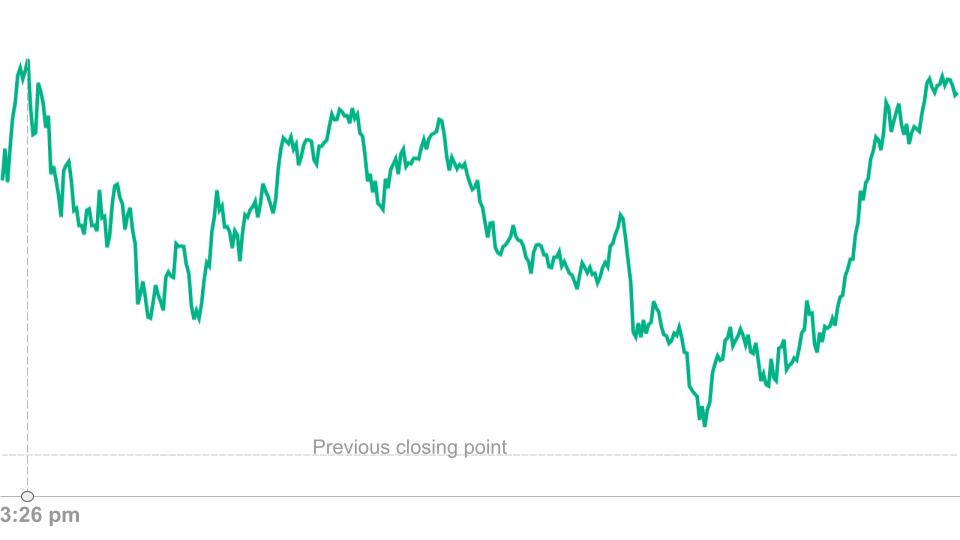
Markets opened above yesterday’s closing point.
Oil and gas stocks and metal stocks rose the most today. FMCG stocks and pharma stocks fell the most.
Global markets: US markets showed a mixed trend. Asian markets rose. Most European markets fell (as of 6 pm IST).
News
India’s industrial production grew 7.8% year-on-year in Dec (vs 7.2% in Nov). Manufacturing grew 8.1% (vs 8.5% in Nov ), mining grew 6.8% (vs 5.8 in Nov) and electricity grew 6.3% (vs a fall of 1.5% in Nov).
The RBI and the European Securities and Markets Authority (ESMA) signed a new MoU to boost cooperation on central counterparties. This MoU will allow Indian clearing houses to regain EU recognition.
Shadowfax IPO listed on the stock exchanges at a discount of 9.19% over the issue price and closed 11.31% down at the end of the day.
Stocks Updates
L&T: net profit fell 4.3% year-on-year to Rs 3,215 crore in the Oct-Dec quarter. It also won a major contract (Rs 5,000 crore to Rs 10,000 crore) to build an 8.4 km extension of Riyadh Metro’s Red Line in Saudi Arabia.
ABB India: won a domestic order from Titagarh Rail Systems to supply traction and control systems for 40 metro trainsets.
Adani Power: issued Rs 7,500 crore worth non-convertible debentures via private placement to fund its operations.
NTPC: declared commercial operation of 130.47 MW from its 1,255 MW Khavda-I Solar PV project in Gujarat.
SBI: will raise $250 million via 12-month senior unsecured bonds.
Vedanta: approved the sale of up to 1.59% stake in Hindustan Zinc via an offer-for-sale.
Maruti Suzuki: net profit rose 4.1% year-on-year to Rs 3,879 crore in the Oct-Dec quarter.
Bharat Electronics: net profit rose 20% year-on-year to Rs 1,579 crore in the Oct-Dec quarter.
SBI Life: net profit rose 4.7% year-on-year to Rs 577 crore in the Oct-Dec quarter.
TVS Motor: net profit rose 49% year-on-year to Rs 841 crore in the Oct-Dec quarter.
Word of the Day
Fiscal Deficit
It occurs when a government spends more than it earns in revenue
It is the difference between total expenditure and total revenue, showing how much the government needs to borrow to meet its spending.
A fiscal deficit is not always bad. It can mean that the government has invested in long term projects or tried to stimulate economic growth.
If the deficit is too high, it may lead to inflation.
In FY 24-25, India had a fiscal deficit of 4.8% of GDP.
6 Day Course
Theme: risk-adjusted returns
Day 3: Wednesday
The first ratio we must talk about here is Sharpe ratio.
Sharpe ratio uses volatility to quantify risk.
So, if a share price is extremely volatile (greater ups and downs), its volatility will be higher.
The ratio uses volatility, expected return, and the risk-free return to compute the result.
A Sharpe ratio of more than 1 is considered ‘good’. It means you are getting adequate returns for the risk you are taking.
Sharpe ratio = (expected return of investment - risk-free return) ÷ volatility.
Investors can make use of this formula but they must also always remember its limitations.
Let’s say a corporate bond is extremely less volatile. Its Sharpe ratio will appear healthy. And then, let’s say something suddenly goes wrong.
In such a case, the Sharpe ratio will fail to predict a risk of that kind.
Another challenge with Sharpe ratio is that it labels every volatile investment as risky whereas there can be volatile but good investments also.
Featured Question
Q. “Gold etf price is changing very frequently. Just want to know if someone buy gold etf units now then etf manger immediately buy the physical gold from shop or it will be bought in defined frequency. Please clarify in detail?”That depends.
Each unit of an ETF is represents a certain quantity of gold.
When you buy gold ETF units, you might be buying it from someone else who is selling.
Similarly, when you sell your ETF units in the markets, someone else is buying them from you. It’s just the ownership that is changing.
In such a case, the gold already exists with the ETF.
So in this case, no gold needs to be bought.
But what happens when there are many buyers and very few sellers of the same ETF units?
In this case, new ETF units are being created. Which means, the fund manager will have to purchase new physical gold to match each unit of the ETF.
So yes, in this case, the gold will be purchased.
The purchase happens in batches and from large-scale pure gold dealers.
The gold is stored in the ETF’s custodian’s secure vaults.
Do note, investors get the value of each unit based on the price they bought the unit at, not when the ETF actually makes the batch purchase.
This way, the investor gets the accurate price he/she bought at.
Did you like this edition?
Leave a feedback here!