
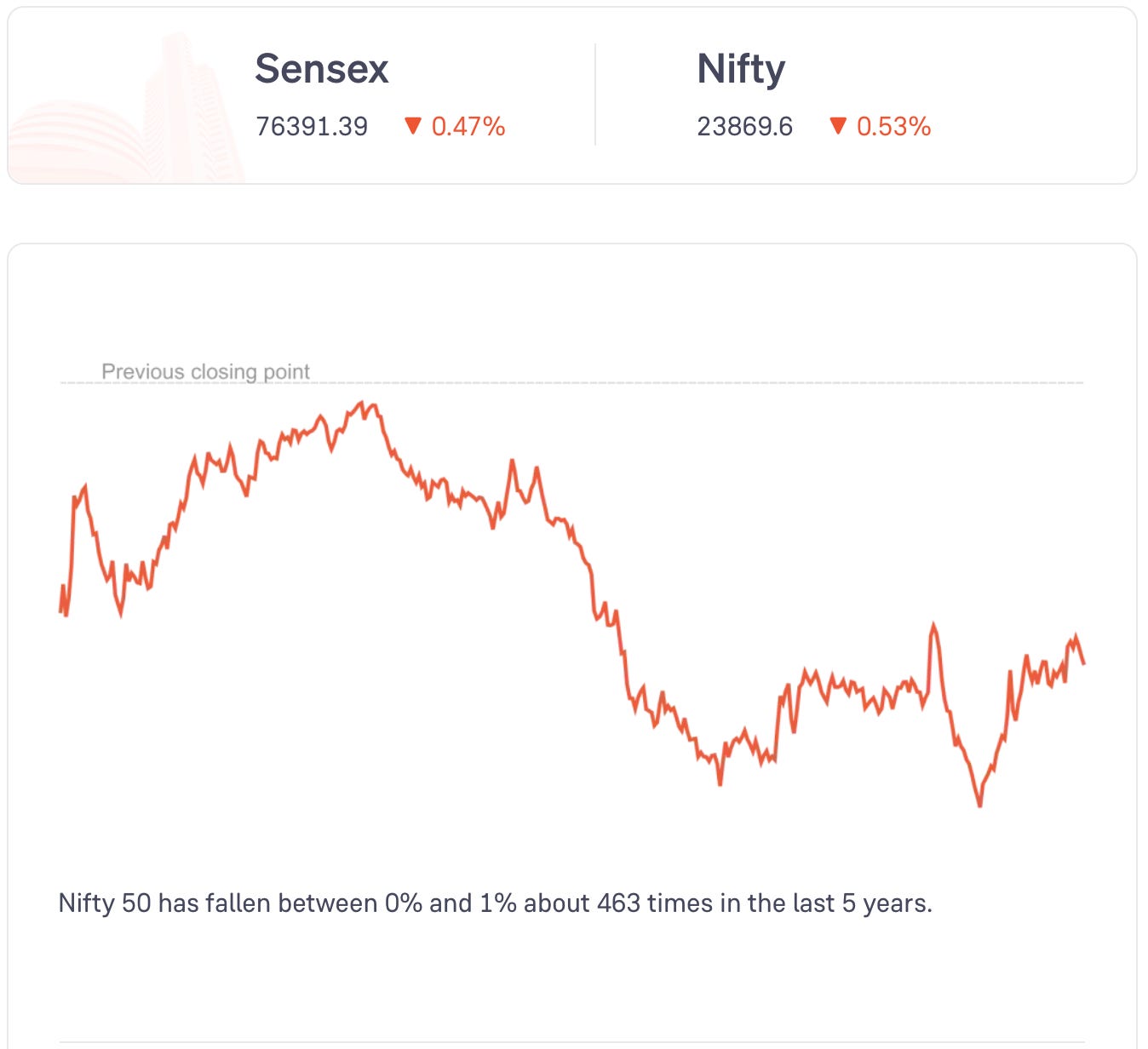
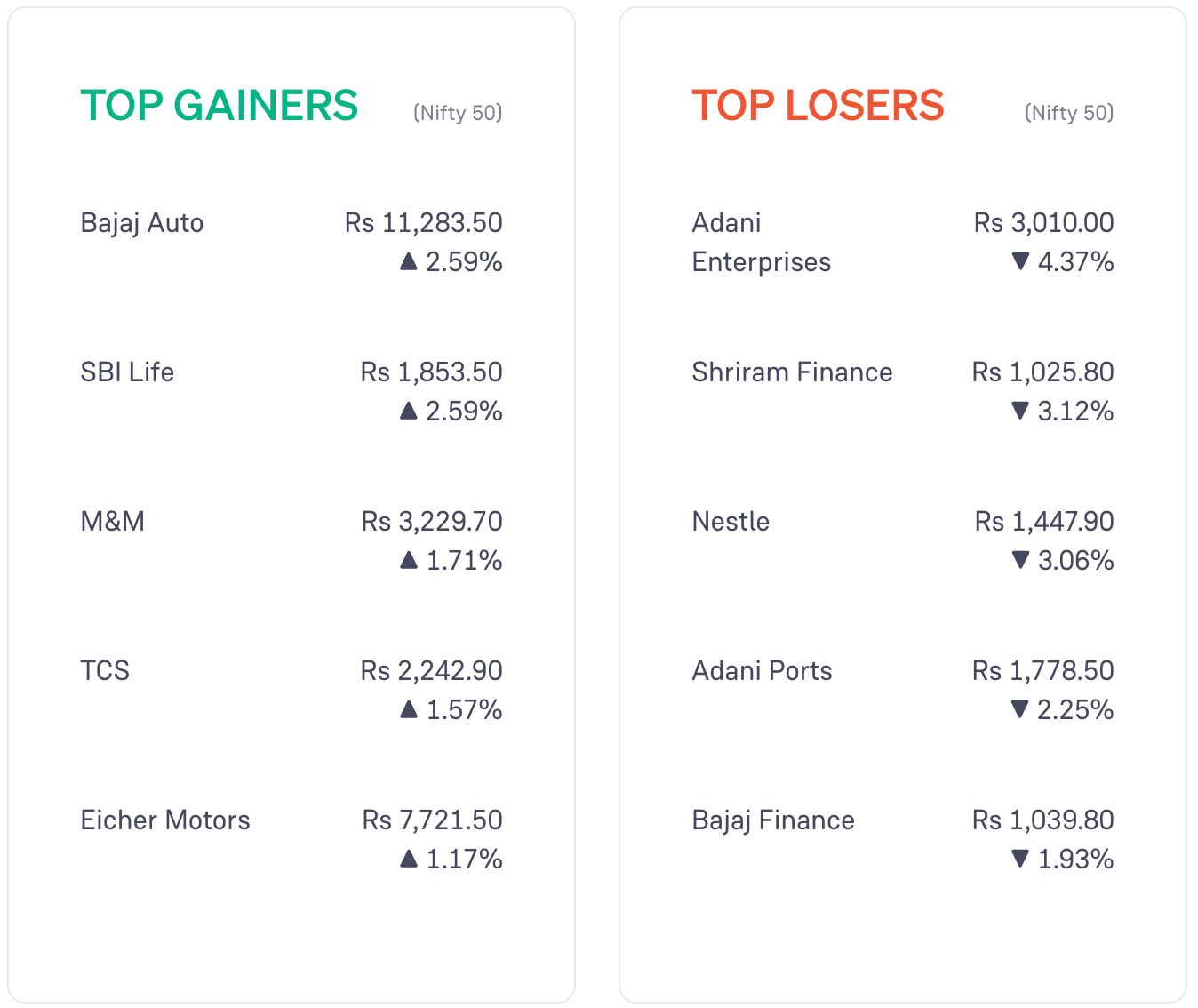
Markets closed lower than yesterday’s closing point as the US-Iran conflict escalated and pushed oil prices close to the $100 mark. Nifty and Sensex declined for the fourth consecutive session.
Chemical stocks and realty stocks fell the most today. Only auto stocks and media stocks rose.
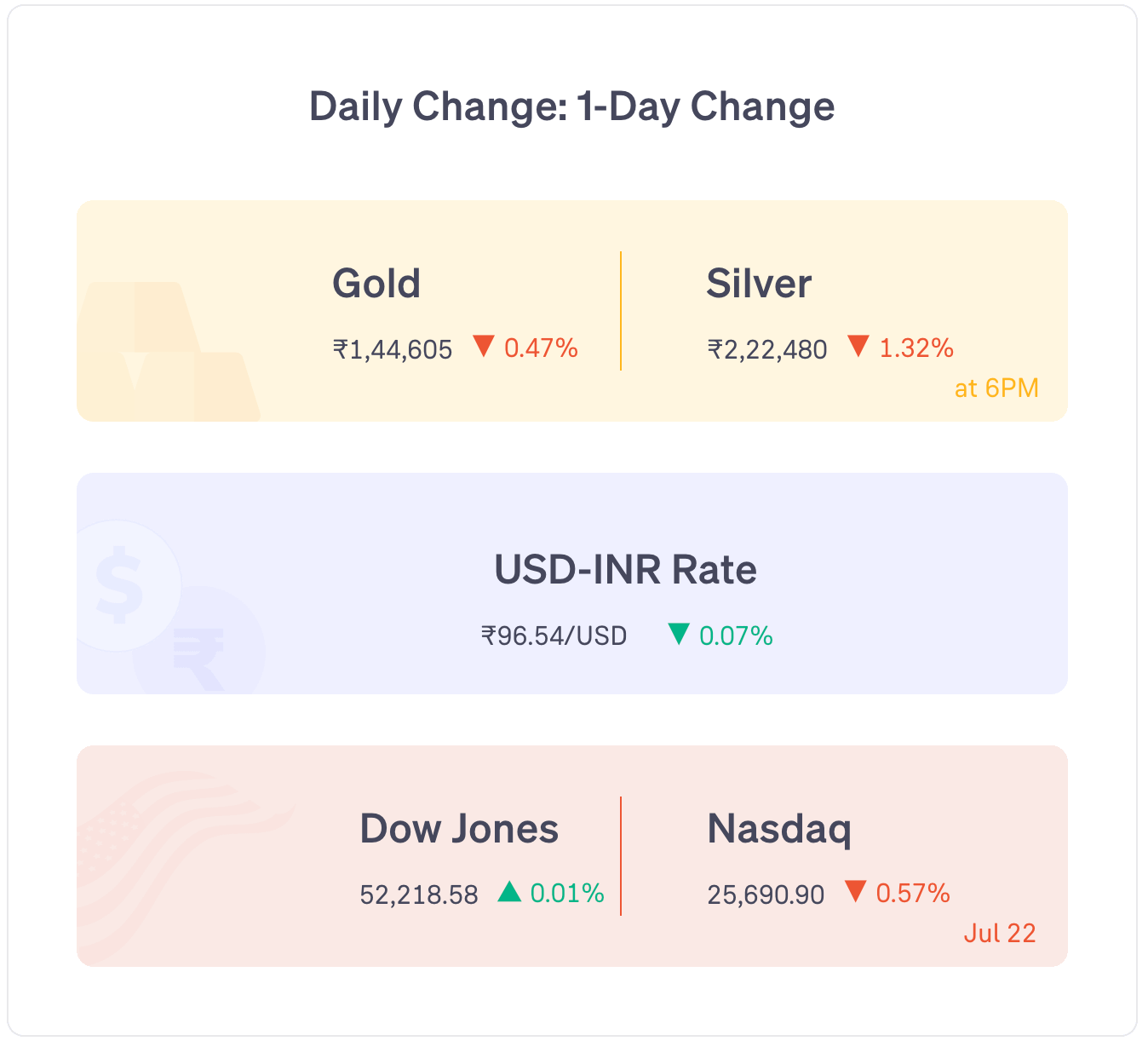
Global markets: US markets fell on Wednesday. Most Asian markets rose on Thursday. Most European markets fell (as of 6 pm IST).
News
The government approved construction of a 14.52 km line between Nimpura and Midnapur, West Bengal for Rs 440 crore. The project is expected to support additional 3.52 MTPA traffic on the freight corridor to transport coal, iron ore, steel etc.
Indo MIM IPO was subscribed 1.13 times on day 1. Retail subscription : 0.86 times. IPO closes on 27 July.
Lohia Corp IPO was subscribed 0.39 times on day 1. Retail subscription : 0.66 times. IPO closes on 27 July.
Stocks Updates
Bajaj Finance: allotted secured NCDs worth Rs 1,152.64 crore through private placement at a coupon rate of 7.93%, mature on 12 June 2029.
Infosys: net profit rose 12.25% year-on-year to Rs 7,769 crore in the Apr-June quarter. It appointed Ashiss Kumar Dash as the CEO, effective from 23 July.
Hindustan Zinc: promoter group entity Twin Star Holdings Ltd entered into a facility agreement for a maximum commitment of $2.25 billion, guaranteed by other Vedanta promoter group entities (Vedanta and Vedanta Aluminium Metal).
InterGlobe (IndiGo): reported a net loss of Rs 237.60 crore in the Apr-June quarter, compared to a net profit of Rs 2,176.30 crore a year earlier.
Samvardhana Motherson: issued a corporate guarantee of up to Rs 240 crore, along with interest, for a credit facility availed by indirect wholly owned subsidiary Motherson Electro Components Ltd from HDFC Bank.
Cipla: net profit fell 39.19% year-on-year to Rs 789.05 crore in the Apr-June quarter.
Zydus Lifesciences: received approval to conduct a Phase III clinical trial of Desidustat for treating anaemia in collaboration with ICMR.
Godrej Consumer: invested Rs 200 crore in wholly owned subsidiary Godrej Pet Care Ltd through a rights issue to fund its operations, growth plans and capital requirements.
Bharat Forge: subsidiary, Kalyani Powertrain Ltd will sell its entire 50% stake in joint venture REFU Drive GmbH to REFU Elektronik GmbH for EUR 12,500. REFU will cease to be a JV of KPTL.
United Spirits: approved an investment of Rs 2.69 crore in Nuvola Spirits Pvt Ltd for a 10.08% stake on a fully diluted basis. Nuvola Spirits sells craft liqueurs under the Mikiamo and Seoulmate brands.
Meesho: net loss narrowed 54.09% year-on-year to Rs 132.84 crore in the Apr-June quarter. The company also approved investing up to Rs 75 crore in wholly owned subsidiary Meesho Grocery through a rights or further issue of shares.
Word of the Day
YTD Returns
It is the return given by an asset since the start of the year.
YTD stands for Year-to-Date.
When we speak of 1-year returns, 3-year returns, 5-year returns, etc. we are comparing the returns over that period matching the start and end date.
Example: 3-year returns would mean the returns of an investment between 23 Jul 2023 and 23 Jul 2026.
YTD returns always measure from 1 January of the current year.
The period is not fixed. The start date is fixed. The end date is the current date.
Most investors tend to rely more on 1, 3, 5, etc year returns and those are better long-term measures.
The difference between 1-year return and YTD return:
-1-year return is the return between 23 Jul 2025 and 23 Jul 2026
-YTD returns is the return between 1 Jan 2026 and 23 Jul 2026
YTD returns are better used to understand the performance of an investment in the current year only.
6 Day Course
Theme: understanding PEG
Day 4: Thursday
So we now know how PEG ratio is calculated.
The challenge is that the PE ratio changes day-to-day (since the price of the share changes everyday).
This can bias the PEG ratio on a day to day bias. Which makes decision making tougher.
To address this challenge, investors often use a 12-month average PE ratio value.
So instead of 1 day’s PE ratio, they use an average value spanning the previous 12 months.
This PE ratio is called the 12-month trailing PE ratio. And the PEG ratio calculated using this is called 12-month trailing PEG ratio.
Some investors believe this does not account for the fact that the company’s future is even brighter.
So some investors try to predict the future earnings over the next 12 months.
Based on those earnings, they calculate the 12-month forward PE ratio.
The PEG ratio calculated using this is called 12-month forward PEG ratio.
This is a bit riskier since the investor has to estimate and predict future earnings and nobody can do that with 100% accuracy.
————
Featured Question
Q. “Is exit load is constant or variable, if variable does it apply to investors of the M Fund who invested in the units before the change announced?”
Exit load is a fee charged by mutual funds if the investor withdraws too fast.
This is a percentage applied to the value being withdrawn.
Example: a certain mutual fund may charge 1% exit load till 12 months.
This means, if you withdraw within 12 months of investing, they will cut 1% of the withdrawal amount as exit load.
After the 12-month period, the exit load becomes 0%.
This is done to discourage investors from withdrawing money too fast.
Different mutual funds apply different exit load percentages and for different periods.
Example: ABC mutual funds charges 0.2% for 3 months, XYZ mutual fund charges 0.5% for 6 months, etc.
Mutual fund companies may announce changes in the exit load sometimes. It is not very common.
The new and updated exit load applies to all investors uniformly.
The information presented in this post has been compiled and prepared by Groww Invest Tech Pvt Ltd and is intended solely for informational purposes. It is not tailored to any specific investment objectives, financial situations, or needs of any individual investor. The content should not be construed as investment, financial, legal, or tax advice and should not be relied upon as a substitute for professional consultation.
Investing in securities markets involves inherent risks. Investors are advised to carefully review all relevant documents and consider their own risk tolerance before making any investment decisions.
Mutual fund investments are subject to market risks; please read all scheme-related documents carefully. Past performance of financial instruments, schemes, or markets is not indicative of future results.
Groww Invest Tech Pvt Ltd is registered with the Securities and Exchange Board of India (SEBI) under Registration No: INZ000301838, as a Research Analyst under No: INH200008662, as a Depository Participant under No: IN-DP-417-2019, and with the Association of Mutual Funds in India (AMFI) under ARN-111686.
SEBI registration details: View registered name and registration numbers
Research Analyst Disclaimer: View Research Analyst disclaimer
Did you like this edition?
Leave a feedback here!