

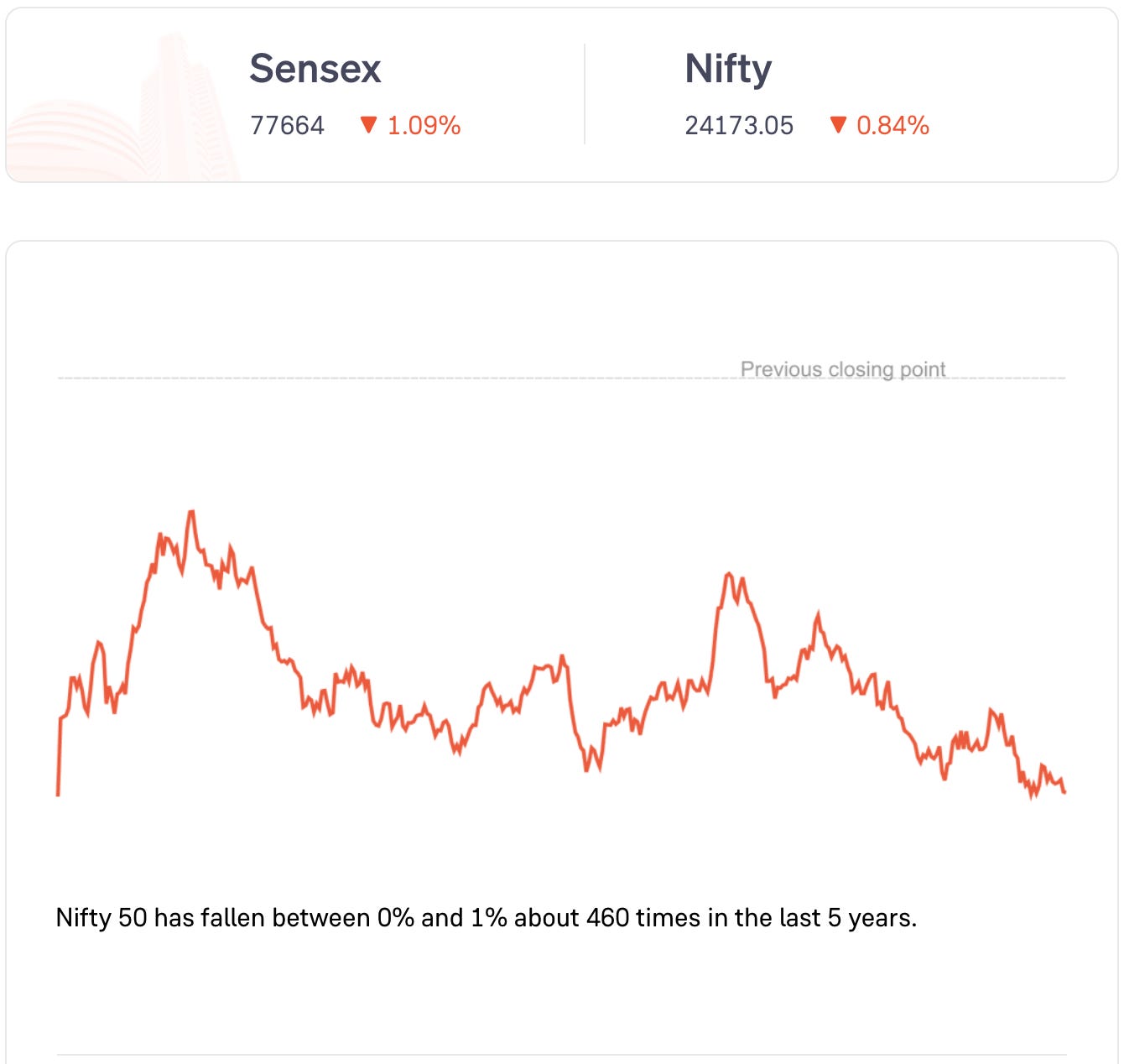
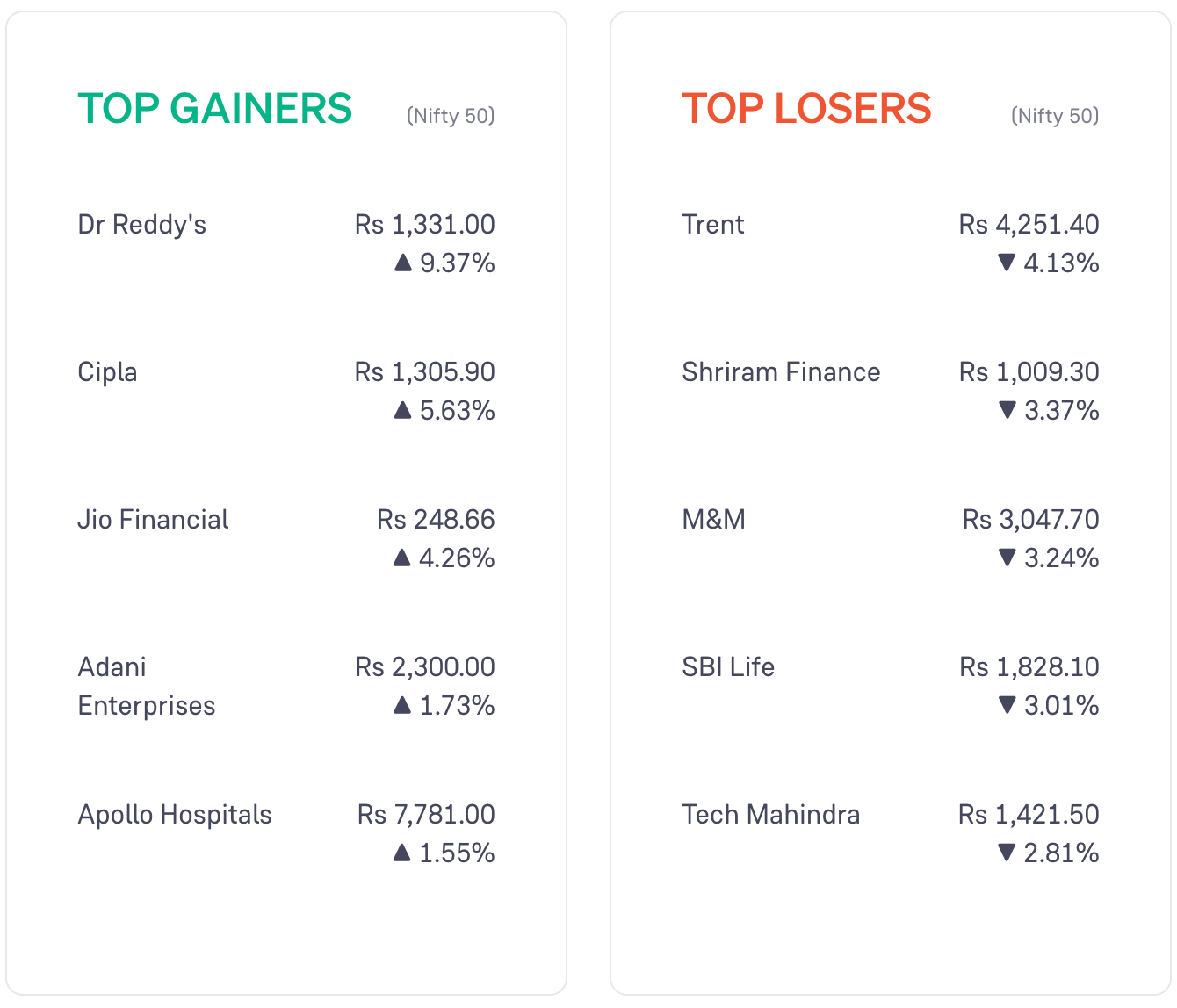
Markets opened below yesterday’s closing point.
Chemicals stocks and FMCG stocks rose the most today. IT stocks and private bank stocks fell the most.
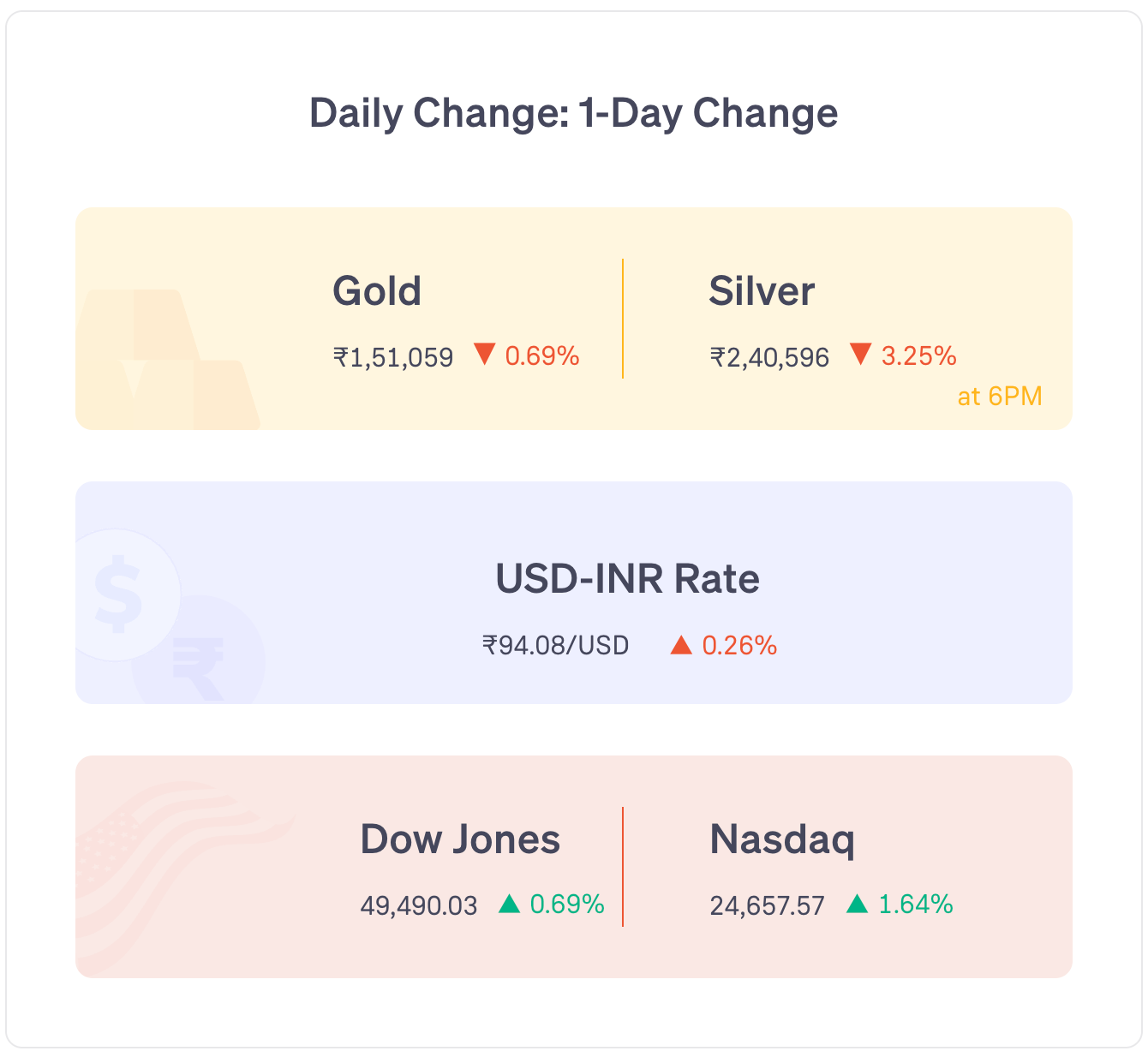
Global markets: US markets fell. Asian markets showed a mixed trend. Most European markets rose (as of 6 pm IST).
News
India’s manufacturing PMI rose to 55.9 in April vs (53.9 in March) as per preliminary estimates. Services PMI rose to 57.9 (vs 57.5 in March). Composite PMI (manufacturing + services) rose to 58.30 (vs 57.0 in March). This means economic activity rose more in April than in March.
Stocks Updates
Infosys: net profit rose 20.87% year-on-year to Rs 8,501 crore during the Jan-March quarter. Dividend announced: Rs 25 per share, with 10 June as the record date.
LTIMindtree: net profit rose 23.38% year-on-year to Rs 1,392.3 crore during the Jan-March quarter. Dividend announced: Rs 53 per share.
Tata Capital: net profit rose 46.65% year-on-year to Rs 1,466.27 crore during the Jan-March quarter. Dividend announced: Rs 0.57 per share.
Union Bank: net profit rose 9.8% year-on-year to Rs 5,503.61 crore during the Jan-March quarter. Dividend announced: Rs 5 per share.
Adani Energy: net profit rose 5.6% year-on-year to Rs 683.78 crore during the Jan-March quarter.
Reliance: subsidiary Jiostar India merged its wholly owned subsidiary, IndiaCast Media Distribution, into itself.
Tata Power: incorporated a wholly owned subsidiary, TP Urja, to expand its power and energy business.
Cipla: has received USFDA approval for a generic version of Ventolin HFA inhaler. The drug is used for asthma and breathing-related conditions.
L&T: won significant orders (Rs 1,000 crore to Rs 2,500 crore) in the buildings and factories segment, including 7 high-rise towers for Oberoi Realty (Gurugram) and a proving ground facility in Haryana. The company also incorporated a wholly owned subsidiary, Vyoma.AI to build data centres and AI infrastructure.
Word of the Day
Active Funds
They are investment funds where a fund manager actively selects and manages investments
Their goal is to beat the market or benchmark index through research, stock picking, and timing decisions.
These funds buy and sell stocks frequently based on the market.
They usually have higher management fees because of active decision-making.
On the other hand, a passive fund replicates the performance of an index.
6 Day Course
Theme: automation in investing
Day 4: Thursday
We must also mention commonly used tools like SIP, STP, and SWP.
SIP lets investors automate investing in a stock (or mutual fund) every month.
Similarly, STP lets investors transfer from one asset to another at a fixed interval. Similarly, SWP lets investors withdraw money at a fixed interval.
Then we have more advanced features that are more customisable.
Let’s say a person wants to start selling a stock once its PE ratio is above a certain level (ignoring the price).
This is possible using trigger based tools. These tools are rare in India. Most platforms do not offer these.
Someone wanting this level of control would have to use code/software tools.
This brings us to API based automation tools.
APIs allow a code or software written by investors to buy/sell/monitor stocks.
This means an investor can write practically any condition to buy/sell/monitor a stock.
It allows for a very high degree of customisation and automation.
Featured Question
Q. “Please elaborate what is Social Stock Exchange”
It is similar to a stock exchange but for social causes.
The stock markets allow companies to raise money from investors and expand their operations, growth, revenues, and earnings.
Similarly, the Social Stock Exchange (SSE) is an exchange that allows Social Enterprises (SE) and Non-Profit Organisations (NPO) to raise money.
For a person going on the SSE, the aim is not to earn more money, but to have a greater impact or good deed done in a society.
In the stock markets you analyse different types of companies and their metrics/fundamentals to decide which company would give you the best return on your invested money.
On the SSE, you would be able to analyse different organisations to give your money to, to have the maximum impact on society.
There are some profit-making social impact oriented companies too.
Such companies can give investors returns similar to a stock on the stock exchange.
The information presented in this post has been compiled and prepared by Groww Invest Tech Pvt Ltd and is intended solely for informational purposes. It is not tailored to any specific investment objectives, financial situations, or needs of any individual investor. The content should not be construed as investment, financial, legal, or tax advice and should not be relied upon as a substitute for professional consultation.
Investing in securities markets involves inherent risks. Investors are advised to carefully review all relevant documents and consider their own risk tolerance before making any investment decisions.
Mutual fund investments are subject to market risks; please read all scheme-related documents carefully. Past performance of financial instruments, schemes, or markets is not indicative of future results.
Groww Invest Tech Pvt Ltd is registered with the Securities and Exchange Board of India (SEBI) under Registration No: INZ000301838, as a Research Analyst under No: INH200008662, as a Depository Participant under No: IN-DP-417-2019, and with the Association of Mutual Funds in India (AMFI) under ARN-111686.
SEBI registration details: View registered name and registration numbers
Research Analyst Disclaimer: View Research Analyst disclaimer
Did you like this edition?
Leave a feedback here!
Very good