

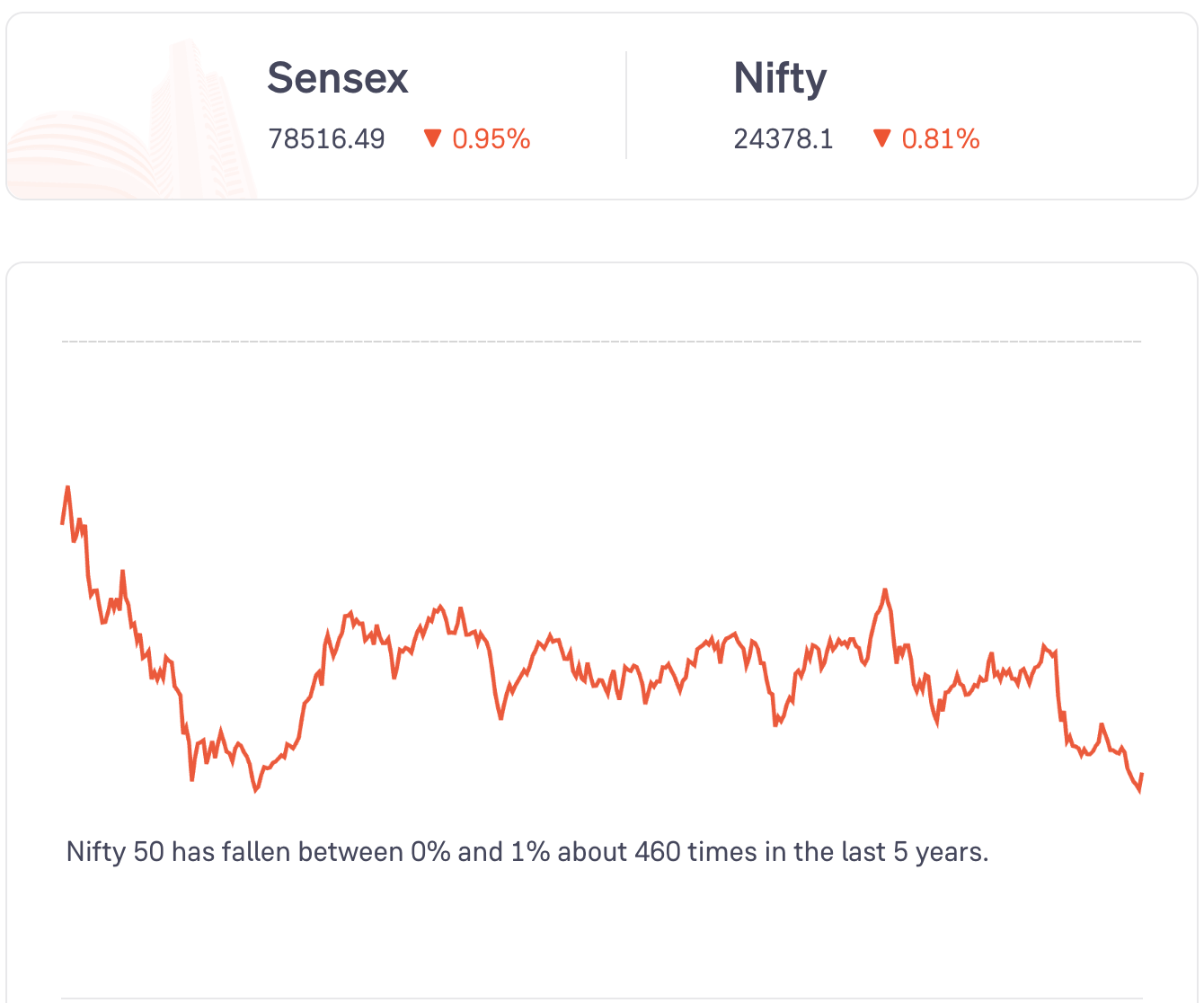
Markets opened below yesterday’s closing point.
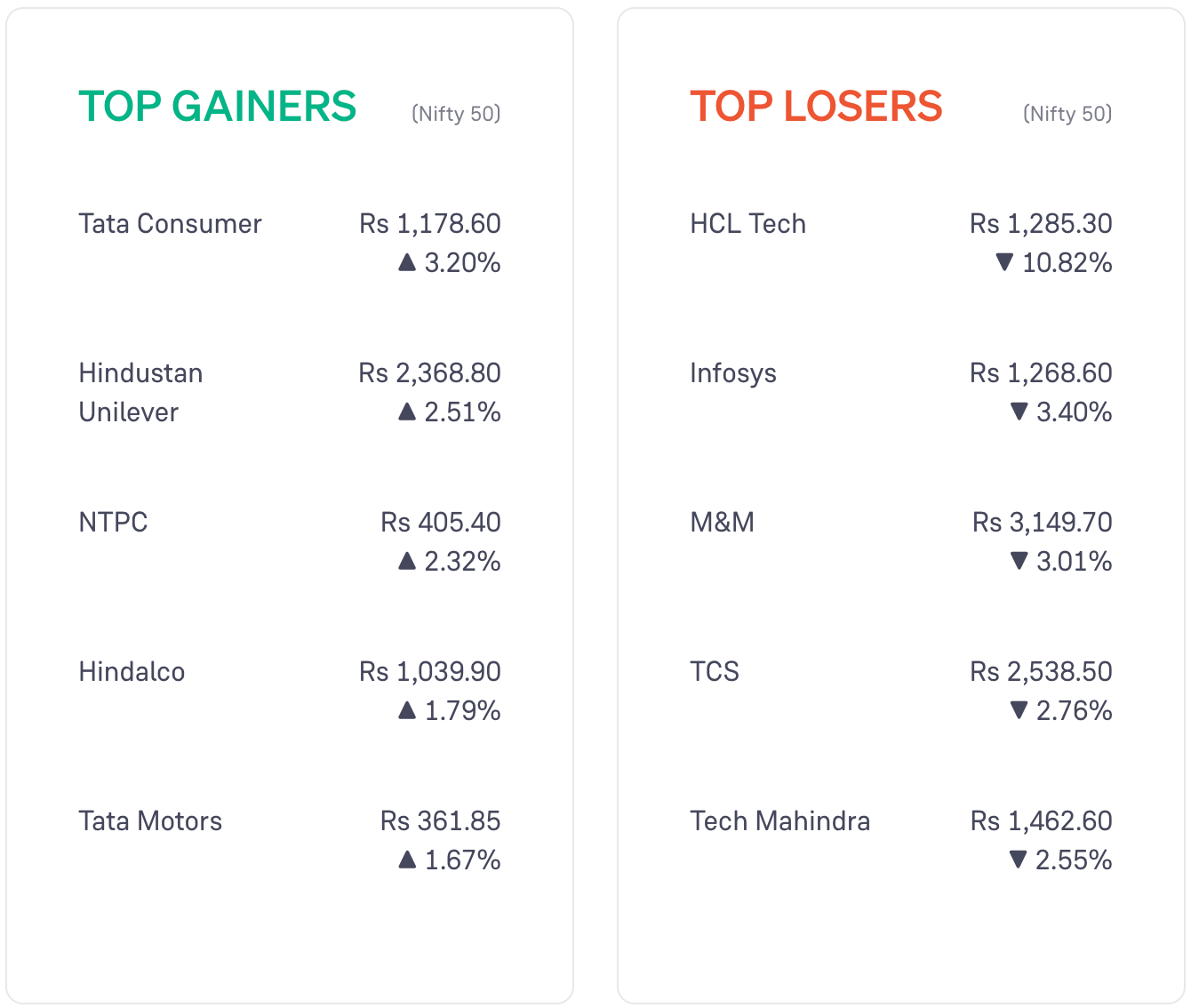
Chemicals stocks and FMCG stocks rose the most today. IT stocks and private bank stocks fell the most.
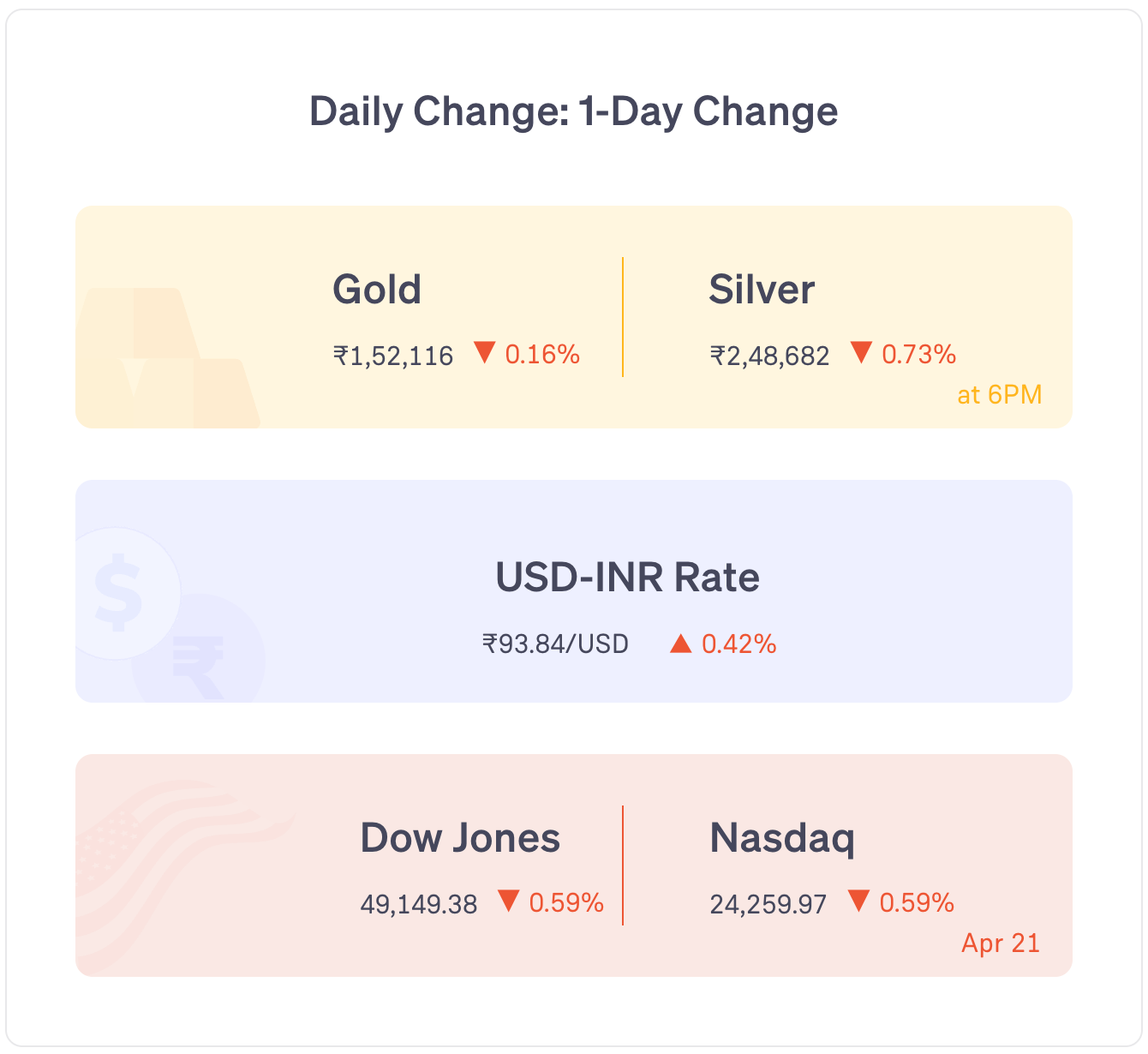
Global markets: US markets fell. Asian markets showed a mixed trend. Most European markets rose (as of 6 pm IST).
News
The RBI has issued new rules for recurring digital payments (e-mandates) allowing auto-debits up to Rs 15,000 without extra authentication after one-time approval. It also included pre and post payment alerts, security checks, and better control over subscriptions and auto-debits.
A SEBI panel has recommended that the National Stock Exchange (NSE) pay about Rs 1,800 crore to settle its long-pending regulatory cases: as per media reports.
Stocks Updates
SBI Life: net profit fell 1.09% year-on-year to Rs 804.6 crore during the Jan-March quarter.
Trent: net profit rose 32.6% year-on-year to Rs 413.10 crore during the Jan-March quarter. Dividend announced: Rs 6 per share. Company has also announced 1 bonus share for every 2 shares held.
Jio Financial: signed a 50:50 joint venture with Allianz Europe BV to enter the general insurance business in India.
Tech Mahindra: net profit rose 18.8% year-on-year to Rs 1,356.4 crore during the Jan-March quarter. Dividend announced: Rs 36 per share, with 3 July as the record date.
Bharat Electronics: received orders worth Rs 569 crore across defence and communication systems.
Tata Steel: acquired a 26% stake in TP Adarsh Ltd (Tata Power renewable subsidiary) for around Rs 5.9 crore, making it an associate company.
HDFC Life: board approved the re-appointment of Vibha Padalkar as MD and CEO for a further 5-year term effective 12 Sept 2026, subject to shareholder and IRDAI approval.
Samvardhana Motherson: merged its Spain-based subsidiary, Modulos Ribera Alta SL, into its holding company, Celulosa Fabril SA (another indirect subsidiary). After the merger, MRA will cease to exist and its assets will move into CEFA.
L&T: subsidiary, L&T Energy GreenTech, signed a long-term deal with Japan’s ITOCHU to supply 3,00,000 tonnes of green ammonia annually from its proposed facility at Kandla, Gujarat.
Lupin: launched Dapagliflozin and Metformin Hydrochloride extended-release tablets (diabetes drug) in the US.
Word of the Day
Depreciation
It is the fall in the value of an asset over time due to wear and tear, usage, or because it becomes outdated.
Example: a machine loses value every year as it is used in production.
Companies account for depreciation in their financial statements by spreading the cost of the asset over its useful life instead of showing it all at once. This yearly portion is the depreciation.
Depreciation is a non-cash expense, meaning no actual cash goes out, but it reduces profit.
This helps show a more realistic picture of profit and the cost of using assets over time.
6 Day Course
Theme: automation in investing
Day 3: Wednesday
The next order type is GTT or Good Till Triggered.
Most other order types expire at the end of the trading day. This means if you want to buy or sell at a certain price (or better), you would have to place a fresh order everyday.
GTT takes care of that.
Once placed, a GTT order is valid for 1 year. This allows investors to not log in to their investment accounts everyday.
OCO or One Cancels the Other.
This is a type of GTT order where if your profit target price is hit, the stop loss order is automatically cancelled.
Or, if the stop loss target is hit, the profit booking order is automatically cancelled.
Featured Question
Q. “You often mention that when assessing a stock price, a single term should not be used in isolation to judge performance. Can you please list all relevant terms in order of priority so we can understand their comparative importance ,in better way?”
There are way too many factors. In fact, many key metrics depend on the company type and the industry it operates in.
First, let’s talk about the numbers that matter broadly.
Revenue, earnings or loss, profit margin, growth (revenue, earnings, customers, etc), debt, PE ratio, PB ratio, PEG, ROCE, ROE, debt to equity ratio, free cash flow, etc are some of the most common metrics to check across stocks of different sectors.
Do note, there is no single right or wrong number for each of these metrics.
Many times, what’s right in the case of one type of company may not be right for another.
Example: it is acceptable for infra companies to have large debt. But IT companies usually have very small or no debt.
It is not always an apples to apples comparison.
As an investor, you will have to understand how each of these metrics should be for companies of different sizes and sectors.
Then of course there are metrics that apply to individual industries.
Example: PB ratio is more important than PE ratio in case of banking stocks and the lending industry.
And above all else, subjective factors that cannot be covered by metrics alone can have a significant impact.
Examples of this are: reliability, management quality, future growth prospects, compliance, corporate governance, industry’s future potential, etc.
The information presented in this post has been compiled and prepared by Groww Invest Tech Pvt Ltd and is intended solely for informational purposes. It is not tailored to any specific investment objectives, financial situations, or needs of any individual investor. The content should not be construed as investment, financial, legal, or tax advice and should not be relied upon as a substitute for professional consultation.
Investing in securities markets involves inherent risks. Investors are advised to carefully review all relevant documents and consider their own risk tolerance before making any investment decisions.
Mutual fund investments are subject to market risks; please read all scheme-related documents carefully. Past performance of financial instruments, schemes, or markets is not indicative of future results.
Groww Invest Tech Pvt Ltd is registered with the Securities and Exchange Board of India (SEBI) under Registration No: INZ000301838, as a Research Analyst under No: INH200008662, as a Depository Participant under No: IN-DP-417-2019, and with the Association of Mutual Funds in India (AMFI) under ARN-111686.
SEBI registration details: View registered name and registration numbers
Research Analyst Disclaimer: View Research Analyst disclaimer
Did you like this edition?
Leave a feedback here!