

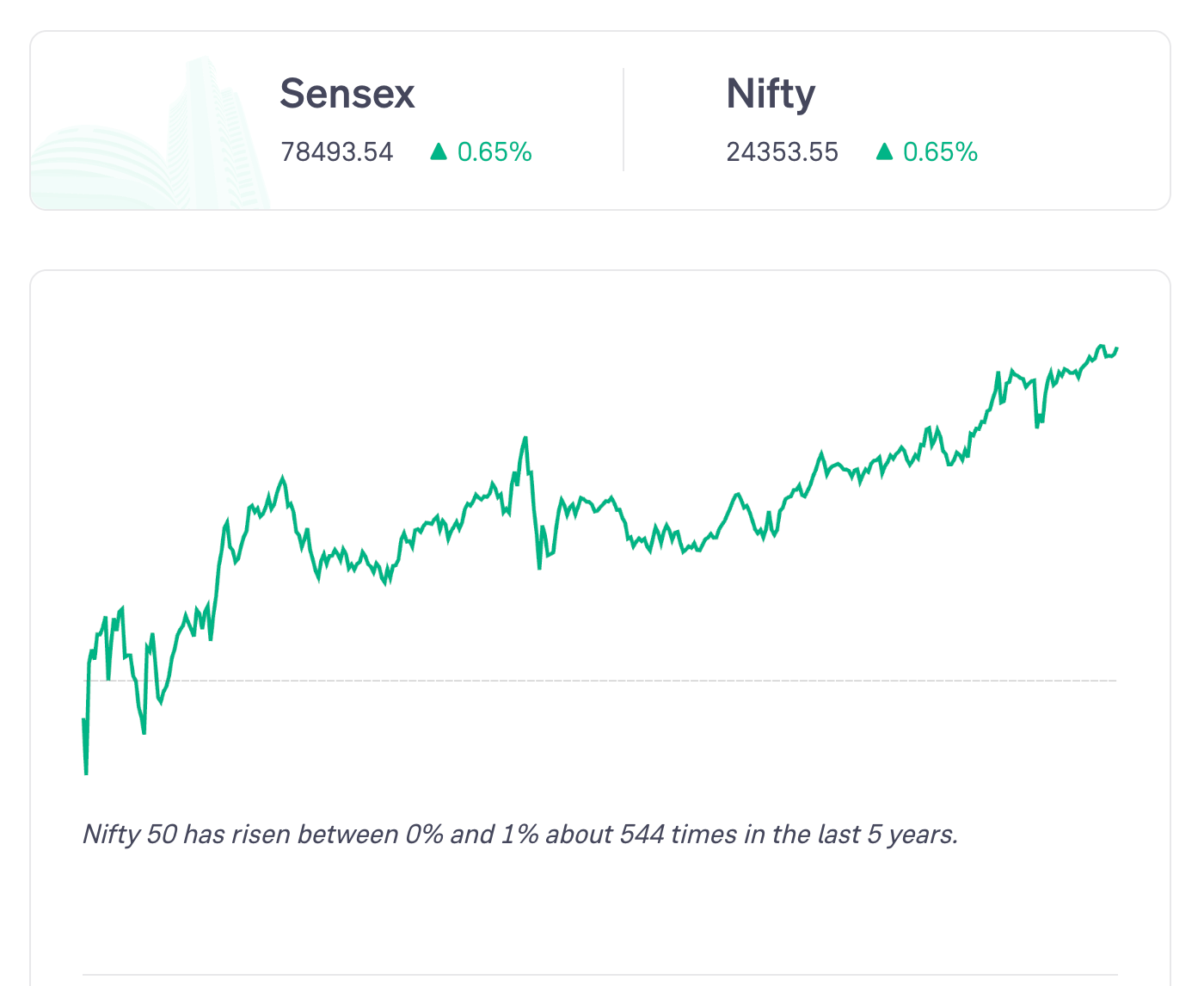
Markets opened below yesterday’s closing point.
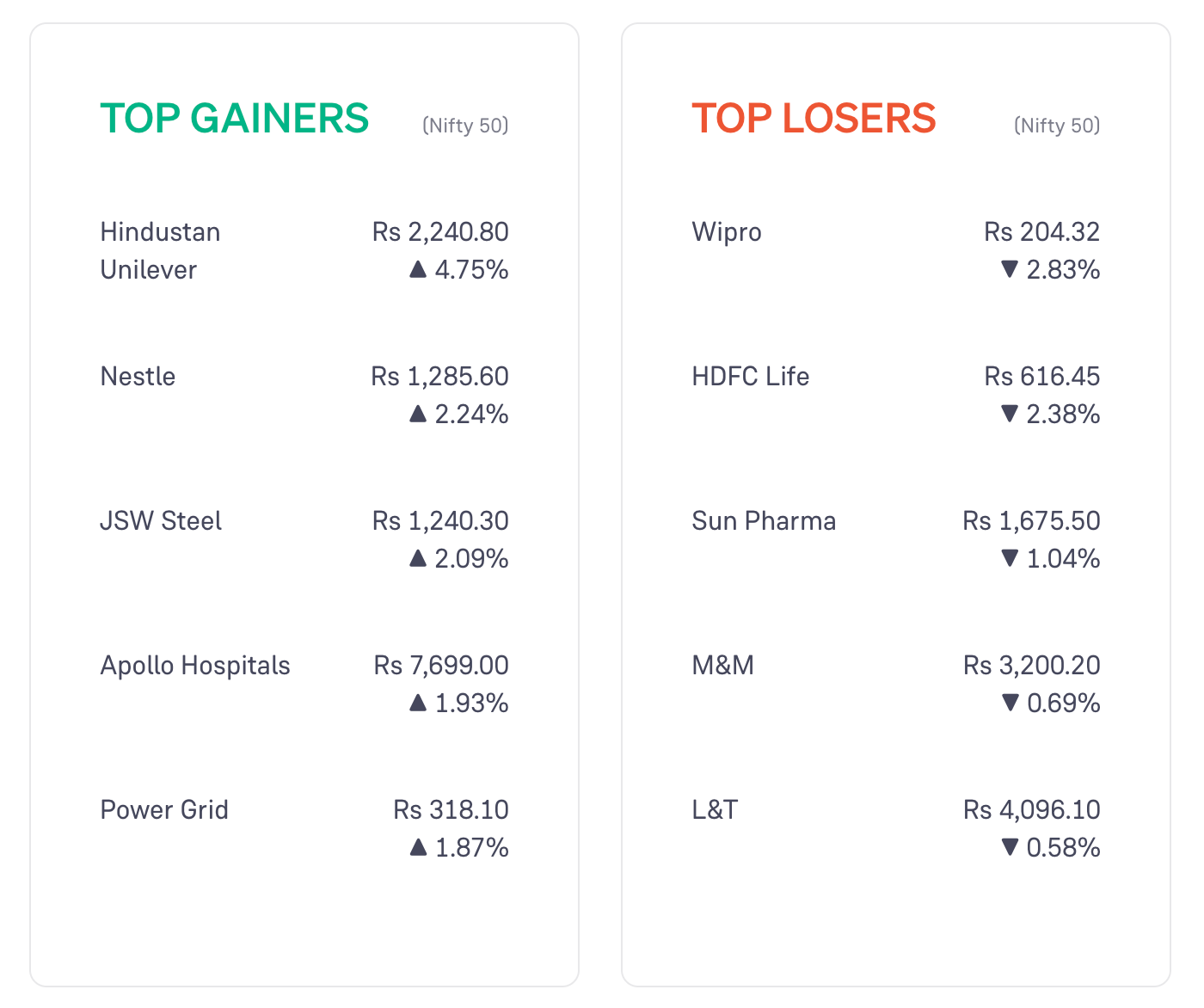
All sectors’ stocks rose today except for the IT stocks. FMCG stocks and oil and gas stocks rose the most.
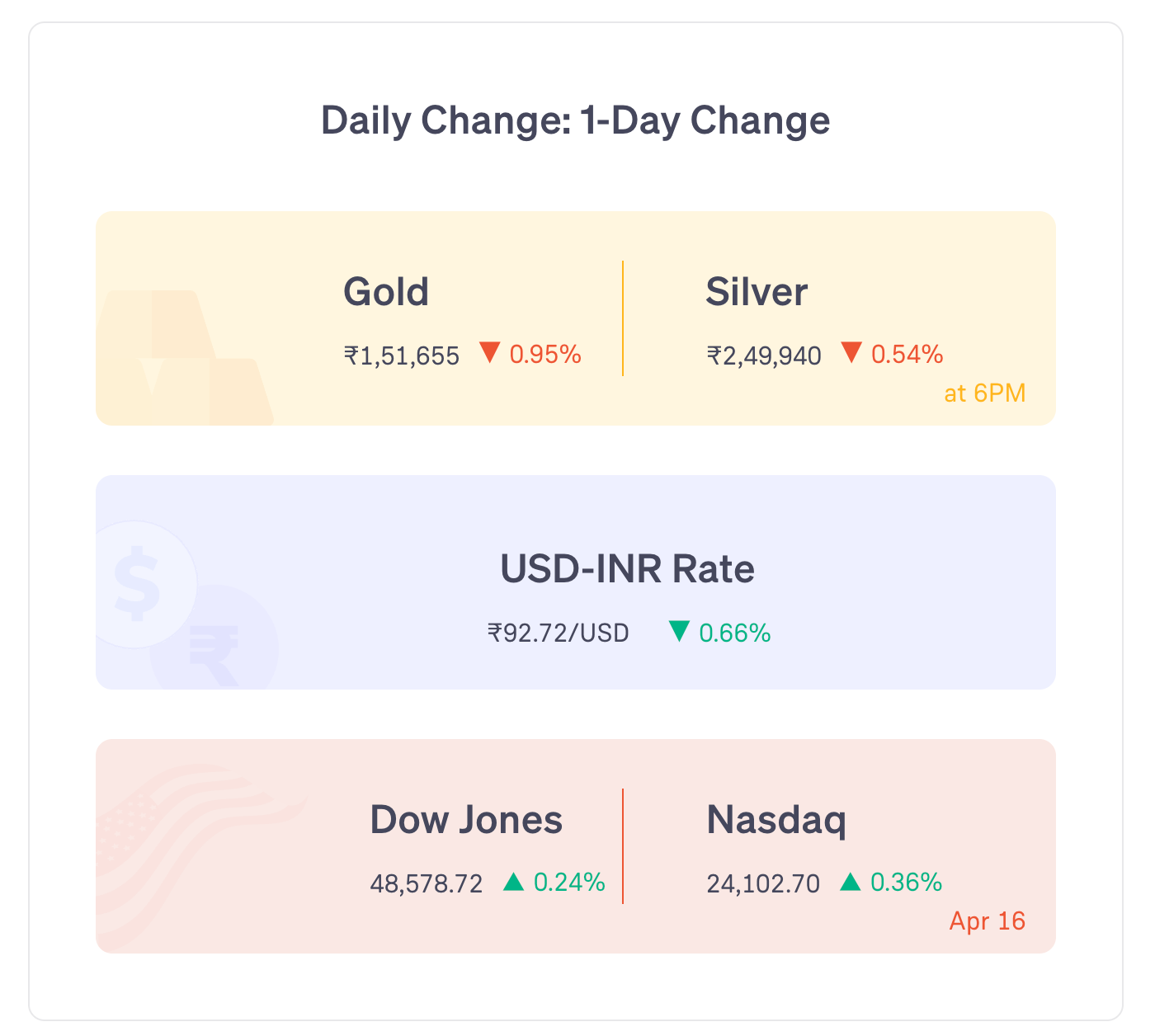
Global markets: US markets rose. Most Asian markets fell. European markets rose (as of 6 pm IST).
News
India’s forex reserves rose by $3.83 billion to $700.95 billion in the week that ended on 10 April.
The RBI has withdrawn Rs 2 lakh crore from the banking system through a 7-day variable rate reverse repo (VRRR) auction to absorb short term surplus liquidity and keep interest rates stable.
Stocks Updates
JSW Steel: entered into a 50:50 joint venture with South Korea’s POSCO Group through its subsidiary Saffron Resources Private Ltd to set up a 6 MTPA integrated steel plant in Odisha.
Hyundai Motor India: received no-objection from NSE and BSE to reclassify Hyundai Motor Investment, Inc from promoter group to public category.
Cipla: received 2 observations from USFDA after inspection at its Goa manufacturing facility.
Lupin: incorporated a wholly owned subsidiary in Thailand called Lupin (Thailand) Ltd. The company’s US subsidiary, Lupin Pharmaceuticals USA, agreed to pay $30 million to settle an antitrust litigation, stating it does not admit any wrongdoing.
TVS Motor: increased its stake in subsidiary DriveX Mobility (used 2-wheeler platform) to 92.41% from 87.38%.
Word of the Day
Coupon Rate
It is the fixed annual interest rate paid on a bond by the issuer to the investor.
It is calculated on the face value of the bond, not the market price.
The effective interest is usually paid periodically (half-yearly or annually) until maturity.
A higher coupon rate means higher regular income for investors.
Example: if a bond has a face value of Rs 1,000 and a coupon rate of 7%, the investor earns Rs 70 per year.
6 Day Course
Theme: sector rotation
Day 5: Friday
Now let’s talk about sectors.
During the recovery phase, sectors like banking, consumer durables, auto, and other consumption based sectors start to see gains. Industrial sector also starts picking up.
Sectors like FMCG and pharmaceuticals tend to not be star performers in this period.
Next, the expansion phase. During this phase, similar sector stocks (like banking, consumer durables, auto, etc) tend to start picking up more as consumers’ confidence grows.
Sectors like industry and real estate also continue performing.
Next, the peak or euphoria phase. As inflation peaks thanks to previous low interest rates, sectors like minerals, energy, commodities start doing well.
Next, the crash phase. This period sees many sectors suffer as confidence and money vanishes.
Essential items’ sectors do well in this phase. So the FMCG and pharma sector does well.
These are broader trends. There are exceptions in each sector and each phase.
Also, the phases do not always repeat in exact patterns, which makes picking stocks that much harder.
Investors practicing sector rotation try to match the phases and pick stocks accordingly.
It doesn’t work perfectly but skilled investors/managers can get it right to a great extent.
Featured Question
Q. “FIIs are leaving Indian Market while domestic investors keep on investing, keeping the market stable. Is it a big risk since once people start taking the money out, we might see a rash?”
These dynamics are always at play.
FIIs selling does not always mean a crash is coming. In fact, many times, FIIs sell after a crash has already started.
Many times FIIs also sell due to other external factors even while the Indian markets are doing well.
Each kind of investor is always dealing with different factors and they invest accordingly.
Also, FIIs are not more “correct” than DIIs.
Think about it. While FIIs are selling, DIIs are buying. Which implies that DIIs would be seeing buying opportunities instead of selling opportunities.
As an investor, you cannot depend only on FII or DII buying/selling to predict a crash or rise.
The information presented in this post has been compiled and prepared by Groww Invest Tech Pvt Ltd and is intended solely for informational purposes. It is not tailored to any specific investment objectives, financial situations, or needs of any individual investor. The content should not be construed as investment, financial, legal, or tax advice and should not be relied upon as a substitute for professional consultation.
Investing in securities markets involves inherent risks. Investors are advised to carefully review all relevant documents and consider their own risk tolerance before making any investment decisions.
Mutual fund investments are subject to market risks; please read all scheme-related documents carefully. Past performance of financial instruments, schemes, or markets is not indicative of future results.
Groww Invest Tech Pvt Ltd is registered with the Securities and Exchange Board of India (SEBI) under Registration No: INZ000301838, as a Research Analyst under No: INH200008662, as a Depository Participant under No: IN-DP-417-2019, and with the Association of Mutual Funds in India (AMFI) under ARN-111686.
SEBI registration details: View registered name and registration numbers
Research Analyst Disclaimer: View Research Analyst disclaimer
Did you like this edition?
Leave a feedback here!