
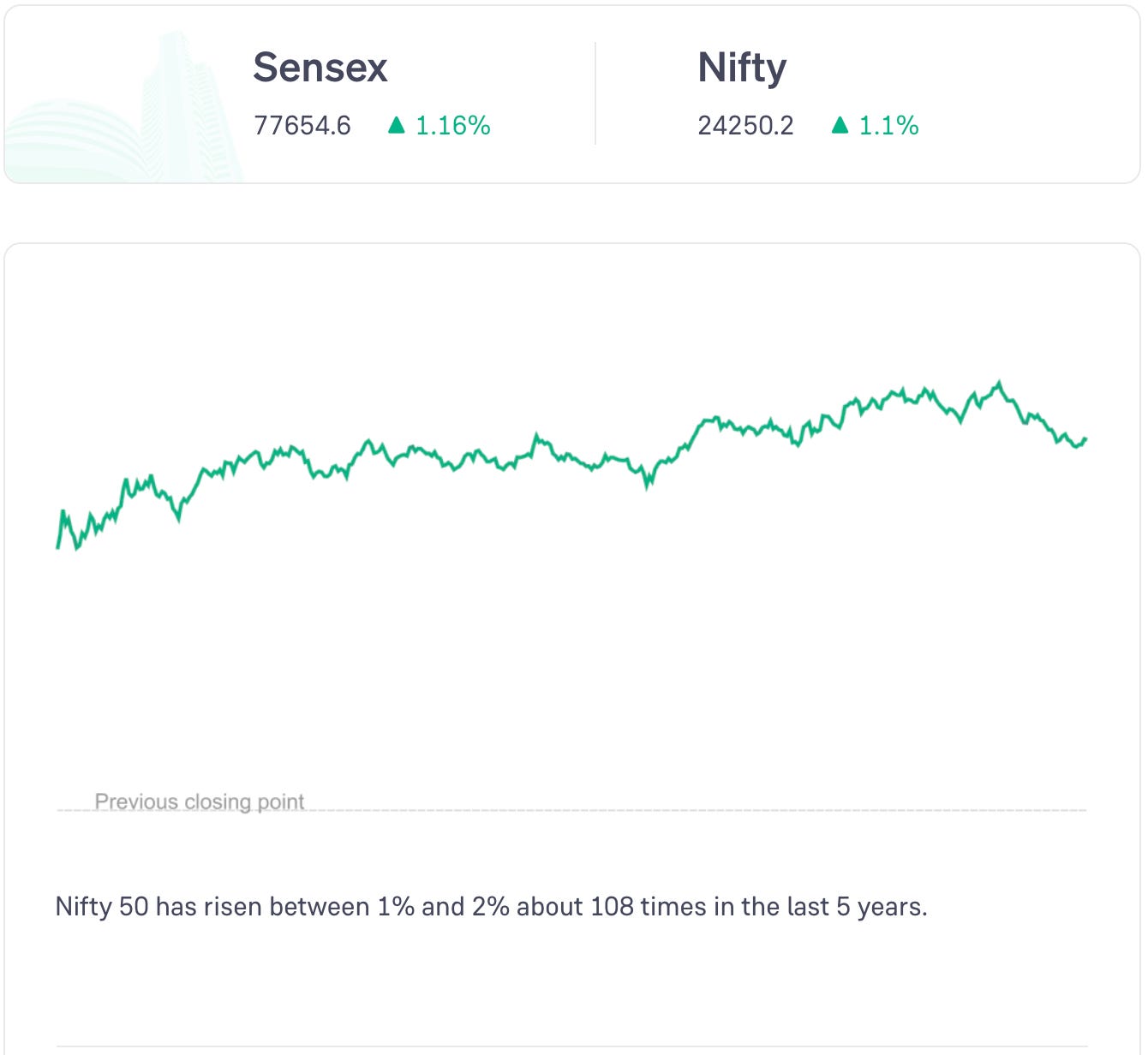
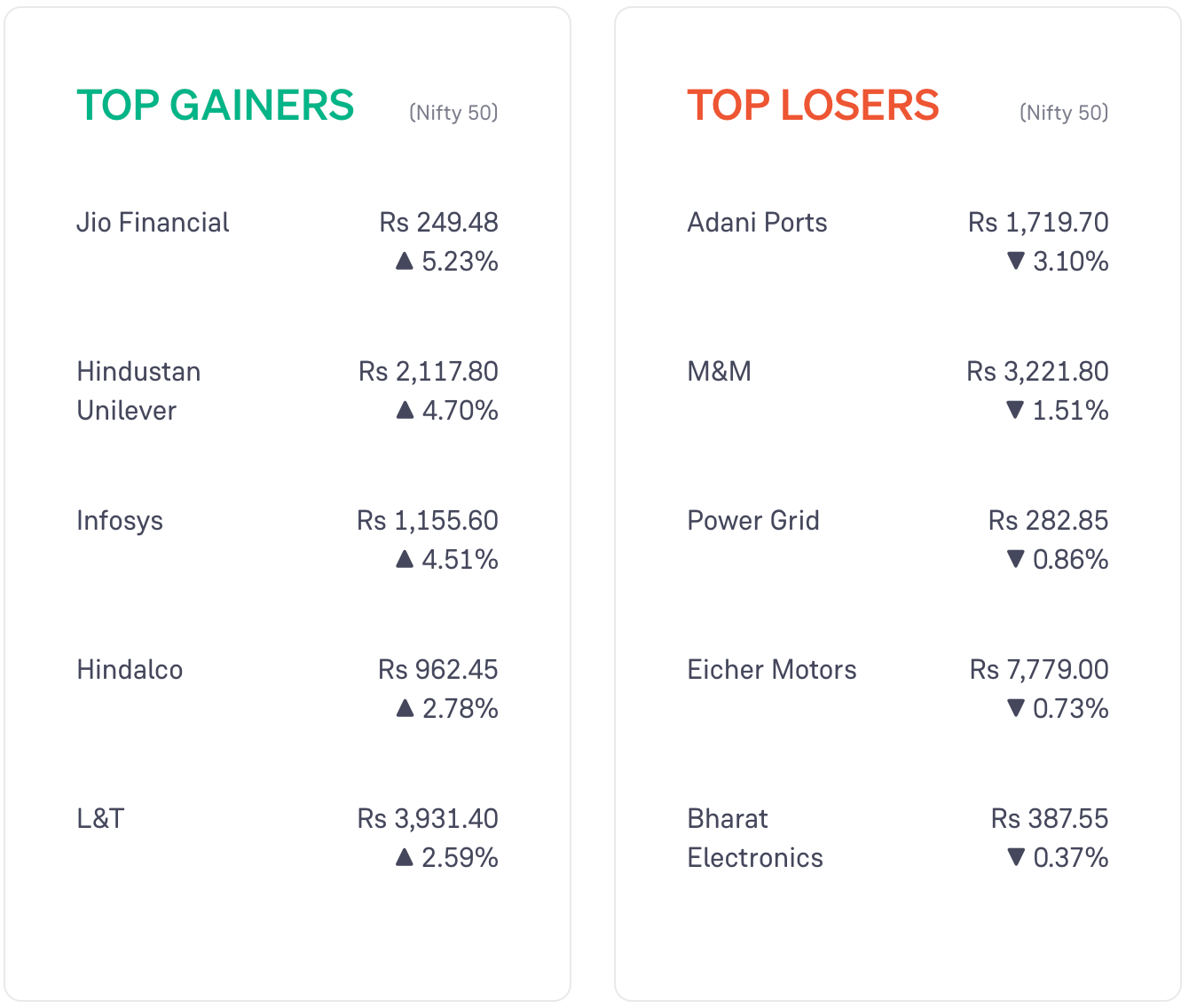
Markets closed higher than yesterday’s closing point.
All sectors’ stocks rose today except for the auto stocks and realty stocks. IT stocks and metal stocks rose the most.
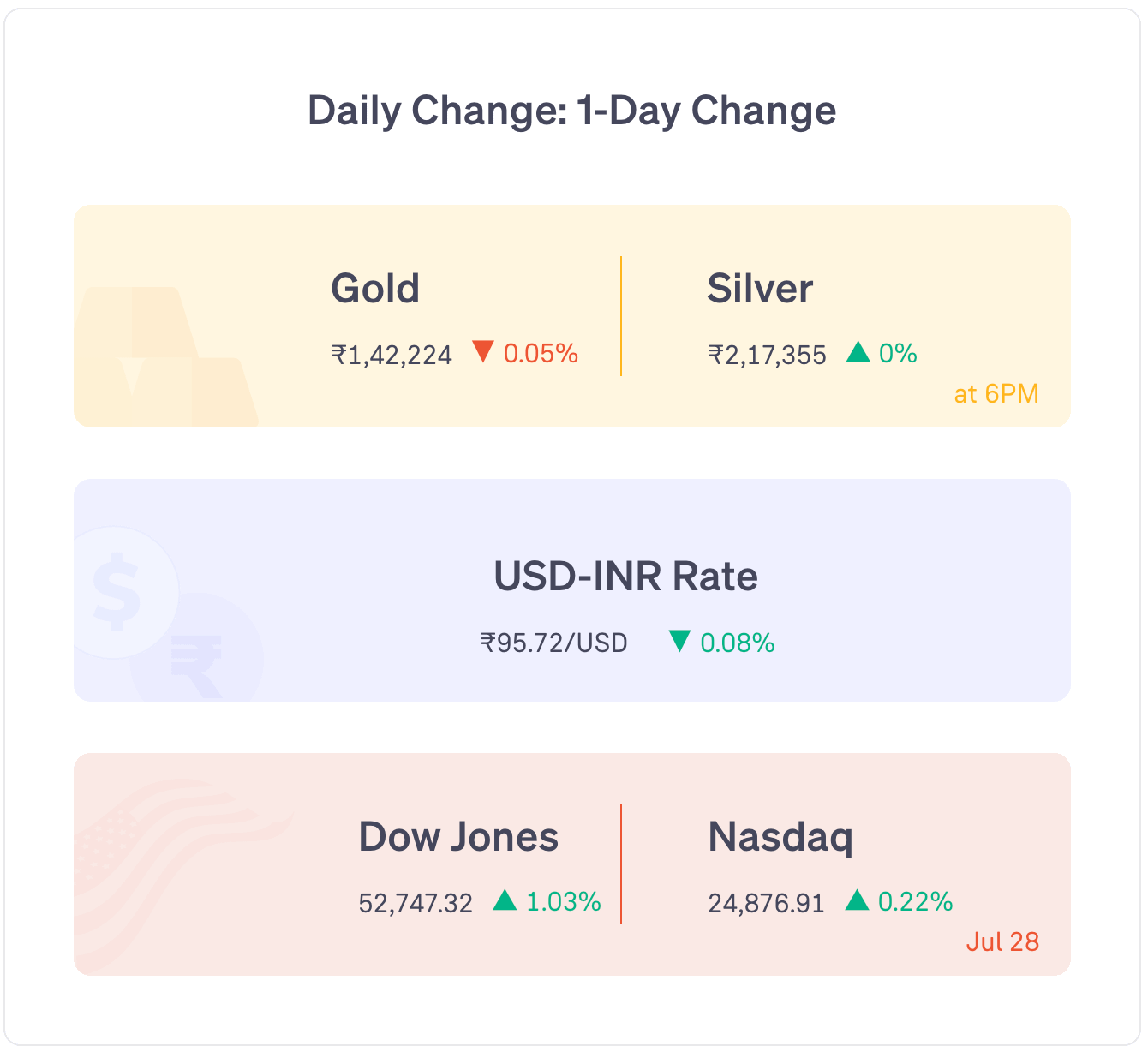
Global markets: US markets closed mixed on Tuesday. Most Asian markets fell on Wednesday. European markets showed a mixed trend (as of 6 pm IST).
News
The government released Index of Services Production (ISP) data for May 2026. 16 out of 19 sub-sectors grew, with accommodation & food and real estate growing the most. Air Transport, postal & courier and information and broadcasting were the only ones that fell.
SEBI will replace the current volume-weighted average price method and use the Close Auction System to calculate the closing prices of shares that have F&O contracts from Monday (3 August).
Stocks Updates
L&T: received a major EPC order (worth Rs 5,000 crore- Rs10,000 crore) from Kuwait Oil Company for Jurassic Light Oil (JLO) export facilities and upgrades to its existing export network.
Hindustan Unilever: net profit fell 3.01% year-on-year to Rs 2,673 crore in the April-June quarter.
Asian Paints: net profit rose 39.96% year-on-year to Rs 1,539.25 crore in the April-June quarter.
Adani Enterprises: reported a net loss of Rs 1,160.23 crore in the April-June quarter, compared with a net profit of Rs 885.23 crore in the year-ago period.
Adani Ports: net profit rose 9.23% year-on-year to Rs 3,620.40 crore in the April-June quarter.
M&M: approved the sale of its Truck and Bus Division to subsidiary SML Mahindra for Rs 525 crore, subject to approvals.
BHEL: in a clarification to the stock exchanges, said recent reports about its development of a 1,200 kV transformer refer to projects completed in 2011 and 2014, and the news being circulated is more than a decade old.
Word of the Day
Generic Medicines
These are medicines whose patents have expired and thus can be made by other companies cheaply.
When pharma companies make new drugs/medicines, the formula or process or both are patented.
This results in higher priced medicines since only one company makes those medicines/drugs.
Once the patent expires after a few years, other pharma companies can copy and make it. Such medicines are called generic medicines/drugs. They must still meet the regulatory standards.
This often results in the drugs/medicine’s price falling.
Indian pharma companies are famous for making such generic medicines.
6 Day Course
Theme: bonds
Day 3: Wednesday
Now, we spoke about how bonds are also traded on the bond markets, much like shares.
But how is the price of a bond decided?
The first thing to understand is the concept of ‘present value’.
The bond is expected to pay the principal + interest on a certain date in the future.
How much would you pay for such a bond today? Different investors have different ways of thinking about this.
Say, a bond will pay a total sum of Rs 110 a year from now.
Will you pay Rs 110 for this bond today? No. That’s a poor investment.
But if this bond is available in the bond markets for Rs 100?
Then maybe it makes sense. You will pay Rs 100 today and a year later, the bond will pay Rs 110 on maturity. That is a return of 10% per annum.
This is just one simple example. Lots of complex factors affect the demand and supply for bonds.
————
Featured Question
Q. “Many companies (e.g.,oil companies) in India declare net losses in their results yet pay out dividends. How can they afford to do that?”
Yes, many loss-making companies also pay dividends.
Many companies build a reputation for paying regular dividends and investors rely on them for their dividends.
When such companies scale down their dividends or not pay dividends, investors lose confidence in them and start selling the shares. This can cause the share price to fall.
To prevent this, companies continue paying dividends despite losses.
They are trying to signal that the losses are temporary and that they are confident that their profits will be good in the future.
Hence, they are trying to signal that paying dividends is not a problem for them.
How do they pay dividends in such cases?
Many companies have healthy cash flows despite losses. They are easily able to pay dividends.
Some may use retained earnings from previous quarters to pay the dividends.
In rare cases, companies may borrow money to pay dividends. This is generally not considered a good option.
The information presented in this post has been compiled and prepared by Groww Invest Tech Pvt Ltd and is intended solely for informational purposes. It is not tailored to any specific investment objectives, financial situations, or needs of any individual investor. The content should not be construed as investment, financial, legal, or tax advice and should not be relied upon as a substitute for professional consultation.
Investing in securities markets involves inherent risks. Investors are advised to carefully review all relevant documents and consider their own risk tolerance before making any investment decisions.
Mutual fund investments are subject to market risks; please read all scheme-related documents carefully. Past performance of financial instruments, schemes, or markets is not indicative of future results.
Groww Invest Tech Pvt Ltd is registered with the Securities and Exchange Board of India (SEBI) under Registration No: INZ000301838, as a Research Analyst under No: INH200008662, as a Depository Participant under No: IN-DP-417-2019, and with the Association of Mutual Funds in India (AMFI) under ARN-111686.
SEBI registration details: View registered name and registration numbers
Research Analyst Disclaimer: View Research Analyst disclaimer
Did you like this edition?
Leave a feedback here!
Good