
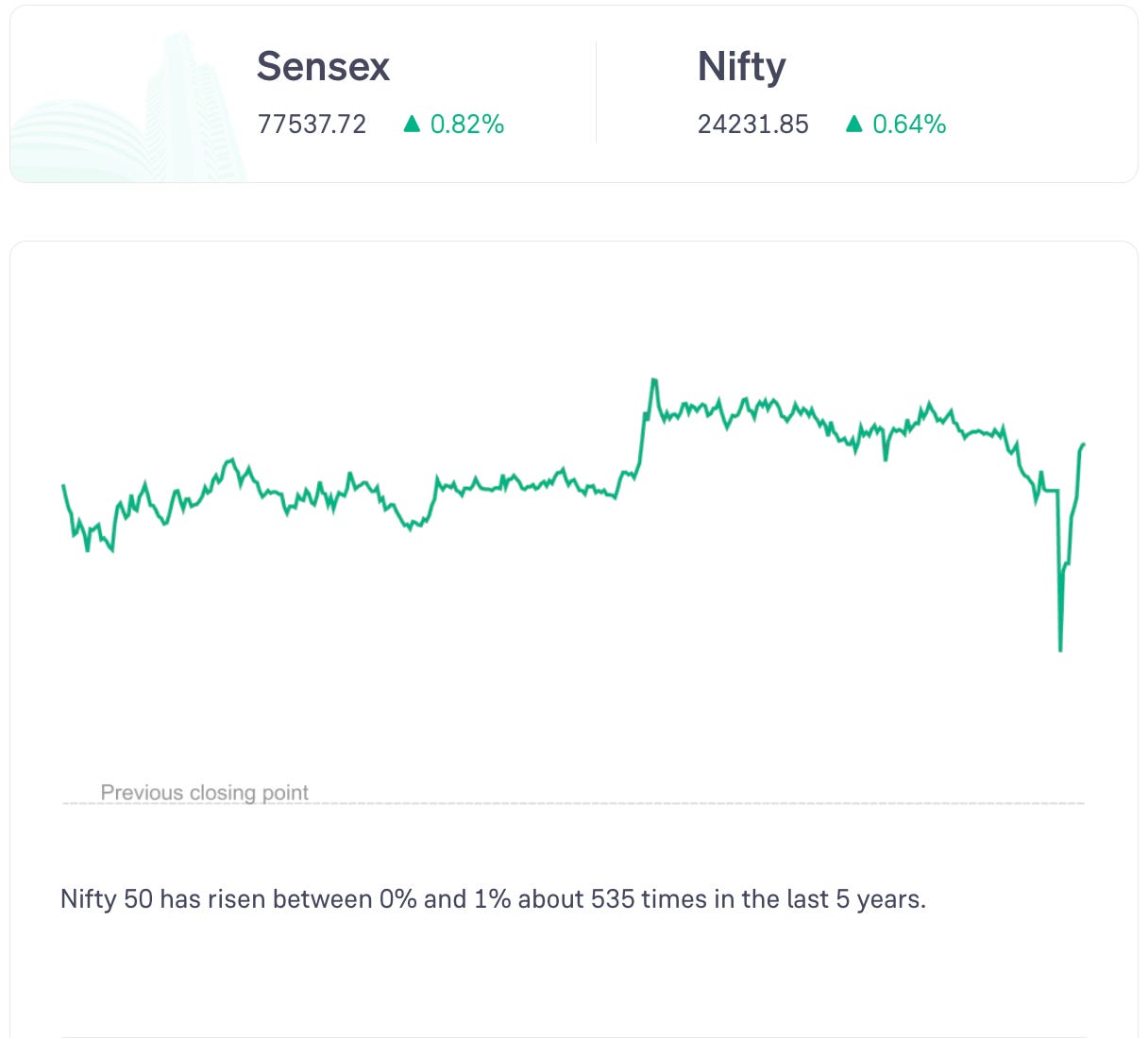
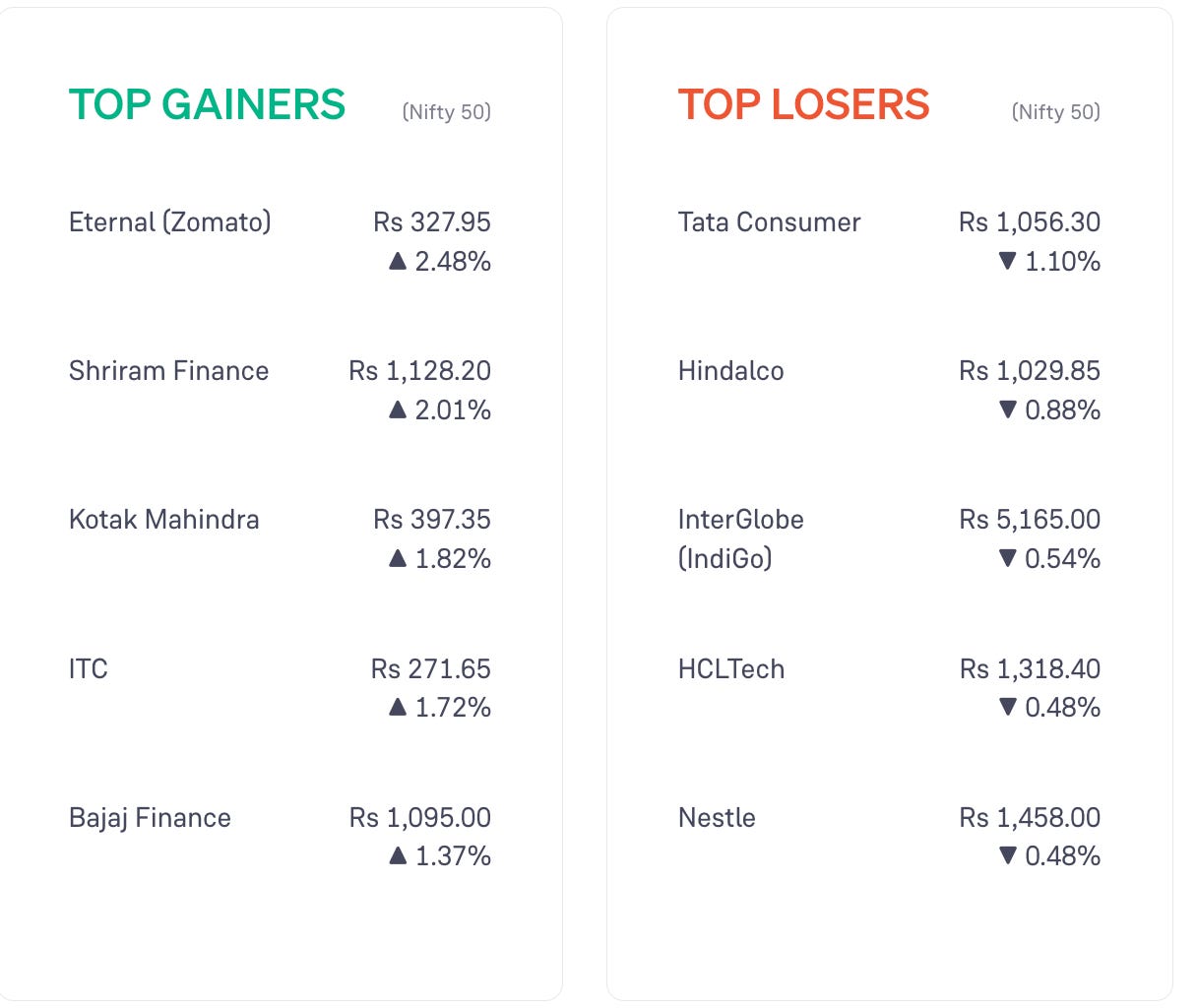
Markets closed higher compared to yesterday’s closing point.
Media stocks and realty stocks rose the most today. Only chemical stocks and PSU Bank stocks fell.
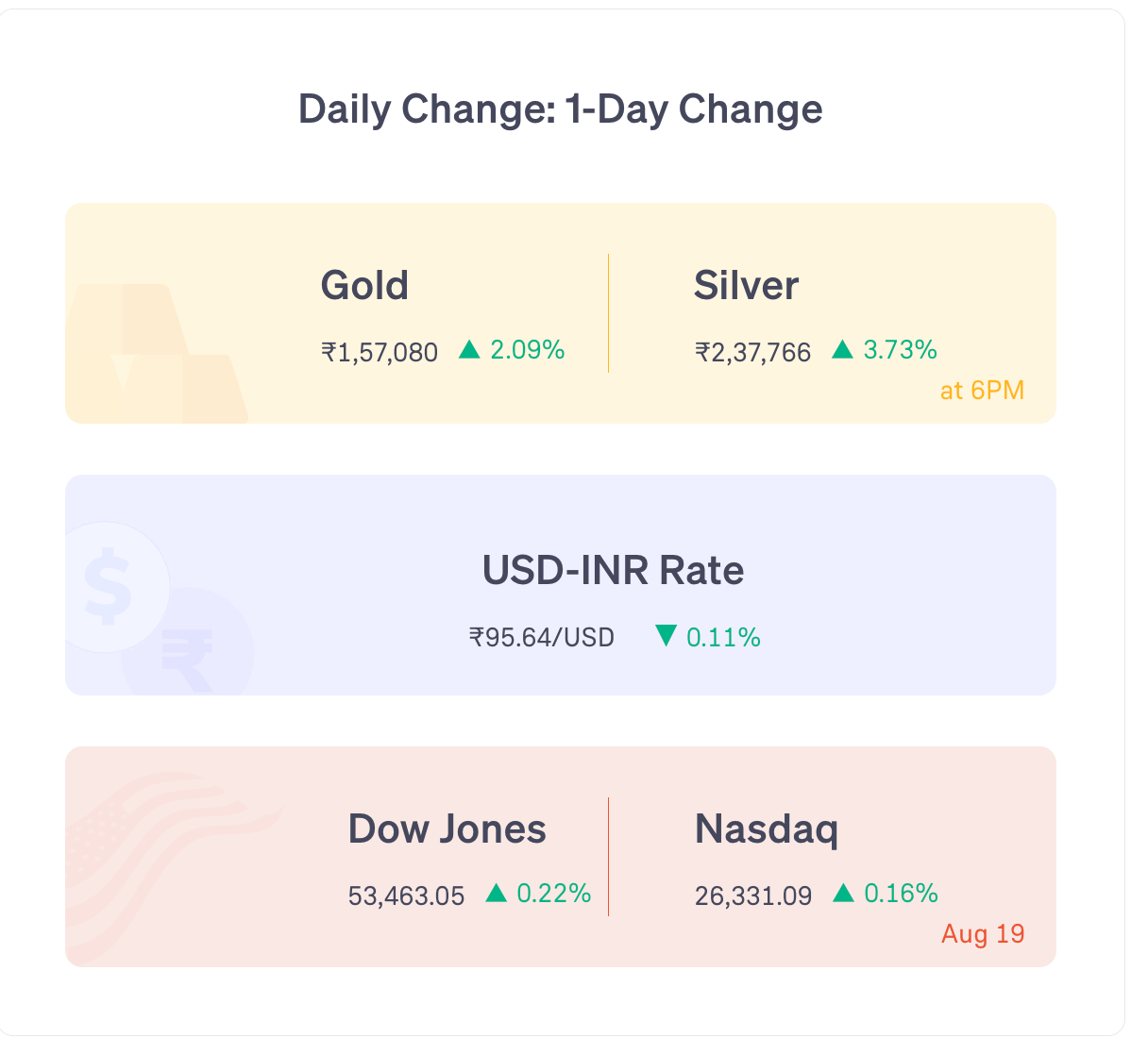
Global markets: US markets rose on Wednesday. Most Asian markets rose on Thursday. Most European markets fell (as of 6 pm IST).
News
India’s infrastructure output rose 5.40% in July compared to 6.00% in June.
SEBI has barred Copthall Mauritius Investment (owned by JPMorgan Chase & Co) and Mansi Share and Stock Broking from the securities market for manipulative trades under the Closing Auction System (CAS) and impounded a combined Rs 3.68 crore.
SEBI permitted the use of digitally signed power of attorney documents for FPIs, removing the need for notarization and enhancing ease of doing business, effective today.
Gaja Alternative Asset Management IPO was subscribed 2.44 times on day 2. Retail subscription: 3.13 times. The IPO will close for subscription on 21 August.
Tempsens Instruments (India) Limited IPO was subscribed 5.94 times on day 1. Retail subscription: 6.46 times. The IPO will close for subscription on 24 August.
Stocks Updates
HDFC Bank: RBI has approved LIC to increase its stake in HDFC Bank up to 9.99%. LIC currently holds 4.11%.
L&T: secured a large order (Rs 2,500 crore - Rs 5,000 crore) with Mitsubishi Heavy Industries to design and build the Automated People Mover system for Phase 1 of Dubai’s Al Maktoum International Airport.
Aditya Birla Capital: entered the gold loan business to expand its secured lending business and plans to open around 1,000 branches over the next three years.
Lupin: Subsidiary VISUfarma secured exclusive rights to sell an eye treatment, YUVEZZI (used to treat presbyopia), in the EU, UK, Switzerland, Norway and Iceland.
Manipal Health: net profit fell 7.48% year-on-year to Rs 231.65 crore in the April-June quarter.
Avenue Supermarts (DMart): allotted Rs 200 crore of unsecured commercial paper with a 90-day tenure and a coupon rate of 6.50%.
L&T Finance: allotted Rs 235 crore of secured NCDs on a private placement basis at a 7.7942% coupon rate, maturing in June 2031.
BSE: signed an agreement with Morgan Stanley Capital International (MSCI) to explore launching futures and options (derivatives) in India based on MSCI indexes, subject to regulatory approvals.
Mankind Pharma: signed an exclusive licensing and marketing agreement with China-based Chongqing Chenan Biopharmaceutical to sell advanced insulin medicines in India.
HAL: NCLT ordered the dissolution (closure) of Infotech HAL Ltd, a joint venture in which HAL held a 50% stake.
United Spirits: FSSAI has revoked its 29 June order regarding the sale of one product manufactured at the company’s Baramati unit.
Word of the Day
Re-rating
It is the process of re-evaluating the worthiness of an asset
We know that bonds are rated based on their quality — credit worthiness, chances of default, etc.
Many times, a bond or debt might be re-rated if the conditions change.
It is possible that a bond issuer’s or borrower’s credit worthiness improves or worsens.
In such a case, the bond or debt might need to be re-rated accordingly.
In the case of stocks, often, some analysts issue their own ratings. They too might re-rate the stocks based on changed conditions.
More commonly, a stock is said to have been re-rated by the markets when its PE ratio goes up or down.
6 Day Course
Theme: opex and capex
Day 4: Thursday
Investors must remember that there is no fixed definition of opex or capex.
Many kinds of expenses are unique to certain companies and each company categorises expenses according to how they think the expense must be categorised.
It is important to remember that a high or low opex is not automatically better or worse. The same goes for capex.
It depends on what the company does, where the money is being spent and not spent, etc.
For example, a company with low capex might be making a mistake by not investing money for future growth.
Or, the opposite of that could be that it is recklessly spending money for future growth that is not guaranteed.
Also, capex cannot be analysed for one period.
Example: Capex can be lumpy. A company invests money to build a new factory in one year. That year, the capex will appear very high.
Building that factory takes the next few years. In those years, its capex does not appear high.
————
The information presented in this post has been compiled and prepared by Groww Invest Tech Pvt Ltd and is intended solely for informational purposes. It is not tailored to any specific investment objectives, financial situations, or needs of any individual investor. The content should not be construed as investment, financial, legal, or tax advice and should not be relied upon as a substitute for professional consultation.
Investing in securities markets involves inherent risks. Investors are advised to carefully review all relevant documents and consider their own risk tolerance before making any investment decisions.
Mutual fund investments are subject to market risks; please read all scheme-related documents carefully. Past performance of financial instruments, schemes, or markets is not indicative of future results.
Groww Invest Tech Pvt Ltd is registered with the Securities and Exchange Board of India (SEBI) under Registration No: INZ000301838, as a Research Analyst under No: INH200008662, as a Depository Participant under No: IN-DP-417-2019, and with the Association of Mutual Funds in India (AMFI) under ARN-111686.
SEBI registration details: View registered name and registration numbers
Research Analyst Disclaimer: View Research Analyst disclaimer
Did you like this edition?
Leave a feedback here!