
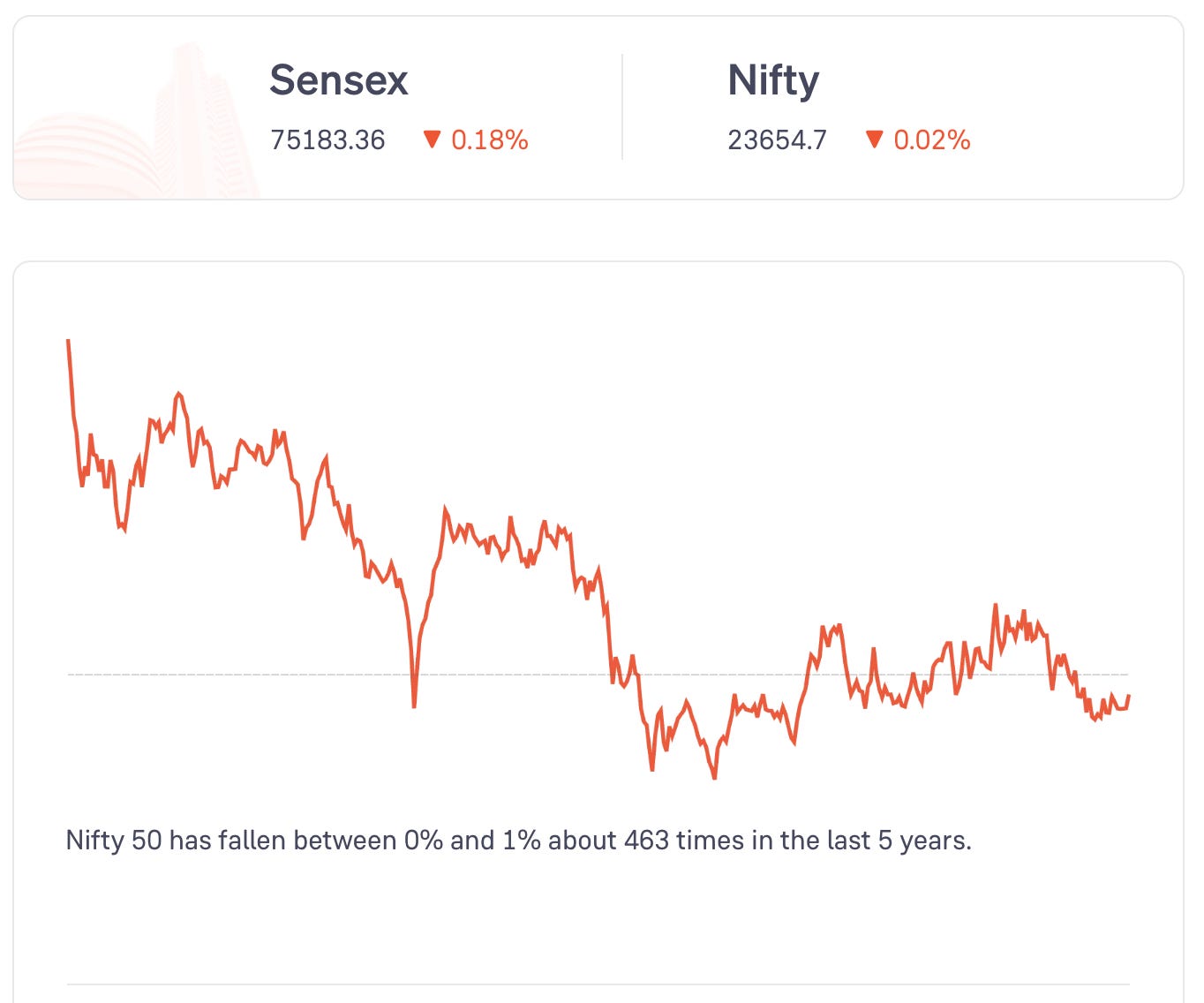
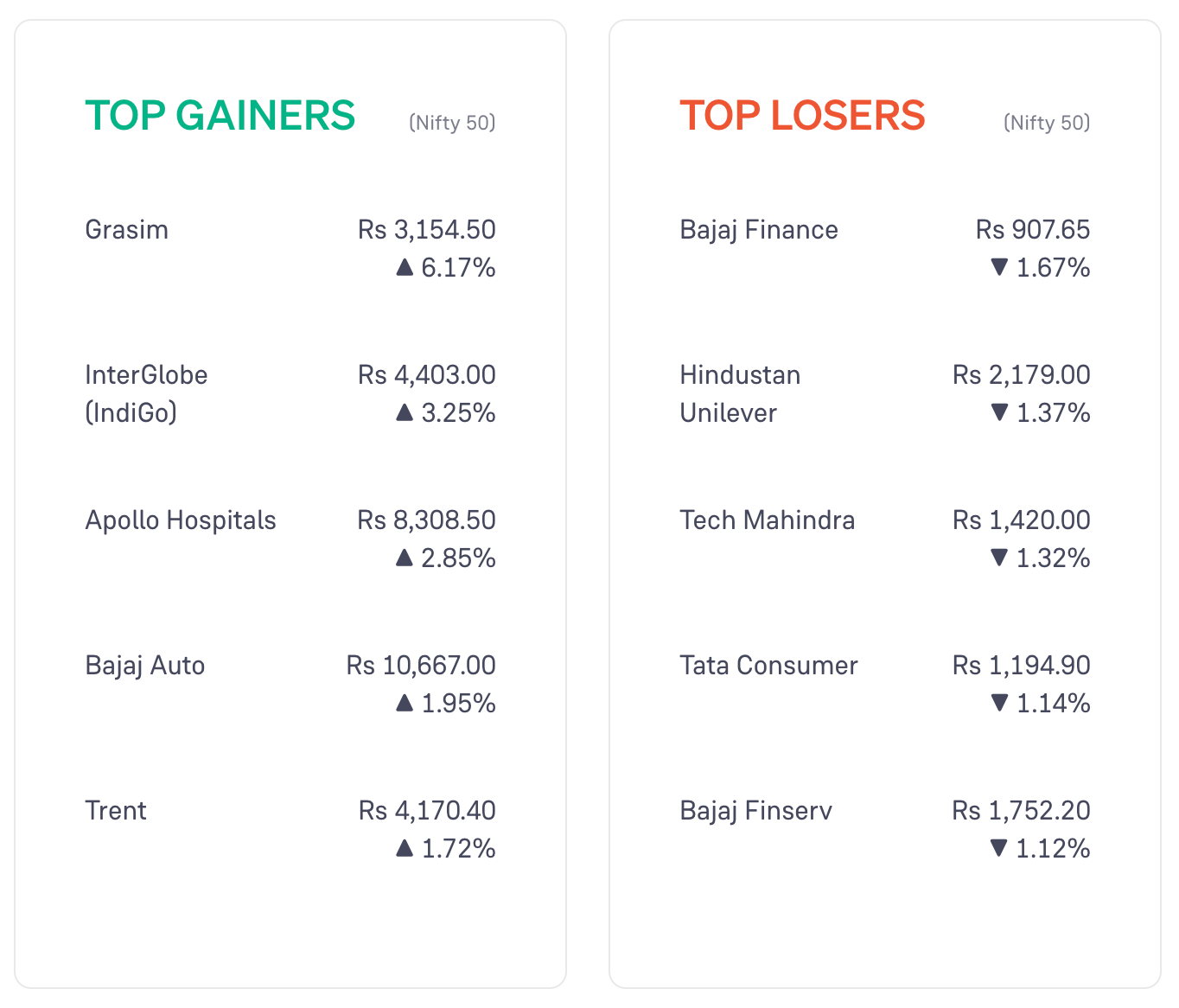
Markets opened above yesterday’s closing point.
Cement stocks and realty stocks rose the most today. IT stocks and FMCG stocks fell the most.
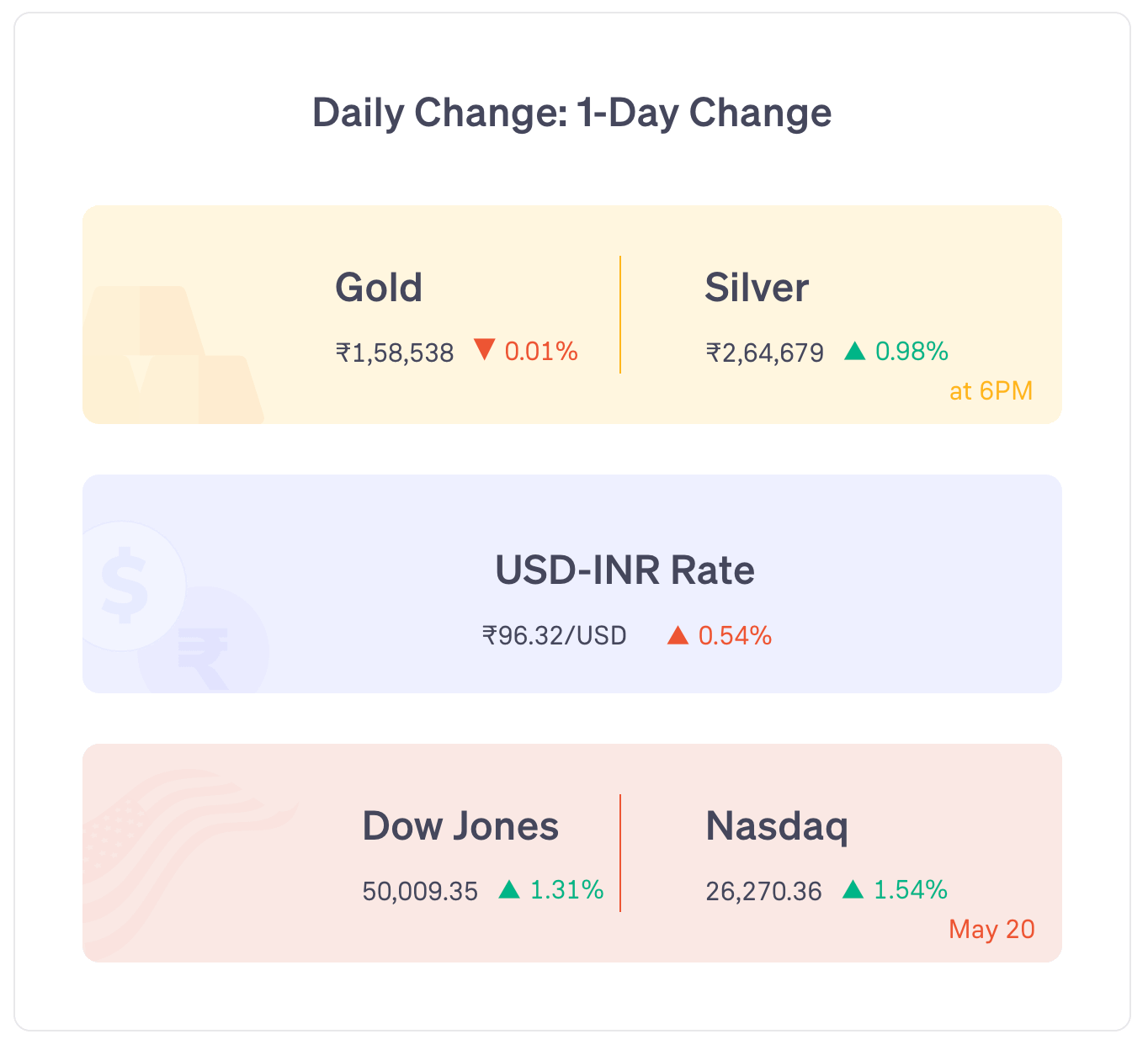
Global markets: US markets rose. Asian markets showed a mixed trend. Most European markets fell (as of 6 pm IST).
News
India’s manufacturing PMI fell marginally to 54.3 in May (vs 54.7 in April) according to preliminary estimates. Services PMI rose marginally to 58.9 (vs 58.8 in April). Composite PMI (manufacturing + services) rose to 58.9 (vs 58.8 in April). This means overall economic activity grew marginally less in May than in April.
The RBI will conduct a $5 billion dollar-rupee swap auction on 26 May to inject liquidity into the financial system, stabilize the Rupee and boost forex reserves.
The National Commodity and Derivatives Exchange (NCDEX) announced the launch of India’s first exchange-traded weather derivatives contract based on Mumbai’s monsoon rains, starting 1 June.
Stocks Updates
LIC: net profit rose 23.26% year-on-year to Rs 23,467.18 crore in the Jan-March quarter. Dividend announced: Rs 10 per share, with 25 June as the record date. Bonus issue of 1:1 also announced, with 29 May as the record date.
Maruti Suzuki: will increase prices of its vehicle portfolio by up to Rs 30,000 per model, effective June 2026.
ITC: net profit rose 9.26% year-on-year to Rs 5,387.97 crore in the Jan-March quarter. Final dividend announced: Rs 8 per share, with 27 May as the record date.
Adani Ports: will acquire Jaypee Fertilizers & Industries for Rs 1,500 crore under Jaiprakash Associates resolution plan to expand the logistics and warehousing business. Company subsidiary incorporated ‘Astro Ship Management Angola’ for ship management business.
Hindalco: extended timeline for AluChem acquisition review in the US till 2 July due to partial US government shutdown.
Eicher Motors: will invest up to Rs 750 crore to acquire 50% stake in Volvo Financial Services India and form a financing JV with Volvo Group to provide vehicle financing, leasing, and financial services in India, subject to RBI approval.
Tata Capital: allotted NCDs worth Rs 2,950 crore via private placement, maturing on 21 Feb 2029.
Apollo Hospitals: net profit rose 35.86% year-on-year to Rs 529.30 crore in the Jan-March quarter. Dividend announced: Rs 10 per share, with 14 Aug as the record date.
GAIL: net profit fell 40.41% year-on-year to Rs 1,484.72 crore in the Jan-March quarter. Final dividend announced: Rs 0.50 per share.
Word of the Day
Treasury Stocks
They are shares that a company has bought back from the shareholders.
The company holds these shares in its own treasury. They are no longer traded in the markets.
These shares are not considered outstanding. This means they don’t get dividends and cannot be used for voting.
The company can hold on to them, reissue them later, or cancel them permanently. They can also be used later in mergers, acquisitions, or fundraising. They serve a strategic purpose.
Treasury stock can increase share prices by reducing the total number of shares available. They can also affect a company’s financial ratios.
6 Day Course
Theme: imports & exports of India
Day 4: Thursday
Electronics and electrical equipment form a decent part of our export (around $40 billion worth).
Machinery and heavy equipment form about $32 billion of our exports.
Pearls, precious metals, coins, contribute about $30 billion.
Pharma exports stand at about $23 billion. Vehicles are at about $22 billion.
Organic chemicals are at around $20 billion. Cereals are about $12 billion.
Other items include iron, steel, textiles, plastics, aircraft and parts, cotton, fish and marine products, coffee, tea, spices, and various others.
All in all, India’s exports come to about $430 billion. Whereas, our imports are worth about $700 billion.
Featured Question
Q. “Exit load loaded on MF redemption How they are fixed & where the amount goes?”
Exit load is a penalty investors are being charged with.
When a mutual fund accepts money from investors, they wish for it to stay invested long-term.
Since most fund managers have to plan their investments for the long-term, they do not like it if investors quickly invest and withdraw money. It hampers their investment plans.
Hence, most put in an exit load which is meant to discourage investors from withdrawing too fast.
In many equity mutual funds, it applies for 1 year from investment.
So if you withdraw within a year of investing, you will have to pay a certain amount (example, 1% of the withdrawal amount).
In case of debt mutual funds, this period is usually much shorter.
After the period ends, no exit load applies.
The money collected via exit load is added back to the AUM.
The information presented in this post has been compiled and prepared by Groww Invest Tech Pvt Ltd and is intended solely for informational purposes. It is not tailored to any specific investment objectives, financial situations, or needs of any individual investor. The content should not be construed as investment, financial, legal, or tax advice and should not be relied upon as a substitute for professional consultation.
Investing in securities markets involves inherent risks. Investors are advised to carefully review all relevant documents and consider their own risk tolerance before making any investment decisions.
Mutual fund investments are subject to market risks; please read all scheme-related documents carefully. Past performance of financial instruments, schemes, or markets is not indicative of future results.
Groww Invest Tech Pvt Ltd is registered with the Securities and Exchange Board of India (SEBI) under Registration No: INZ000301838, as a Research Analyst under No: INH200008662, as a Depository Participant under No: IN-DP-417-2019, and with the Association of Mutual Funds in India (AMFI) under ARN-111686.
SEBI registration details: View registered name and registration numbers
Research Analyst Disclaimer: View Research Analyst disclaimer
Did you like this edition?
Leave a feedback here!