

Pay 1 Euro to use the toilet.
In 2009, Michael O’Leary made a calculated announcement.
The CEO of the low-cost carrier airline, Ryanair, revealed plans for a toilet-use charge for its planes.
Passengers were flabbergasted.
A huge uproar followed. The airline never implemented that plan.
About a year later, the CEO was heard introducing the idea of standing seats. The seats would be narrow and spaced closer.
Passengers would practically be leaning on the backrest of the “standing seat”, held in place by a seat belt.
People found the idea just as ridiculous. Social media was abuzz with people throwing nasty words at Ryanair.
There’s more. A lot more.
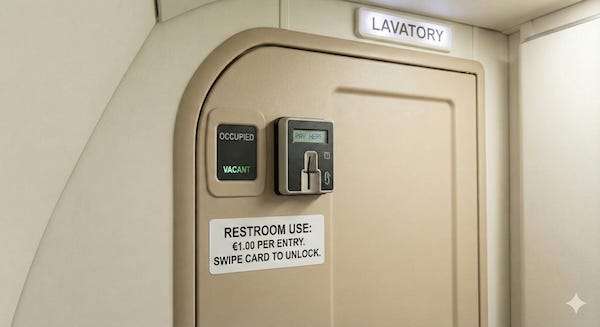
Paid drinking water, ticket prices based on passengers’ weight, and more.
Ryanair’s Failure
The airline started back in the 1980s in Ireland.
Back then, they had one small plane.
Tony Ryan, the founder of the airline, hired a young personal tax advisor. His name was Michael O’Leary (yes, the same Michael O’Leary).
Back then, full service airlines like British Airways and several other airlines across Europe were struggling to make profits.
Tony’s idea was to launch a low-cost full-service airline.
The tax advisor, Michael, saw the business plan and immediately advised Tony to shut the business down.
To him, it made no sense at all.
Tony Ryan was convinced there was a way to make this work. He asked Michael to visit the USA with him and study the low-cost airline Southwest Airlines.
And so they did just that.
Learnings Southwest
In the USA, Tony and Michael got a taste of the Southwest way of doing things.
One of the first things they noticed at the airport was the turnaround time.
A plane arrived, deboarded its passengers, boarded new passengers, and flew off again — all within 25 minutes.
This absolutely stumped them. European airlines back then used to take over 1 hr to do that.
Another peculiarity they observed about Southwest was that they used only one airplane model.
It helped Southwest buy planes in bulk. Further, they were able to buy parts for the plane’s maintenance in bulk, at discounted prices.
Southwest was also in the habit of using secondary airports. These were airports close to the city but not in the city.
This helped them avoid crowded airports with high charges.
Such secondary airports are not common in India, but they can often be seen in western countries.
In an age of full-service airlines, food and drinks on airlines was the norm. Not serving meals was outright revolutionary.
Southwest served only water and peanuts.
Tony and Michael also met with the legendary founder of Southwest, Herb Kelleher, and discussed all things airlines.
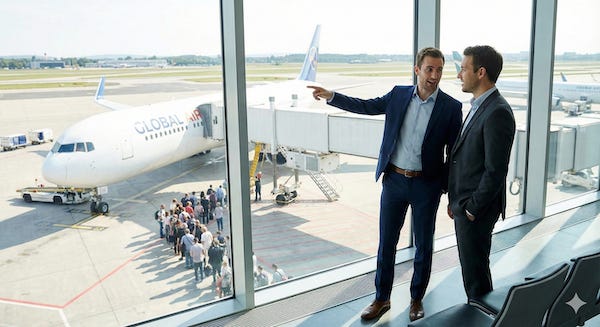
Tony Ryan and Michael O’Leary came back impressed.
They were confident that European airlines were just wasting money and charging sky-high ticket prices. All they had to do was replicate the Southwest model in Europe, and they would win.
They particularly noted that cutting out food and drinks did not result in passengers avoiding Southwest Airlines.
It made their conviction even stronger that the passengers cared a lot more about prices than services.
Ryanair Reborn
When they came back, their airline was bleeding. Turning things around takes time.
They started.
All that they loved about Southwest was on the table.
They started with reducing the turnaround time. Planes that are in the air are the planes that earn money.
Food was no longer available.
New routes were introduced. They placed orders for Boeing 737 planes — with the intention of owning only Boeing 737s in the future.
The focus was on busy routes and cities that had a secondary airport.
In 1994, their first Boeing 737 arrived. By 1997, many other 737s arrived and newer routes were added accordingly.
In 1994, Ryanair got its new CEO — Michael O’Leary (Tony Ryan’s tax advisor). He is still the CEO of Ryanair today.
They started cutting costs aggressively.
In the 1990s, they transitioned to a fully low-cost airline model. Even when they were not a low-cost airline, their ticket prices were much cheaper than their competitors.
When they became a low-cost airline, their ticket prices were unmatched.
In 1997, a regulation change allowed airlines to rapidly expand to all over Europe. Ryanair exploded all over Europe.
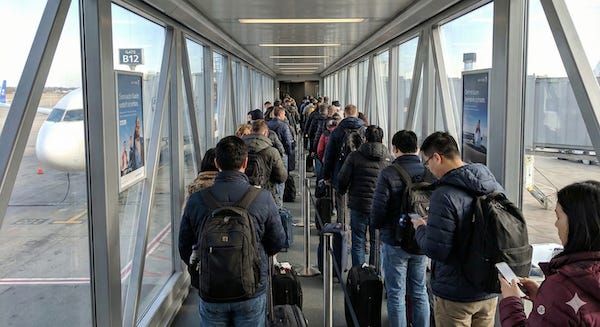
By 2002-2003, the airline crossed 1 million passengers.
The growth did not plateau.
By 2012-23, they crossed 75 million passengers.
By 2024-25, they had touched 180 million passengers.
Ryanair Today
Today, Ryanair remains true to its low-cost identity.
The internet is filled with memes about its low-cost nature.
A video shows a plane arriving at a runway from the skies, and making a gentle and smooth landing. The caption below it reads “And then Ryanair fired this pilot”.
The joke is that Ryanair is so cheap, they don’t let their customers have the luxury of a smooth landing.
It might be funny, but it is also true (for a different reason).
A smooth landing requires a long distance of the runway. Ryanair operates in all sorts of airports including small ones. So their pilots are trained to land planes at shorter runways.
The hard landings are not actually unsafe. They ensure the plane lands firmly without the risk of running out of the runway.
By the way, Ryanair has a stellar flight safety record with no deaths in decades of operations.
There’s another one: for Ryanair, “Paris” is an empty field with cows grazing.
The meme is a nod to the fact that Ryanair uses secondary airports. This airport is actually 80 km from the actual city.
Another meme talks about how they don’t let you sleep on overnight flights because they sell lottery tickets loudly.
Again, true.
A significant part of their revenue comes from sales of items on board. Even the crew’s salary is structured to incentivise onboard sales.
The interiors of the plane are a bright and loud yellow colour. It is designed to keep the passengers alert so they de-board the plane fast after landing.
Upon landing, they play a loud jingle about their on-time performance. The idea is to drill into passengers heads that they are cheap and on-time, despite offering no frills.
Those are two traits most passengers care most about.
Efficiency is the name of the game.
For all of them — Southwest and its copycat airlines like Ryanair, Indigo, AirAsia, JetBlue, easyJet, and a few more.
They try to keep everything operating extremely efficiently.
They strive to save time, weight, fuel, employee salaries, maintenance cost, plane purchase cost, money — everything.
This might explain why they are so particular about everything including the extra services they charge customers for.
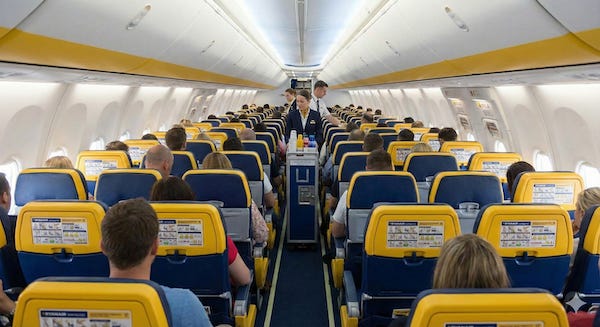
They’re playing the low-margin-high-volume game.
It works for them.
In their respective markets, these low-cost airlines are some of the most consistently profitable airlines.
For those who are not aware, the airline industry is notoriously difficult to make profits in.
Low Cost Marketing
Ryanair’s social media pages are quite active. They really own their image.
They readily mock customers for choosing the cheapest possible flight tickets (Ryanair), take a dig at their competitors, make jokes about how they will charge customers for ridiculous “services”, etc.
Being an ultra-low-cost airline, they try to save money on marketing too.
Their social media page is one easy way to go viral.
Their CEO is no slouch in this regard either.
The toilet fee we spoke about earlier seems like a calculated PR stunt to garner attention without actually charging customers for using the toilet.
If you go on YouTube, you can watch the CEO clearly talk about introducing standing seats.
But regulations do not allow for that. Surely the CEO of an airline would be aware of such regulations?
So even that seems like a calculated publicity stunt.
Even this — the CEO saying ludicrous things to gain publicity — is something that the Southwest founder was famous for.
It appears that Ryanair really loved the Southwest model.
And Michael O’Leary copied it to the greatest extent possible.
Quick Takes
+ India and the European Union will resume talks on the proposed Free Trade Agreement (FTA).
+ US President Trump accused India of ‘dumping’ rice in the US and hinted at the possibility of new tariffs on Indian rice imports to protect US farmers. Meanwhile, the India-US trade talks are set to resume this week.
+ China’s inflation rate rose to 0.7% in Nov (vs 0.2% in Oct). It is the highest level since Feb 2024.
+ Meesho IPO listed on the stock exchanges at a premium of 46.40% over the issue price and closed 53.23% up at the end of the day.
+ Aequs IPO listed on the stock exchanges at a premium of 12.90% over the issue price and closed 22.01% up at the end of the day.
+ The US Fed lowered the key lending rate for the 3rd time this year, to a range of 3.50% to 3.75%.
+ Mexico approved higher tariffs of up to 50% on imports from India, China, and other Asian countries on a variety of goods to protect its domestic industries.
+ India’s retail inflation rose to 0.71% year-on-year in Nov (vs 0.25% in Oct).
+ India’s forex reserves rose by $1.03 billion to $687.26 billion in the week that ended on 5 Dec.
+ The central government approved a rail line between Bhanupalli-Bilaspur-Beri in Himachal Pradesh at a cost of Rs 6,753 crore.
+ The central government approved the proposal of conducting the population census in 2027 at a cost of Rs 11,718.24 crore.
The information contained in this Groww Digest is purely for knowledge. This Groww Digest does not contain any recommendations or advice.
Team Groww Digest
It was fun to read. Loved it.
Great article Team.