
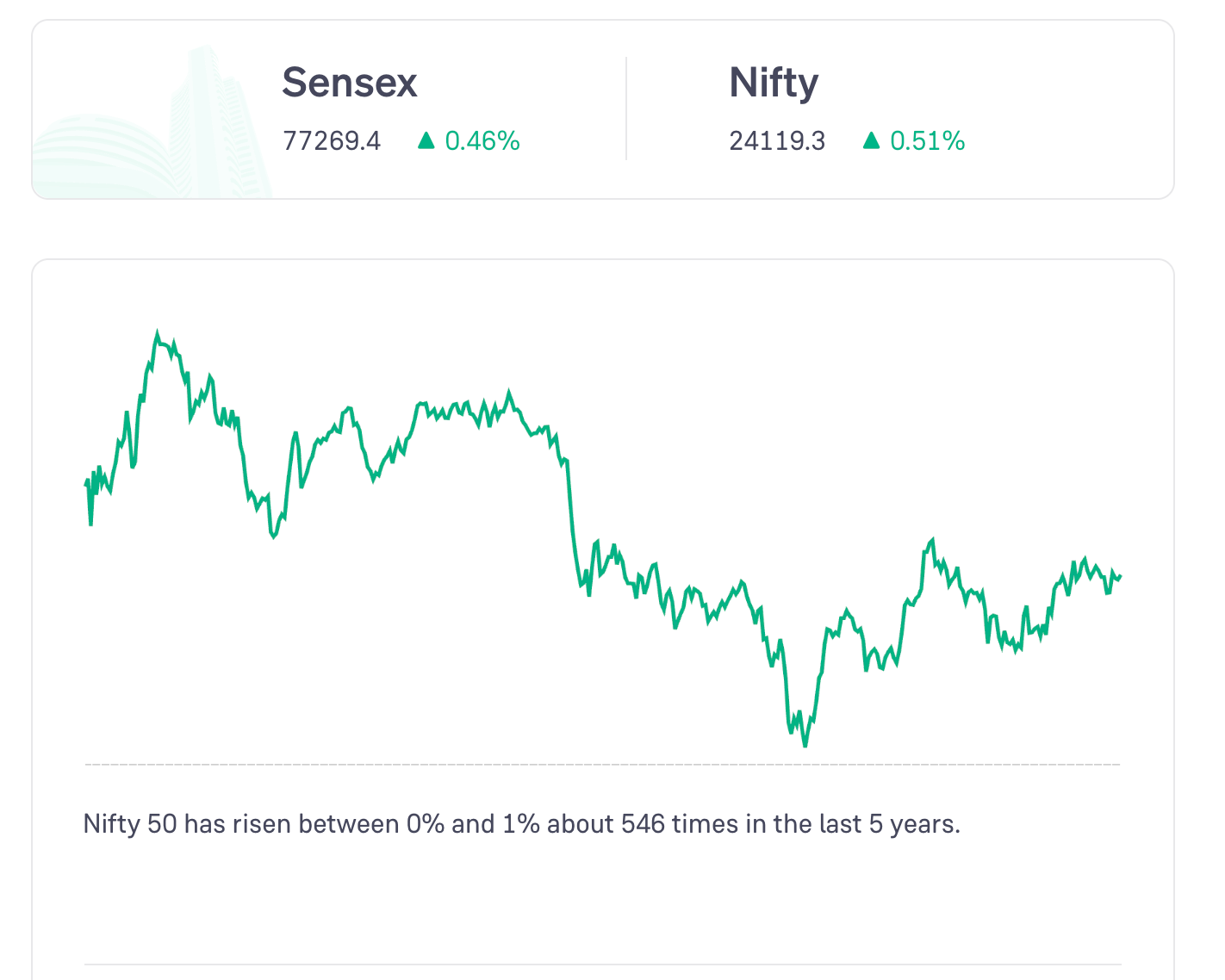
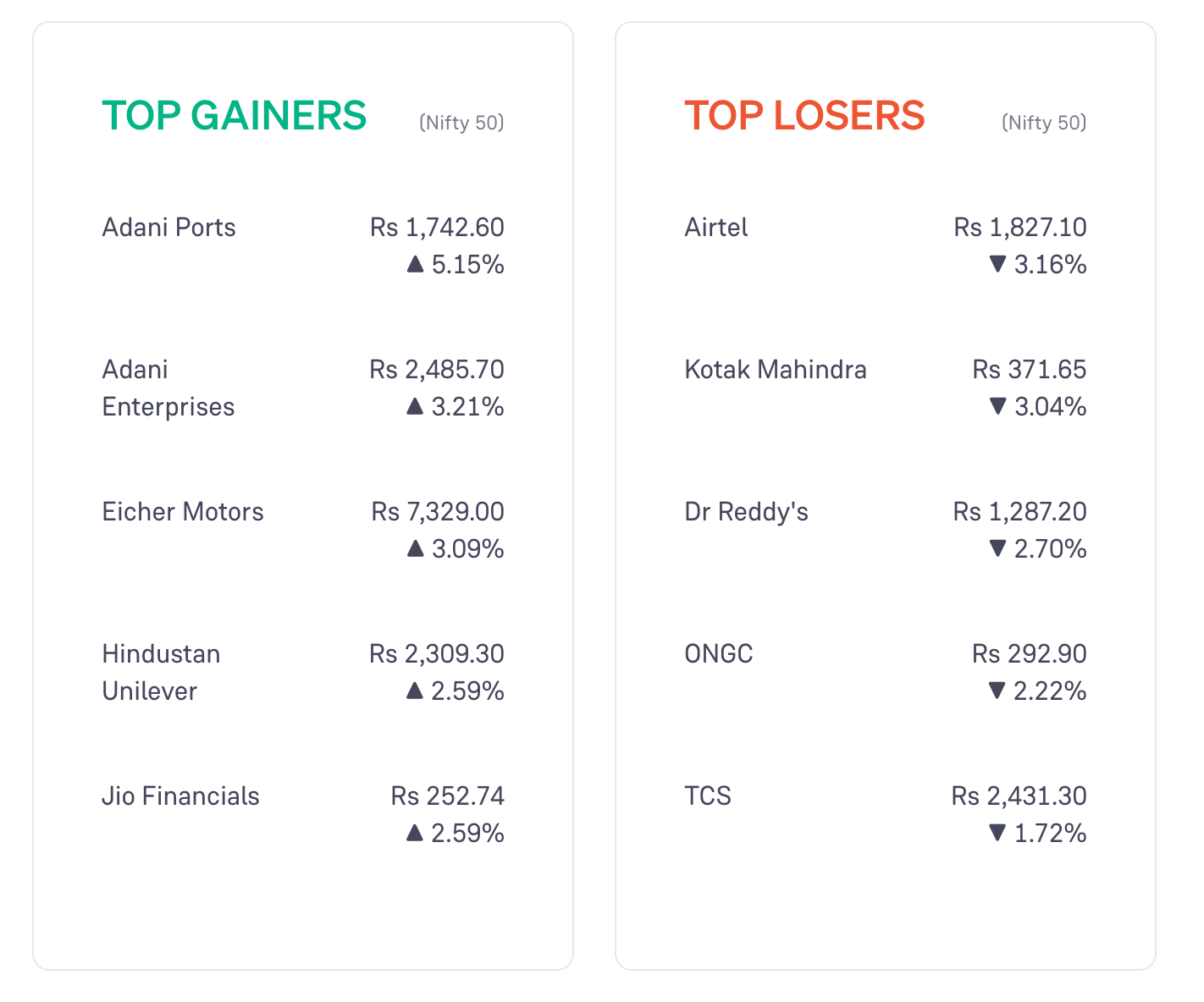
Markets opened above Friday’s closing point.
Realty stocks and metal stocks rose the most. IT stocks and media stocks fell the most.
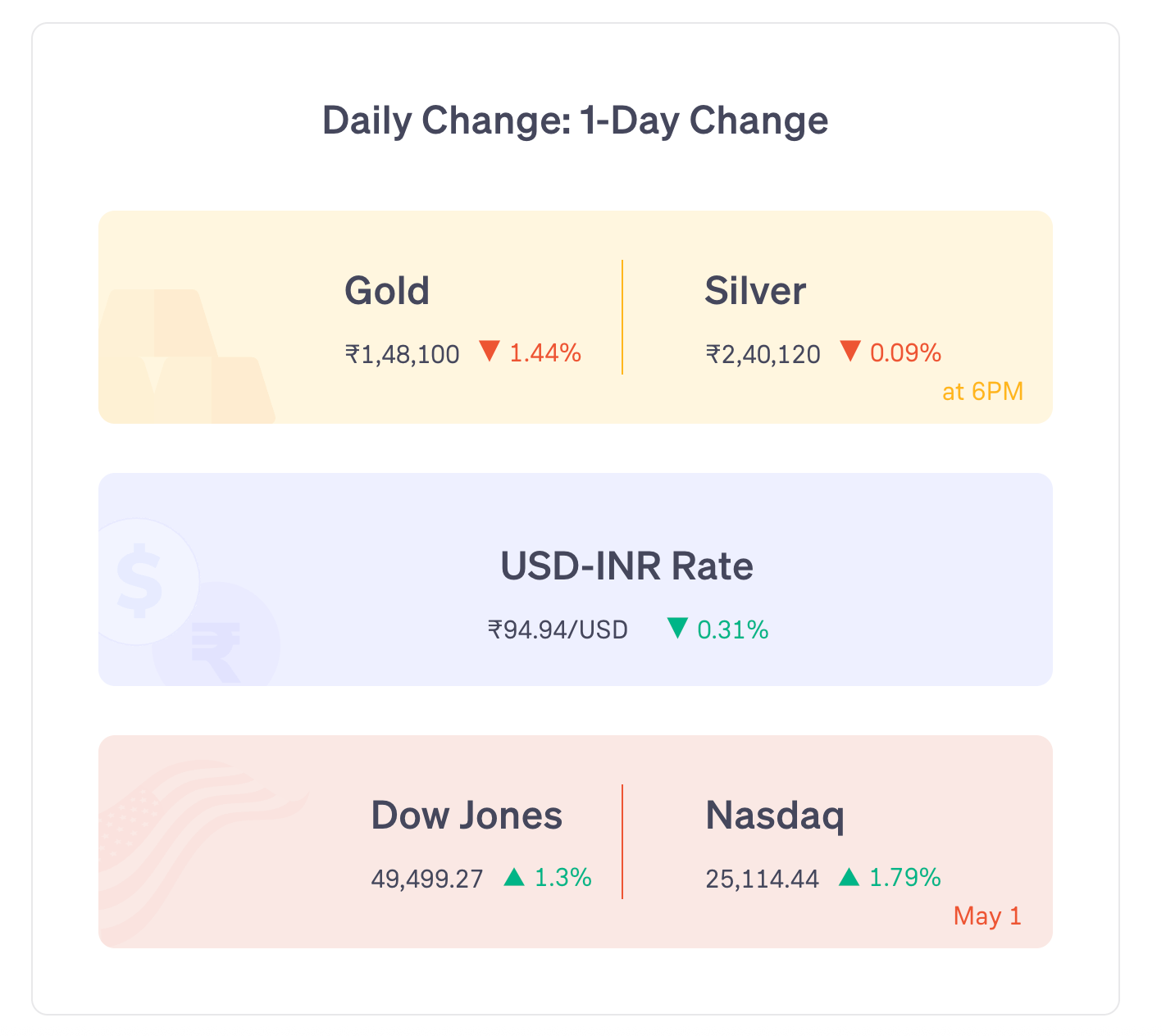
Global markets: US markets and most Asian markets rose. Most European markets fell (as of 6 pm IST).
News
India’s manufacturing PMI rose to 54.7 in April (vs 53.9 in March). This means manufacturing activity grew more in April than in March.
India’s LPG consumption fell 16.2% year-on-year in April (vs a fall of 12.3% in March): Ministry of Petroleum and Natural Gas
Onemi Technology Solutions (Kissht) IPO has been subscribed 0.60 times. Retail subscription: 0.16 times. IPO closes tomorrow (5 May).
Stocks Updates
Kotak Mahindra: net profit rose 10.04% year-on-year to Rs 5,401.55 crore in the Jan-March quarter. Dividend announced: Rs 0.65 per share.
Avenue Supermarts: net profit rose 19.19% year-on-year to Rs 656.59 crore in the Jan-March quarter.
Ambuja Cement: net profit rose 78.47% year-on-year to Rs 1,830.15 crore in the Jan-March quarter. Dividend announced: Rs 2 per share, with a 12 June record date.
BHEL: net profit rose 155.8% year-on-year to Rs 1290.47 crore in the Jan-March quarter. Dividend announced: Rs 1.40 per share.
NTPC: has started commercial operations of 100 MW from its 176 MW solar project in Ramagundam, Telangana, taking total group capacity to 89,805 MW.
Auto Updates (April)
Maruti Suzuki: sales grew by 33.2% year-on-year to 2.40 lakh units. Domestic sales stood at 1.99 lakh units and exports stood at 40,054 units.
M&M: sales grew 14% year-on-year to 94,627 units. Domestic passenger vehicle sales grew 8% to 56,331 units while commercial vehicle sales stood at 23,427 units.
Tata Motors Passenger: sales grew 31.1% year-on-year to 59,701 units.
Hyundai Motor: sales grew 17% year-on-year to 51,902 units including export sales of 13,708 units.
Eicher Motors: sales grew 31% year-on-year to 1.13 lakh units. Exports fell 14% to 9,035 units.
TVS Motor: sales grew 7% year-on-year to 4.74 lakh units. EV sales grew 36% to 37,771 units.
Ashok Leyland: sales grew 9% year-on-year to 14,646 units.
Escorts Kubota: sales grew 24.4% year-on-year to 10,857 units.
Bajaj Auto: sales grew 40% year-on-year to 5.14 lakh units.
Word of the Day
Index Rebalancing
It is the process of updating the composition of an index to maintain its defined criteria.
Indices are reviewed at regular intervals. Stocks may be added or removed based on factors like market capitalization and liquidity.
This ensures the index continues to reflect the current market accurately.
After the rebalancing of an index, funds that track the index buy/sell to follow the composition, which may impact stock prices in the short term.
Example: the Nifty 50 index is updated bi-annually, in March and September, where stocks may be added or removed based on eligibility criteria.
6 Day Course
Theme: India’s relation with USD
Day 1: Monday
Many of us are aware that the US dollar is one of the most accepted currencies of the globe.
It is considered the reserve currency of the world.
When we in India buy crude oil, we often pay in USD. We also get paid in USD for some of our exports.
We also receive investments from foreign companies in USD.
This is why USD is important to us. It is also why the USD-INR relation is even more critical to us.
In this week’s course, we will try to understand this relation between our currency and the US dollar.
At present, the exchange rate is around Rs 95/USD. This means, we need to pay Rs 95 in Indian Rupees to get 1 USD.
This is called the exchange rate and it changes every day similar to how the price of shares change.
Featured Question
Q. “If a mutual fund company raises their total expense ratio for an ongoing fund, will current NAV also go down? Affecting past investment? Or does it only affect the NAV the day after?”
The past is not affected. It is applied from the point the new expense ratio comes into effect.
Its impact is on the present and the future, not on the past.
Expense ratio is deducted on a daily basis.
So once it is deducted for a day, that matter is closed. It will not be re-deducted for that day.
Think of it like this: if they increase the toll for a highway, you will not have to pay a higher toll for all the past trips you made. You will only pay the higher toll for the newer trips you will make.
Did you like this edition?
Leave a feedback here!