
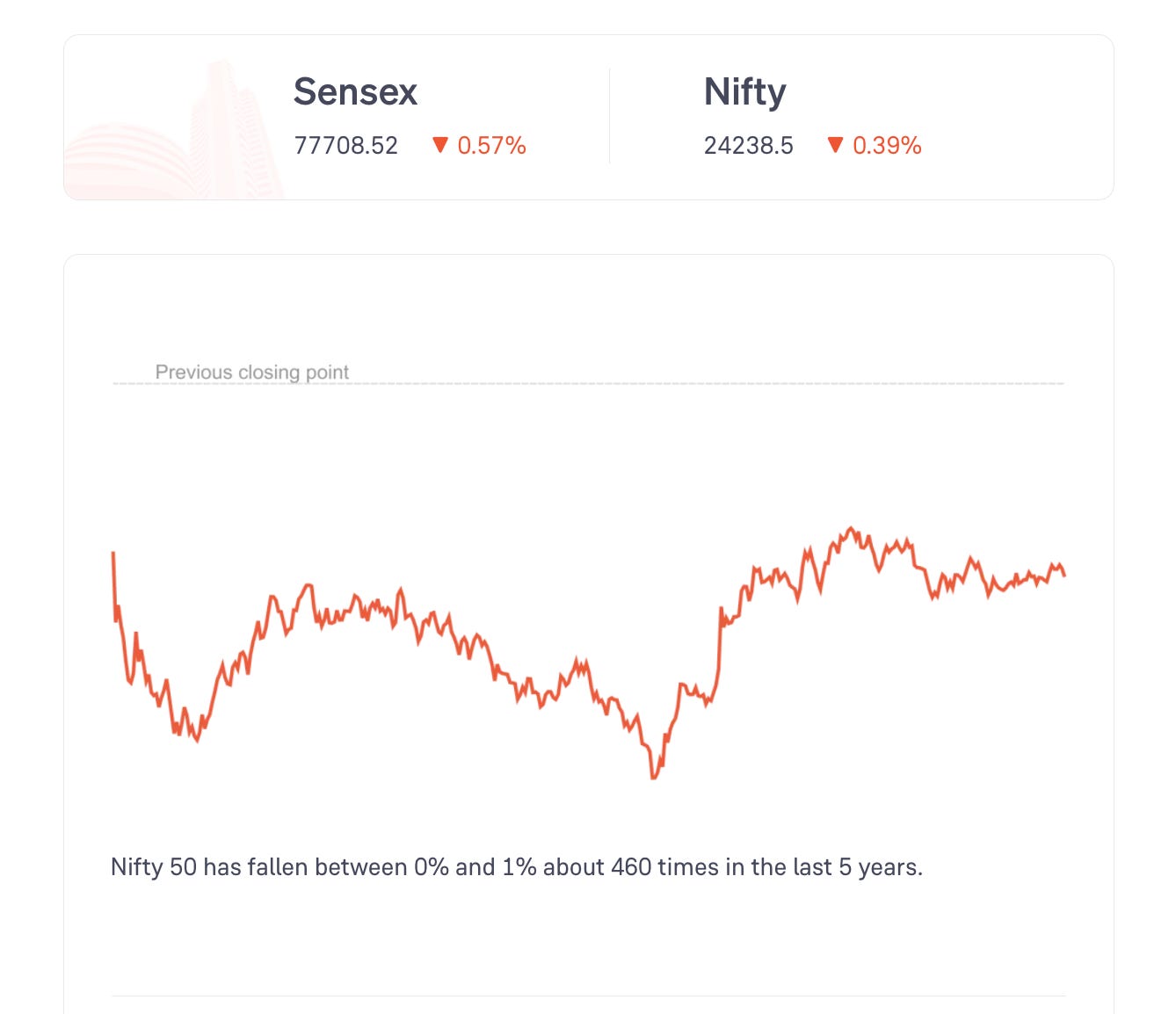
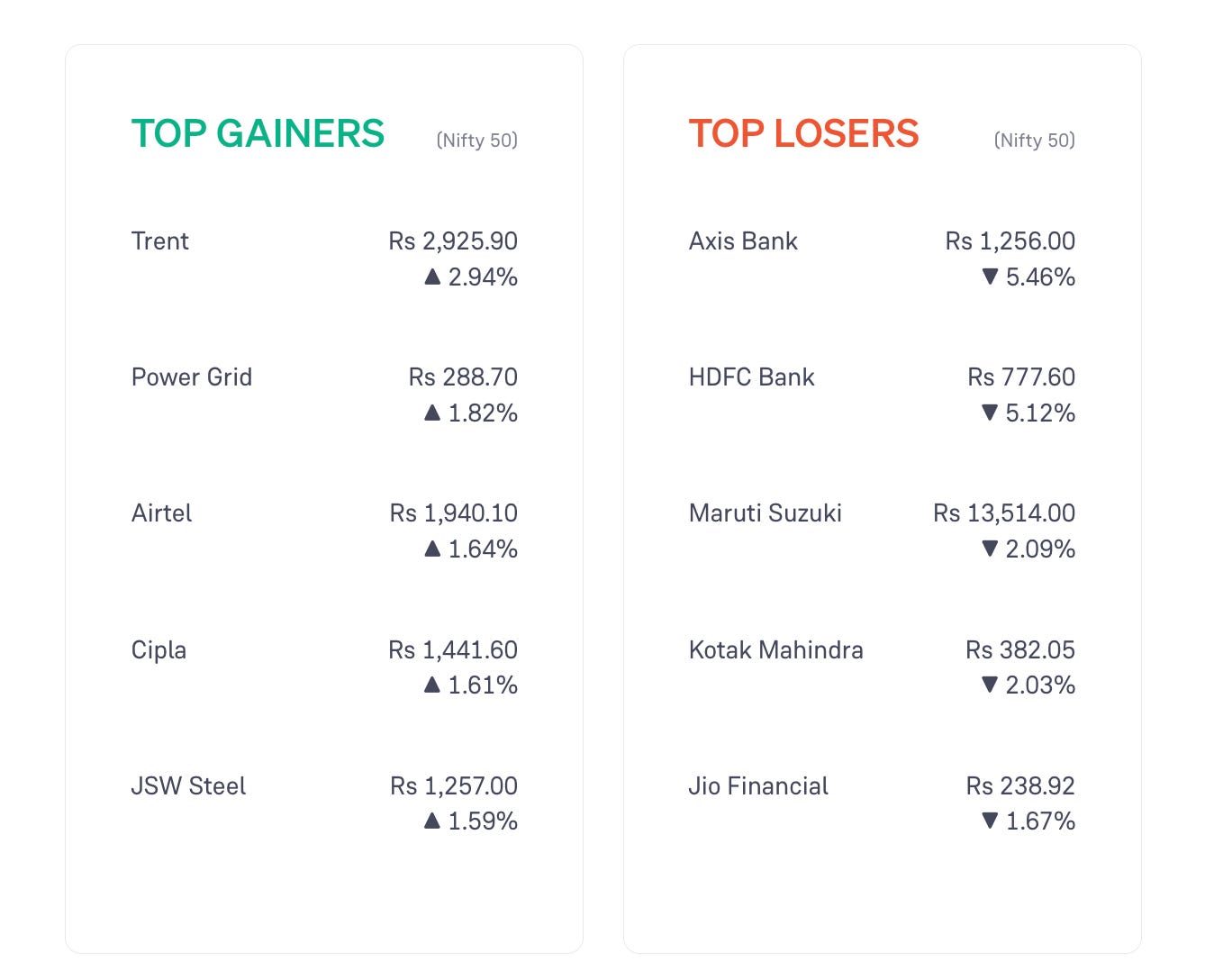
Markets closed lower than Friday’s closing point.
PSU Bank stocks and pharma stocks rose the most. Private bank stocks fell the most after they announced results over the weekend.
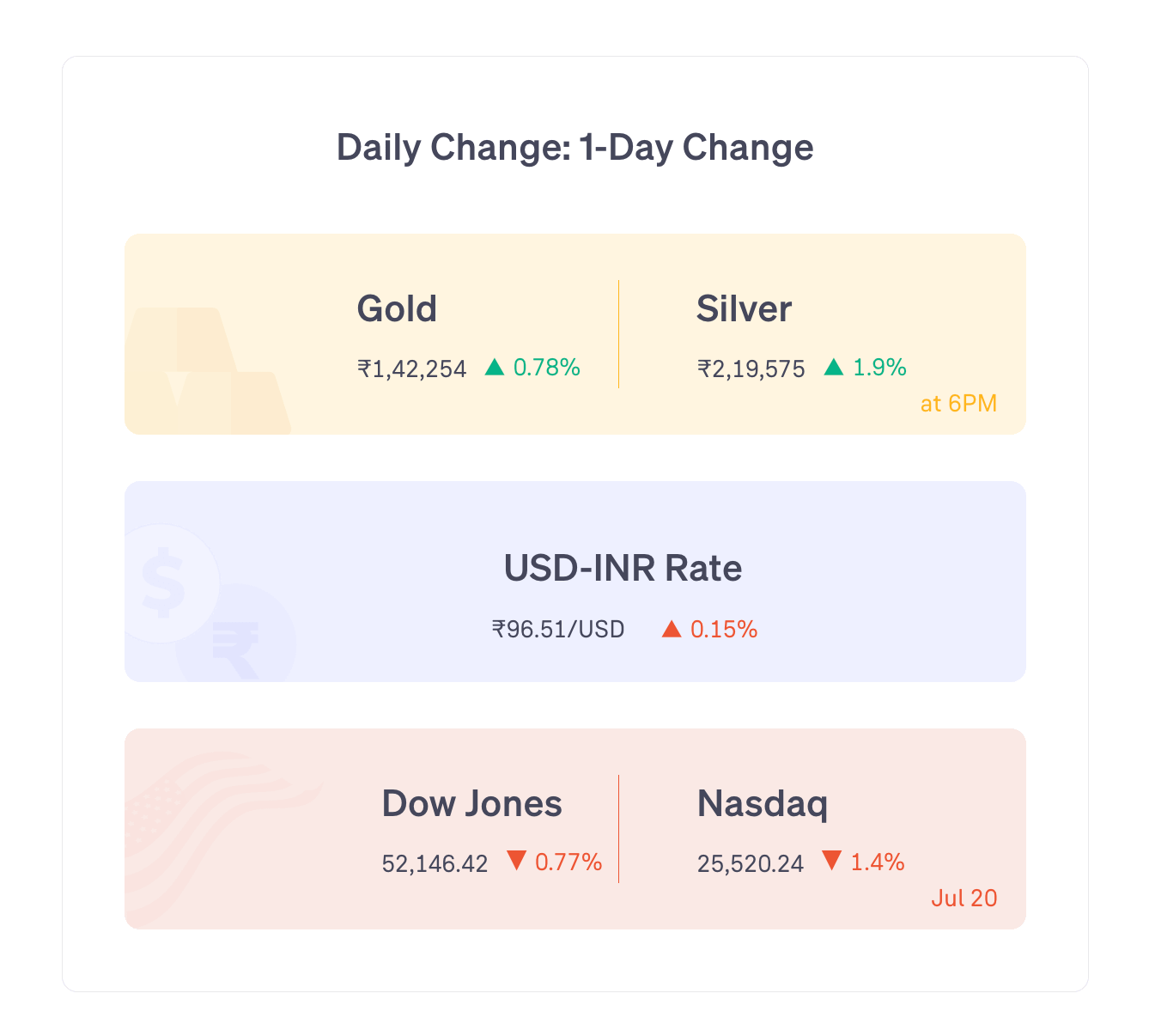
Global markets: US markets fell on Friday. Asian markets showed a mixed trend. Most European markets fell (as of 6 pm IST).
News
India’s Infrastructure output rose to a five month high of 5% year-on- year in June. (vs 3.2% in May). The Index of Core Industries for June is the first data released with a revised base year of 2022-23.
The government clarified that there is no proposal to remove long-term capital gains tax on equities for domestic investors in the parliament. The clarification was followed by the decision to exempt FPIs from LTCG tax on investments in government securities last month.
Stocks Updates
HDFC Bank: net profit rose 18.4% year-on-year to Rs 19,245 crore in the Apr-June quarter.
ICICI Bank: net profit rose 13.9% year-on-year to Rs 15,440 crore in the Apr-June quarter.
L&T: metals & minerals business won mega orders (Rs 10,000 crore - Rs 15,000 crore) across iron ore handling, steel plant expansion and zinc processing projects in Chhattisgarh and West Bengal.
Axis Bank: net profit rose 22.2% year-on-year to Rs 7,632 crore in the Apr-June quarter.
Kotak Mahindra: net profit rose 22.5% year-on-year to Rs 5,480 crore in the Apr-June quarter.
UltraTech: net profit rose 16.8% year-on-year to Rs 2,599 crore in the Apr-June quarter.
Tech Mahindra: is proceeding with a proposed merger of three wholly owned subsidiaries (Zen3 Infosolutions, Tech Mahindra Enterprise Services and BeGig Pvt Ltd) into itself.
Tata Power: received a Letter of Award from SECI to provide storage services from a 324 MW/2,592 MWh pumped storage plant for 40 years, with annual fixed charges of Rs 351.3 crore.
PNB: net profit rose 174.3% year-on-year to Rs 5,815 crore in the Apr-June quarter.
Cipla: US FDA completed a routine inspection at subsidiary InvaGen’s Central Islip facility in New York. The company said it will respond within the required timeline.
Vedanta: promoter group entity Twin Star Holdings entered into a $1 billion facility agreement. Vedanta is not a party to the agreement, but some covenants and share encumbrances apply to it.
IDBI Bank: net profit rose 5.3% year-on-year to Rs 2,127 crore in the Apr-June quarter.
REC: subsidiary RECPDCL incorporated two wholly owned subsidiaries, Beed Parli Power Transmission Ltd and Yavatmal Power Transmission Ltd as wholly owned subsidiaries for transmission projects in Maharashtra.
Word of the Day
Confidential DRHP
It is a method of filing for IPO where the details of the company are not revealed to the public during application
Every IPO must be checked by SEBI before being launched.
During this process, SEBI might ask for more information, revelations, compliance, etc. Companies may need more time to finish this procedure. This can delay the launch of the IPO.
In this time, a company’s competitors may get some early advantages over the company.
Filing for an IPO via the confidential DRHP route allows companies to keep their details private from the public until the IPO is launched.
Companies have to reveal all details before the IPO is launched for subscribing.
6 Day Course
Theme: understanding PEG
Day 1:Monday
PEG stands for PE-to-growth ratio.
In other words, it compares a company’s PE ratio with its growth.
Let’s first understand why we need this at all.
Many investors would already know, PE ratio is the ratio of a company’s share price to its earnings (per share).
So, it compares how much the company earns vs how much its share costs.
Many investors use this to determine if a stock is underpriced, overpriced, or fairly priced.
Remember, a company can be an excellent business and still be a bad investment. If investors buy the share at overvalued levels, the return can be poor.
This is why we use PE ratio.
But any experienced investor will tell you, relying only on the PE ratio to determine if a share is undervalued/overvalued/fairly valued is a bad strategy.
In the practical investing world, often, we see good companies tend to have higher PE ratios and give good returns despite that.
Some companies with low PE ratios end up being poor investments also.
PEG aims to address this.
————
Featured Question
Q. “We hear many terms of investors, like angel investors, early investors, series C investors etc. Can you explain what each such types mean and how they affect the company ?”
These are mostly different kinds of startup investors and investment stages.
Startups go through many rounds of investment.
Many successful startups get acquired by other companies, or go for an IPO.
Before that stage a company goes through many rounds of investment:
Angel round: in this, individuals invest money in the startup. This is usually the very first investment round the startup company has. Some investors specialise in investing in start-ups at this stage. They are called angel investors.
Seed round: this is the next round. In this, individuals or institutional investors like venture capital firms might invest. Sometimes, there may be a pre-seed round before this round where other angel investors invest.
Series A: this is the next round. In this, usually institutional investors invest (venture capital firms).
After that, all rounds are termed alphabetically — series A, B, C, etc.
It depends on the number of times the start up raises money and is based on the progress the company has made.
Often, in later rounds, bigger institutional investors like private equity funds, sovereign wealth funds, etc might also invest.
This format is largely common. But it is not mandatory to follow this exact format.
Angel investors, venture capital firms, and private equity funds are often called early-stage investors because they invest relatively early in the life of a company.
Not all private equity funds are early stage investors. But some are.
While specifically talking about individual companies’ funding round, the investors might be labelled based on the round they are investing in. Example: an investor who invested in a Series B round will be called a ‘Series B investor’ for that company.
The information presented in this post has been compiled and prepared by Groww Invest Tech Pvt Ltd and is intended solely for informational purposes. It is not tailored to any specific investment objectives, financial situations, or needs of any individual investor. The content should not be construed as investment, financial, legal, or tax advice and should not be relied upon as a substitute for professional consultation.
Investing in securities markets involves inherent risks. Investors are advised to carefully review all relevant documents and consider their own risk tolerance before making any investment decisions.
Mutual fund investments are subject to market risks; please read all scheme-related documents carefully. Past performance of financial instruments, schemes, or markets is not indicative of future results.
Groww Invest Tech Pvt Ltd is registered with the Securities and Exchange Board of India (SEBI) under Registration No: INZ000301838, as a Research Analyst under No: INH200008662, as a Depository Participant under No: IN-DP-417-2019, and with the Association of Mutual Funds in India (AMFI) under ARN-111686.
SEBI registration details: View registered name and registration numbers
Research Analyst Disclaimer: View Research Analyst disclaimer
Did you like this edition?
Leave a feedback here!
PE, 50% KNOWN BY INVESTORS. PEG NOW A REAL TREND BY FUNDAMENTALISTS. GOOD TO UNDERSTAND THE DIFFERENCE
Very well explained