

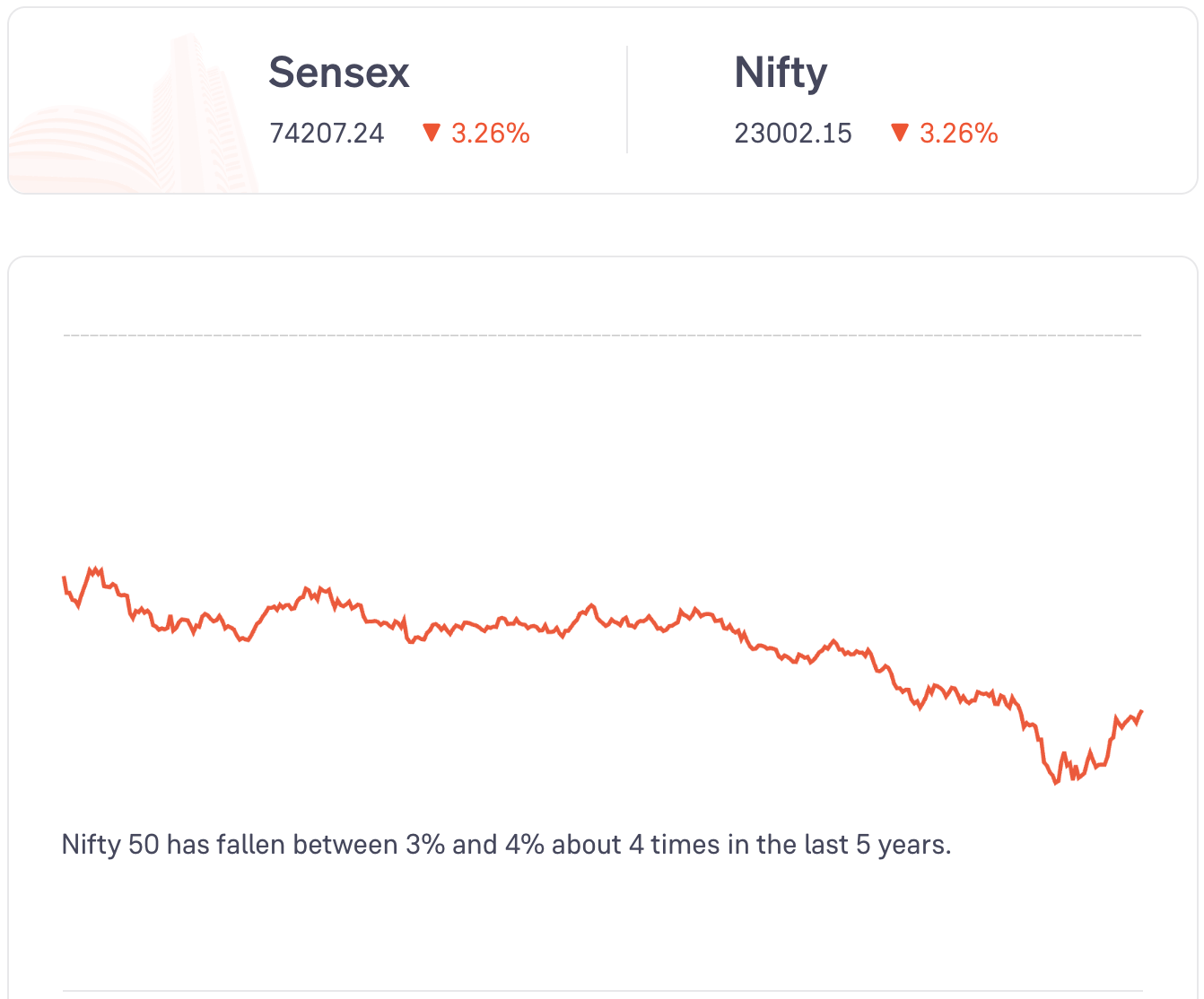
Markets opened below yesterday’s closing point.
Nifty 50 opened significantly lower. The fall was mainly due to sharp rise in crude oil prices and weak global sentiment.
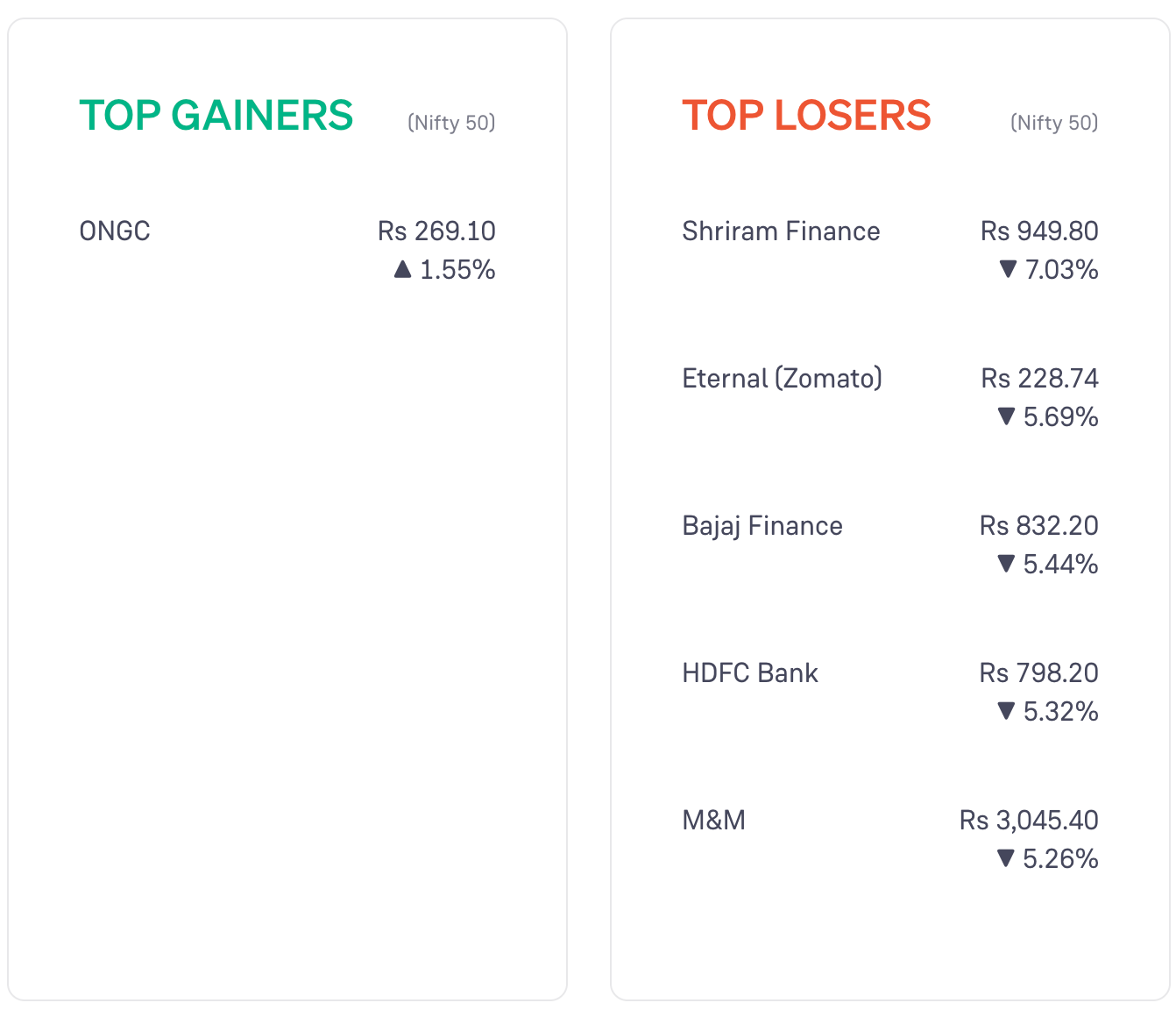
Only 1 stock in the Nifty 50 rose today. Hence, there is only 1 stock in the ‘Top Gainers’ section.
All sectorsʼ stocks fell today. Auto stocks and realty stocks fell the most.
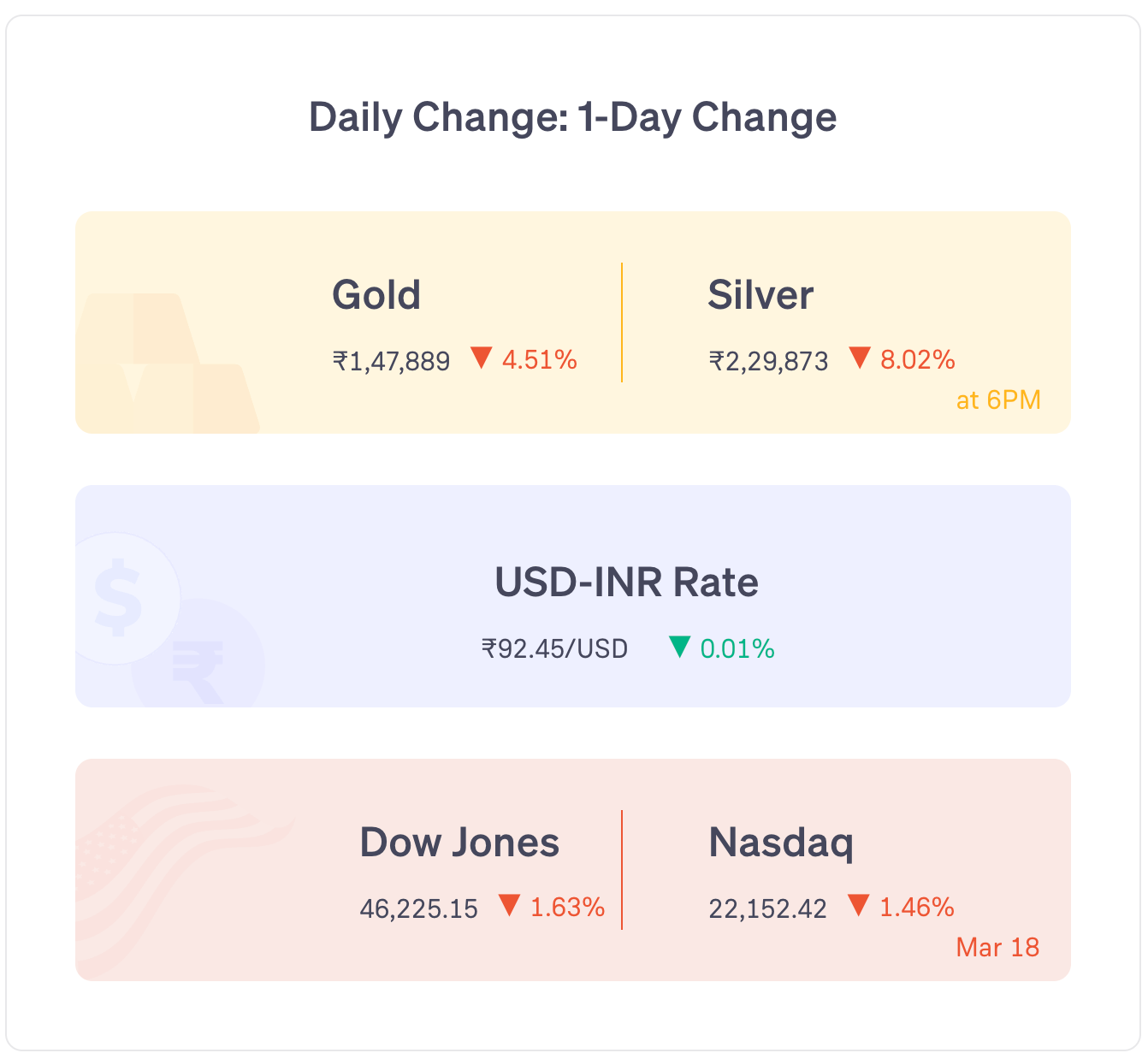
Global markets: US markets and Asian markets fell. European markets also fell (as of 6 pm IST).
News
The US Fed kept its benchmark interest rate unchanged between the 3.5% to 3.75% band.
The central government approved the RELIEF scheme to support exporters hit by disruptions due to the West Asia conflict. The aim is to provide risk coverage and cost reimbursement to maintain exports and protect trade flows.
SEBI has proposed simplified nomination rules for demat and mutual fund accounts, including making nomination easier and more flexible to ensure smoother transfer of assets.
Stocks Updates
HDFC Bank: part-time Chairman and Independent Director Atanu Chakraborty resigned with immediate effect on 18 March. RBI approved Keki Mistry as interim part-time Chairman for 3 months, effective 19 March.
Reliance: received a customs order imposing a penalty and fine of Rs 17.07 lakh for alleged incorrect classification of imported goods, which it plans to appeal.
NTPC: company’s stepdown subsidiary, NTPC Renewable Energy Limited, commissioned 165 MW capacity at its Khavda-II solar project in Gujarat, taking NTPC group’s total installed capacity to 88,709 MW. It also signed an MoU with UK-based Octopus Energy to explore collaboration in renewable energy, EV infrastructure and digital energy platforms across India and the UK.
TCS: signed an MoU with ABB to expand collaboration across IT infrastructure, AI, engineering and industrial digital solutions. It also announced a global strategic partnership with travel technology company Amadeus to develop smarter airline software using AI and cloud.
ICICI Bank: received a GST demand of Rs 384.34 crore plus penalty and interest from the CGST Mumbai East Commissionerate, which it will challenge.
Lupin: company’s subsidiary, Lupin Manufacturing Solutions, expanded its manufacturing facility at Dabhasa, Gujarat.
Cipla: board approved investing up to $100 million in its UK subsidiary, Cipla (EU). The board approved merging its fully owned subsidiary, Inzpera Healthsciences, into itself (pending NCLT approval).
Varun Beverages: company’s South Africa subsidiary, The Beverage Company Proprietary Limited, completed the acquisition of 100% stake in Twizza for ZAR 2,053 million, making it a step-down subsidiary.
Nestle India: will invest around Rs 225 crore to add a new Munch production line at its Sanand plant with approximately 8,300 tonnes annual capacity.
Samvardhana Motherson: board declared an interim dividend of Rs 0.35 per share with March 27 as the record date.
Word of the Day
DRHP
It is a document filed by a company with SEBI before launching an IPO.
It stands for Draft Red Herring Prospectus.
It contains details about the company’s business, financials, promoters, risks, and how the money will be used.
It gives potential investors insights into the company’s fundamentals.
After SEBI reviews it and gives observations, the company files the final version called the RHP (Red Herring Prospectus).
6 Day Course
Theme: AI terms for investors
Day 4: Thursday
RAG: Retrieval Augmented Generation is a feature of LLMs that allows them to access new information.
When LLMs are made, they are trained on specific data. But this also fixes their knowledge.
If you want to update knowledge, like new developments, or add personal data that might not be available to the makers of the LLM, RAG can be used.
Training an LLM from the start is a time and cost consuming task. Hence, RAG is a good bridge for new/proprietary data.
RAG allows existing models to be adapted for specific use cases or allows them to access private info.
Agents: LLMs with dedicated functions are called agents. This usually involves multiple steps which a regular LLM chatbot is unable to do.
Example: booking a movie ticket might involve steps like “check which halls are screening this movie”, “if found, which is the nearest one”, “of the nearest ones, which are best suited for an evening time”, and so on.
Agents already have a defined structure under which they operate. This makes them good at one specific task.
Featured Question
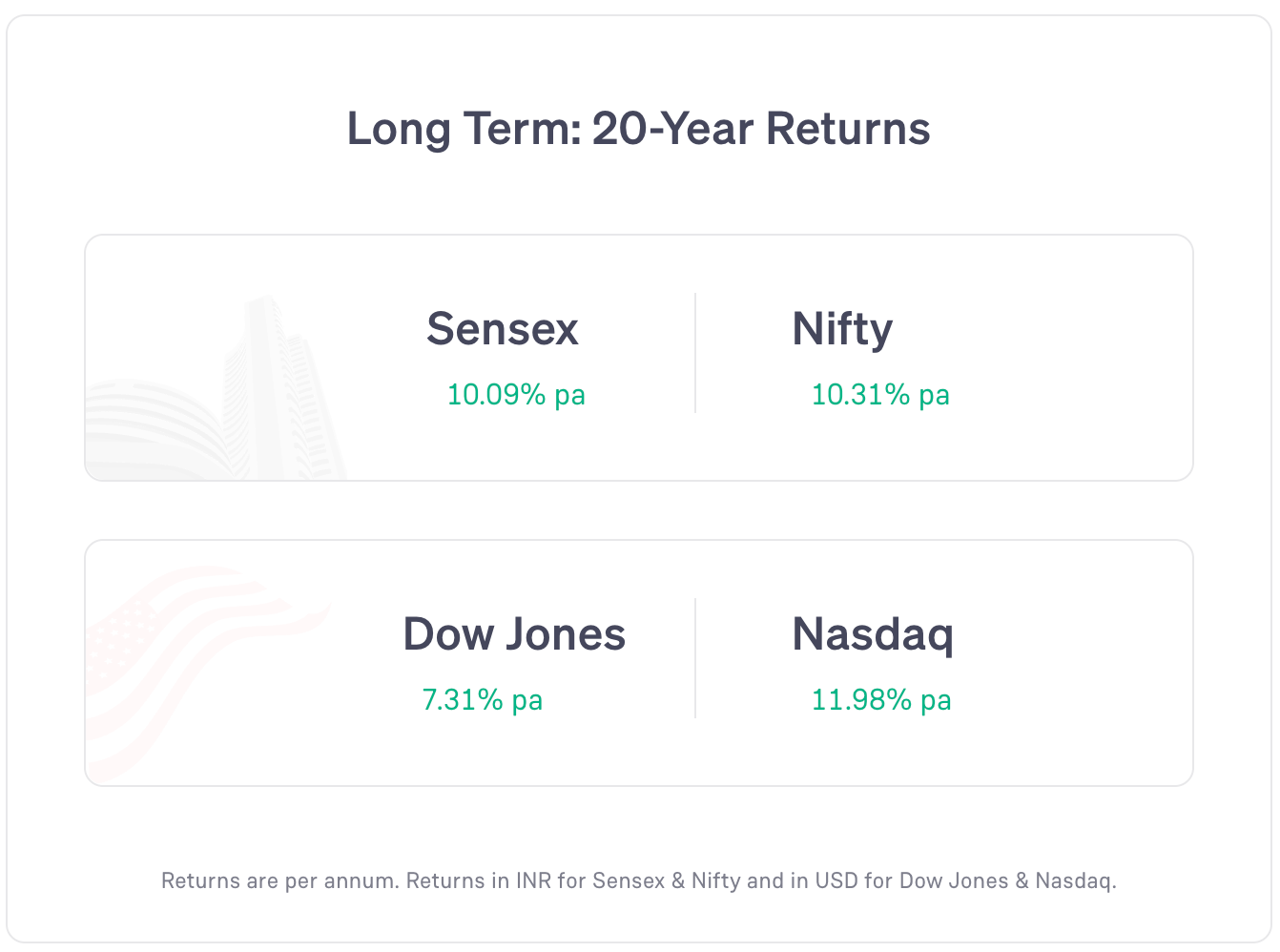
Q. “Hi, I’m following your Digest for quite a long time. I can see how long term returns for last 20 yrs of Sensex is now below 10.5%. I guess just 1-2 yrs ago it was 12.5%. And Nasdaq return is currently at 12%. It was about 11%. Can you explain this?”
Yes, it is never constant.
Long term returns are more stable than recent returns. That’s what it is meant to show.
When the markets are down a lot, you will notice that the 20-years returns are down but only by a small percentage.
Similarly, when the markets are up a lot, you will notice that the 20-years returns are up but only by a small percentage.
It is meant to show that while markets might look extremely turbulent in current times, in the long run, they have been more stable with a much smaller difference in returns.
Did you like this edition?
Leave a feedback here!