
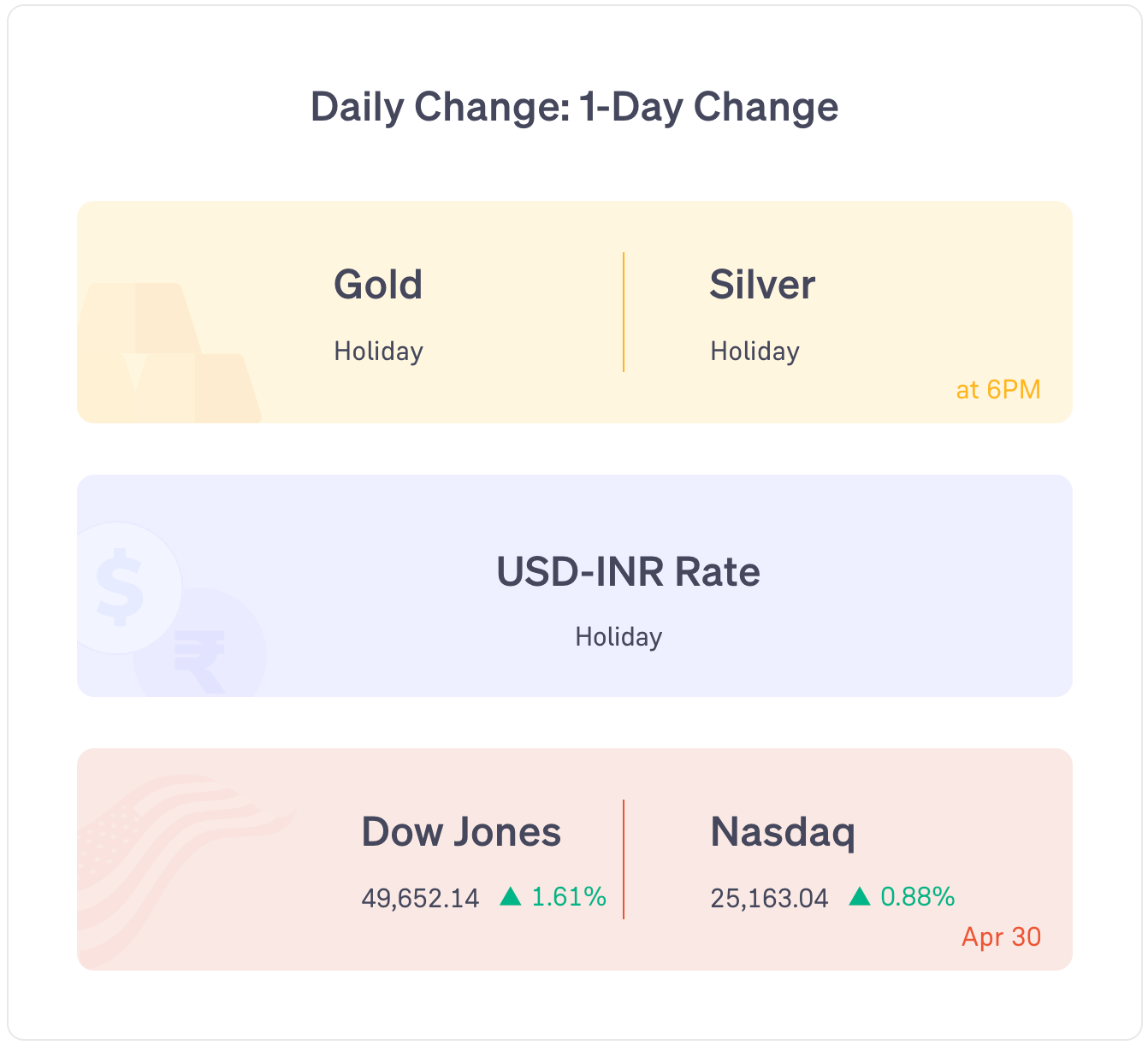
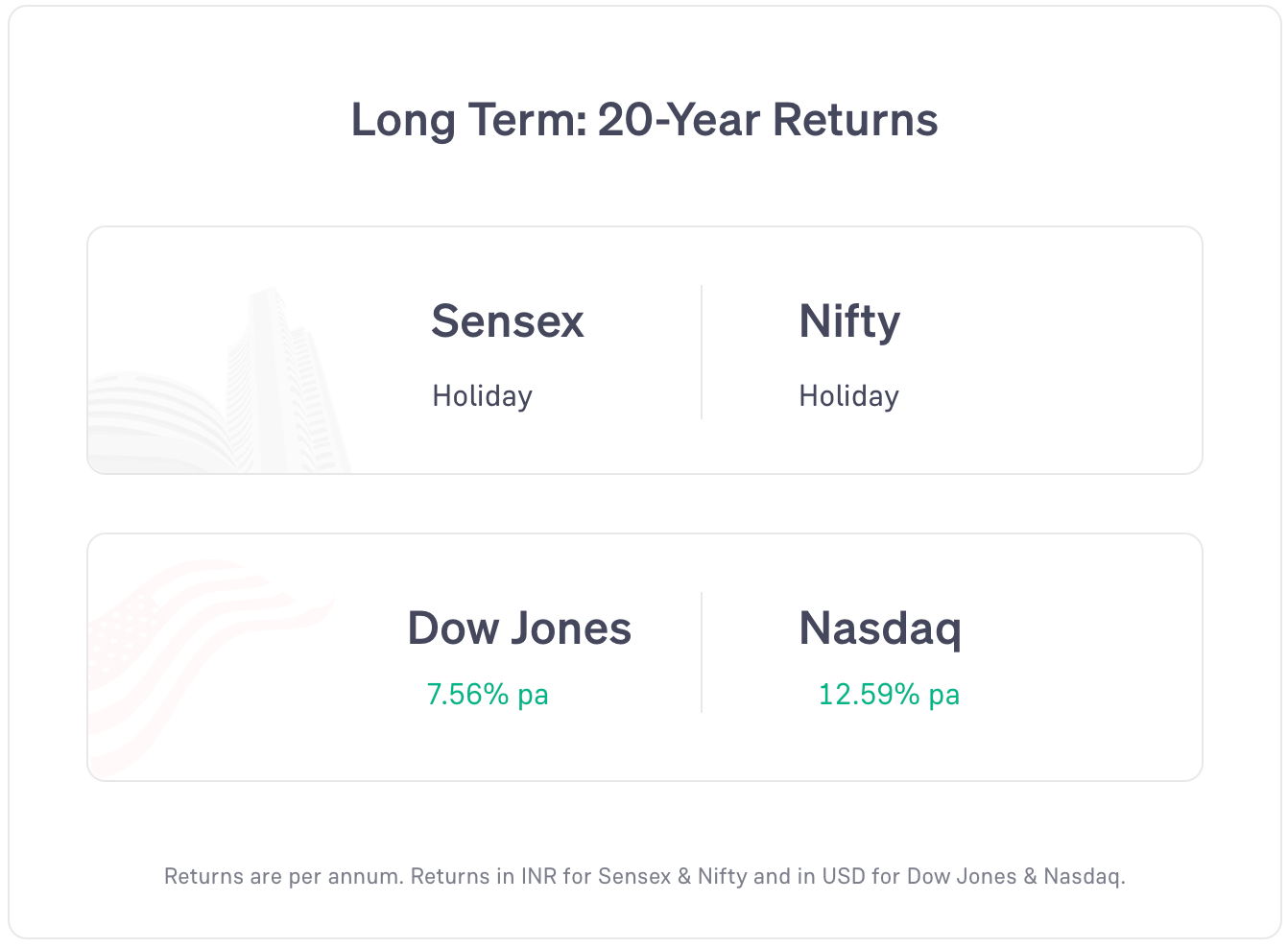
The Indian stock markets were closed today on account of Maharashtra Day.
Hence, there won’t be any updates on the Nifty 50, Sensex, Top Gainers, and Top Losers sections today.
Global markets: most US markets rose. Asian markets and European markets showed a mixed trend (as of 6 pm IST).
News
India’s forex reserves fell by $4.82 billion to Rs 698.49 billion in the week that ended on 24 April.
India’s gross GST collections rose 8.7% year-on-year to Rs 2.43 lakh crore in April. Net collections rose 7.3% to Rs 2.11 lakh crore.
The commercial LPG prices in India have been raised for the third time since February, with a hike of around Rs 993: as per media sources
Since the Comprehensive Economic Partnership Agreement (CEPA), the India-UAE trade has crossed $100 billion: Minister of Commerce and Industry
Stocks Updates
Bajaj Finserv: approved renaming two wholly owned subsidiaries, Bajaj Finserv Asset Management to Bajaj Asset Management and Bajaj Finserv Mutual Fund Trustee to Bajaj Mutual Fund Trustee as part of rebranding exercise.
Tech Mahindra: will acquire Avant, a Canada-based payments modernization and wealth platform firm for around CAD 28 million to strengthen BFSI and payments capabilities.
PFC: subsidiary incorporated 5 SPV subsidiaries to develop power transmission projects under competitive bidding.
Samvardhana Motherson: incorporated wholly owned subsidiary Motherson Digital Technologies to expand IT services business. It also completed acquisition of a 51% equity stake in Nissin India from Nissin Electric Co Ltd, Japan, making Nissin India an indirect wholly owned subsidiary.
Word of the Day
Disinvestment
It is when the government sells/reduces its stake in a business
Disinvestment can be partial or full, depending on how much stake is sold.
Example: the government sells its stake in a Public Sector Undertaking (PSU) to private investors or the public.
The goal is to raise funds, improve efficiency, and reduce government involvement in business.
6 Day Course
Theme: fund manager role
Day 4: Thursday
Many fund managers rise to become CIOs or Chief Investment Officers.
A CIO is the head of investment at an AMC. This is the person to whom all fund managers report to.
The CIO dictates the investment style and philosophy to a great extent.
Which is why when a CIO retires or leaves, some advisors become alert since a change in investing style might be possible.
Many senior fund managers also leave their jobs to start their own AMC or offer Portfolio Management Services (PMS), etc.
This is why whenever fund managers change roles or retire, they often do so over a certain time period wherein a replacement fund manager spends considerable time also managing the fund or role.
This aims to ensure the transition is smooth and without surprises for investors.
This period can last anywhere from a few months to even years.
Featured Question
Q. “Why the expense ratio of commodities MFs is lesser compared to the equity and debt Mutual funds ? Even though they will give high return (In long term)”
Hence, their expense ratio (or mutual fund fees) is much lower too.
Also, commodities funds’ returns vary a lot.
It is incorrect to assume these commodity mutual funds will give higher returns than equity mutual funds.
Over longer periods of time, many equity mutual funds have managed to give higher returns when compared to many commodity mutual funds.
Currently, gold and silver prices have shot up to astronomical levels. Hence the returns of many silver and gold funds are skewed.
Did you like this edition?
Leave a feedback here!
ram
Why do stock prices decrease on sharing dividends. Isn't it that dividends are paid from profits and not shares?