
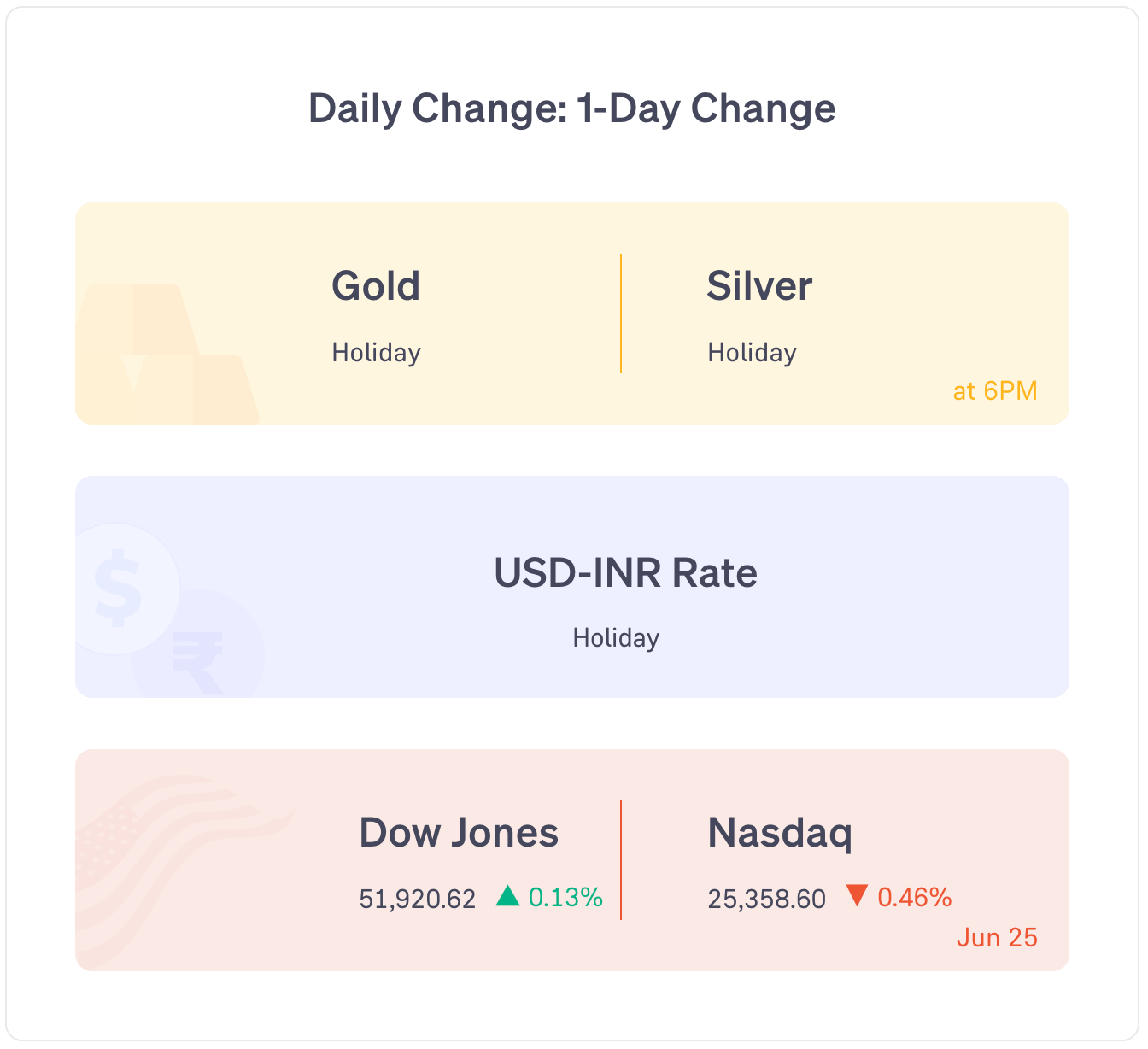
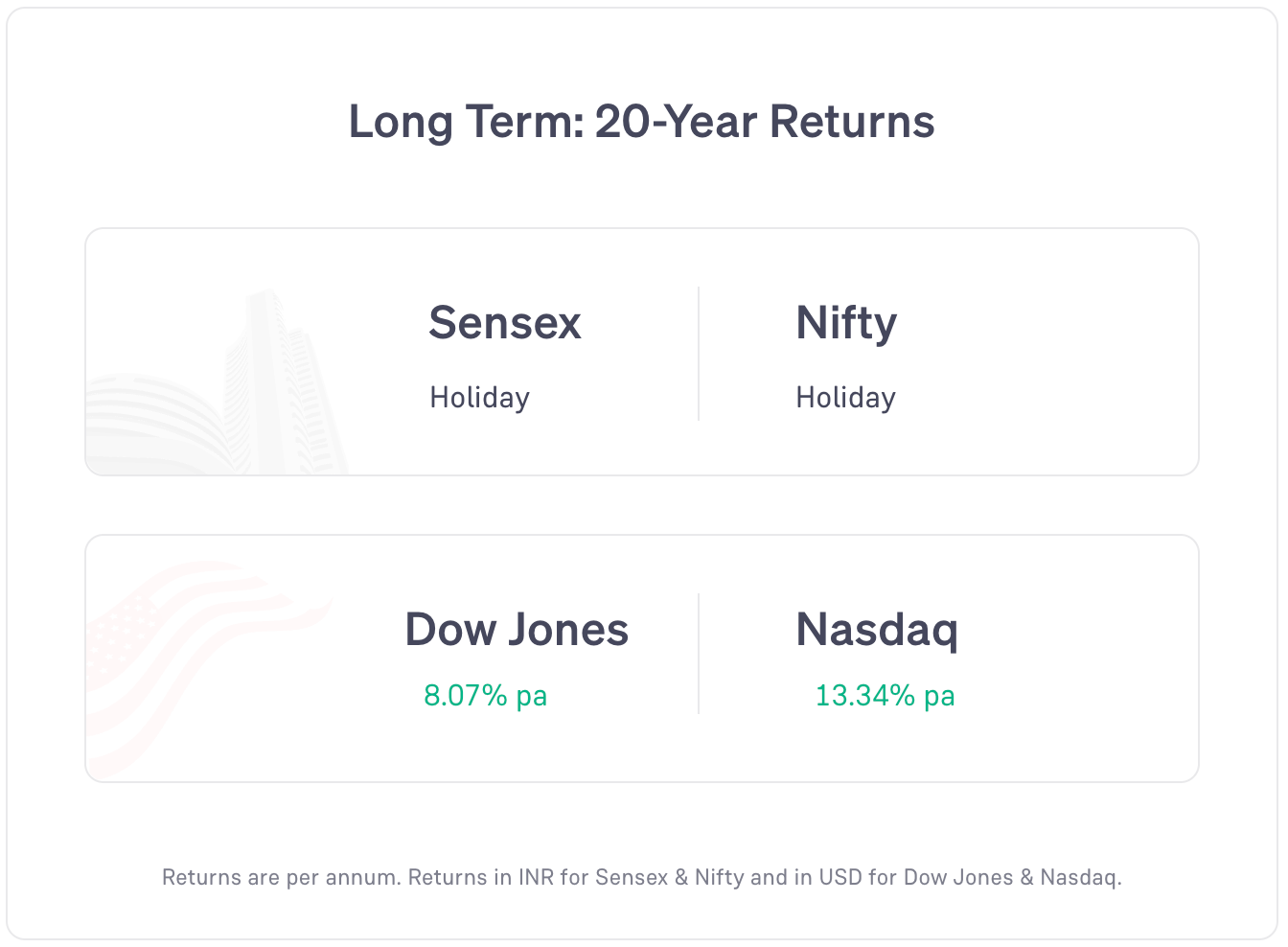
The Indian stock markets and commodities markets were closed today on account of Muharram.
Hence, there won’t be any updates on the Nifty 50, Sensex, Top Gainers, and Top Losers sections today.
Global markets: US markets showed a mixed trend. Most Asian markets and European markets fell (as of 6 pm IST).
Stocks Updates
L&T: completed 100% divestment of Nabha Power Ltd to Torrent Power for Rs 3,632.35 crore. Following this Nabha Power has ceased to be a subsidiary of the company.
Adani Power: subsidiary Adani Atomic Energy Ltd incorporated wholly owned step-down subsidiary Progressive-UP Atomic Energy Ltd to generate, transmit and distribute nuclear/atomic energy power.
NTPC: incorporated wholly owned subsidiary NTPC (Mauritius) Energy Ltd with capital of MUR 1 million (around Rs 19.8 lakh) to develop floating solar projects and other power projects in Mauritius.
HCLTech: completed its Rs 1,427.25 crore investment in Axonwise Private Ltd (Sarvam AI), acquiring a 10.46% stake.
Power Grid: board approved raising borrowing limit to Rs 2.2 lakh crore, subject to shareholder approval. It also approved raising up to $500 million through an External Commercial Borrowing (ECB) from Bank of Baroda, and sanctioned a Rs 772.65 crore investment to upgrade the Udumalpet–Madurai 400 kV transmission line.
Cholamandalam Investment: allotted unsecured subordinated NCDs worth Rs 2,000 crore (including Rs 1,400 crore green shoe) at a coupon rate of 8.88% via private placement basis.
Zydus Lifesciences: formed a 50:50 joint venture with Sri Lanka’s Sunshine Healthcare Lanka Ltd to set up a pharmaceutical manufacturing facility in Sri Lanka.
Lupin: received tentative USFDA approval for Enzalutamide tablets used to treat prostate cancer.
Aurobindo Pharma: acquired a 26% stake in Swarnaakshu Solar Power Pvt Ltd and signed a power purchase agreement for captive solar power consumption against an approved investment of up to Rs 10.40 crore.
Word of the Day
Greenshoe Option
It is an option used during an IPO or a bond/NCD issue to issue more securities than originally planned
It is also called the over-allotment option.
In an IPO, underwriters can issue up to 15% extra shares if investor demand is high.
In bond/NCD issues, the greenshoe option lets the company increase the issue size and raise more money when demand is strong.
Example: Cholamandalam Investment raised Rs 2,000 crore through NCDs (including Rs 1,400 crore green shoe). This means the company originally planned a smaller issue but increased the issue size because investor demand was strong.
6 Day Course
Theme: crucial points in IPO
Day 5: Friday
In case of IPOs, another important metric to check is the lock-in and large sellers.
Investors must remember that anchor investors usually have a lock-in till which they cannot sell.
This means, they are allowed to sell only after a certain time period. This usually ranges from 30 to 90 days.
If many large investors are waiting to sell, the share price can fall drastically as the lock in period ends.
On similar lines, IPO investors must also check sentiments of other investors in general.
Why are most other investors buying into the IPO?
Is it because of quick listing gains? In that case, the investor needs to be careful since the share price might fall or be volatile upon listing.
Is it because they are excited about the company’s long-term future? In such a case, the IPO may be a good candidate for long-term holding.
Featured Question
Q. “While Selling why I'm not allowed to sell which transaction date stock to be sold to decide my own P&L. Why it is always First In First Out is followed while selling MF units/equity shares.”We include this line in every Groww Digest Daily and update the numbers everyday.
FIFO or First In First Out principle is followed while selling shares or mutual funds’ units in India.
It is the default way of selling. It is in compliance with the tax regulations in India.
From the investors’ perspective, FIFO allows the lowest possible tax burden since long term tax has a lower rate.
Hence, it is the default option in India.
Did you like this edition?
Leave a feedback here!
Informative