

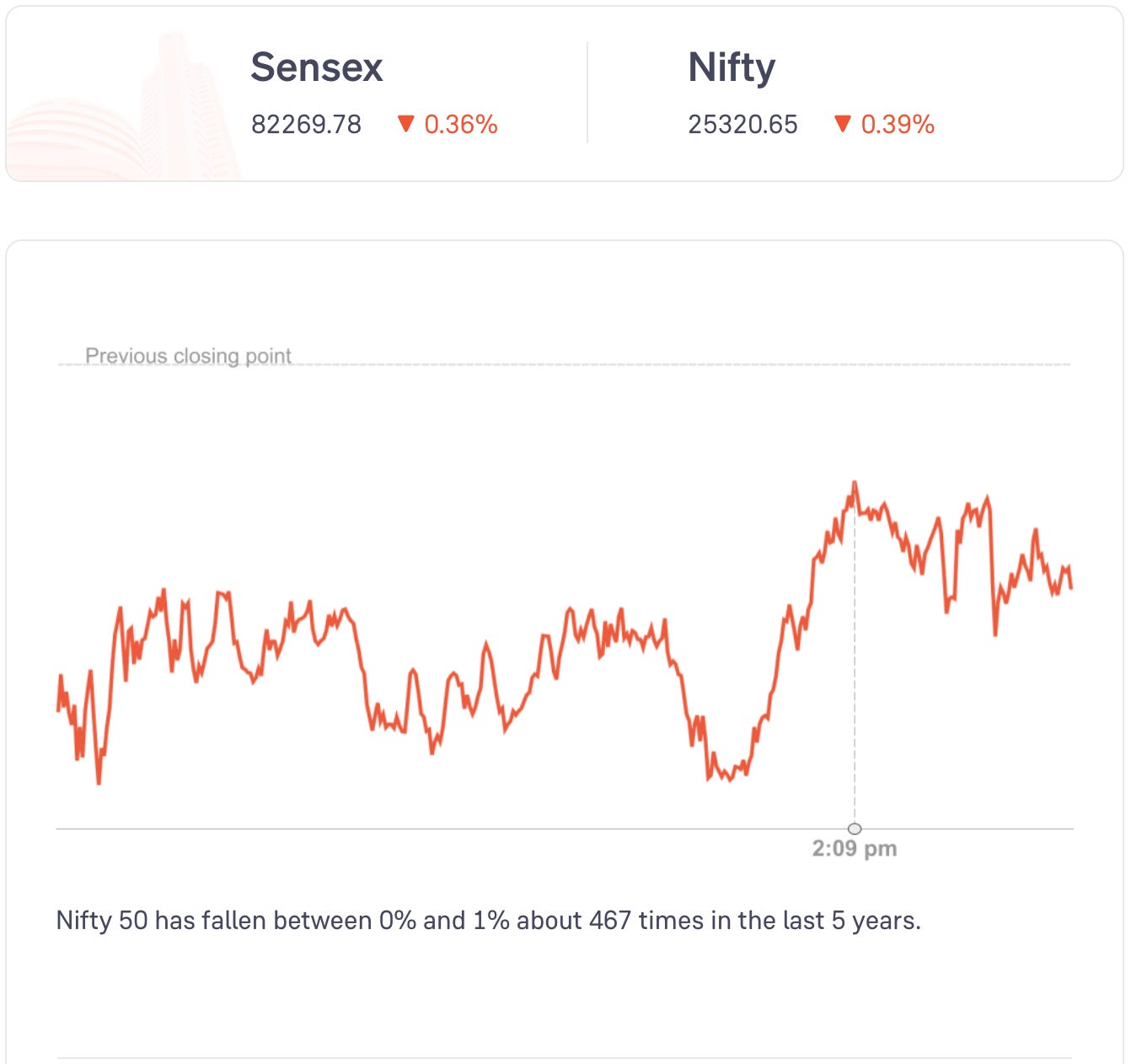
Markets opened below yesterday’s closing point.
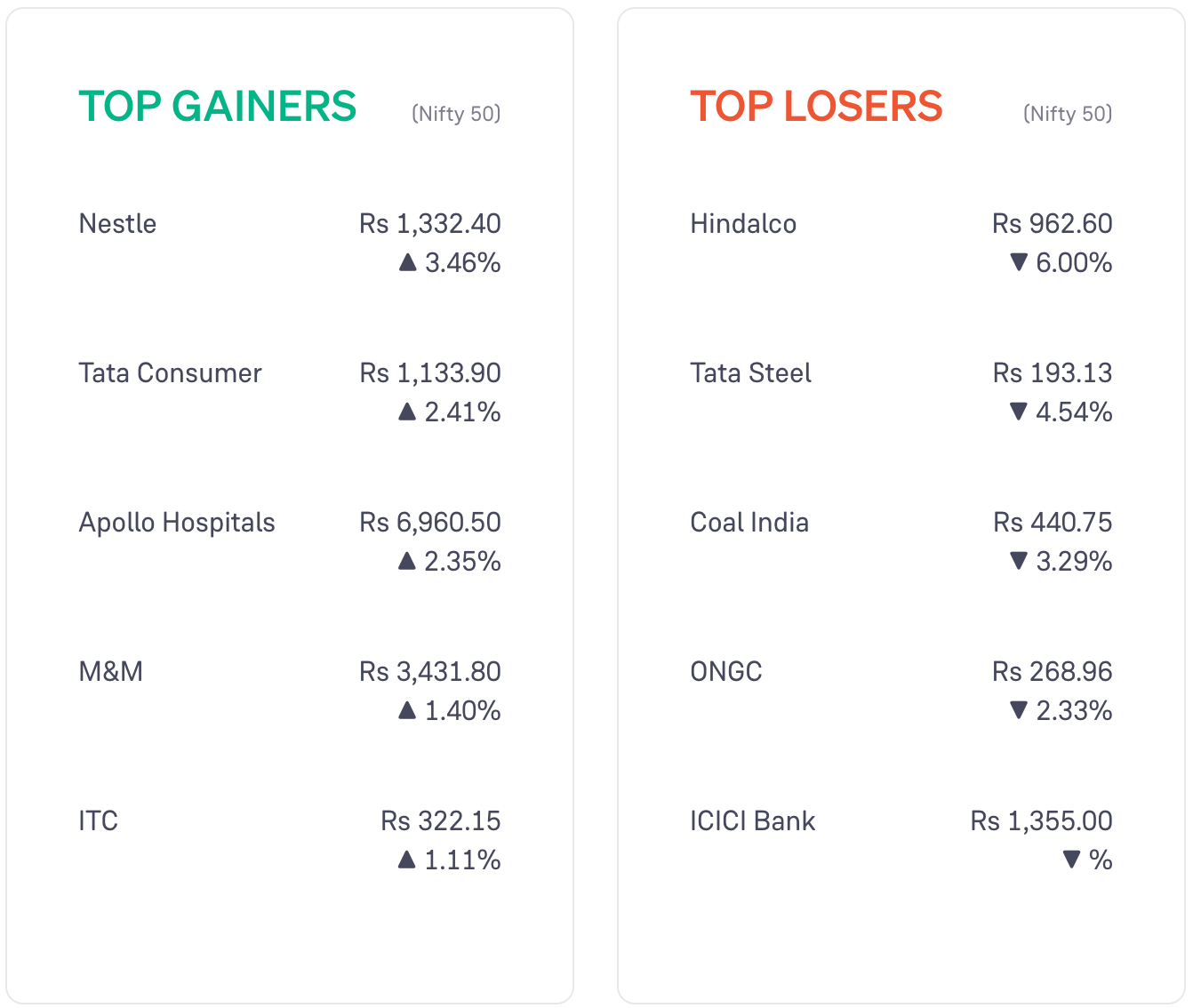
Media stocks and FMCG stocks rose the most today. Metal stocks and IT stocks fell the most.
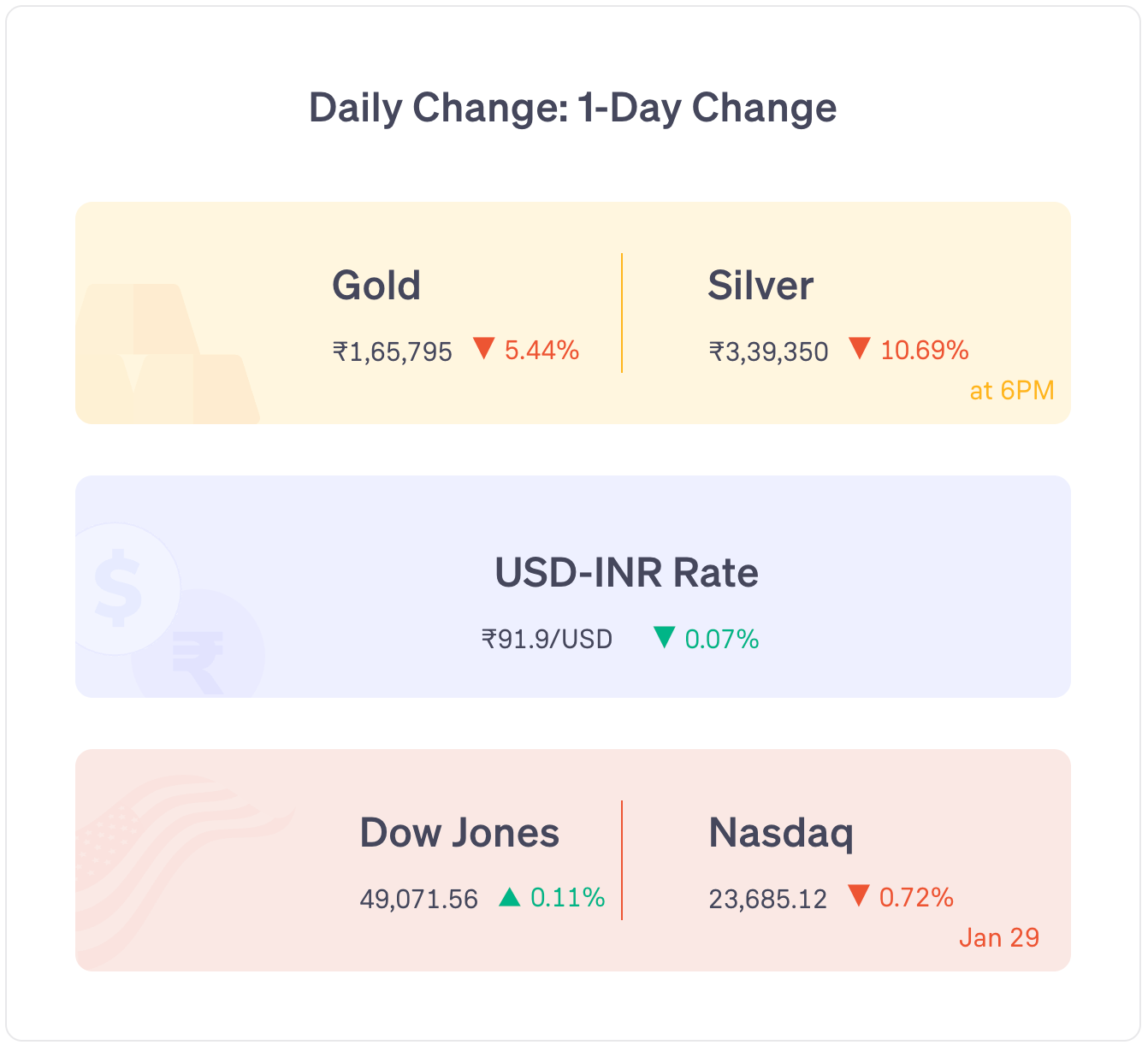
Global markets: Most US markets and most Asian markets fell. European markets rose (as of 6 pm IST).
News
The Indian markets will remain open on Sunday, 1 Feb, the day of the Union Budget announcement.
India’s forex reserves rose by $8.05 billion to $709.4 billion in the week that ended on 23 Jan.
The US’s exports rose 6.3% year-on-year in Nov, while imports increased by 5.8%. The trade deficit rose to $56.8 billion.
SEBI has given a no-objection certificate for NSE’s IPO: as per media reports.
Stocks Updates
Tata Steel: acquired a 50.01% stake in Thriveni Pellets for Rs 635 crore.
Tata Power: commissioned two 765 kV transmission lines in Uttar Pradesh. It enables evacuation of over 3,000 MW power.
HPCL: announced multiple partnerships at IEW 2026, including investing Rs 2 crore in Maraal Aerospace for clean energy UAVs, signing an MoU with IGX to enhance LNG terminal access at Chhara (Gujarat), and collaborating with Thermax on clean and new energy technologies.
NTPC: net profit rose 8.4% year-on-year to Rs 5,489 crore in the Oct-Dec quarter. Dividend declared: Rs 2.75 per share.
Bajaj Auto: net profit rose 25.2% year-on-year to Rs 2,750 crore in the Oct-Dec quarter. It will also invest up to Rs 12 crore in Clean Max Godavari to source wind and solar power for its Pune plants.
Nestle: net profit rose 45% year-on-year to Rs 998 crore in the Oct-Dec quarter. Dividend declared: Rs 7 per share. Record date: 6 Feb.
Bank of Baroda: net profit rose 4.4% year-on-year to Rs 5,443 crore in the Oct-Dec quarter. Interest income rose 2% to Rs 33,600 crore.
Cholamandalam Investment: net profit rose 18.5% year-on-year to Rs 1,290 crore in the Oct-Dec quarter. Dividend declared: Rs 1.3 per share. Record date: 5 Feb.
Ambuja Cement: net profit fell 91% year-on-year to Rs 204 crore in the Oct-Dec quarter.
Jindal Steel: net profit fell 80% year-on-year to Rs 190 crore in the Oct-Dec quarter.
Word of the Day
Equity Savings Fund
They are funds that invest in equity, debt and arbitrage opportunities
The goal is to reduce the risk faced by equity funds while aiming for better returns than pure debt funds.
They reduce risk by investing in debt investments up to 35%.
They are taxed the same as equity mutual funds.
6 Day Course
Theme: risk-adjusted returns
Day 5: Friday
Most great investors use various ratios in combination with subjective factors.
But nearly all of them worry about how much risk they are taking versus the returns they are getting.
When seen from this lens, many investments with higher returns also can seem like poor performers.
This can be seen in the case of bonds where the returns may be only 1-2% higher than the risk-free return but the risk may be much higher.
A good framework to think about this is to worry about the potential downside vs upside.
Example 1: in case of a corporate bond, the max upside is let’s say 8%. The max downside is 0% returns and loss of investment amount.
Example 2: in case of a company’s stock, the max upside is let’s say 20%. The max downside is 0% returns and loss of investment amount.
Example 3: in case of an early stage company’s stock, the max upside is let’s say 50%. The max downside is 0% returns and loss of investment amount.
Keeping these in mind can help investors decide if a certain investment is sufficiently rewarding for the risk being taken.
Featured Question
Q. “What if someone gifts half of his mutual fund units to his wife or parents and then both start redeeming as per SWP then how tax will be calculated for both of them.”When you gift mutual fund units, the onus of tax is completely on the gift receiver.
The gift giver does not have to pay any tax.
The receiver also has to pay a tax only in case of withdrawal.
How is the tax calculated?
As you might know, mutual fund taxation depends on the mutual fund type and the duration of the investment.
In case of gifted mutual fund units, the original investment date is considered as the buying date and the withdrawal date is considered as the selling date.
Tax is calculated accordingly.
This is in case the gift is to specified-relatives.
In case of gifts to non-specified relatives, there will be a gift tax that would have to be paid by the gift receiver in addition to capital gains tax.
The gift tax would have to be paid at the time of receiving the gift units, not when they withdraw.
Did you like this edition?
Leave a feedback here!