
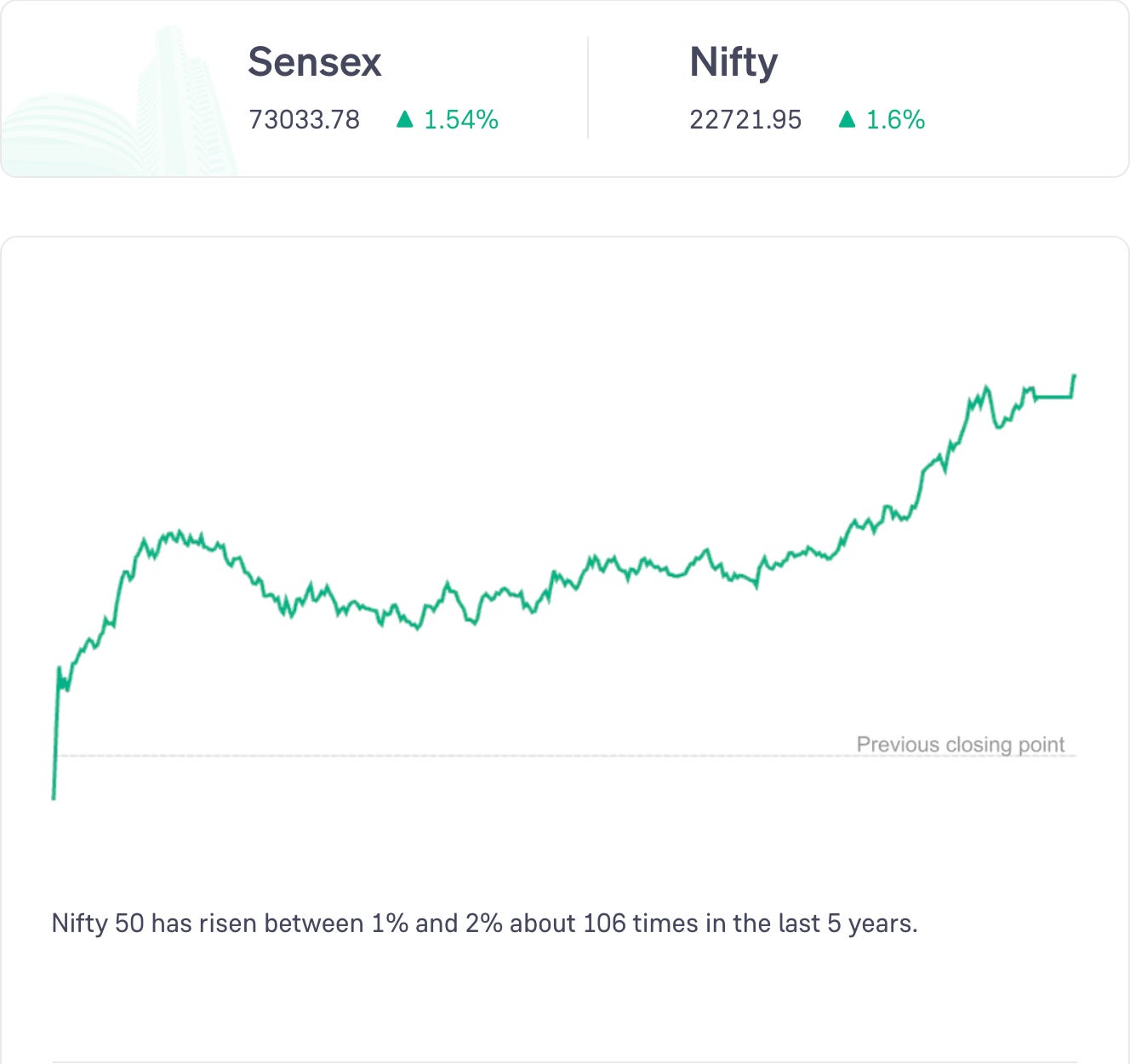
Markets closed significantly higher compared to yesterday’s closing point. The rise could be due to a rally in IT stocks and the rupee strengthening for the third continuous session after recent RBI measures.
All sectors’ stocks rose today except for the pharma stocks. IT stocks and realty stocks rose the most today.
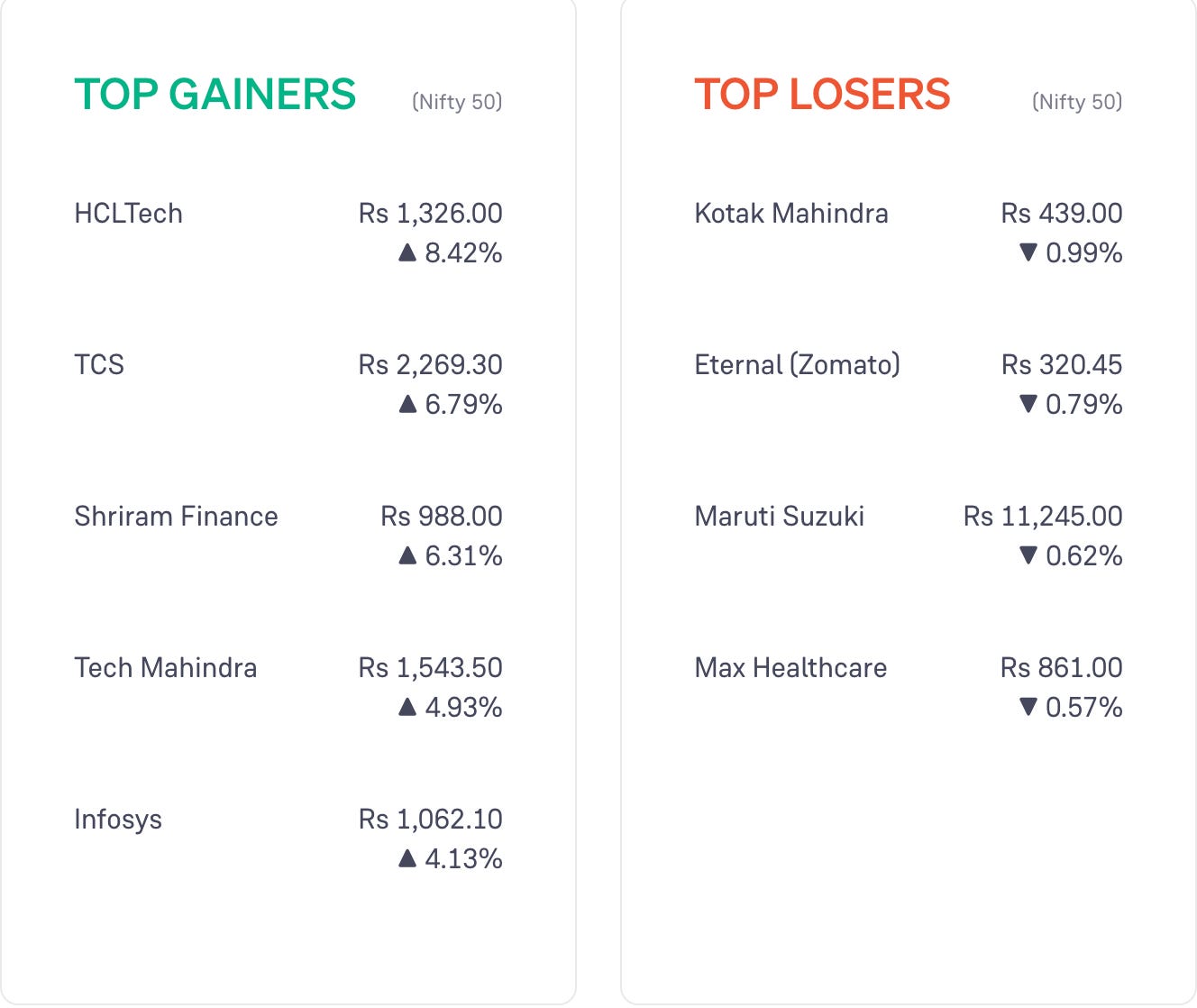
Only 4 stocks in Nifty 50 fell today. So there are only 4 stocks in the ‘Top Losers’ section.
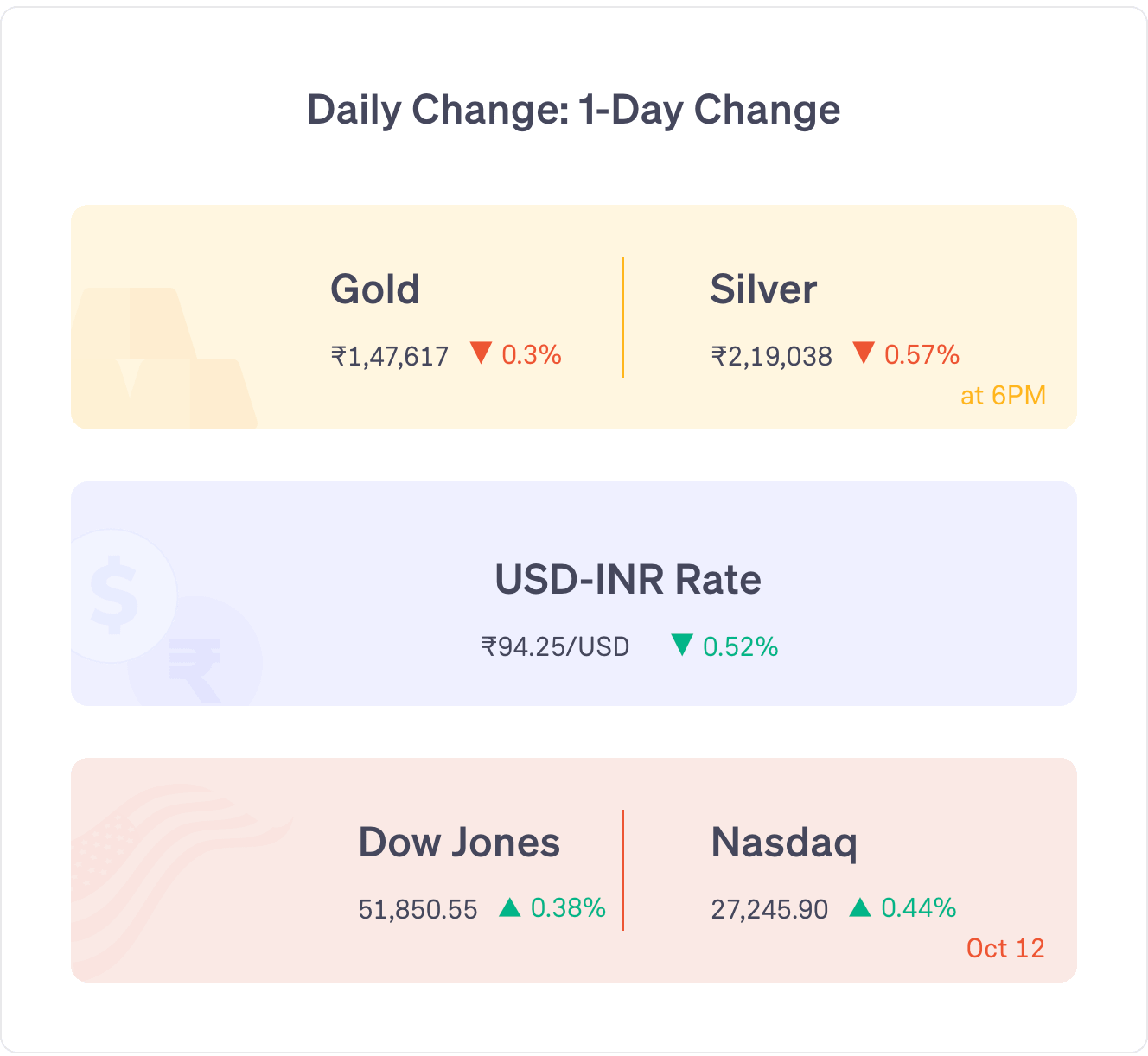
Global markets: US markets traded mixed on Monday. Asian markets were also mixed on Tuesday. Most European markets traded in green (as of 6 pm IST).
News
MDR on UPI transactions has been postponed until after Diwali, keeping the festive season in mind. The new start date has not been announced yet.
The IMF raised India’s economic growth forecast to 7% for FY27 (earlier forecast was 6.4%). Forecast for FY28 was also increased to 7% (vs 6.7% earlier).
HD Fire Protect’s Rs 712.31 crore IPO was subscribed 4.62 times on day 1. Retail subscription: 3.78 times. The IPO will close for subscription on 15 Oct.
Stock Updates
Bharat Electronics: received additional orders worth Rs 533 crore for communication equipment, avionics, drones, jammers, software, spares & services, etc.
Sun Pharma: approved plans to raise up to Rs 10,000 crore through unsecured NCDs via private placement.
Adani Enterprises: signed a non-binding MoU with US-based Jabil to form a 50:50 joint venture to manufacture AI and data-centre equipment in India, including servers, networking and cooling systems.
Wipro: said the US suspension of new PERM green card applications is not expected to significantly affect its business, as over 80% of its US workforce is hired locally.
Word of the Day
Conservative
In finance and investing, different assets carry different levels of risk.
Investors who stick to safer, lower risk options are called conservative investors.
It is a relative term often used to compare two styles.
Not just individual investors, ‘conservative’ can be used to describe a strategy, an investment institution, etc.
Examples:
“He is an extremely conservative investor who sticks to government bonds and bank deposits only”.
“This mutual fund generally has a conservative outlook and avoids investing in tech companies’ stocks”.
In investing, the opposite of conservative is aggressive.
Example:
“My brother is a more aggressive investor than I am”.
6 Day Course
Theme: understanding bond pricing
Day 2: Tuesday
In case of bonds, the longer the period, the riskier the bond is considered.
A bond that matures in 2 weeks is considered far less risky than a bond that matures in 10 years (all other factors being equal).
This is because as time increases, the probability of something going wrong increases.
This is why investors demand a higher return from bonds that mature later.
Of course, it goes without saying that bonds’ rates are also decided by the risk profile of the bond issuer.
A more stable and reliable bond issuer will offer lower interest rates than a higher risk one.
Example: for the same period, a small company’s bonds usually offer a higher interest than a large and stable company’s.
————
Featured Question
Q. “stock marketIn the share market, when too many shares are sold then the market falls, and when too many shares are bought then the market goes up, like if someone sells a thousand shares, then there is someone who will buy the thousand shares, there are buyers and sellers, then why is there an impact in the market?”
The impact is because the trades are happening at lower prices.
Let’s say you want to sell 10,000 shares of a company ABC.
The current share price is Rs 120 per share.
You try to sell by setting up a limit order of Rs 120 or above. Which means, the sale will only happen at a price of Rs 120 or above.
Now, let’s say, nobody is willing to pay Rs 120 each for 10,000 shares.
No trade will take place.
So wanting to sell, you reduce your selling price to Rs 119 — you set a limit order for selling at Rs 119 or higher.
Let’s say there are many buyers at this price and therefore all your 10,000 shares get sold.
But what happened? The stock price effectively fell from Rs 120 to 119.
The other way to sell is by placing a market order (instead of a limit order).
In market order, you are saying “sell at whatever price possible”.
The opposite happens when the share price goes up.
So, in short, the share prices get impacted because the prices being offered are different.
Now, say you want to sell 10,000 shares and the current share price is Rs 120.
And, say another buyer wanted to buy 10,000 shares at exactly that same price — Rs 120.
In this case, the trade will take place, and there will be no impact on the share price.
During active trading hours of the markets thousands of buy and sell orders are being placed at different price levels.
The share price we see is the price of the last transaction that took place.
The real method of transaction is a bit more complicated than this. There is an order book. There are multiple price bands and quantities in each band.
The simple version is as stated above.
The information presented in this post has been compiled and prepared by Groww Invest Tech Pvt Ltd and is intended solely for informational purposes. It is not tailored to any specific investment objectives, financial situations, or needs of any individual investor. The content should not be construed as investment, financial, legal, or tax advice and should not be relied upon as a substitute for professional consultation.
Investing in securities markets involves inherent risks. Investors are advised to carefully review all relevant documents and consider their own risk tolerance before making any investment decisions.
Mutual fund investments are subject to market risks; please read all scheme-related documents carefully. Past performance of financial instruments, schemes, or markets is not indicative of future results.
SEBI Reg Name: Groww Invest Tech Pvt Ltd | SEBI Reg No: INZ000301838 | RA No: INH200008662
Groww Invest Tech Pvt Ltd is registered with the Securities and Exchange Board of India (SEBI) under Registration No: INZ000301838, as a Research Analyst under No: INH200008662, as a Depository Participant under No: IN-DP-417-2019, and with the Association of Mutual Funds in India (AMFI) under ARN-111686.
SEBI registration details: View registered name and registration numbers
Did you like this edition?
Leave a feedback here!