

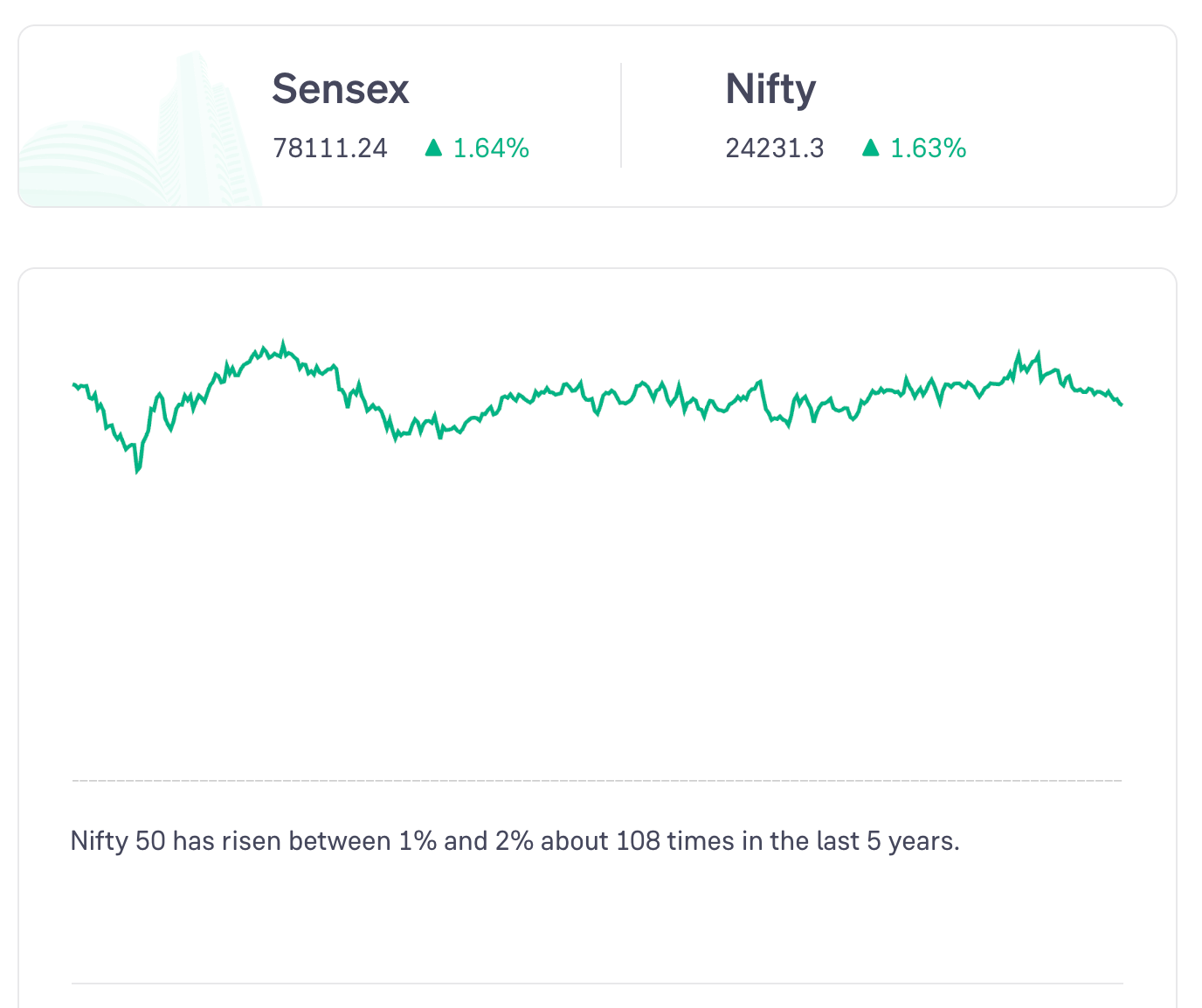
Markets opened above Monday’s closing point.
All sectors’ stocks rose today. Consumer durables stocks and IT stocks rose the most.
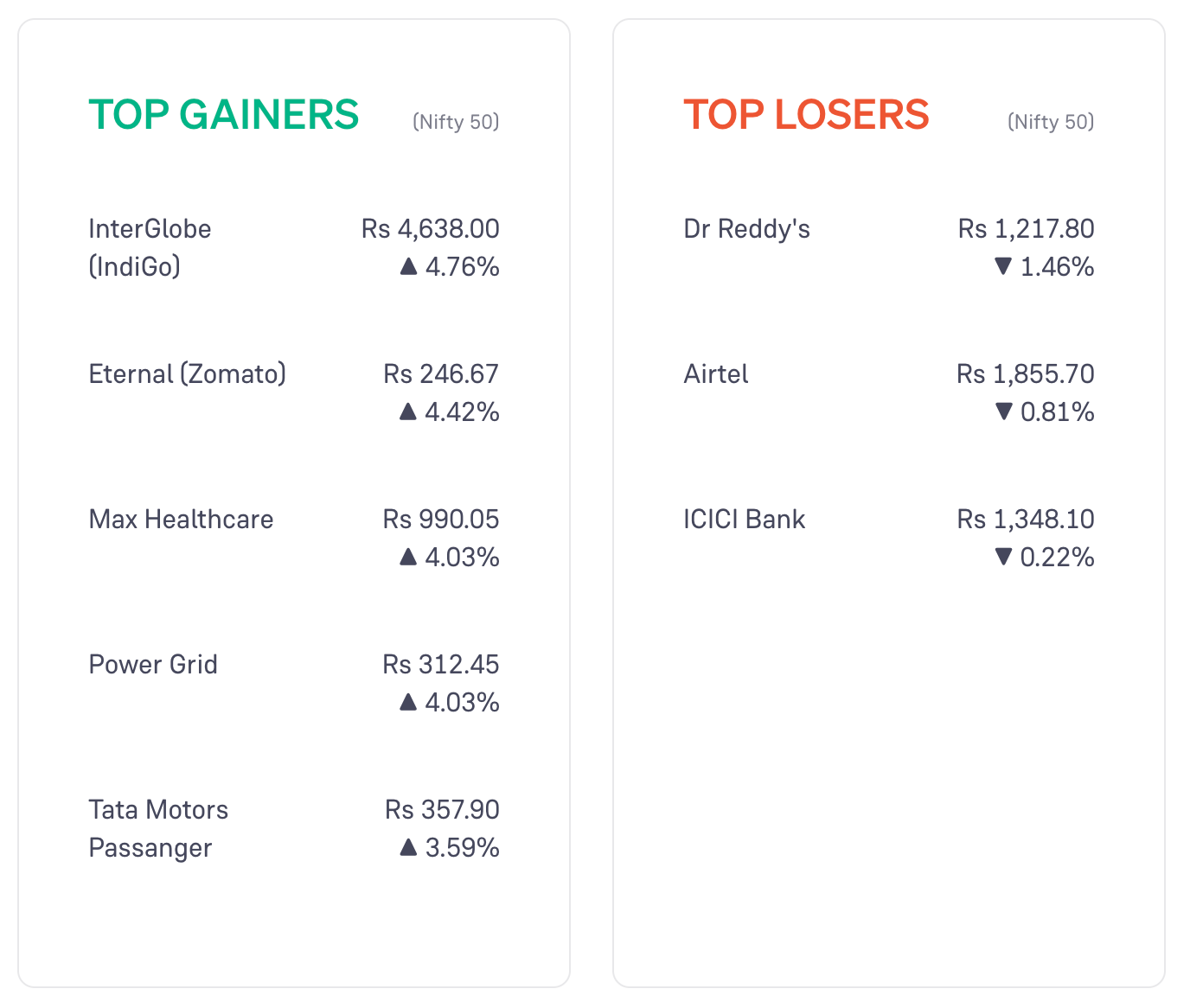
There are only 3 stocks in the Nifty 50 that fell today. Hence, there are only 3 stocks in the ‘Top Losers’ section.
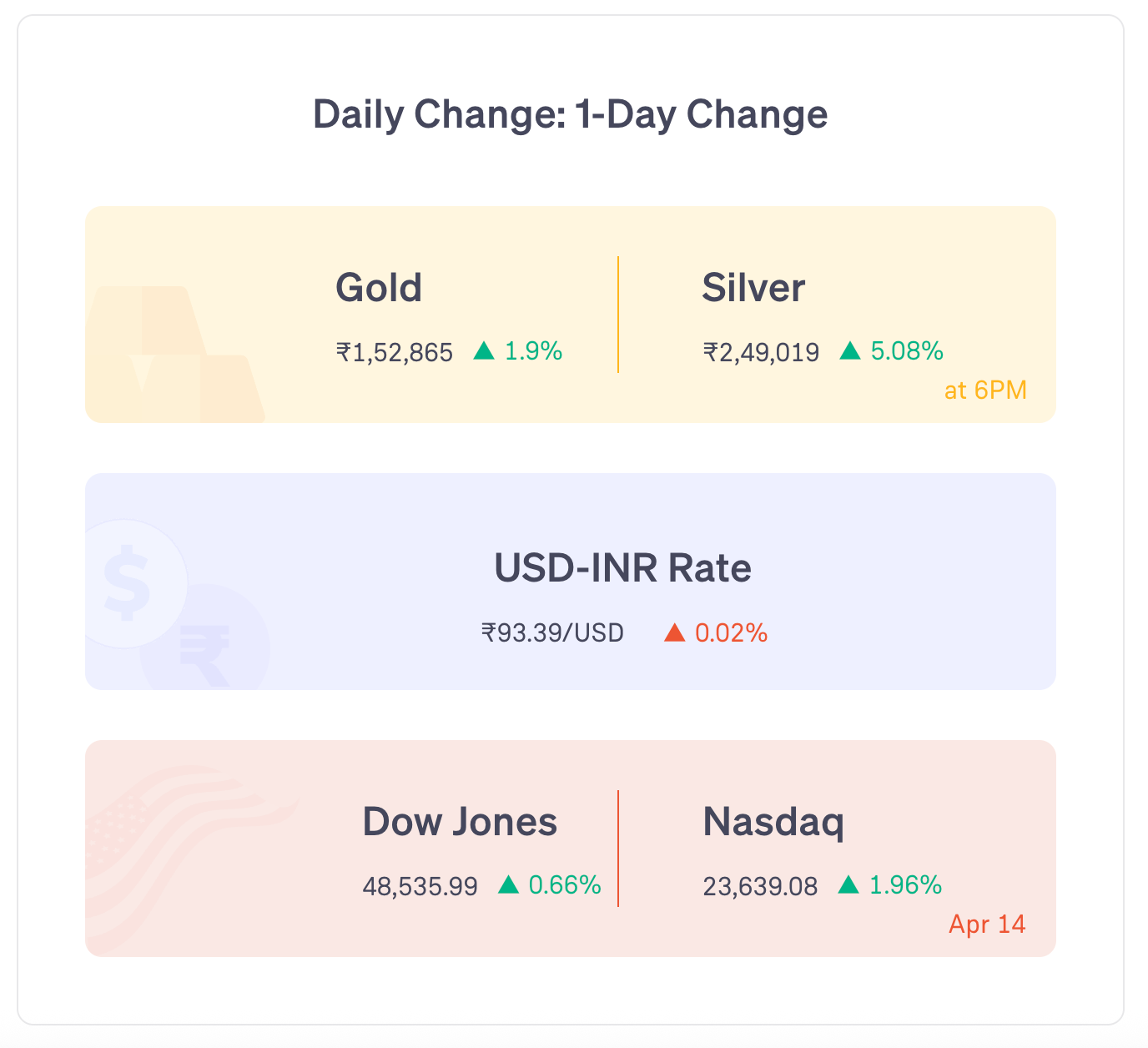
Global markets: US markets rose. Asian markets and European markets showed a mixed trend (as of 6 pm IST).
News
India’s merchandise exports fell 7.4% year-on-year in March. Imports fell 6.5%. The trade deficit narrowed to $20.67 billion.
India’s unemployment rate rose to 5.1% in March (vs 4.9% in Feb).
India’s passenger vehicle sales in FY25-26 grew 7.9% year-on-year to 46.43 lakh units, the highest in a financial year. Sales in March rose 16% to 4.42 lakh units: SIAM
India’s wholesale inflation rose 3.88% year-on-year in March (vs 2.13% in Feb).
Amazon has signed an agreement to acquire satellite firm Globalstar for about $11.57 billion to strengthen its own low-Earth orbit satellite network and compete with SpaceX’s Starlink.
Stocks Updates
Wipro: will acquire select customer contracts of US-based Alpha Net Consulting for up to $70.8 million to expand IT services business.
JSW Steel: NCLT has reopened the takeover process for Colour Roof (India), allowing other bidders to participate again.
Shriram Finance: subsidiary Shriram Overseas Investments Ltd, received initial approval from RBI to start Primary Dealer (PD) business, subject to compliance.
Varun Beverages: acquired a 29.99% stake in FPEL HR2 Energy Private Ltd, a solar power SPV in Haryana, for Rs 1.58 crore, to source captive solar power.
Power Finance: subsidiary PFC Consulting Ltd has set up 4 transmission SPVs to develop projects in Rajasthan and Karnataka.
Adani Energy: subsidiary Adani Electricity Mumbai Infrastructure Limited, commissioned a 1,000 MW HVDC power transmission link between Kudus and Aarey in Mumbai.
Dr Reddy’s: Russian subsidiary, Dr Reddy’s Laboratories LLC Russia, received a tax penalty of RUB 9.27 million (Rs 1.14 crore) from Russian tax authorities.
Word of the Day
Variable Interest Rate
It is the interest rate on a loan or an investment that changes over time.
It is linked to a benchmark rate (eg: RBI’s repo rate), and moves up and down as the market conditions change.
When the benchmark rate changes, the interest rate for the loan/investment will change too.
For example: in home loans, the monthly payments (EMIs) can change. They may reduce when rates fall, but can increase when rates rise.
Thus, while variable interest rates may lower payments at times, they can also bring uncertainty and risk (as opposed to a fixed interest rate).
6 Day Course
Theme: sector rotation
Day 3: Wednesday
The period right after the recovery phase is called the expansion or growth phase.
During this period, it is clear that a recovery has taken place and doubt largely vanishes.
This leads more people to feel comfortable and confident about spending money.
Similar sentiments are felt by companies and businesses.
In short, more money gets spent in all directions, including discretionary and non-essential spending.
Banks start lending more readily as they feel confident about people’s ability to pay back.
The central bank may start increasing the interest rate in this phase.
The phase after this is euphoria.
Everyone feels extremely bullish about the future and spends a lot. Maybe even recklessly.
Lending increases further and lenders relax their checks.
Due to higher spending, inflation might start to creep in. Central banks may start increasing interest rates even higher.
Featured Question
Q. “Is it the right time for investing on the stocks those seems to be down trending for quite sometime and noticed to be moving upwards”
This strategy, on its own, is not good.
Stocks that have been falling for a long time could start going up for any reason. It could be because the company is improving again. It could be temporary rise before another big crash.
There are numerous reasons.
But yes, some good quality companies can also show a similar pattern.
The only way to verify is to look beyond the share price pattern.
In case of such stocks, investors need to understand how the company is doing as a business.
Investors also need to understand if the shares are valued correctly (fair, undervalued, or overvalued).
Investors need to gauge the future of the company and its potential growth.
In short, investors need to analyse the company’s stock just like analysing any other company’s stock — only that will lead to an answer.
Simply investing based on stock price history patterns is not a good idea.
The information presented in this post has been compiled and prepared by Groww Invest Tech Pvt Ltd and is intended solely for informational purposes. It is not tailored to any specific investment objectives, financial situations, or needs of any individual investor. The content should not be construed as investment, financial, legal, or tax advice and should not be relied upon as a substitute for professional consultation.
Investing in securities markets involves inherent risks. Investors are advised to carefully review all relevant documents and consider their own risk tolerance before making any investment decisions.
Mutual fund investments are subject to market risks; please read all scheme-related documents carefully. Past performance of financial instruments, schemes, or markets is not indicative of future results.
Groww Invest Tech Pvt Ltd is registered with the Securities and Exchange Board of India (SEBI) under Registration No: INZ000301838, as a Research Analyst under No: INH200008662, as a Depository Participant under No: IN-DP-417-2019, and with the Association of Mutual Funds in India (AMFI) under ARN-111686.
SEBI registration details: View registered name and registration numbers
Research Analyst Disclaimer: View Research Analyst disclaimer
Did you like this edition?
Leave a feedback here!
Thank you