

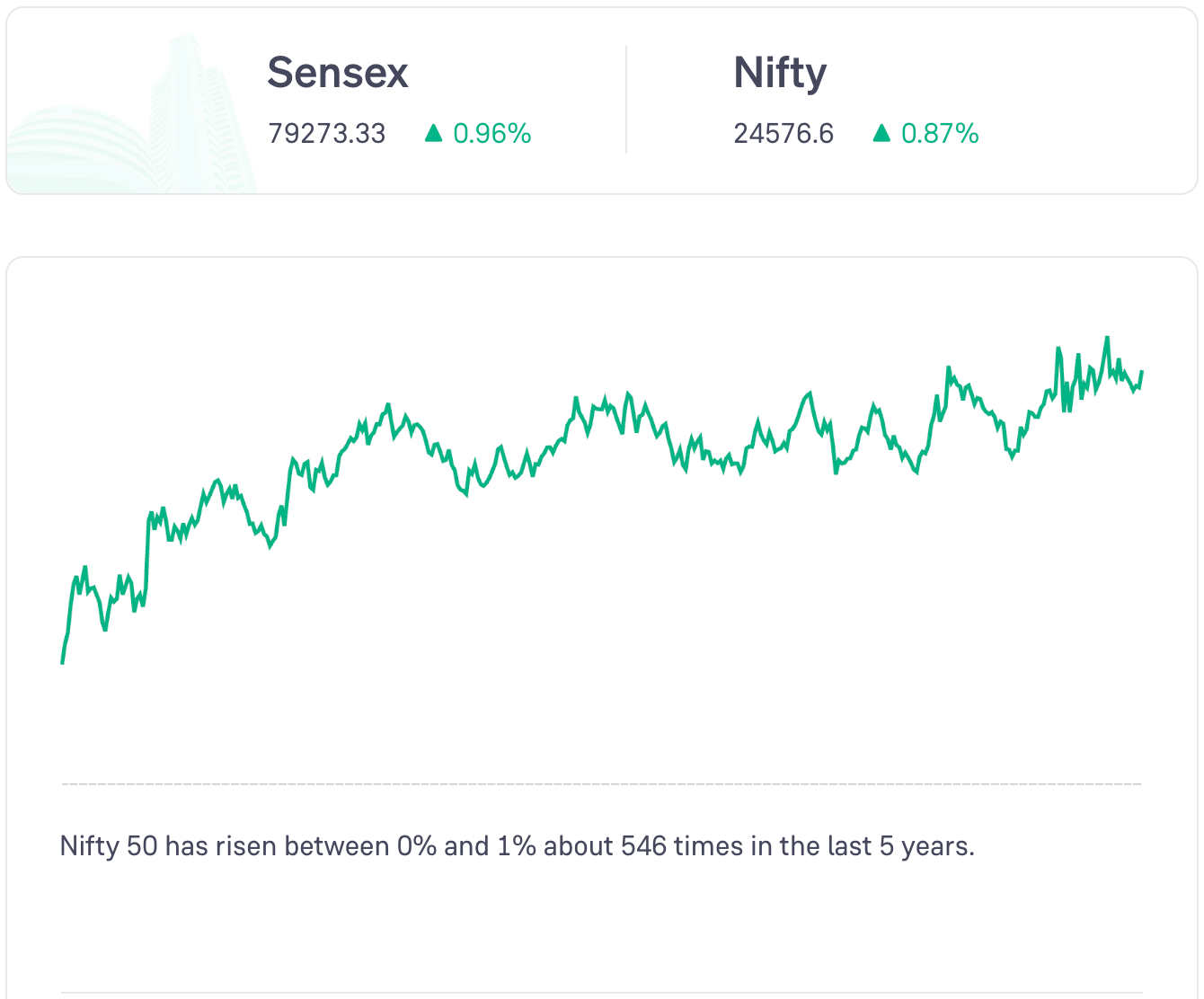
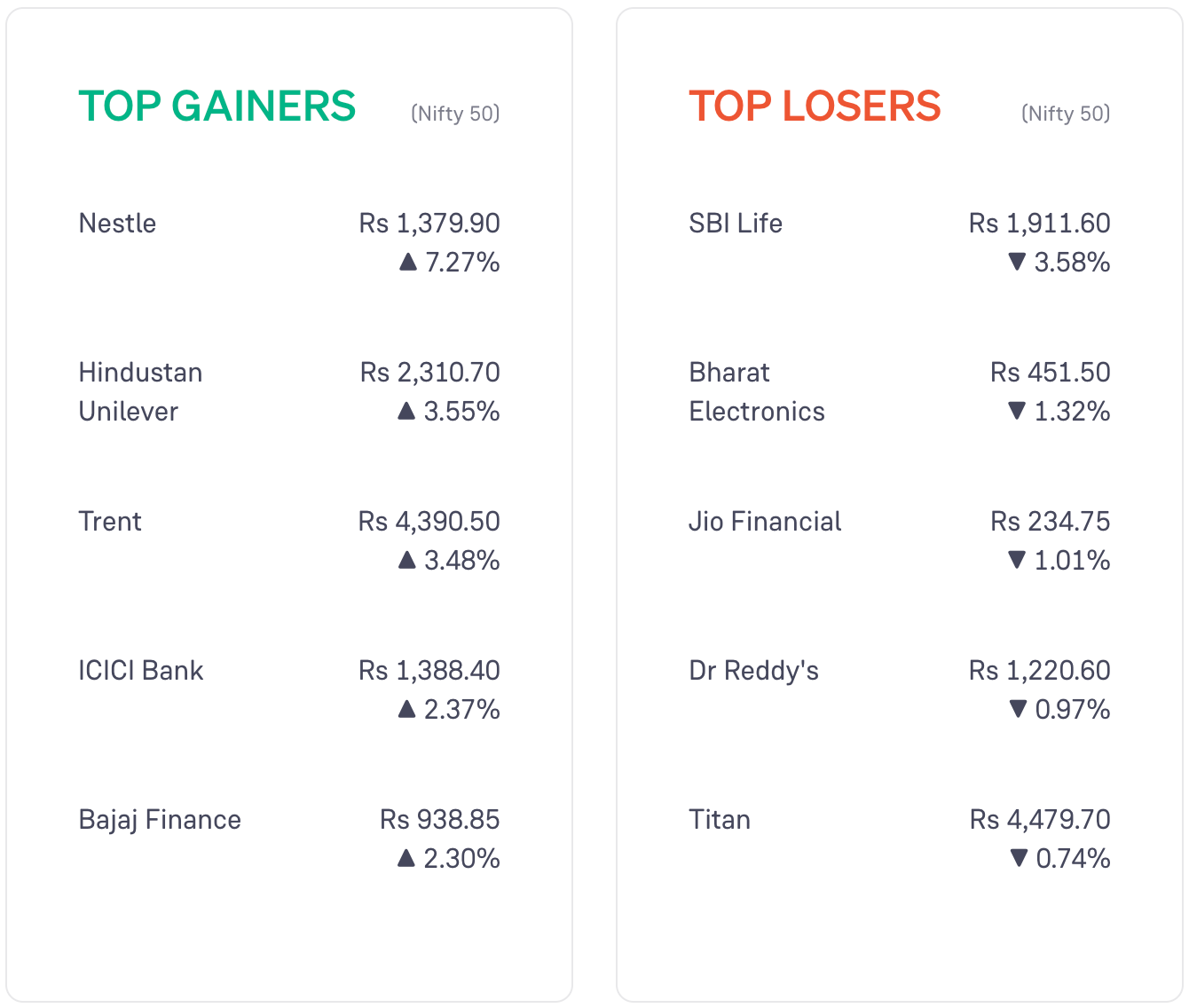
Markets opened above yesterday’s closing point.
All sectors’ stocks rose today except for the pharma stocks and consumer durables stocks. FMCG stocks and realty stocks rose the most.
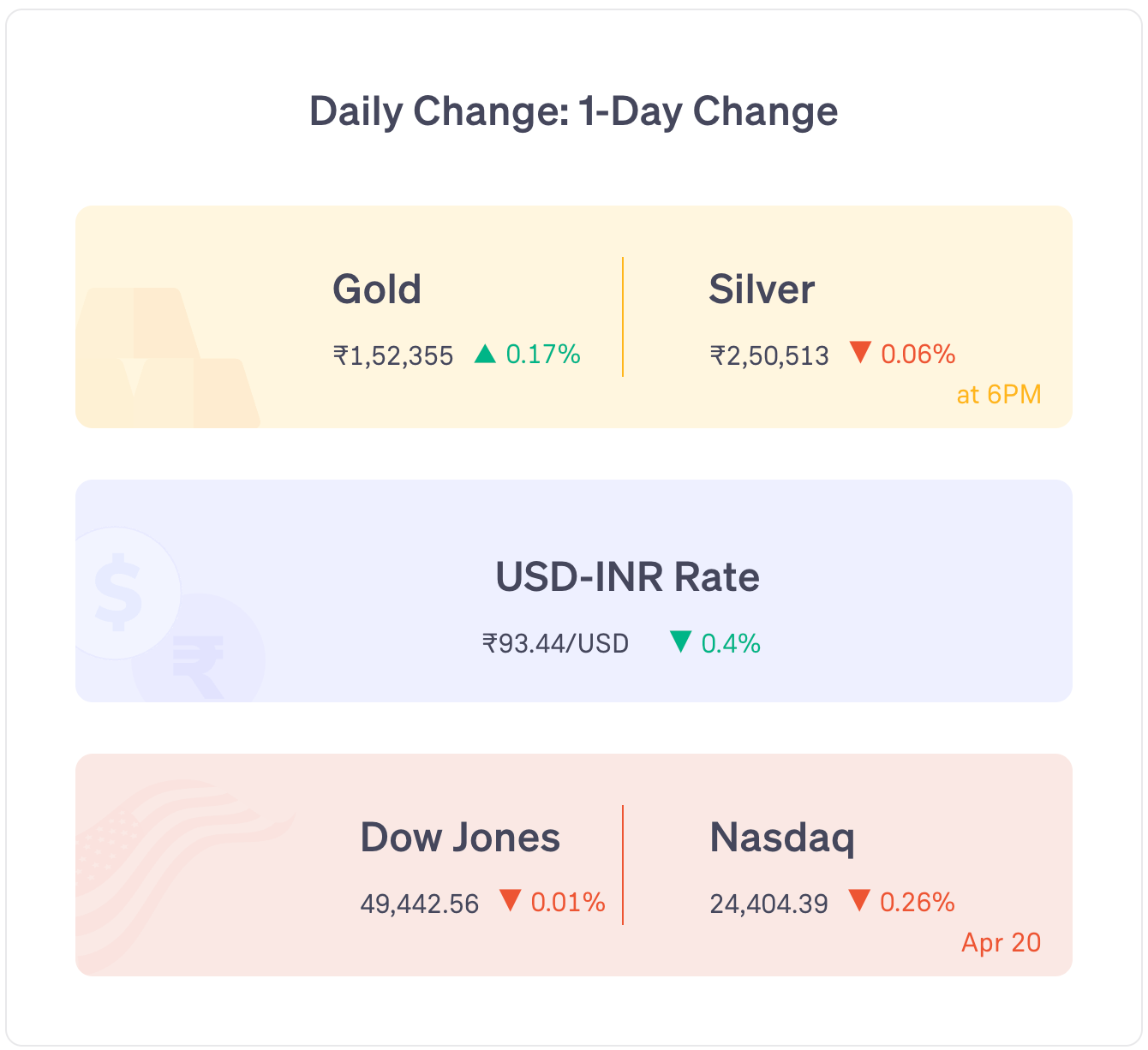
Global markets: US markets showed a mixed trend. Asian markets rose. European markets showed a mixed trend (as of 6 pm IST).
News
The Ministry of Defence signed contracts worth Rs 975 crore with Bharat Earth Movers Limited (BEML) and Electro Pneumatics and Hydraulics (India) Private Limited for the procurement of TRAWL Assembly for T-72 and T-90 tanks.
SEBI has reduced the minimum investment in social impact funds from Rs 2 lakh to Rs 1,000 to widen retail participation on the Social Stock Exchange.
Stocks Updates
HCL Tech: net profit rose 4.2% year-on-year to Rs 4,488 crore during the Jan-March quarter. Dividend announced: Rs 24 per share, with 5 May as the record date.
Nestle: net profit rose 6.9% year-on-year to Rs 3,544.6 crore during the Jan-March quarter. Dividend announced: Rs 5 per share, with 10 July as the record date.
Coal India: Ministry of Corporate Affairs (MCA) proposed striking off subsidiary CIL Solar PV Ltd under Companies Act provisions.
TVS Motor: signed an agreement with Hyundai to develop and commercialise electric three-wheelers. TVS will hold exclusive worldwide manufacturing rights and handle India sales, while Hyundai will lead design and manage sales in Korea. TVS also entered the Zambian market with a multi-product launch to expand its African presence.
Tata Steel: partnered with Paul Wurth S.A. (part of SMS Group) to implement the world’s first EASyMelt technology in Jamshedpur.
Adani Power: subsidiary, Adani Atomic Energy Ltd, incorporated a wholly owned subsidiary, Rawatbhata-Raj Atomic Energy Ltd, to generate, transmit, and distribute nuclear/atomic energy-derived power.
Word of the Day
EBITDA
It is a measure of a company’s operating performance and profitability
It stands for earnings before interest, taxes, depreciation, and amortisation.
It helps investors understand how the core business is performing, without the impact of financing and accounting decisions.
A higher EBITDA generally indicates stronger operational efficiency.
6 Day Course
Theme: automation in investing
Day 2: Tuesday
Now, let’s talk about some automation tools that are similar to the ones we spoke about yesterday, but a bit more advanced.
Trailing stop loss: So, let’s say a stock is rising fast. To prevent loss but also not miss out on the newly made gains, investors keep moving the stop loss price higher as the price moves higher.
This can be done with a trailing stop loss.
Bracket orders: this is a combination of some tools we discussed.
In it, investors can define:
- the price at which (or below) the buying will happen
- the price at which profit will be booked (selling price if stock goes up)
- the price at which the loss will be cut (selling price if stock goes down)
Time based order: as the name sounds. In this, investors place an order with certain conditions (buying/selling price), and define the period when this order will expire.
If the buy/sell conditions are not met in that time period, the order gets canceled.
Featured Question
Q. “Wipro announces buyback @250 and if i buy it on current cmp which is much lower then will i be in a profit ? easy money right?”
If you bought at a price much lower (let’s say Rs 200), then you can take part in the buyback.
Easy money — yes.
But there are some conditions which prevent it from being easy.
Usually, for being eligible, investors must own the shares on or before a certain date. This is called the record date.
If the current share price is lower but an investor has missed buying before the record date, they are ineligible for the buyback.
Also, when a buyback is taking place, other investors also start buying quickly. This causes the share price to rise.
This new price can be similar or higher than the current price. This removes the opportunity to make a profit.
Also, companies perform buybacks for a certain number of shares only. Once that is done, they stop buying.
So if you are unable to sell in that chunk, you will not get the buyback price.
This is called the acceptance ratio.
For example: you might want to sell 200 shares in the buyback. But they might buy only 10 shares from you. In this case, the acceptance ratio is 5%.
The information presented in this post has been compiled and prepared by Groww Invest Tech Pvt Ltd and is intended solely for informational purposes. It is not tailored to any specific investment objectives, financial situations, or needs of any individual investor. The content should not be construed as investment, financial, legal, or tax advice and should not be relied upon as a substitute for professional consultation.
Investing in securities markets involves inherent risks. Investors are advised to carefully review all relevant documents and consider their own risk tolerance before making any investment decisions.
Mutual fund investments are subject to market risks; please read all scheme-related documents carefully. Past performance of financial instruments, schemes, or markets is not indicative of future results.
Groww Invest Tech Pvt Ltd is registered with the Securities and Exchange Board of India (SEBI) under Registration No: INZ000301838, as a Research Analyst under No: INH200008662, as a Depository Participant under No: IN-DP-417-2019, and with the Association of Mutual Funds in India (AMFI) under ARN-111686.
SEBI registration details: View registered name and registration numbers
Research Analyst Disclaimer: View Research Analyst disclaimer
Did you like this edition?
Leave a feedback here!