
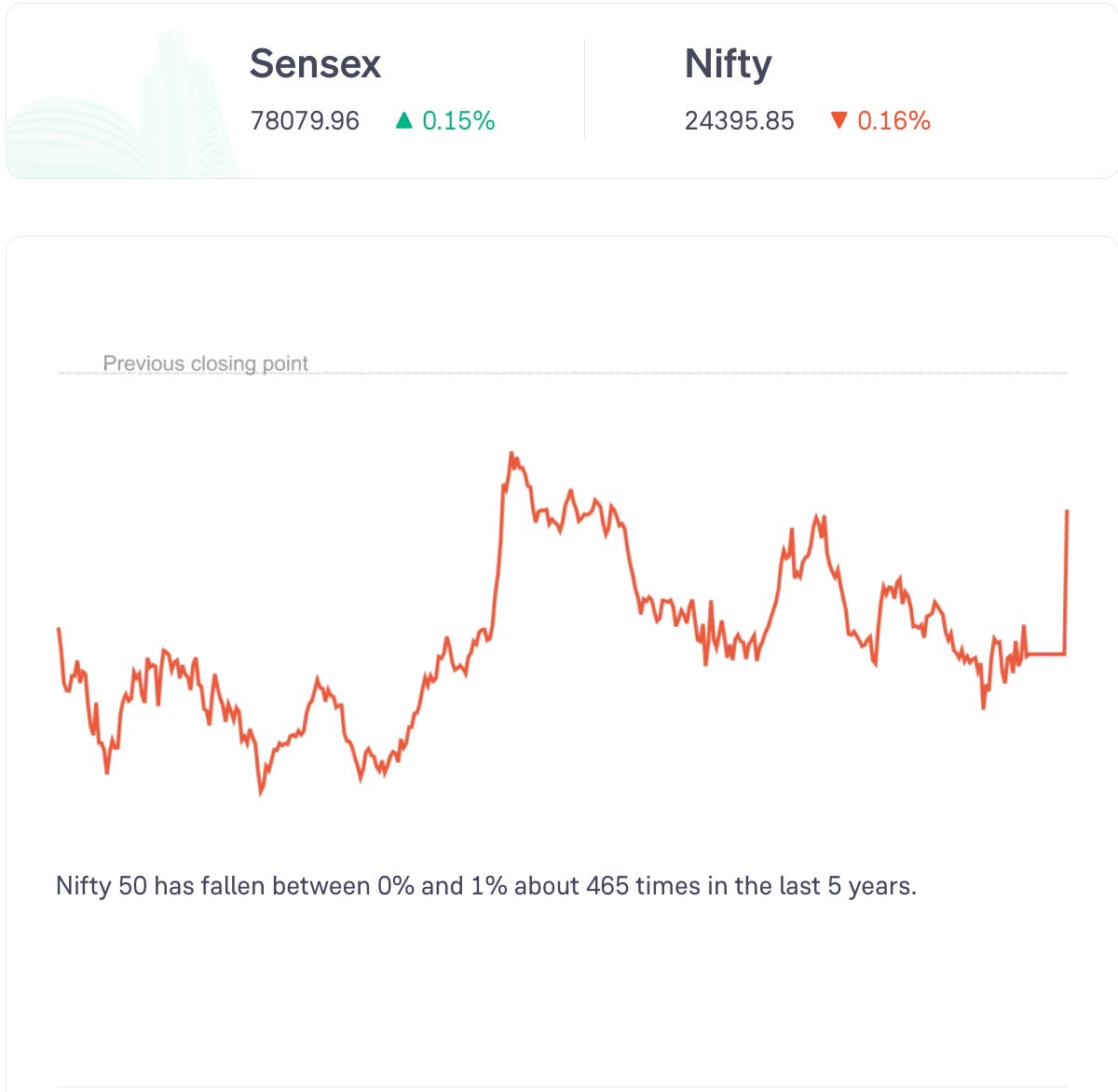
Markets closed flat compared to yesterday’s closing point.
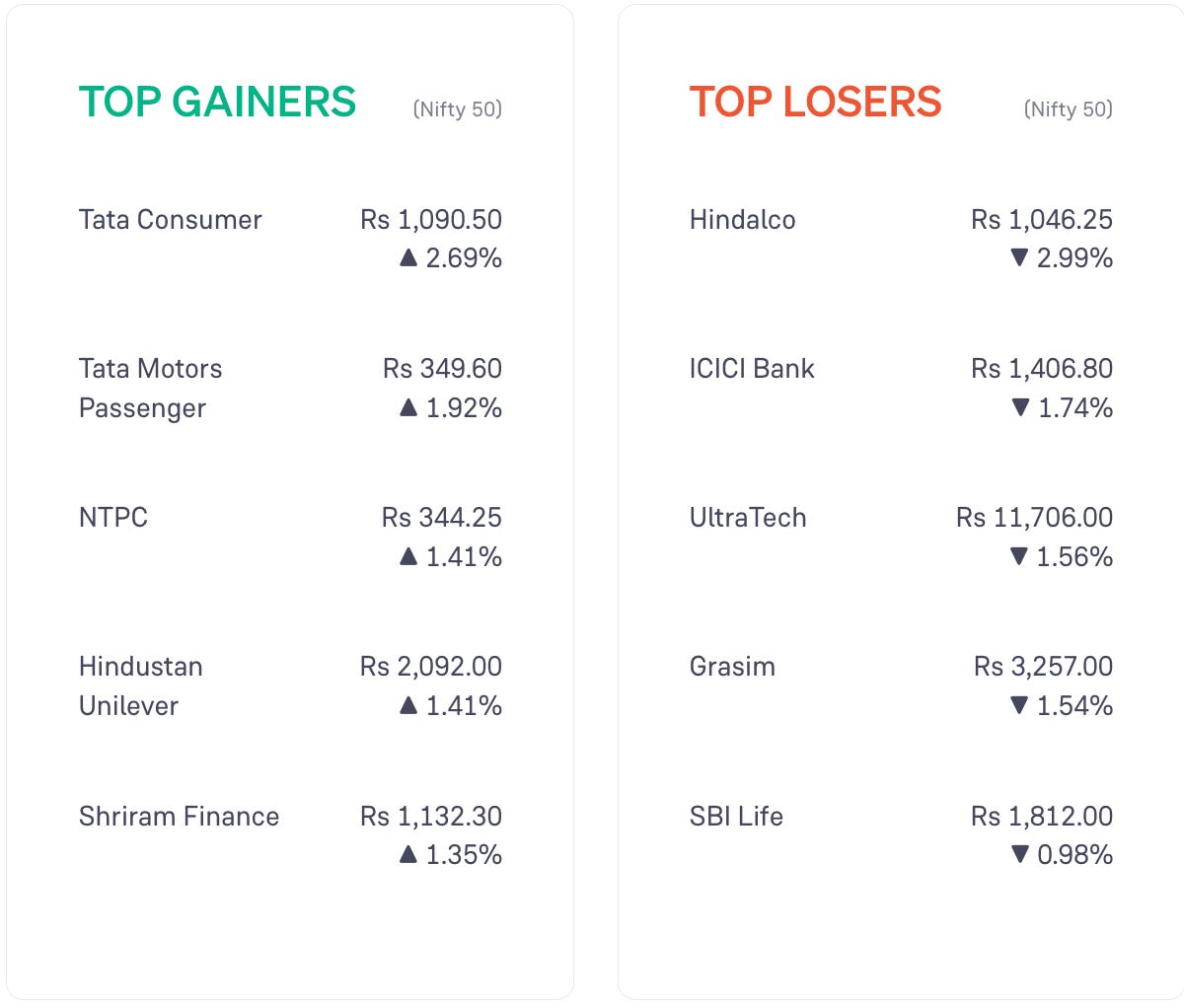
Metal stocks and cement stocks fell the most today. Chemical stocks and realty stocks rose the most.
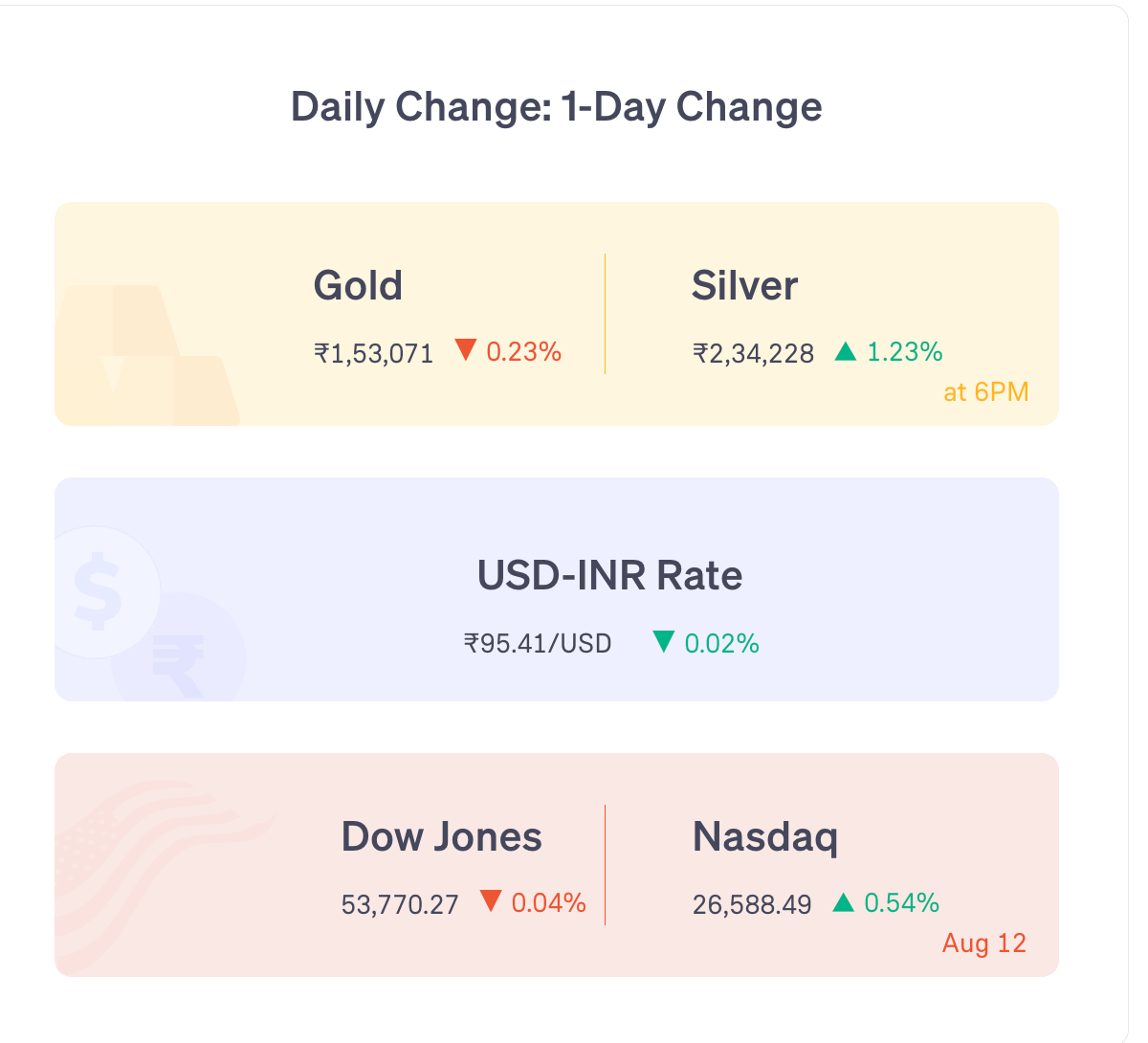
Global markets: US markets ended mixed on Wednesday. Most Asian markets also traded mixed on Thursday. European markets showed a mixed trend (as of 6 pm IST).
News
India’s merchandise exports rose to $44.24 billion in July compared to $36.98 billion a year ago. Petroleum Products, Electronic Goods, Engineering Goods, Organic & Inorganic Chemicals etc, were the major drivers of merchandise exports.
MSCI will add four companies (Adani Energy Solutions, Billionbrains Garage Ventures, Laurus Labs and Lenskart Solutions) to its Global Standard Index and it will remove Astral, Balkrishna Industries and SBI Cards, effective from 1 September.
Milky Mist’s IPO was subscribed 56.12 times on day 3. Retail subscription: 8.41 times. The IPO will close for subscription on 13 August.
Shiprocket IPO was subscribed 3.16 times on day 2. Retail subscription: 9.77 times. IPO will close for subscription on 14 August.
Stocks Updates
L&T: subsidiary LTN Compute secured a mega order (Rs 10,000 cr - Rs 15,000 cr) to build a 10,000-GPU NVIDIA B300 AI Factory for US-based Together AI at L&T’s Chennai data centre campus.
Solar Industries: net profit rose 92.66% year-on-year to Rs 652.55 crore in the April-June quarter.
Jio Financial: Bank of America (BofA) agreed to invest up to Rs 18,268.22 crore in subsidiary Jio Credit Ltd through shares and warrants. BofA will initially acquire 26.50% and can increase its stake to 49.90% after full conversion of the warrants, subject to approvals.
BHEL: signed a strategic agreement with Norway-based Hystar AS for PEM electrolyser systems for green hydrogen projects in India.
Tata Motors Passenger: net profit fell 80.25% year-on-year to Rs 775 crore in the April-June quarter. The year-on-year comparison is affected by the demerger of the commercial vehicles business, whose appointed date was 1 July 2025.
Apollo Hospitals: net profit rose 34.17% year-on-year to Rs 580.70 crore in the April-June quarter.
GMR Airports: reported a net profit of Rs 91.04 crore in the April-June quarter from a net loss of Rs 211.59 crore in the year-ago quarter. The board also approved raising up to Rs 5,000 crore via securities and up to Rs 1,500 crore through non-convertible bonds to refinance existing NCBs.
LG Electronics India: net profit rose 27.20% year-on-year to Rs 652.86 crore in the April-June quarter.
Aditya Birla Capital: allotted secured NCDs worth Rs 835 crore on a private placement basis. The company allotted Rs 350 crore of NCDs at a 7.98% coupon rate and Rs 485 crore at an 8.0163% coupon rate.
Indian Hotels: received an additional penalty claim of Rs 5.51 crore from the BMC on unpaid property taxes for Taj Lands End, Mumbai, taking the total penalty claim to Rs 103.08 crore.
Max Healthcare: net profit rose 4.71% year-on-year to Rs 322.49 crore in the April-June quarter. The board also approved around Rs 425 crore of capex to construct an additional hospital block at Max Super Speciality Hospital, Vaishali.
Aurobindo Pharma: incorporated wholly owned subsidiary Auropharm Overseas Ltd to undertake pharmaceutical manufacturing and marketing operations in India and overseas.
Word of the Day
OEM
OEMs are companies that supply equipment or parts to another company
OEM = Original Equipment Manufacturer
OEMs manufacture products that are sold with the client company’s brand name.
Consider the automobile industry.
A fuel filter making OEM company might be making a part that gets fitted in a car of another company.
That part will be used and sold by that car company as its own part.
The same part may be manufactured by many different OEM companies and supplied to the car company as per its exact specifications.
6 Day Course
Theme: micro-cap investing
Day 4: Thursday
Micro-cap companies usually tend to be a lot more susceptible to shocks.
Since their operations are small and have a limited number of customers, many of them suffer greatly when a change in consumer behaviour occurs or an external shock stresses the company.
This is why many micro-cap companies go bankrupt or suffer huge hits to their revenues during recessions.
The flip side of this is that since these companies are small, they are also much more nimble.
They are often able to adapt quickly and make changes to their operations and products in response to the markets’ demands.
It is this nimble nature of theirs that enables them to grow fast too.
This is why some micro cap companies’ earnings grow very fast and therefore result in their stocks growing fast as well.
————
Featured Question
Q. “Quite often we receive a communication from mutual fund AMCs regarding increase in base expense ratio. Is there any cap/regulation on the frequency or quantum of increase of the expense ratios?”
There is no restriction on the number of times an AMC can change a mutual funds’ base expense ratio (BER).
But there is a cap on the max base expense ratio they can charge.
These caps are based on the category and subcategory of the mutual fund and total money that mutual fund is managing or Assets Under Management (AUM).
The bigger a mutual fund (higher AUM), the lower the max BER allowed.
Did you like this edition?
Leave a feedback here!