
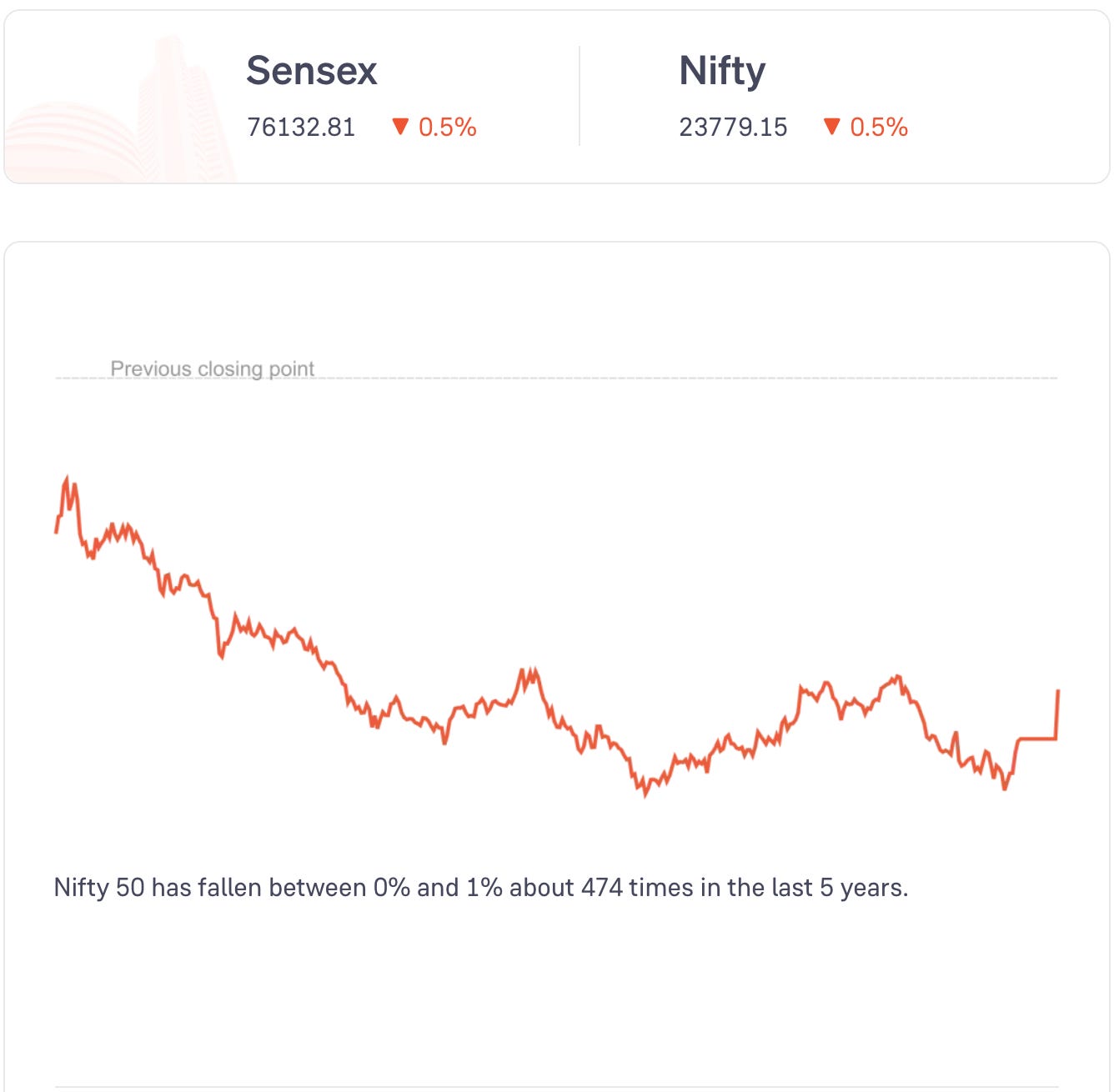
Markets closed lower compared to Friday’s closing point.
Nifty 50 fell throughout the day, and the major reason for the fall in markets could have been due to rising oil prices, and a fall in IT stocks.
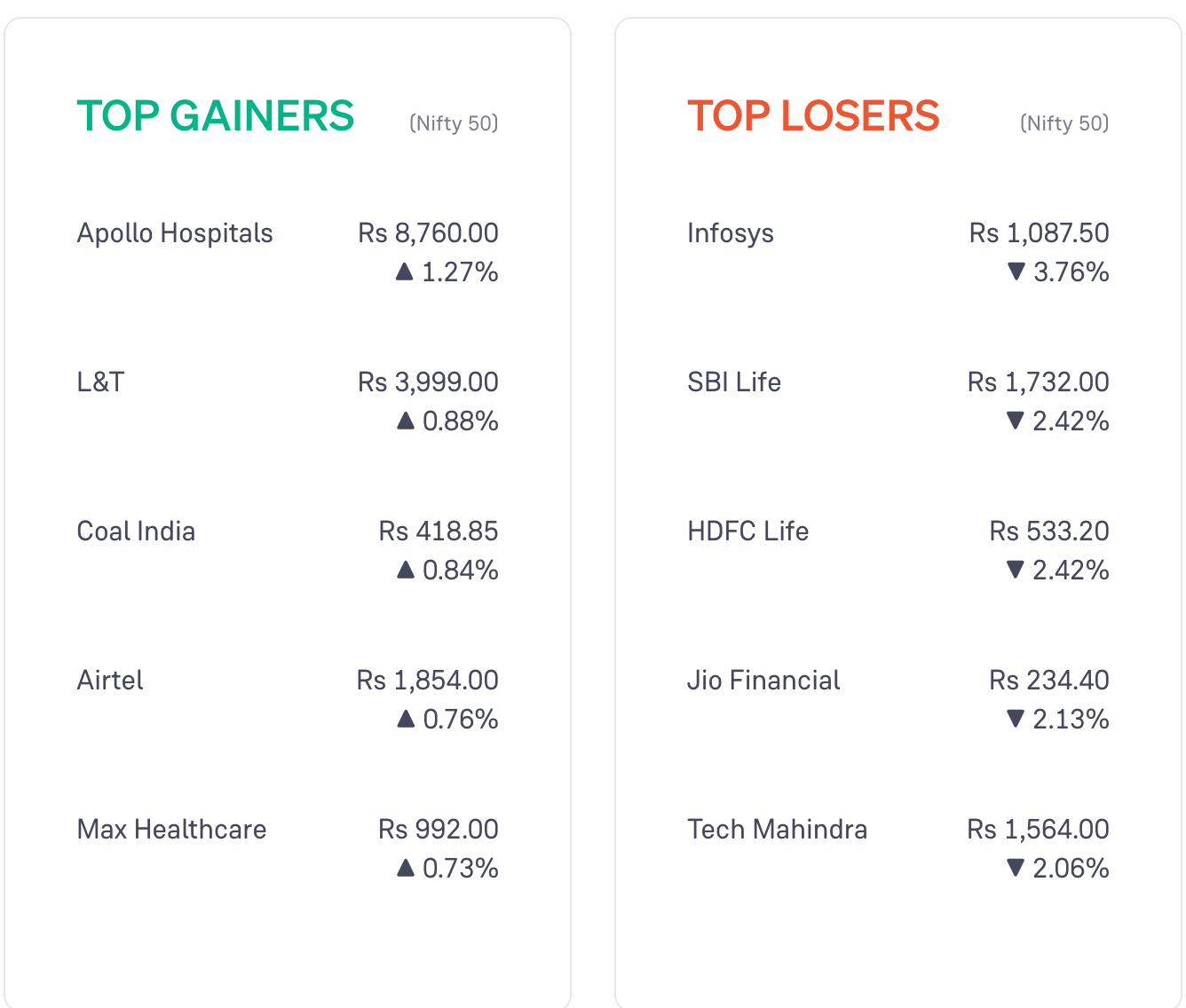
Media stocks and IT stocks fell the most today. Pharma stocks and healthcare stocks rose the most.
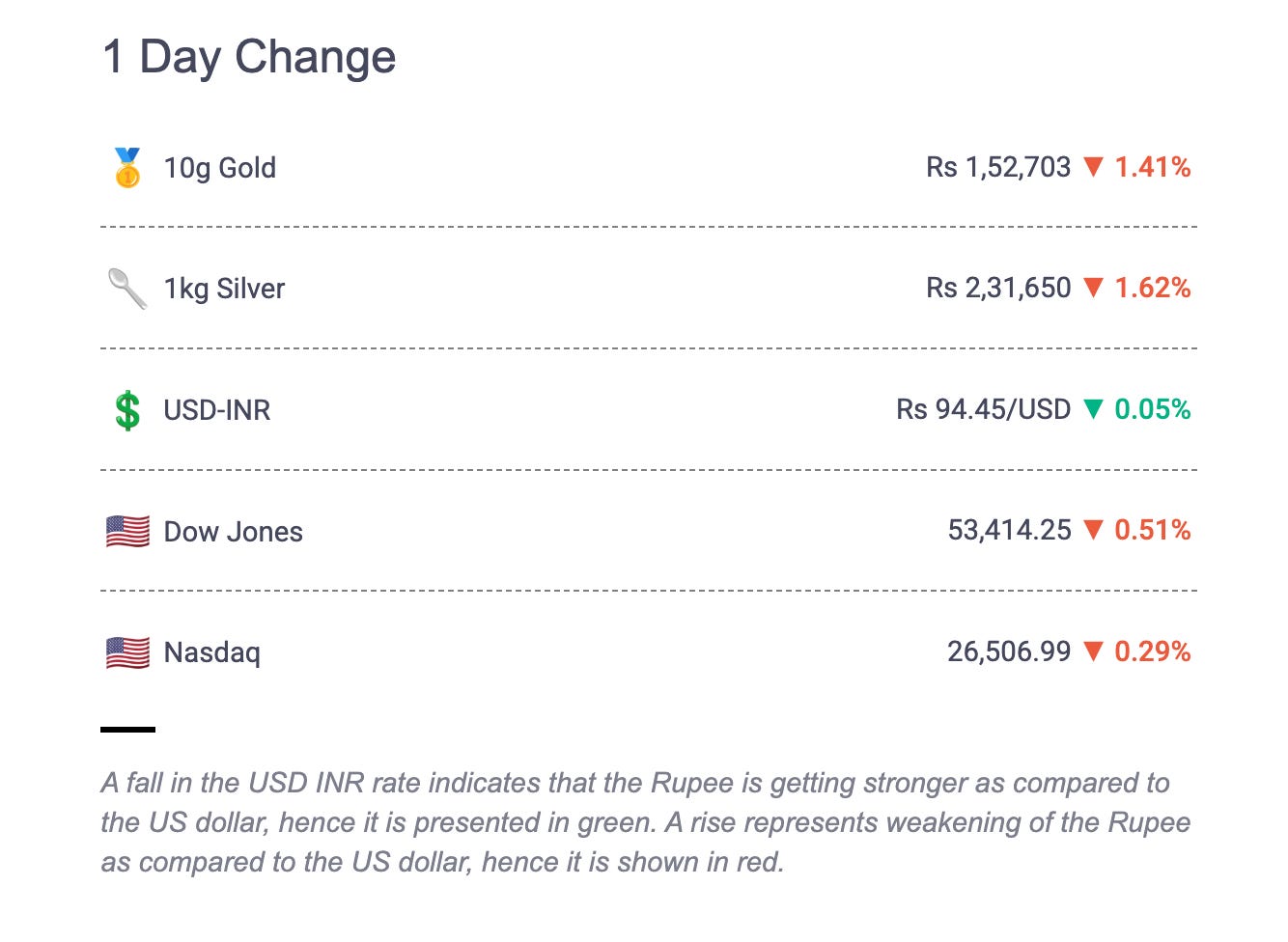
Global markets: US markets fell on Friday. Most Asian markets rose on Monday. European markets showed a mixed trend (as of 6 pm IST).
News
NSE changes pre-open session rules, including new time windows for market and limit orders, separate period of order matching and opening price determination came into effect on 7 September.
SEBI’s revised framework for ETF trading came into effect on 7 September. The framework revised base price norms, introduced dynamic price bands based on underlying assets, among others.
Purple Style Labs listed at Rs 535 on NSE, a discount of 6.96% over its issue price and closed 1.13% lower.
Stock Updates
ICICI Bank: RBI approved LIC acquiring an aggregate holding of up to 9.99% in ICICI Bank within one year.
TCS: subsidiary HyperVault secured 264 acres in Hyderabad to build an AI data centre campus with a capacity of up to 1 GW. HyperVault and its partners will be investing up to Rs 70,000 crore.
Maruti Suzuki: will increase prices of selected models by up to Rs 20,000 in September due to higher input costs and inflation.
Adani Power: was selected to acquire GVK Energy, which owns a 330 MW hydroelectric plant in Uttarakhand, through its subsidiary, Alaknanda Hydro Power Company Ltd, subject to approvals.
Nykaa: completed the acquisition of an additional 24.2% stake in Earth Rhythm, which had been announced earlier in May.
Reliance: step-down subsidiary Roptonal Ltd was dissolved in Cyprus.
Word of the Day
Churn
It is the rate of change or replacement of assets being held
Say investor A owns 10 stocks and by the end of the year, he has sold 3 of them and bought 3 other new ones.
Investor B has 10 stocks and in a year’s time has sold 9 of his stocks and bought 9 new stocks.
In this case, we will say investor B’s investment portfolio had more churn than investor A.
Churn can also be used to describe change in other aspects, such as customer churn (referring to how loyal a company’s customers are), employee churn (how long a company’s employees stay in the company, etc).
6 Day Course
Theme: mutual fund ratings
Day 1: Monday
Many mutual fund investing platforms rate mutual funds. Usually, the ratings go from 1 to 5 stars.
In this week’s course, we will try to learn more about mutual fund ratings.
The first thing to understand about these ratings is that there is no single standard mutual fund rating.
There are many different bodies, organisations, advisors, etc who have their own ratings for mutual funds.
These ratings can be similar but may not be necessarily the same.
The reason for this is that each mutual fund rating system uses their own systems to judge mutual funds. It is not a standard method.
Some ratings are purely formulaic. It is calculated based on clearly defined numbers and formulas.
Some ratings are also partly formulaic and partly subjective.
Such ratings depend on subjective factors and are also opinion based.
The formulas and opinions can vary and therefore, the ratings vary too.
————
Featured Question
Q. “What is Bulk deal? I notice every now & then ‘Breaking news’ ‘Bulk deal happened’ It does not say who sold or who buy…. Is my understanding correct below: In the Bulk deal, first someone will ‘sell’ stock in bulk, then stock price will fall suddenly… then after sometime in that hour someone buy in bulk, then stock price regains its last value before the deal began. In such cases, when stock price drops then ‘is it wise to buy before bulk deal completes’”
Whenever a large number of a company’s listed shares are traded on the stock markets, it must be reported and publicly announced.
The limit for this is 0.5% or more of the company’s total listed shares.
Such deals are called bulk deals.
Because these deals are usually very large in nature, they are mostly done by institutional investors like mutual funds, FIIs, promoters, etc.
This is done during regular market trading hours.
The name of the party doing the trade is also made public, along with the date, buy/sell, number of shares, and the average price of the trade.
When a very large number of shares are sold in the markets, it can cause the share price to fall a bit or even a lot.
This is not necessarily always the case.
If there are many willing buyers in the markets, the price could stay or even climb despite a bulk deal.
If a stock price falls after a bulk deal, there is no guarantee that it will climb back up in a short while or even longer than that.
The same logic applies in reverse while buying shares in a bulk deal.
What you are describing might be a pattern you have seen in some very specific case.
It is hard to say what the right thing to do in such a case might be.
Did you like this edition?
Leave a feedback here!