

The Americans drove land yachts.
Land yachts were cars that were stupendously sized.
A four-seater car would sometimes take up as much space as a small truck. Inside, the manufacturers gave these cars all they could.
Practically all surfaces were covered in leather, wood, metal, carpets, and glass.
The 1950s, 1960s, and a part of the 1970s too were the peak years of the land yacht.
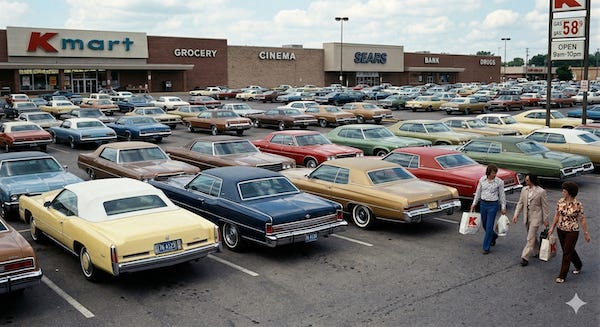
Three companies came to dominate the US automotive industry. Ford, General Motors, and Chrysler.
These land yachts had massive engines too — V8 engines that could be as big as 5 or even 7 liters (5000 to 7000 cc).
Despite having engines as gargantuan as these, the engines produced relatively lower power. Obviously, they consumed a lot of petrol.
But the American customers did not mind. Fuel costs were never thought about. Comfort, features, decadence, opulence, status, those mattered more.
The Japanese had come to the US some time ago to sell their cars.
In comparison, the Japanese made tiny cars. Small, simple, light, and cheap. They were called toy cars. As you might imagine, they did not sell that well.
1973
In 1973, the world was hit by the oil crisis.
All of a sudden, cheap petrol and other petroleum products were not cheap anymore.
Americans lined up at petrol pumps to get their fill. Some pumps employed armed bodyguards to ensure there were no threats to the attendants.
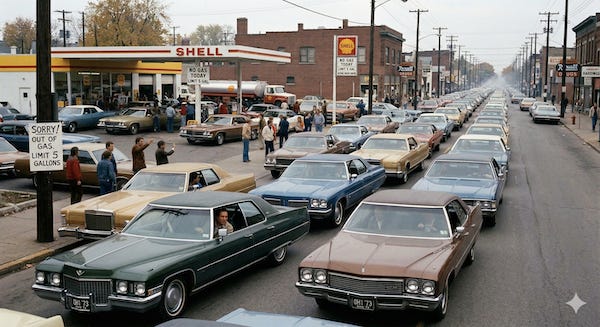
People waited hours to get petrol in their cars; that too rationed petrol. Only 5 or 10 gallons of petrol per car. No more.
The lines were so long, a couple even got married while in line. Petrol theft shot up.
The government enforced a mandatory reduced speed limit of 55 mph to force people to consume less petrol.
Absurd experiments were conducted by daring people. A rumour spread that people could fill in with used vegetable oil in their cars. That led to some ruined engines.
Citizens were encouraged to reduce their consumption of energy in all forms.
Government offices and buildings greatly reduced the number of Christmas lights to serve as a role model to the public.
Amid this backdrop, people realised the value of simple, light, and cheap cars — the kind the Japanese companies manufactured.
1973 was the turning point for Japanese car companies in the USA.
The era of cheap petrol was over. Once Americans tasted the reliability and low cost of Japanese cars, there was no going back.
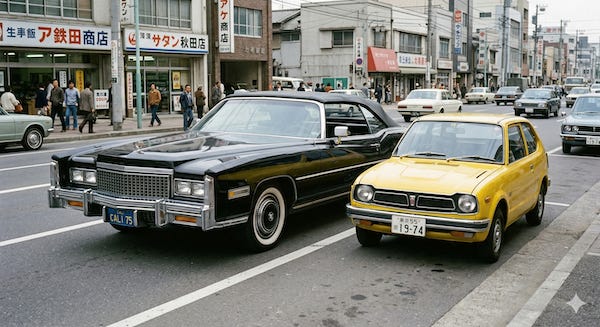
About 20 years later, some of the highest-selling cars in the USA were Japanese. The American cars were still selling well, often topping the charts. But their monopoly was over.
Things haven’t changed much today.
The big American car companies never gained market share like they had. The Japanese companies, especially Toyota and Honda, top the charts even today.
What Happened in 1973?
Like present times, geopolitics had a role to play.
It started on 6th October, 1973.
Egypt and Syria launched an attack on Israel.
This war came to be known as the Yom Kippur War. The USA backed Israel back then (as is the case in the present too).
$2.2 billion worth of American aid was provided to Israel.
We shall not go into the history of the conflict here. That is a long and complicated history. The Arab nations have been in disagreement with Israel for long.
Many of these Arab countries were not happy about America giving military aid to Israel. So they decided to put pressure on the US.
How? Crude oil.
The Organisation of Petroleum Exporting Countries (OPEC) was a body composed of some of the biggest crude oil producers back then.
In protest, the Arab members of OPEC decided to shut off their crude oil supplies to the US and other Western nations. No oil exports.
In the 1970s, over 80% of the USA’s crude oil came from the Middle East. So shutting off the oil supply to the USA was going to hit them very hard.
Before the war started, crude oil prices were hovering around $3 per barrel. After the Arab countries stopped supplying oil to the US, the price of oil shot up 4 times to around $12 per barrel.
You would probably know that crude oil doesn’t just impact petrol prices; it impacts everything; the overall economy.
A 4 times increase in oil price? That was not going to be easy to stomach.
By the end of 1974, the US was in a severe recession.
But the Arab countries did not get what they wanted. Just 5 months after placing the embargo, they rolled it back.
Why?
While those countries weren’t selling oil to the US, they were selling that oil to other countries. The demand was so high, many middlemen in those countries sold the oil to the US for a high price.
So the US was paying a lot more in money for its oil, but it was not starved of oil. It was getting oil, just at a higher price.
This allowed the US to maintain its stance on the war.
Until this point in history, many countries did not realise the importance of having reserves of crude oil, or of not depending on a small number of countries too much.
1973 changed that.
The US targeted to produce more of their own oil themselves.
1973 vs Today?
In some ways, we are in a similar situation today.
The global supply of oil and gas is under threat because of conflicts in the Middle East. It’s easy to draw parallels.
But a few key details separate and distinguish the two events.
Maybe, the current situation is a lot less severe than the one the world experienced in 1973.
What are those factors?
Well, to start with, the world’s oil supply is extremely diversified now.
In 1973, a few countries produced a bulk of the oil of the world.
Today, this looks different. The biggest producer of oil in the world is the USA. Around 14% of daily supply. (In 1973, the US was the biggest importer of crude oil in the world).
Saudi Arabia supplies about 10%. Russia does about the same. Canada, Iran, Iraq, and China do roughly 4-5% each.
The short version is this — it’s very scattered. These aren’t blocs that are famous for co-operating with each other.
So the supply of global crude oil is very diversified.
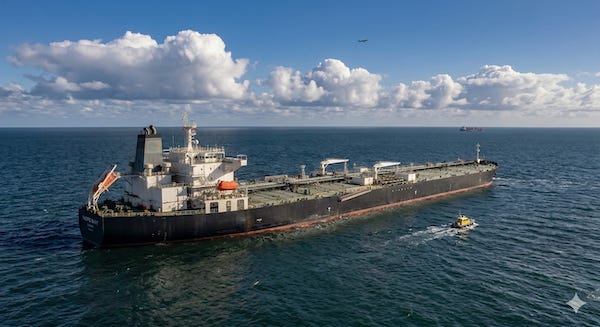
Besides, the world’s dependence on crude oil has also reduced in comparison to 1973. Now, the world has also added gas and nuclear power as primary sources of energy.
As mentioned earlier, the price of crude oil had jumped 4 times in 1973 — from $3 to $12.
Over the last few years, the price of crude oil had been roughly in the $70 zone. Yes, it has gone up now, to a little above $100.
That’s high, but not disastrously high. In fact, we have seen crude oil prices at these levels before too.
Will it go up further?
We don’t know. And frankly, nobody does. We will have to wait and watch this rapidly evolving situation.
Given that the world has many more oil producers now, it is hard to imagine the price of crude oil going 4 times higher than the present. It’s a very competitive market.
Still, you never know.
Quick Takes
+ India’s unemployment rate fell marginally to 4.9% in Feb (vs 5% in Jan).
+ India’s merchandise exports fell by 0.8% year-on-year in Feb while imports rose 24.12%. The merchandise trade deficit widened to $27.1 billion.
+ India’s annual wholesale inflation rate rose to an 11-month high of 2.13% in Feb (vs 1.81% in Jan).
+ The signing of the India-US trade deal will be put on hold until a new tariff structure between the two countries is finalised.
+ India’s inter‑ministerial briefing on West Asia developments updated that fuel and LPG supplies in India remain adequate, with measures underway to curb hoarding and black‑marketing and to ensure continued availability.
+ The central government approved the Small Hydro Power Development Scheme (FY 2026-27 to FY 2030-31) with an outlay of Rs 2,584.6 crore to set up around 1,500 MW of small hydro projects in the country.
+ The central government approved the Bharat Audyogik Vikas Yojna (BHAVYA) with an allocation of Rs 33,660 crore to develop 100 plug‑and‑play (meaning pre-built, ready to use) industrial parks across the country.
+ The central government approved the construction of a 101.5 km, 4-lane access-controlled NH-927 from Barabanki to Bahraich in Uttar Pradesh at a cost of Rs 6,969.04 crore.
+ The US Fed kept its benchmark interest rate unchanged between the 3.5% to 3.75% band.
+ The central government approved the RELIEF scheme to support exporters hit by disruptions due to the West Asia conflict. The aim is to provide risk coverage and cost reimbursement to maintain exports and protect trade flows.
+ India’s infrastructure output of core industries grew 2.3% year-on-year in Feb (vs 4.7% in Jan). Cement, steel, fertilizers, coal and electricity grew in output while crude oil, natural gas and petroleum refinery products declined.
+ The Indian Rupee reached a record low, slipping past the Rs 93 per US$ mark for the first time.
+ India’s forex reserves fell by $7.05 billion to $709.76 billion in the week that ended on 13 March.
The information contained in this Groww Digest is purely for knowledge. This Groww Digest does not contain any recommendations or advice.
Team Groww Digest