

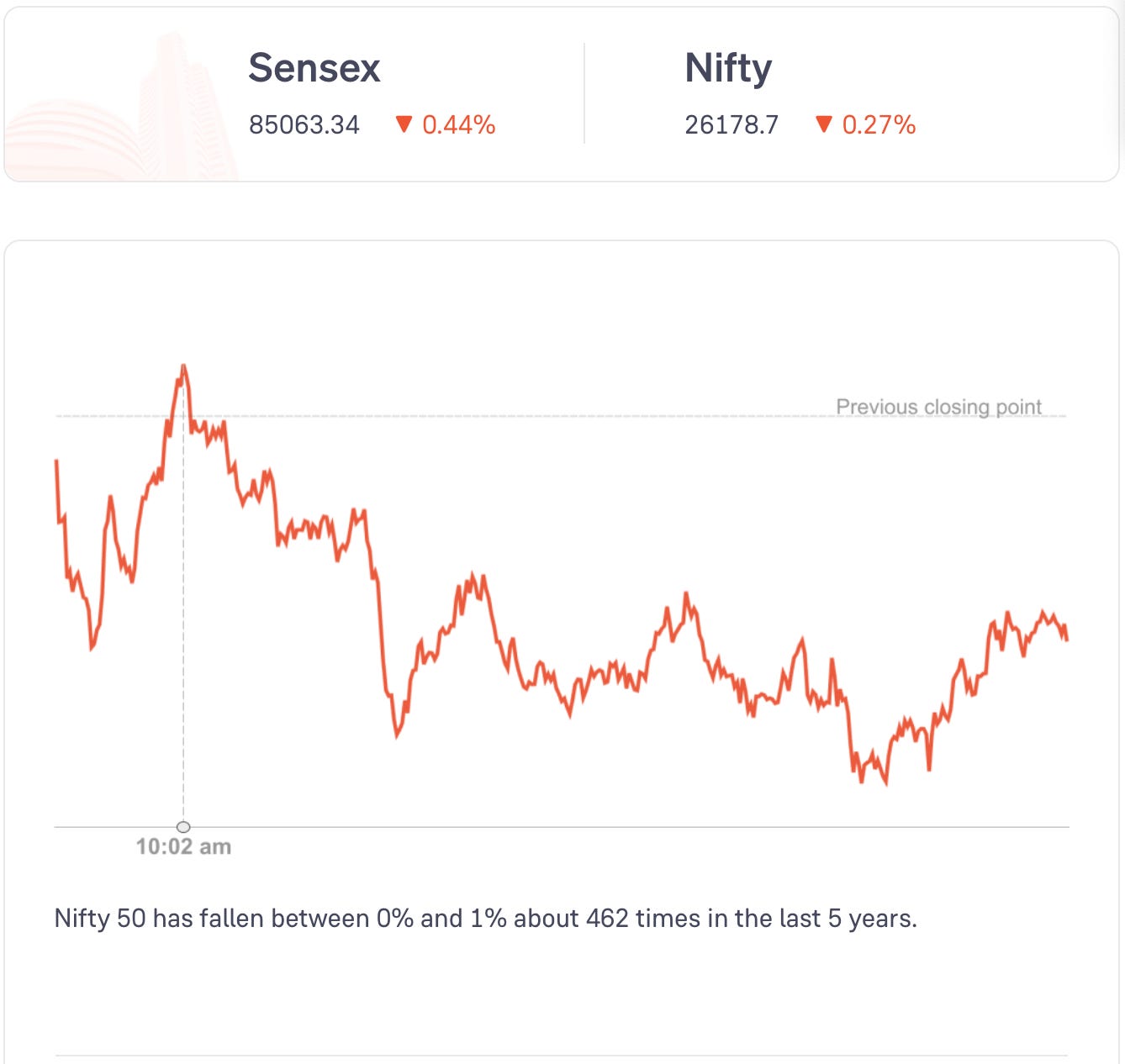
Markets opened below yesterday’s closing point.
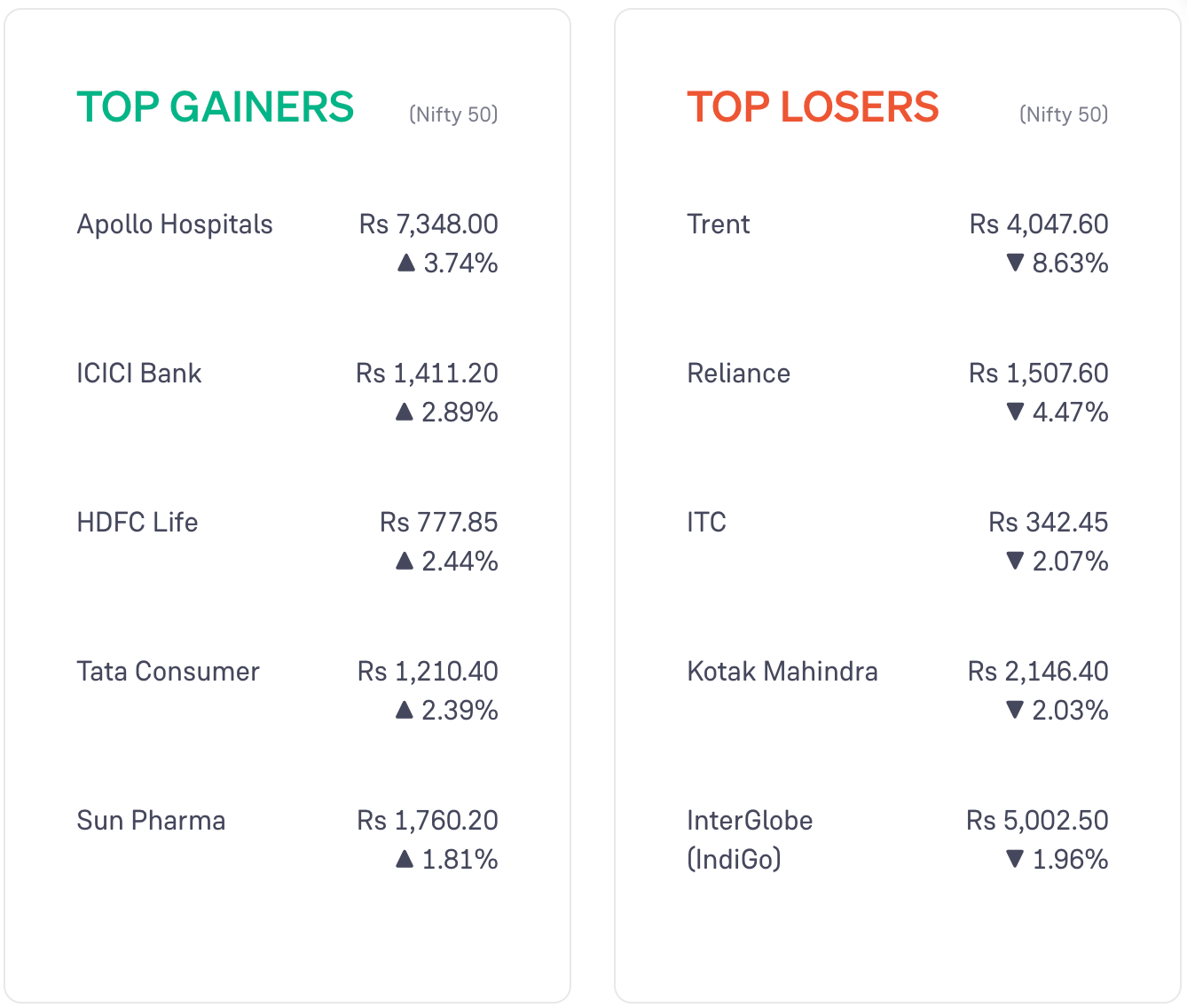
Healthcare stocks and pharma stocks rose the most today. Oil and gas stocks and media stocks fell the most.
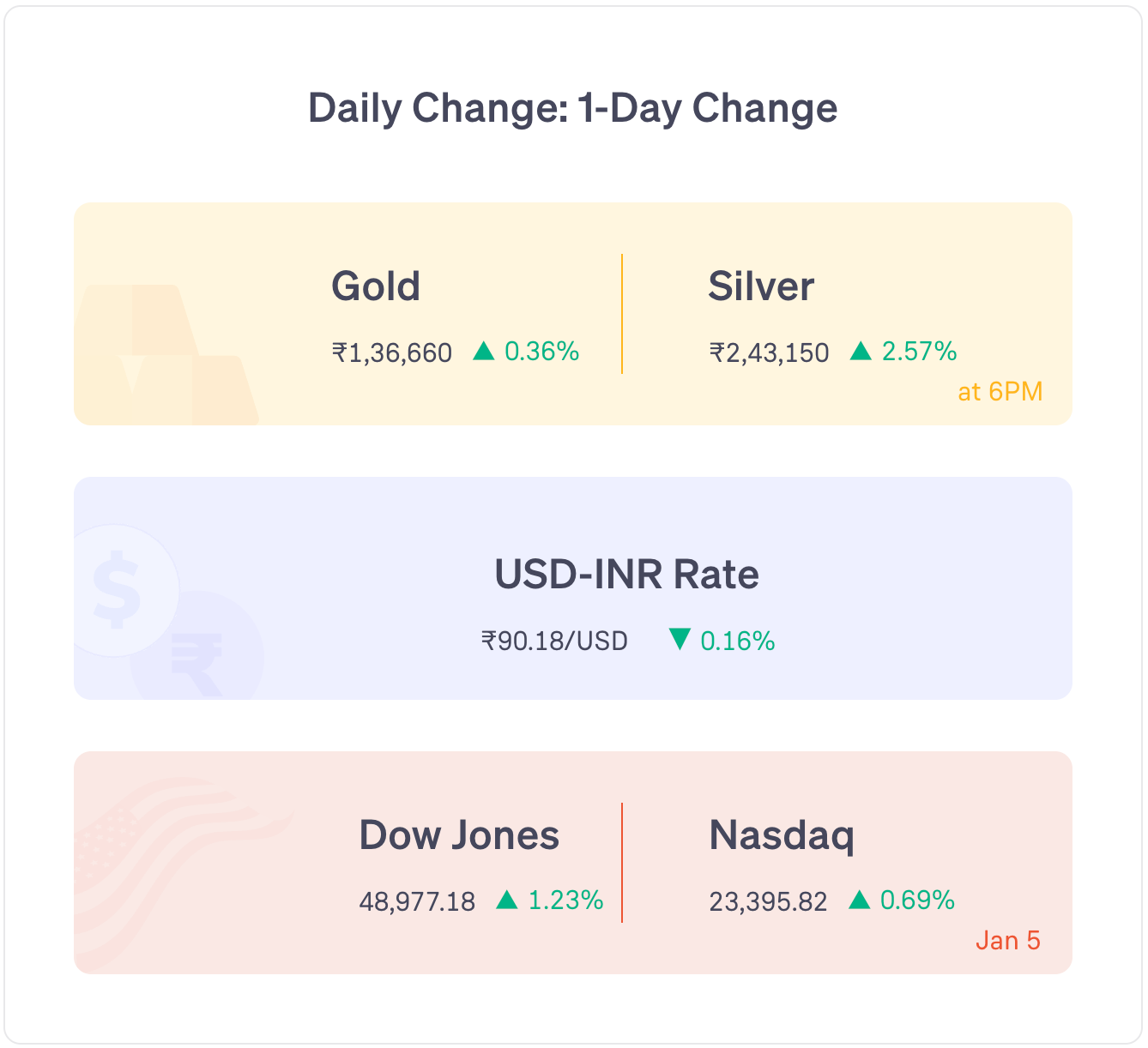
Global markets: US markets and most Asian markets rose. Most European markets rose (as of 6 pm IST).
News
India’s composite PMI (manufacturing + services) fell to 57.8 in Dec (vs 59.7 in Nov). Services PMI fell to a 11-month low of 58 (vs 59.1 in Nov). This means economic activity grew less in Dec than in Nov.
The RBI held the first meeting of the Payments Regulatory Board which discussed the development of India’s payments system.
Hindustan Laboratories has applied for an IPO with SEBI.
Stocks Updates
ONGC: took control of the fire in its Mori-5 oil well in Andhra Pradesh, with flame intensity reducing and safety and environmental monitoring in place.
ICICI Bank: the PFRDA approved acquisition of 100% stake in ICICI Prudential Pension Funds Management, making it a wholly owned subsidiary.
Reliance: clarified that recent media reports suggesting its Jamnagar refinery received Russian oil were incorrect and have been corrected.
Vodafone-Idea (Vi): received a Rs 8.78 crore service tax penalty order from Ahmedabad authorities, which it will challenge.
Tata Consumer: received an income tax demand of Rs 269.29 crore for FY18-19. The company is challenging the order.
Trent: reported 17% year-on-year standalone revenue growth in the Oct-Dec quarter to Rs 5,220 crore and expanded its store network to 1,164 stores, led by Zudio.
Auto Updates (Dec)
Maruti Suzuki: sales stood at 2.18 lakh units. Domestic sales stood at 1.92 lakh units and exports stood at 25,739 units.
M&M: sales grew 25% year-on-year to 86,090 units. Domestic passenger vehicle sales grew 23% year-on-year to 50,946 units while commercial vehicle sales grew 34% year-on-year to 24,786 units.
Tata Motors Passenger: sales grew 14.1% year-on-year to 50,519 units.
Hyundai Motor: sales grew 6.6% year-on-year to 58,702 units including export sales of 16,286 units.
Eicher Motors: sales grew 30% year-on-year to 1.04 lakh units. Exports fell 10% year-on-year to 10,397 units.
TVS Motor: sales grew 50% year-on-year to 4.81 lakh units. EV sales grew 77% year-on-year to 35,605 units.
Ashok Leyland: sales grew 27% year-on-year to 21,533 units.
Escorts Kubota: sales grew 38.5% year-on-year to 7,577 units. Exports grew 64.3% year-on-year to 749 units.
Bajaj Auto: sales grew 14% year-on-year to 3.70 lakh units.
Word of the Day
Operating Profit
It is the profit a company makes from its core business operations
It is calculated by subtracting operating expenses (like raw materials, employee costs, rent, and utilities) from revenue, before accounting for interest and taxes.
It reflects how a company is managing its day-to-day activities and shows how profitable the main business is, independent of financing or tax structures.
6 Day Course
Theme: over-valued stocks
Day 2: Tuesday
Continuing from where we left yesterday — one challenge investors face is PE ratio in good quality companies.
Good quality companies tend to grow faster. And because the future potential is so high, investors are okay buying the share at higher PE ratio values.
One metric that aims to help in this situation is called PEG ratio.
PE ratio divided by growth of earnings-per-share.
The ratio’s aim is to see if the higher PE ratio value is justified by the growth it is experiencing.
Let’s say
+Company ABC’s PE ratio is 20. And its earnings are growing at 20% per year.
+Company XYZ’s PE ratio is 50. And its earnings are growing at 50% per year.
It is easy to see that company ABC’s PE ratio is much lower than company XYZ’s.
But if we calculate both their PEG ratios, we see that it is 1 in both cases.
So an investor might treat them as similarly valued even though XYZ’s PE ratio is more than twice as much as ABC’s.
Featured Question
Q. “Mutual Fund Companies are investing. Our amount in various Companies and allotting unit at the NAV of the day. But when they get hudge dividend from various Companies invested, whether our NAV is increased to that extent.”
Yes. It is fully added to the mutual fund’s AUM.
Whenever a dividend is added, the NAV value goes up proportionately.
Mutual funds do not have to pay any taxes on the dividend received either.
And mutual fund investors do not have to worry about dividend tax separately.
Mutual fund investors only have to pay capital gains tax when they withdraw.
Did you like this edition?
Leave a feedback here!
Liked the content on PEG ratio.