

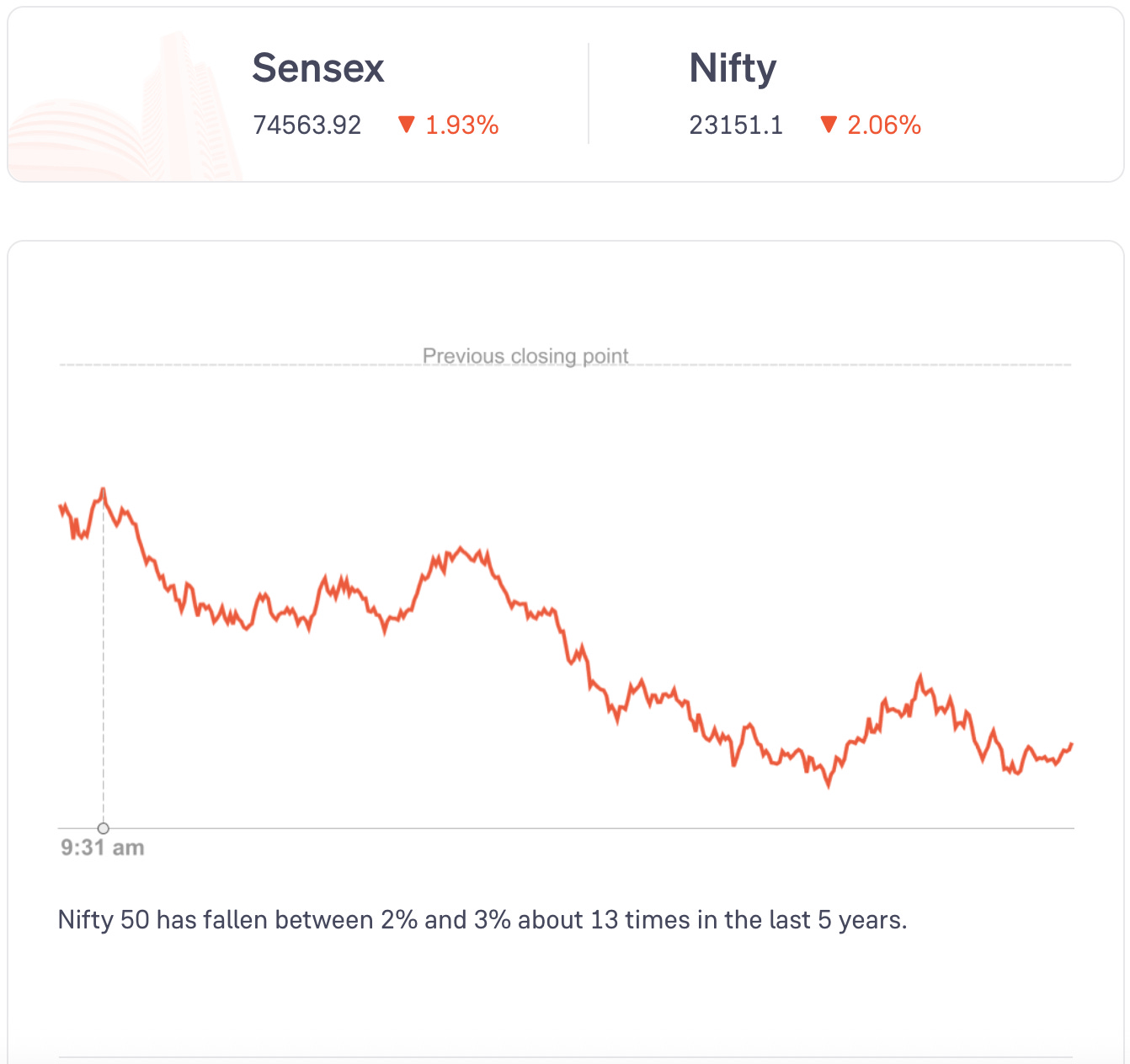
Markets opened below yesterday’s closing point and closed in red.
This was mainly because of the continued weak global sentiments due to the ongoing US-Iran conflict leading to a rise in crude oil prices.
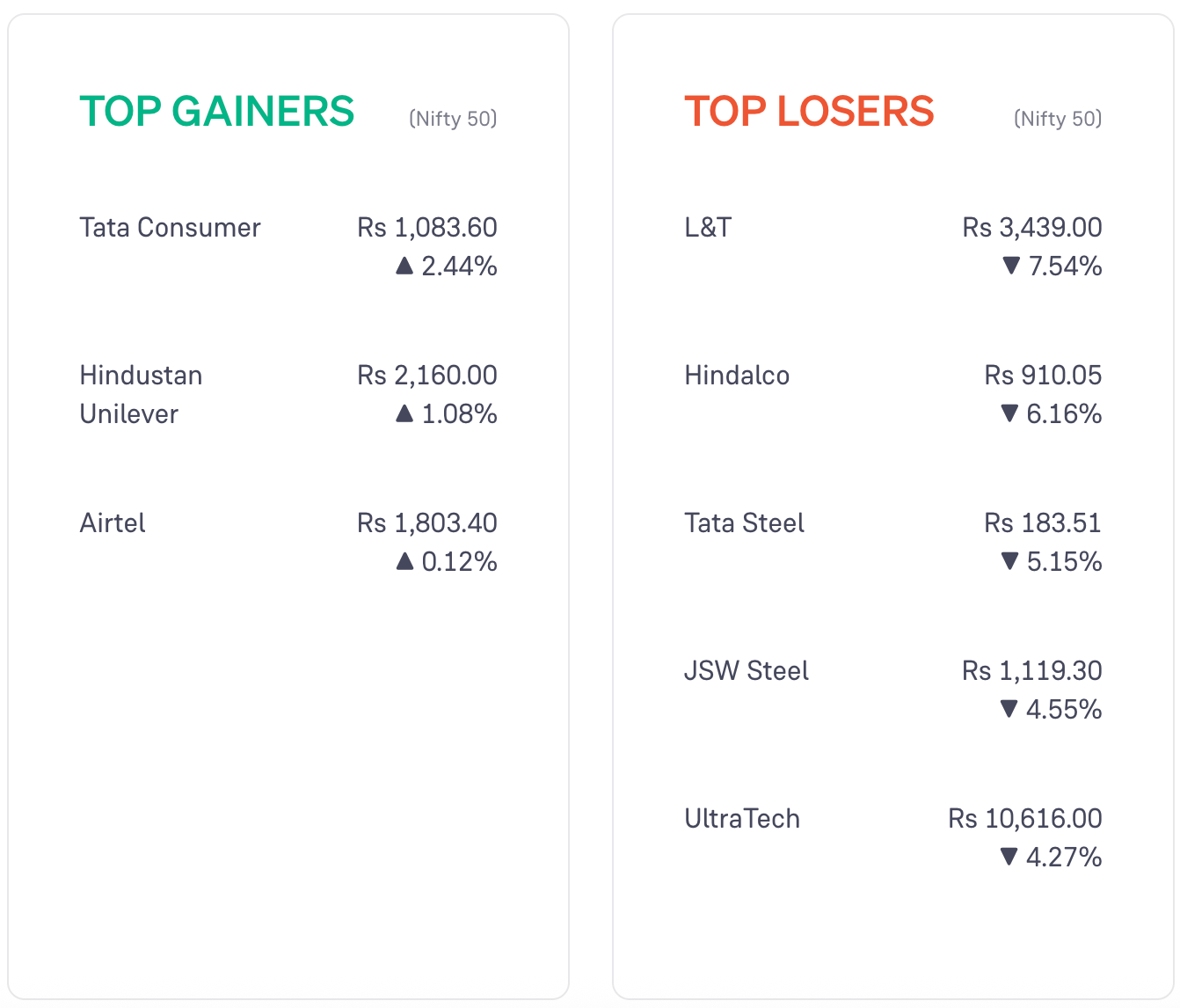
There are only 3 stocks in the Nifty 50 that rose today. Hence, there are only 3 stocks in the ‘Top Gainers’ section.
All sectors’ stocks fell today. Metal stocks and PSU bank stocks fell the most.
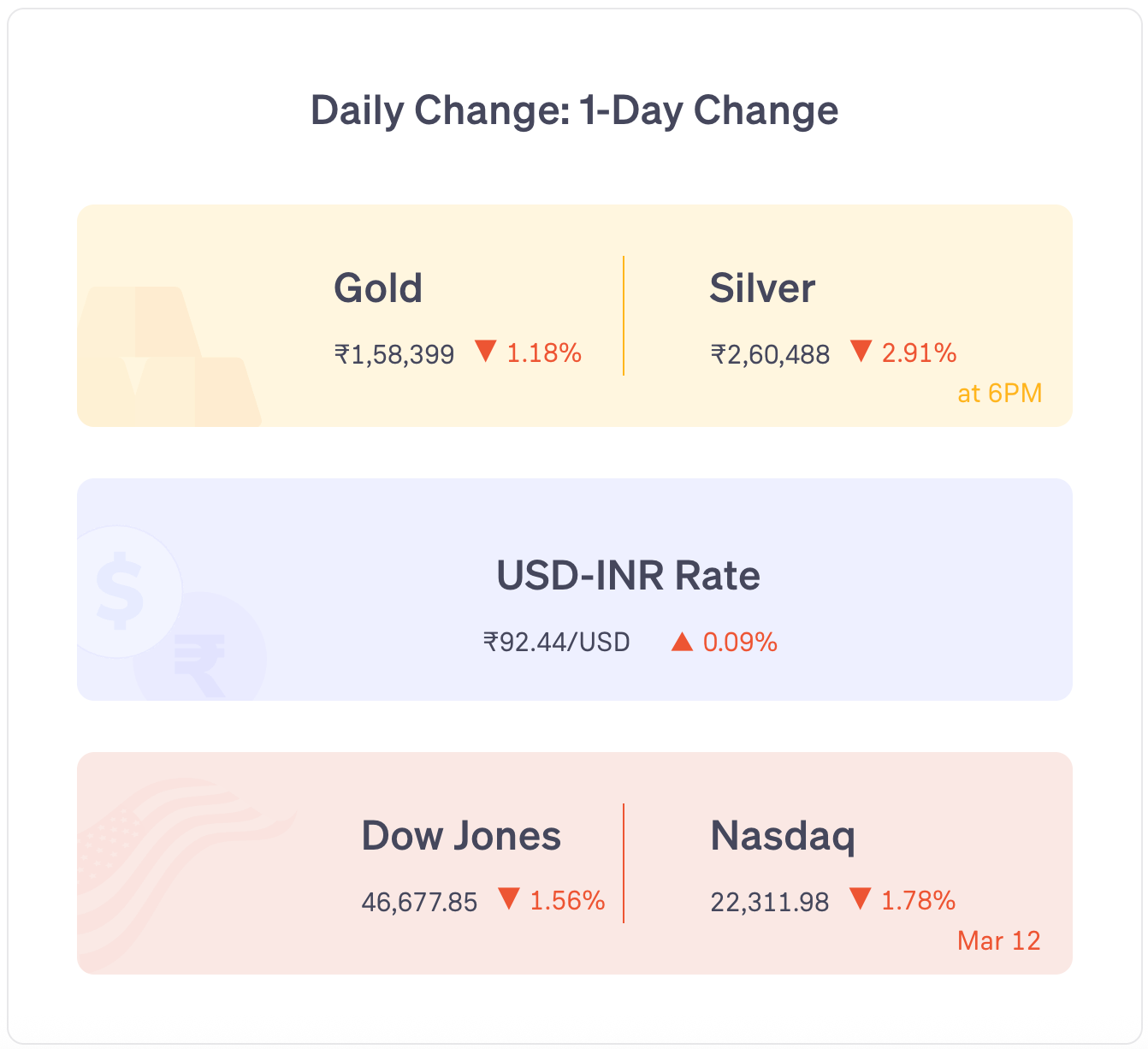
Global markets: US markets and Asian markets fell. European markets rose (as of 6 pm IST).
News
India’s forex reserves fell by $11.68 billion to $716.81 billion in the week that ended on 6 March.
India’s passenger vehicle sales grew 10.6% year-on-year to 4.18 lakh units in Feb: SIAM
US exports increased 10.4% year-on-year in Jan and imports decreased 11.3%. The trade deficit narrowed to $54.5 billion.
Stocks Updates
GMR Airports: will operate Delhi Airport’s Cargo Terminal 1 till 2036. It is expecting about Rs 340 crore revenue share in the first year.
Coal India: has filed the Red Herring Prospectus (RHP) with SEBI for the proposed IPO of its wholly owned subsidiary CMPDIL.
Ambuja Cement: company’s merger with Sanghi Industries became effective on 12 March with Sanghi dissolved. Its shareholders will receive Ambuja shares as per the scheme.
Hero Moto: received tax appeal orders reducing its demand from Rs 177.96 crore to Rs 27 crore and will further appeal the remaining amount.
Word of the Day
Circuit Breakers
They are automatic mechanisms that temporarily stop trading when stock prices move too sharply in a short time.
There are circuit breakers that apply to the entire stock market as well as individual stocks.
In India, market-wide circuit breakers are triggered when the Nifty 50 or Sensex falls by 10%, 15%, or 20% in a single day.
Trading pauses for a few minutes or hours depending on the level of the fall.
For individual stocks, there are price bands, which limit how much a stock can rise or fall in a day to prevent extreme volatility.
Circuit breakers help control panic selling and excessive speculation by providing a cooling-off period.
6 Day Course
Theme: crude oil price
Day 5: Friday
Lastly, let’s talk about the biggest risks with crude oil.
Most countries today depend heavily on crude oil. So anything that can limit or cut off supply of crude oil is treated as a major risk.
Geopolitics is easily one of the biggest factors behind this.
Conflicting countries that are either oil producers or have the potential to block oil shipping routes can easily affect crude oil prices.
Sanctions on countries can also limit crude oil sales. Example: most countries didn’t buy oil from Iran and Venezuela because of sanctions on them by countries like the US.
Besides geopolitics, oil production and discovery can affect the supply of crude oil in the world and can be a major reason behind price movements.
Example: the US started producing crude oil of its own in much larger quantities in the 2010s making it a significant producer.
This became a buffer against oil supply from the Middle East.
6 Day Course
Q. “Almost every month or 2 I keep receiving emails from Mutual fund AMC’s regarding the change in Base TER & unfortunately it’s always rising. Is there an upper limit to which they can keep rising the Base TER & also does it impact our investments in the long run?”
Some AMCs are increasing the expense ratio, yes.
Many AMCs tweak and change the expense ratios. Sometimes they increase it, and sometimes they even decrease it.
SEBI has a mandatory limit on the expense ratio. These limits depend on the category of mutual fund and the total Assets Under Management (AUM).
In case of equity mutual funds, the max expense ratio allowed is 2.25% per annum. In case of all other mutual funds, the expense ratio is 2% per annum.
Many mutual funds’ expense ratios are much below this limit.
The returns you see in case of any mutual fund are after the expense ratios have been deducted. You do not need to pay any expense ratio from your returns.
Yes, higher expense ratios can affect your long term return. In this case, a lower expense ratio is usually better.
Practically speaking, investors should not worry about the expense ratio as much as they should worry about the returns.
If a mutual fund is charging a high expense ratio, but is giving the investors good returns, that is okay.
It is better than mutual funds that charge a lower expense ratio but give lower returns.
You should try to optimise for the highest returns. Many times, that will automatically mean your mutual fund has a low or reasonable expense ratio.
Did you like this edition?
Leave a feedback here!
Please be consistent with your daily post, I really like reading your posts and when you take a day or two off I can't stay on top of things