

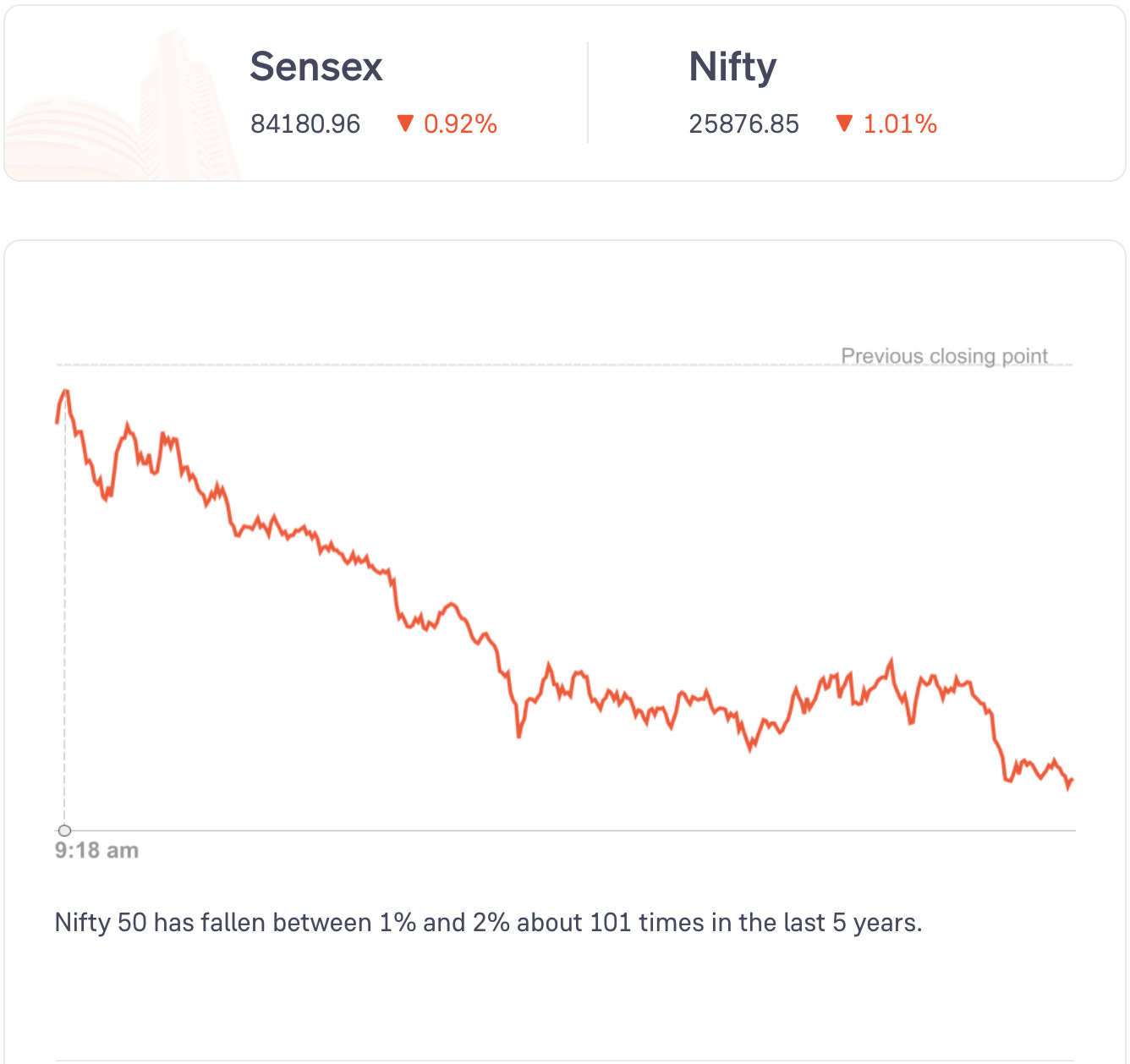
Markets opened below yesterday’s closing point.
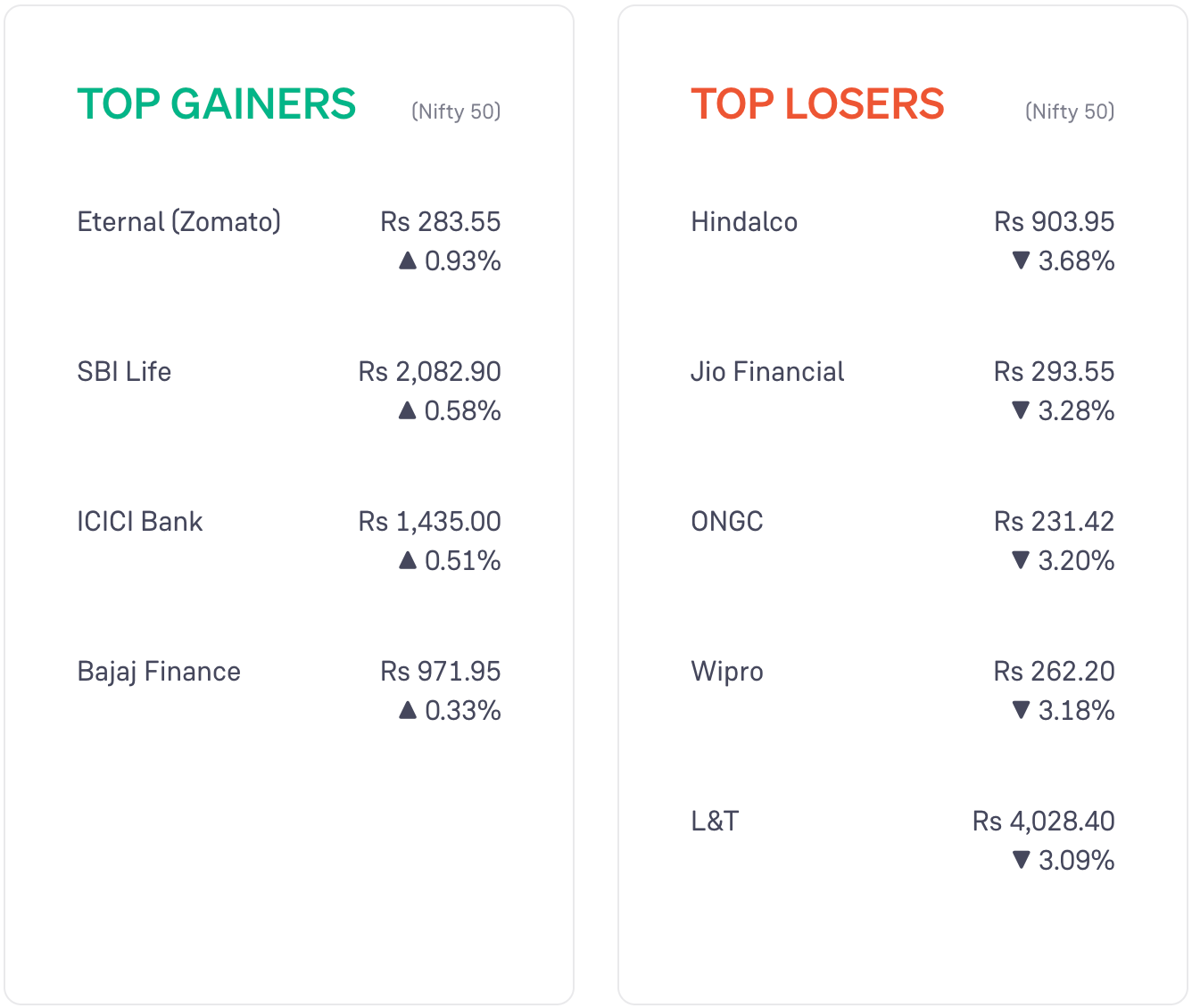
All sectors’ stocks fell today. Metal stocks and oil and gas stocks fell the most.
There are only 4 stocks in the Nifty 50 that rose today. Hence, there are only 4 stocks in the ‘Top Gainers’ section.
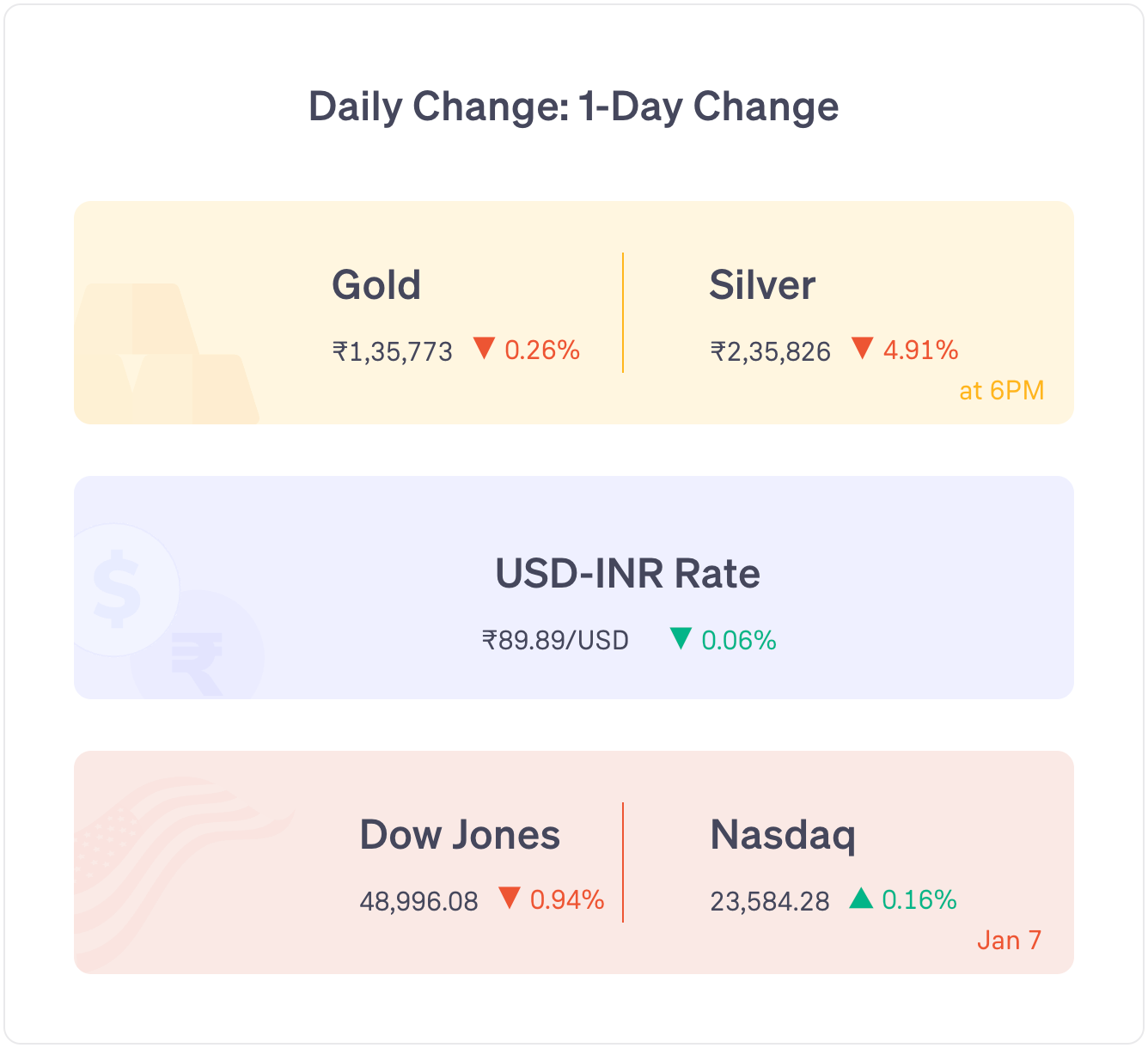
Global markets: Most US markets and most Asian markets fell. European markets fell (as of 6 pm IST).
News
Govt has announced that the first phase of population census will begin from 1 April 2026, and will continue till Sept end.
SEBI has accused Bank of America of breaching insider trading rules and internal controls during a 2024 share sale deal: as per media reports.
The Dept of Telecommunications has signed an MoU with IIT Kanpur to jointly develop India-specific telecom standards and advance research in future technologies like 6G, AI, satellite networks, etc.
Stocks Updates
BHEL: received a Rs 5,400 crore order from BCGCL (its joint venture with Coal India) for a coal gasification & syngas plant in Odisha. It also began supplying traction converters for the Vande Bharat Sleeper Train project.
L&T: partnered with the Indian Army to overhaul, upgrade and support in-service Pinaka rocket launcher systems. It also incorporated a wholly owned subsidiary, SuFin Ltd, for its e-commerce wholesale business.
Bajaj Holdings: along with Bajaj Finserv and promoter group, acquired most of Allianz SE’s stake in Bajaj General and Bajaj Life, taking combined ownership to 97%. The remaining 3% is planned to be acquired by July.
BPCL: clarified that it has issued routine capex to Technip Energies for Bina and Mumbai refineries, totaling about Rs 4,100 crore. These are normal business transactions with no significant impact on its share price.
Samvardhana Motherson: and South Korea’s Egtronics created a joint venture, Motherson Egtronics Electronics Solutions Ltd, with 51:49 ownership. This new company will focus on developing electronics for clean mobility vehicles.
Havells: fixed 23 Jan as the record date for a potential interim dividend, which is to be decided in a board meeting on 19 Jan.
Adani Green: a step-down subsidiary signed agreements to supply 20.8 MW of solar-wind hybrid power from Khavda, Gujarat, to Asahi India Glass Ltd.
Vedanta: announced that the Delhi High Court has ordered a ‘status quo’ (keeping things as they are) regarding the company’s challenge to the government’s refusal to extend a production contract for an oil and gas block.
Word of the Day
Oligopoly
It is when a few companies in the industry controls most of that industry.
In an oligopoly market, whatever one company does directly affects the others (example: like price cuts, discounts, or new launches).
It’s hard for new companies to enter this kind of market. Existing players already have strong advantages such as a well-known brand, lots of money, large customer base, or government licences.
There are 2 other types of markets like this:
-Monopoly: one company controls most of the market without any competition
-Duopoly: two large companies control most of the market.
6 Day Course
Theme: over-valued stocks
Day 4: Thursday
So, we discussed PE ratio, PEG ratio, valuation in case of a company that has revenues but no profits.
What if the revenues are also very low? Things get tough.
When there were no profits, we used revenues to estimate future profits. Then we used that number to get a rough idea of the PE ratio.
If the revenue is low/missing, we will have to first assume the revenue, then profits, and then use that to find the PE ratio.
If you assume so many things, aren’t you prone to big errors?
Yes — absolutely.
This is why early stage investing is so difficult (small-cap early companies growing aggressively, start-ups, etc).
Even the best of investors in this make lots of mistakes. In fact, most investors make more wrong decisions than right decisions.
It still works because the return on even one successful investment is so high, it covers for the many losses.
Because individual opinion is involved so much in this case, the valuation is also very opinionated and different in each investor’s case.
Featured Question
Q. “What is IDCW? How does its payout affects NAV of a fund?”
Every mutual fund has many different “variants” like a car has many variants (Swift VXi, Swift ZXi, etc).
In the case of mutual funds, these variants are called ‘schemes’.
So one mutual fund can have many different schemes.
Example:
Mutual fund name: SBI Large Cap Fund
Different schemes of this mutual fund:
- SBI Large Cap Fund - Growth Plan
- SBI Large Cap Fund - IDCW Plan
- SBI Large Cap Fund - Direct - Growth Plan, etc
IDCW stands for Income Distribution cum Capital Withdrawal plan.
This plan used to be called ‘dividend plan’ earlier.
In IDCW, mutual funds give a regular payout to investors, similar to stocks giving dividends.
But calling it a dividend plan is a bit misleading. That’s why it was renamed to the IDCW plan.
Why?
Because when these mutual funds give payouts, they don’t always give the dividends they are receiving.
They actually promise to give a payout. Sometimes, that can mean selling some shares to give the payout.
Sometimes, when they receive a very high amount of dividends from shares, they might share only a smaller portion of the dividends as payout — while letting the rest remain invested in the mutual fund.
Hence, the name ‘IDCW plan’ makes more sense.
Just to be clear, the growth plan receives dividends from shares too. They just re-invest the entire amount back in the same mutual fund.
IDCW plans may re-invest a part of the dividends and give investors a payout with the rest.
When an IDCW plan gives a payout, the NAV drops.
So, let’s say a mutual fund declared a payout of Rs 4 per unit, and its current NAV is Rs 54.
After the payout, the NAV will drop to Rs 50.
In both cases (IDCW and Growth plans), investors are not losing nor gaining any extra money.
It’s just that both plans handle it differently.
Many investors prefer the Growth plan because it leads to higher compounding.
Many investors prefer the IDCW plan because it gives them a regular payout instead of simply re-investing the money.
Did you like this edition?
Leave a feedback here!