

Marcus to Commodus
‘Meditations’ by Marcus Aurelius, is a book heavily praised by many.
One such modern example is that of James Mattis, the former US Defence Secretary.
James Mattis has been through some very difficult phases in the US’ military operations.
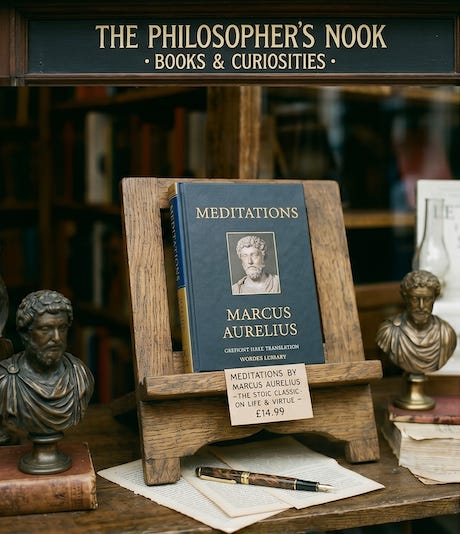
His appreciation comes from being in somewhat of a similar position to Marcus.
Marcus Aurelius was the emperor of Rome about 2,000 years ago.
As a ruler, he had a hard life. He was constantly up north in his territory, fighting invaders, and protecting Rome from losing territory.
During Marcus’ reign, Rome was the biggest it had ever been. It was in its golden era.
Rome had been stable for about a century with well established internal systems. During this period, 5 emperors had ruled over Rome. Marcus was the 5th emperor.
It was not easy.
The role required a deep understanding of human nature, self control, and discipline.
‘Meditations’ was not a philosophical book written by Marcus. It was not a book at all. It was a personal diary. The writings were letters to himself. He wrote them throughout his life.
Marcus’ tenure was marked by many struggles.
Of the roughly 20 years he ruled, many years were spent in military tents. He believed in fighting wars from the front, not by sitting in the capital.
Rome was under attack and his struggles ranged from military strategy to arranging funds for the war effort.
Wars are expensive and Rome was always arranging money for them.
It didn’t help that simultaneously, Rome was suffering through a plague that resulted in the deaths of a significant portion of its population.
The plague itself caused death, illness, labour shortages, and an economic slowdown.
At the same time, only a few of Marcus’ 13 children survived to reach adulthood.
We also see a co-emperor of Marcus who had revolted and launched a campaign to break off from the Roman Empire.
Marcus was always under attack figuratively and literally.
It was in this setting that he wrote to himself in his diary. ‘Meditations’.

His demeanor, restraint, discipline and approach to life earned him the title of being a ‘philosopher-king’.
Today, he is most famous for ‘Stoicism’ — the philosophy of not reacting too much to any situation, and maintaining composure.
Rome was marked by constant chaos. While the kingdom gained and expanded, the internal chaos remained constant.
There were a string of absolutist rulers. They viewed their position as permission to do whatever they felt like.
Power led to reckless behaviour. Killing and seizing the property of citizens was easily possible. All sorts of rumours used to float around. Punishments based on the rumours, without verification, were also common.
Extreme amounts of internal politics and backstabbing coupled with assassinations were common among the ruling classes.
The period of the 5 emperors is often referred to as the golden period in the history of Rome.
Among other rules, one particular rule that enabled this period was that of succession.
Emperors of Rome were often appointed because the older one had been killed or forcefully replaced. If not that, then the son of the current ruler would take over the throne.
In Rome, the next ruler was selected from the existing senior bureaucrats. It was merit based. The best candidates were promoted.
The winner would then be adopted to become the son of the present ruler.
The adopted son and father would rule together until the death of the father. Then, the adopted son would continue as the ruler from there on — after having learnt the ropes along with an experienced ruler.
Marcus was extremely intelligent and able.
However, he did not follow this succession rule.
He simply appointed his biological son, Commodus, as the successor.
This was despite being well aware of Commodus’ faults.
Commodus was one of Marcus’ children who had survived to be an adult.
Commodus just wasn’t interested in being a ruler. He was more interested in keeping himself entertained.
Things didn’t go well after Marcus died.
He did not spend time on the frontiers. Rome was his primary location. He signed deals with others easily and without much pushback.
Commodus delegated most of the work to his favourite senior senators (many were corrupt).
Internal fault lines formed. Corruption, bureaucracy, inefficiency, and general public resentment built up.
Over time, many senators grew unhappy with Commodus. A general sense of trust in the system vanished. Everyone was suspicious of the other. Internal struggles started to take place.
All the while, Commodus thought of himself as a gladiator.
Gladiators were wrestlers who fought each other, sometimes to death. The public used to gather to watch these fights (similar to any sport).
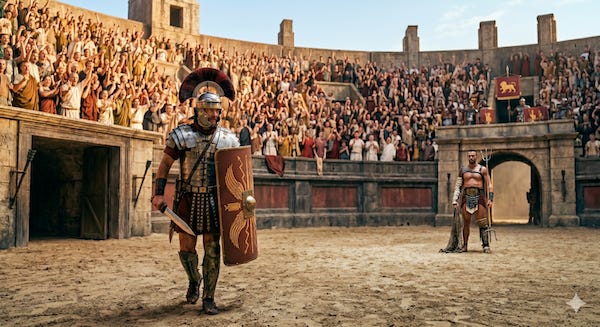
He took a keen interest in these sporting events and even fought (staged) fights himself.
Commodus’ reign ended with his assassination.
After 5 great emperors selected by merit, Rome’s golden age ended.
Rome went back to utter chaos – similar to the situation before the 5 emperors.
Rome went from a good ruler to a bad ruler.
Domitian to Nerva
Domitian belonged to an era when the emperor’s throne was seen as family property. It was inherited.
Domitian inherited the throne from his brother.
He spent money building vast palaces and monuments, distancing himself from the public and senators.
He was afraid and suspicious. He was always scanning the room for rivals. When he noticed a rival voicing his opinions strongly, Domitian would have him killed.
This created a sense of fear in the senate’s atmosphere.
Senators avoided saying anything altogether. This resulted in crucial work in not getting done, including passage and amendment of laws.
The condition of Rome as an empire worsened. The period before Domitian hadn’t been any good.
Over time, Domitian became distrustful of most people around him.
He was left with an inner circle who he trusted.
Skepticism and doubt soon entered this inner circle as well.
Domitian started targeting members of this inner circle who he developed suspicions against.
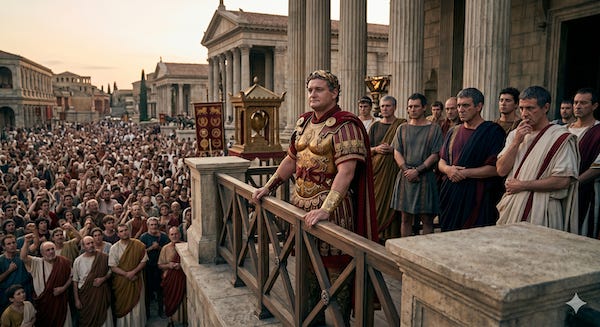
He maintained a diary which he kept under his pillow. The diary contained the names of the people he wanted killed. They even found his own wife’s name in that diary.
In an act of self preservation, the senators and advisors who were a part of this circle started making plans to get rid of Domitian.
They planned his assassination.
But, before they assassinated him, they made preparations to prevent Rome’s collapse into chaos.
They chose Nerva.
Nerva was a senator who had been a diplomat and a lawyer.
He was old and had no sons. He did not have dynastic ambitions. His coming to power would signal the rule of law.
Because of his past work, it was believed that he would act as a good bridge between the military and the senators.
Nerva started facing problems soon after he took power.
He realised the army needed someone strict and strong, not a diplomat like him. Before leaving, he drafted a key rule: succession of power.
Nerva is credited with the merit-based succession system.
The one that allowed 5 great emperors to rule over the golden era of the Roman Empire. He laid the foundation for the era to start.
He was the first of the five emperors. Marcus was the fifth.
Rome went from a good ruler to a bad ruler.
Rome’s Golden Era
Nerva marked the start of one of the best periods of the Roman Civilisation.
As Nerva was getting old, he handed over the reins to his successor, Trajan.
Trajan was at the border areas when this happened. Instead of rushing back to Rome, Trajan decided to continue manning the frontiers, leading the military forces.
This signalled that he valued Rome more than personal power.
Trajan ruled for about 20 years. His death was sudden but the successor had already been selected. His name was Hadrian.
On his way out, Hadrian selected Antoninus as his successor. In fact, he even made Antoninus adopt Marcus.
In short, Hadrian ensured two generations of rulers had been appointed.
When Antoninus died, Marcus simply stepped into the role.
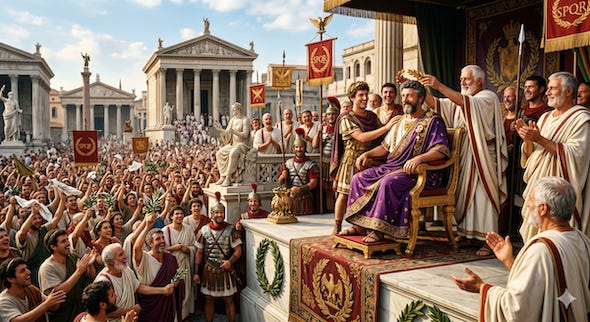
This century in Roman history was marked with unseen stability, peace, prosperity, and economic expansion.
Many new cities were built. Urbanisation became the theme.
An extremely fair system was built. People from newly conquered and ethnically different territories could rise through the ranks and become senators.
Trade flourished and the Roman economy grew stronger.
More peaceful professions like philosophers, architects, and intellectuals were celebrated.
It is said that Marcus was the peak of the golden era of Rome. He was the culmination of the great work done by the four emperors before him.
Between each of these five emperors’ succession, no blood was shed, no civil war took place, prosperity didn’t suffer.
Rome went from one good ruler to another good ruler.
Transition of Power
The lesson we are trying to highlight from Roman Civilization is this: a change of leader can mean many things.
You would have noticed that the section talking about transition from a good state to bad state is much longer.
The one that talks about going from good to another good ruler is relatively short.
That’s mostly because when things are good, there’s not much to record.
Any leadership change is an opportunity. But it can also be a threat.
But when done absolutely right, it barely feels like news.
As investors, we can see this happen all too often in corporate circles.
Good to Bad
This can be a bit controversial since these names can be opinion based.
Disney.
Bob Iger spent years building Disney to what it was. Then, Bob Chapek was appointed CEO of Disney in 2020.
The poor performance and loss of confidence led to a 40% drop in share price in the 2 years he was CEO. Market forces were involved too but the board was unhappy for other reasons as well.
Bob Iger was brought back from retirement and re-appointed the CEO of Disney.
Yahoo!
Marissa Mayer, an ex-Google top executive was hired as CEO of Yahoo. Under her, the company made some poor acquisitions and Yahoo! continued to perform poorly.
Bad to Good
Ford.
Alan Mulally was appointed CEO of Ford in 2006. Until his hiring, the previous CEO had struggled to build trust in the company. He repaired the culture in the company.
Ford was the only American car company that did not require a bailout post the 2008 Recession.
Microsoft.
This one’s a controversial one. Many argue that Steve Balmer had not done justice to his role as CEO of Microsoft.
Though the company was indeed profitable, it was losing ground fast. He was blamed for missing the smartphone revolution which was taken up well by Google (Android) and Apple (iOS).
He was succeeded by Satya Nadella, who turned the company’s fortunes around and took at back to the top — to being one of the top 10 biggest companies in the world.
Good to Good
PepsiCo.
Indra Nooyi took over as PepsiCo CEO from Reinemund.
She propelled an already successful brand into the 21st century and ensured the leadership transition was absolutely flawless.
Apple.
Steve Jobs leaving Apple was seen as a drastic change. But the new CEO, Tim Cook, took over the reins and continued pulling the company to newer heights.
Apple today is facing yet another power transition as Tim Cook steps down and the new CEO John Turnus, takes over.
Quick Takes
+ India’s manufacturing PMI rose to 54.7 in April (vs 53.9 in March). This means manufacturing activity grew more in April than in March.
+ India’s LPG consumption fell 16.2% year-on-year in April (vs a fall of 12.3% in March): Ministry of Petroleum and Natural Gas
+ SEBI has proposed allowing online bond platforms to offer overseas-listed debt securities regulated by the International Financial Services Centres Authority (IFSCA), as part of ease-of-doing-business measures.
+ The government approved the Emergency Credit Line Guarantee Scheme (ECLGS) 5.0, providing 100% government credit guarantee for MSMEs and 90% for the non-MSMEs as well as the airline sector to boost liquidity amid the disruptions due to the West Asia conflict.
+ India’s composite PMI (manufacturing + services) rose to 58.2 in April (vs 57.0 in March). Services PMI rose to 58.8 (vs 57.5 in March). This means economic activity rose more in April than in March.
+ India’s forex reserves fell by $7.79 billion to $690.69 billion in the week that ended on 1 March.
The information contained in this Groww Digest is purely for knowledge. This Groww Digest does not contain any recommendations or advice.
Team Groww Digest
Very informative article.