

Dollar Shave Club was attacking giants.
Gillette and Schick together had 90% of the US shaving market.
It was technically still a monopoly, as 70% of the market was dominated by Gillette.
One quirky video shot by Dollar Shave Club (DSC) rocketed it to popularity in 2012.
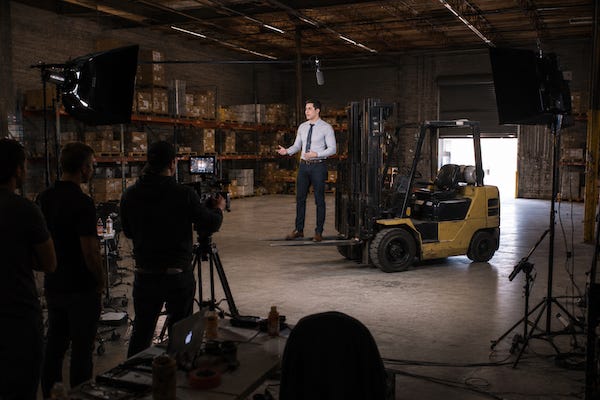
It was actually the founder of the company, walking around their warehouse, explaining how DSC was better.
There were props like a machete, forklift, and other such eye-catching details. It made things a bit edgy.
It worked well.
The proposition was simple.
Modern-day shaving razors had become too complicated and expensive — unnecessarily.
DSC shipped razors for just $1 a month.
Their servers crashed, and they got 12,000 orders within 2 days.
DSC was a Direct-to-Consumer (D2C) brand aiming straight at the big shaving razor companies.
In that year, blades by Gillette or Schick cost around $5.
These razors were quite unique and were not interchangeable. You could not buy a razor from one company and fit blades from any other company.
In short, the company sold you a razor and hoped to lock you in via blade purchases.
DSC challenged this model by offering each of their blades for around $0.60.
So what DSC promised was a pack of 5 blades for $1.
(Shipping was $2, so the final cost was around $3 a month).
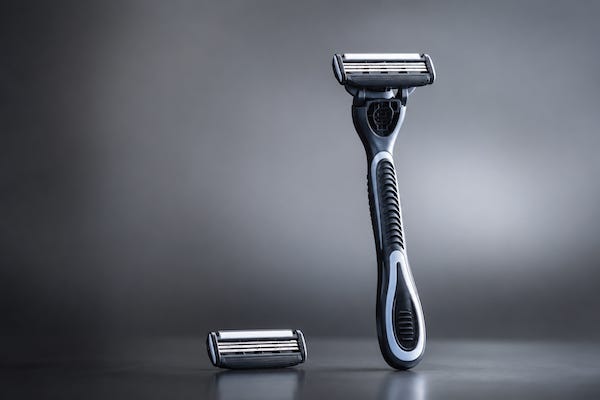
It was a subscription. Unlike other blades that were bought at the department store, DSC blades just arrived at home via courier.
So once users subscribed, customers just stayed with their choice.
DSC
By 2015, some reports put DSC’s market share (USA) at around 5%.
Sure, that’s nothing compared to Gillette’s 70%. But definitely not worth ignoring.
Dollar Shave Club was acquired by Unilever for $1 billion in 2016. Unilever was a competitor to P&G (Gillette’s parent company).
At the time of acquiring, the D2C brand had revenue of around $150 million and was growing fast. And this was a sticky group of customers since they weren’t simply buyers, they were subscribers.
Almost simultaneously, chatter about the acquisition started doing the rounds.
Media, business school students, and several others were all asking what exactly Unilever acquired.
Why was that the case?
Their question was grounded in the fact that DSC did not have any manufacturing plants of their own.
Their blades weren’t unique in any real way.
They were sourcing blades from a Korean manufacturer that sold very similar blades under different brand names.
Some DSC customers actually started buying blades from this manufacturer directly since they worked out even cheaper!
But that was never DSC’s pitch.
DSC was a subscription service that eased the delivery of cheap blades to the customers. It was never promised it had its own manufacturing or R&D facilities.
In some ways, it was white-labelling the blades. And it worked.
Later though, DSC switched their blade sources and made them more proprietary.
Unilever had acquired Dollar Shave Club to grab a slice of a very fast subscription-based shaving market. Unfortunately for them, that didn’t pan out as expected.
In 2023, it sold 65% of Dollar Shave Club off to an investor while remaining a minority shareholder.
D2C: Distribution
Dollar Shave Club was a perfect D2C example.
Companies that operate in the Fast-Moving Consumer Goods (FMCG) space have incredible moats. It is tough to crack their markets.
One crucial link in their chain is that of the distribution network.
New companies do not have the supply chain that FMCG companies have built over years. This allows them to make their products reach stores in every corner.
FMCG companies do not own the entire chain. It is a well-oiled machine with many parties involved. Distributors, wholesalers, transporters, etc, each with their own little business model and tiny margins.
So when a customer buys a product, they are indirectly paying for that entire chain of companies working to get that product on the shelves.
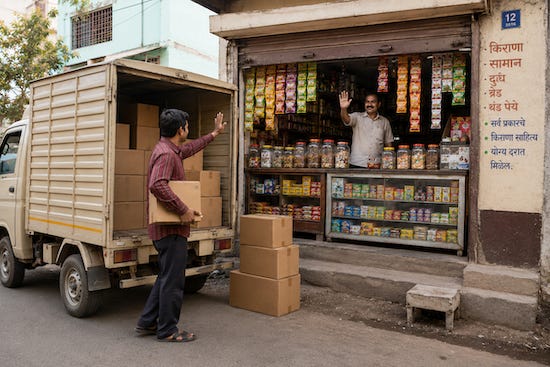
Obviously a new company cannot match that from day 1. In fact, the complexity and difficulty of building the distribution network are one reason why this industry does not get as many competitors as some others.
The difficulty is a barrier.
D2C companies try to crack that.
They try to establish a connection with the final customer directly, skipping the wholesalers, distributors, etc in between.
The added advantage of this process is that they are able to offer much lower prices on their products. Not always, but many times.
The D2C space is not new. It has existed for a long time. But the internet, and then social media, made it that much easier for D2C brands to reach their target customers.
And that in turn led to more D2C brands being started.
In India, we have been seeing a particularly high number of D2C brands mushrooming in the last 5 years or so.
Modern e-commerce websites aid in this too.
D2C brands manage to attract customers via their social media and content while listing their products on Amazon and Flipkart.
That makes it easier for customers to trust them with their money since they already trust buying on Amazon and Flipkart with their hard-earned money.
Further, since e-commerce companies have existed in India for so long, many of the logistics bumps have been well-ironed out. Example: courier companies are well-versed with handling e-commerce packages, and even accepting payments.
But it isn’t just that reason that D2C brands have mushroomed in such numbers.
It’s also the manufacturing, or rather, the lack of manufacturing needed.
D2C: Manufacture
D2C companies don’t always manufacture. In fact, forget a factory, they might not even have a warehouse.
Of course, not all of them are that way. Many do have their own factories.
—White-Labelling—
White-labelling is a sticker job.
Some suppliers manufacture the products in bulk without any labels. When a brand wants to label the product and sell under their brand, they buy in bulk and add their own label to it.
This is why you will notice that certain products like power banks, chargers, trimmers, etc often look alike despite being from different brands.
White-labelling is also common in textiles and apparel, grooming & beauty products, pet products, etc.
Some D2C brands do go one step extra and put their own quality check measures on these generic sourced products.
—Private Label/Custom Spec—
Many D2C brands wish to change available products and make them more in line with their brand’s positioning.
In such cases, the brand specifies what they want, and the manufacturer makes the product accordingly.
Of course, there are levels to this customisation. For example:
Level 1: A sunscreen D2C brand might ask its supplier to put the cream in a customised container and packaging.
Level 2: In addition to that, the brand might ask its supplier to add a certain perfume and colour to the cream.
Level 3: In addition to that, the brand might ask its supplier to change the very formulation of the cream to increase its SPF count or reduce its viscosity.
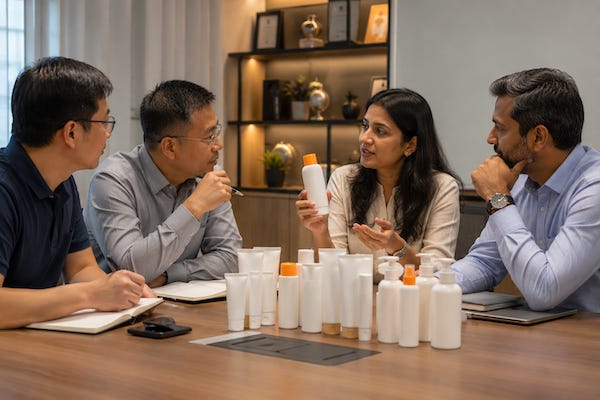
If a D2C brand customises its products to this extent, it is getting close to what many large and established brands are doing.
—Contract Manufacturer—
This is an option even the biggest and most established brands use.
This is even more specialised than the previous option. In this, the product gets designed/formulated by the company.
And then the specifications are handed over to the manufacturer to make the product. The brand may even define how the quality of the products will be tested.
The key distinction between the Private Label model and contract manufacturer model is the level of customisation.
In the case of a private label, the brand makes minimal changes to a product already developed by the manufacturer.
In contract manufacturing, the brand has far more control over the product.
In fact, in this, the manufacturer might be asked to carry out operations that it does not already do.
D2C brands that employ this model are often seeking higher quality, product distinction, and/or have a large order size.
—Co-developed Product—
Some D2C brands, and even large established brands might work closely with their manufacturer and their capabilities to develop a product that is highly customised and unique.
This obviously is more expensive and requires a large order size or high margins.
—Fully Integrated—
The last step in this chain is the fully integrated option.
Not even all big and established brands use this. But many do.
And some D2C brands also make use of it. Especially in cases where they want absolute control over the final product.
D2C: Suppliers and Manufacturers
Companies that work in this space are usually very secretive about brands they supply to. They sign contracts and NDAs to ensure word does not get out.
When Dollar Shave Club’s sourcing news was out in public, everyone was talking about Dorco, the South Korean razor blade manufacturer that used to supply to many brands.
There are similar companies in many product categories.
Cosmax is a South Korean company that plays in the skincare industry. The company does not reveal the brands it works with.
But it does clearly talk about its offerings — including cream products that can be white-labelled, customised, manufactured-to-spec, tested, packaged, etc.
Pou Chen works similarly in the world of sports footwear.
Even the energy drink industry have their own set of manufacturing companies offering all sorts of options from ready-made energy drinks to custom-formulated fruit juices.
Refresco is one such company operating in Europe and the Americas.
This might help explain how some popular YouTubers who specialise in making content suddenly start selling energy drinks, apparel, etc.
Safilo does the same in the world of eyewear.
You’d be surprised.
There are such companies serving D2C brands even in sectors like babycare, pet food, home care, and supplements.
Ease
So by now, it must be clear that starting a D2C company might be more accessible than you think.
If a person has reasonable knowledge about a product and its sector, knows what he or she wants to make, and reaches out to the right vendors, the input costs can be incredibly low.
Some D2C brands have nothing more than a small office space and a few employees.

Clearly manufacturing was never really a challenge.
There are enough options. White labelled products are available for companies that do not have the resources to support a R&D team of their own.
Warehousing — that is offered too, often by the same folks who manufacture.
The supply chain has become a well-oiled machine.
And thanks to social media, distribution has gotten much easier too.
Often, many D2C brands are nothing more than branding and marketing companies for products that have been developed and manufactured by someone else.
This does make it incredibly easy for new entrants.
And that’s where D2C brands have some drawbacks.
Many D2C brands are often unable to answer what makes their product better or unique. It’s often the case that they’re not unique at all.
Customers may trust them less since they are new and their standards are less known.
To make matters worse, their products are easily copied by competitors. So many D2C brands die early deaths because their products suffered due to imitation.
That said, D2C brands are often able to do what big brands can only dream about.
Many D2C brands are excellent at finding a niche audience and serving them exactly what they want.
Think about a D2C wrist-watch brand that caters to fans of astronomy. Examples like that.
They’re also excellent at listening to feedback from these customers and making adjustments accordingly.
Storytelling plays a big role when it comes to targeting niche markets, and D2C brands are much better placed to do just that.
India’s many D2C brands have all sorts of examples that have performed well and risen through the ranks to become established players themselves.
Can you think of any companies that are operating in the Indian D2C space?
You’d be surprised to know some top-favourite brands today started off as D2C brands.
Quick Takes
+ The Defence Acquisition Council (DAC) approved proposals worth nearly Rs 52,000 crore to procure advanced indigenous military hardware, including Akash Tarang electronic warfare systems, Kamikaze drones, anti-tank missiles, and naval unmanned aerial systems.
+ The India-Israel Bilateral Investment Agreement (BIA) came into force on 4 July, establishing a secure legal framework to boost cross-border capital flows while safeguarding both nations’ sovereign rights to regulate public policy.
+ India and Indonesia signed multiple MoUs including agreements on defense cooperation for BrahMos and Astra missile systems, critical minerals and steel supply chain technology, medical product regulation, disaster management, telecommunications, agriculture, etc.
+ Manipal Health has received SEBI’s approval for a Rs 8,000 crore IPO.
+ Cult.fit has filed draft papers with SEBI for a Rs 950 crore IPO.
+ The US-Iran ceasefire collapsed with the US launching airstrikes on 80 targets in Iran and revoking its oil sanctions waiver after Iran attacked 3 commercial shipping tankers in the Strait of Hormuz. This triggered retaliatory attacks on US bases in Bahrain and Kuwait.
+ India’s auto component industry grew 12.7% year-on-year reaching a turnover of Rs 7.6 lakh crore in FY26.
+ India and Australia signed a Joint Declaration on Defence and Security and fast-tracked negotiations for a CECA (Comprehensive Economic Cooperation Agreement) while concluding strategic partnerships in maritime security, civil nuclear administrative arrangements, and critical tech supply chains during the 3rd Annual Leaders’ Summit in Melbourne.
+ Zostel has approached SEBI to review Prism’s (Oyo’s parent company) updated Rs 6,650 crore IPO prospectus, claiming it conceals critical facts about their decade-long 7% equity ownership dispute.
+ India’s forex reserves rose by $0.73 billion to $674.19 billion in the week that ended on 3 July.
+ Equity mutual funds saw a net inflow of Rs 28,973 crore in June (compared to Rs 22,908 crore in May). Debt funds saw a net outflow of Rs 1.09 lakh crore in June (compared to a net outflow of Rs 96,948.51 crore in May): AMFI.
+ The Indian Railways has approved 2 projects: Rs 175 crore to set up additional maintenance facilities for 250 three-phase electric locomotives at the Raipur Diesel Shed and Rs 206 crore to install the ‘Kavach 4.0’ Automatic Train Protection system across 680 route kilometers of the Northern Railway.
The information contained in this Groww Digest is purely for knowledge. This Groww Digest does not contain any recommendations or advice.
Team Groww Digest
"You’d be surprised to know some top-favourite brands today started off as D2C brands."
Why not give some examples to make the article even more interesting?
Very informative...