
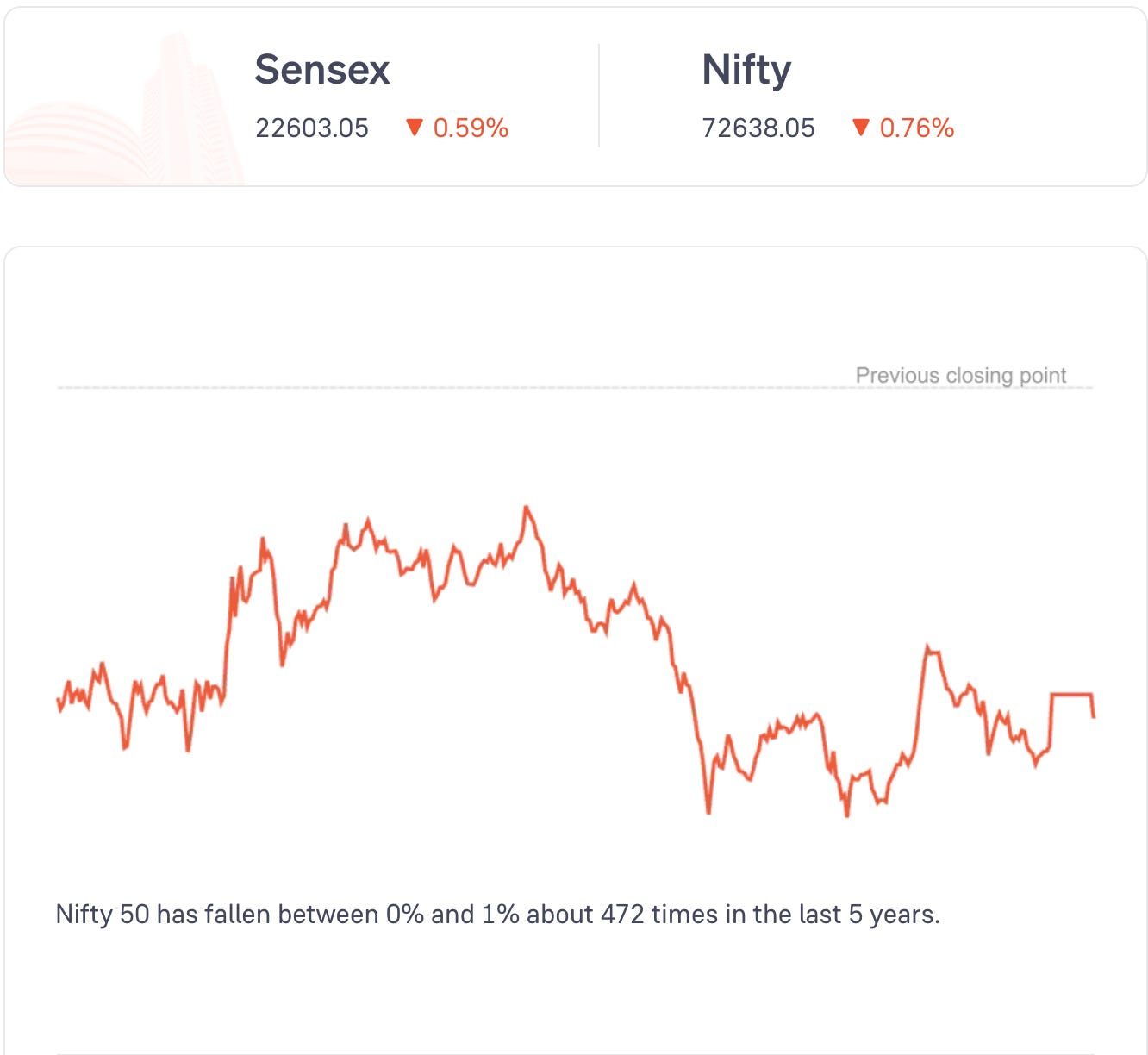
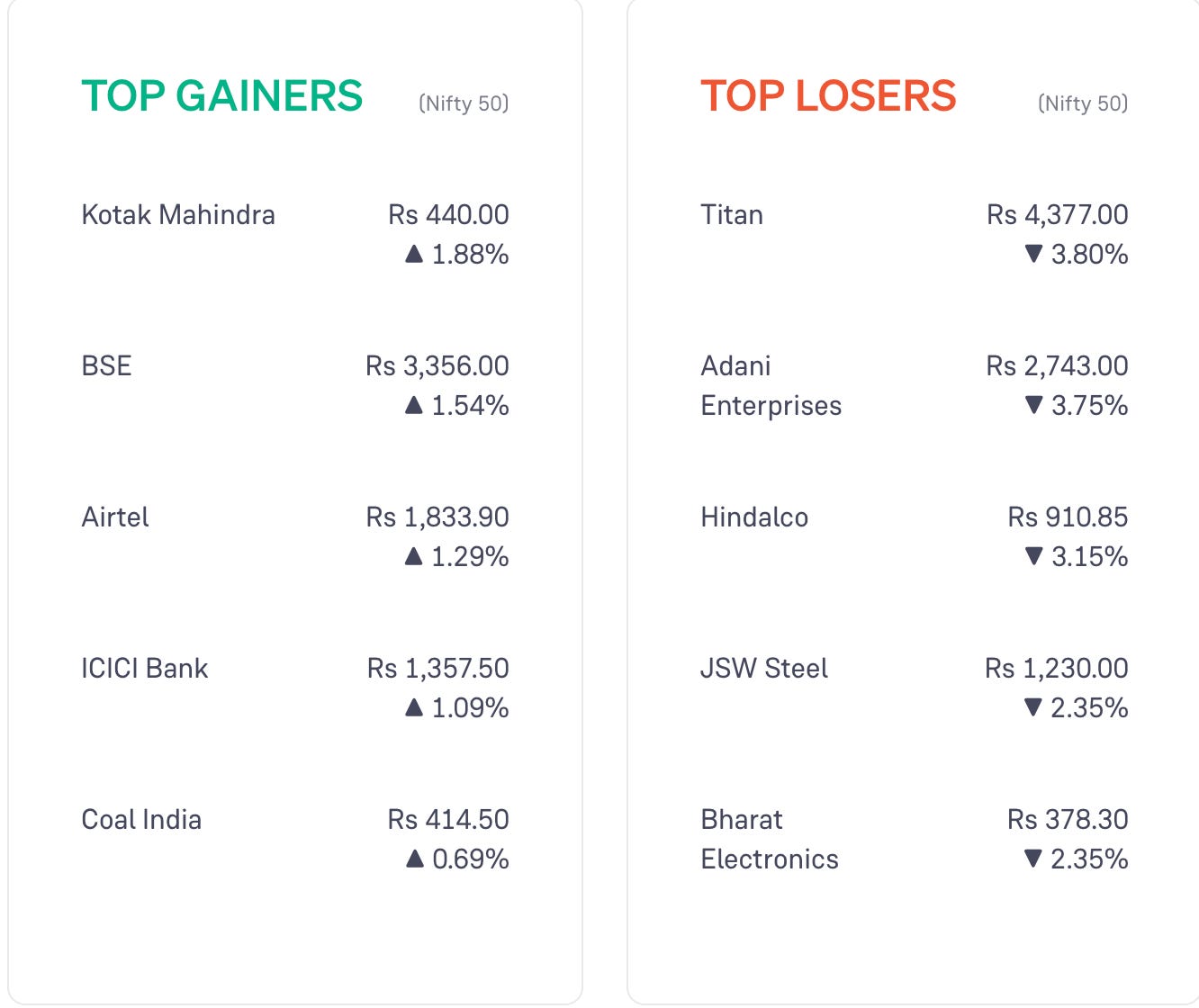
Markets closed lower compared to yesterday’s closing point.
Nifty 50 opened significantly lower. The fall in the markets today was mainly due to RBI’s interest rate hike.
Metal stocks and auto stocks fell the most today. PSU Bank stocks and media stocks rose the most.
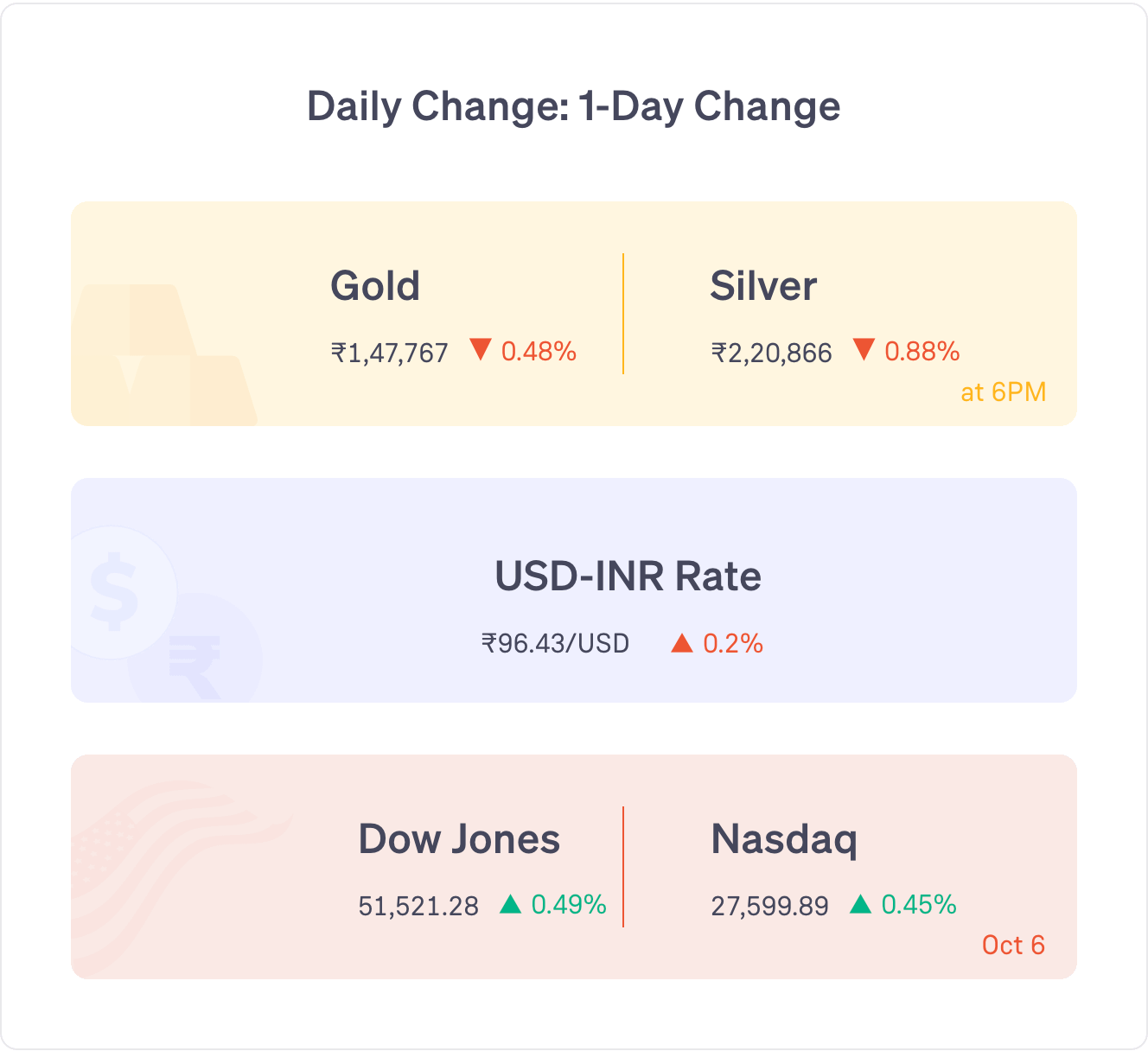
Global markets: US markets rose on Tuesday. Most Asian markets fell on Wednesday and most European markets also traded in red (as of 6 pm IST).
News
RBI raised the repo rate by 25 basis points to 5.5% in the monetary policy; the 1st hike in about 4 years. It also changed its stance to “calibrated tightening” from “neutral” which could indicate more rate hikes.
The US 30-year bond yield rose to a 24 year high of 5.7041% ahead of the Federal Reserve’s September meeting results.
Federation of Indian Export Organisations (FIEO) asked for an extension of export credit period to 450 days after the RBI hiked repo rate to support exporters.
Stock Updates
L&T: received a Major order (Rs 5,000 crore to Rs 10,000 crore) from DVC CIL Power, a JV of Damodar Valley Corporation and Coal India, for the 1,600 MW thermal power project in Jharkhand. The order was given through a Limited Notice to Proceed (LNTP).
Adani Ports: set up wholly owned subsidiary Paradip Mahanadi Terminal Ltd to develop and operate 2 dry-bulk berths at Paradip Port in Odisha.
HCLTech: opened a new regional headquarters in Johannesburg, South Africa.
Adani Energy: bought 100% of Satara Power Transmission Ltd from PFC Consulting for Rs 19.01 crore. Satara Power is the SPV for Adani Energy’s earlier Rs 4,700 crore Maharashtra transmission project.
Varun Beverages: will invest up to Rs 4.10 crore for a 26% stake in Jager Renewables, a solar-power SPV.
Tata Power: partnered with Norway-based Ocean Sun to set up a 300 kWp floating solar pilot at its Mulshi reservoir in Maharashtra using membrane-based solar technology.
Meesho: will invest up to Rs 50 crore in Retail Pulse Labs, a Kirana Club subsidiary, once it makes the first payment for its earlier Rs 202.09 crore acquisition of Kirana Club.
Laurus Labs: invested another Rs 12.10 crore in associate Kurnool Renewables Pvt Ltd through a rights issue.
Word of the Day
Floor
It is the lowest possible price.
Floor or floor price is used in many different contexts.
For example, an investor might plan on selling his shares at Rs 455 or above. So, we can say this investor has set the floor price as Rs 455.
During IPOs, companies have a floor price below which they do not offer their shares.
In loans, the floor is the minimum interest rate that will be charged by the bank (in case the loan has a floating interest rate).
6 Day Course
Theme: things investors should ignore
Day 3: Wednesday
Forecasts
There are many experts in the markets who try to predict various stocks’ future prices.
Most such experts do not have a solid track record of being right.
It isn’t that most of these experts who lack a track record are trying to do something wrong. It’s just that it’s extremely hard and difficult to predict individual stocks’ future prices.
While a certain logic may sound right, there may be multiple other factors that also affect the company that the expert is failing to recognise.
In these matters, investors should buy stocks only if they can independently develop their own opinion on the stock.
Most good investors do not come on the news or social media to publicly predict stocks’ future prices.
Some really good ones do occasionally talk about stocks from a learning and lessons perspective.
Such investors are worth listening to and learning from.
————
Featured Question
Q. “What metric can I use to compare performance of two different mutual funds. is one metric sufficient or I should take into consideration more than one matrics.”
Before we talk about this, it is necessary to understand that mutual funds should only be compared if they belong to the same category and sub category.
Example: comparing two mid-cap mutual funds is fair. Comparing a small-cap mutual fund with a large-cap mutual fund does not make sense.
The first and most commonly used metric to compare two mutual funds is returns.
Investors should stick to comparing long term returns (3, 5, 7 years etc).
Many times, the returns may be similar.
Investors can also compare the expense ratio (mutual funds fees).
But this is lower priority since the returns shown are shown after deducting the expense ratio. So just comparing returns is also enough in this case.
Investors can also compare volatility levels to see which is more suitable to their comfort. This can be done using SD or Standard Deviation.
The beta ratio can be compared to see which fund is likely to be more sensitive to market conditions.
Sharpe ratio is another metric that can tell investors whether the risk taken by the fund is justified by the returns it gives.
More detailed and keen investors can also try to analyse the fund’s holdings and see if they can judge which mutual fund is better.
In such cases, mutual fund investors can also compare the PE ratio of the mutual funds to see which is more likely to be overvalued.
The information presented in this post has been compiled and prepared by Groww Invest Tech Pvt Ltd and is intended solely for informational purposes. It is not tailored to any specific investment objectives, financial situations, or needs of any individual investor. The content should not be construed as investment, financial, legal, or tax advice and should not be relied upon as a substitute for professional consultation.
Investing in securities markets involves inherent risks. Investors are advised to carefully review all relevant documents and consider their own risk tolerance before making any investment decisions.
Mutual fund investments are subject to market risks; please read all scheme-related documents carefully. Past performance of financial instruments, schemes, or markets is not indicative of future results.
SEBI Reg Name: Groww Invest Tech Pvt Ltd | SEBI Reg No: INZ000301838 | RA No: INH200008662
Groww Invest Tech Pvt Ltd is registered with the Securities and Exchange Board of India (SEBI) under Registration No: INZ000301838, as a Research Analyst under No: INH200008662, as a Depository Participant under No: IN-DP-417-2019, and with the Association of Mutual Funds in India (AMFI) under ARN-111686.
SEBI registration details: View registered name and registration numbers
Did you like this edition?
Leave a feedback here!