
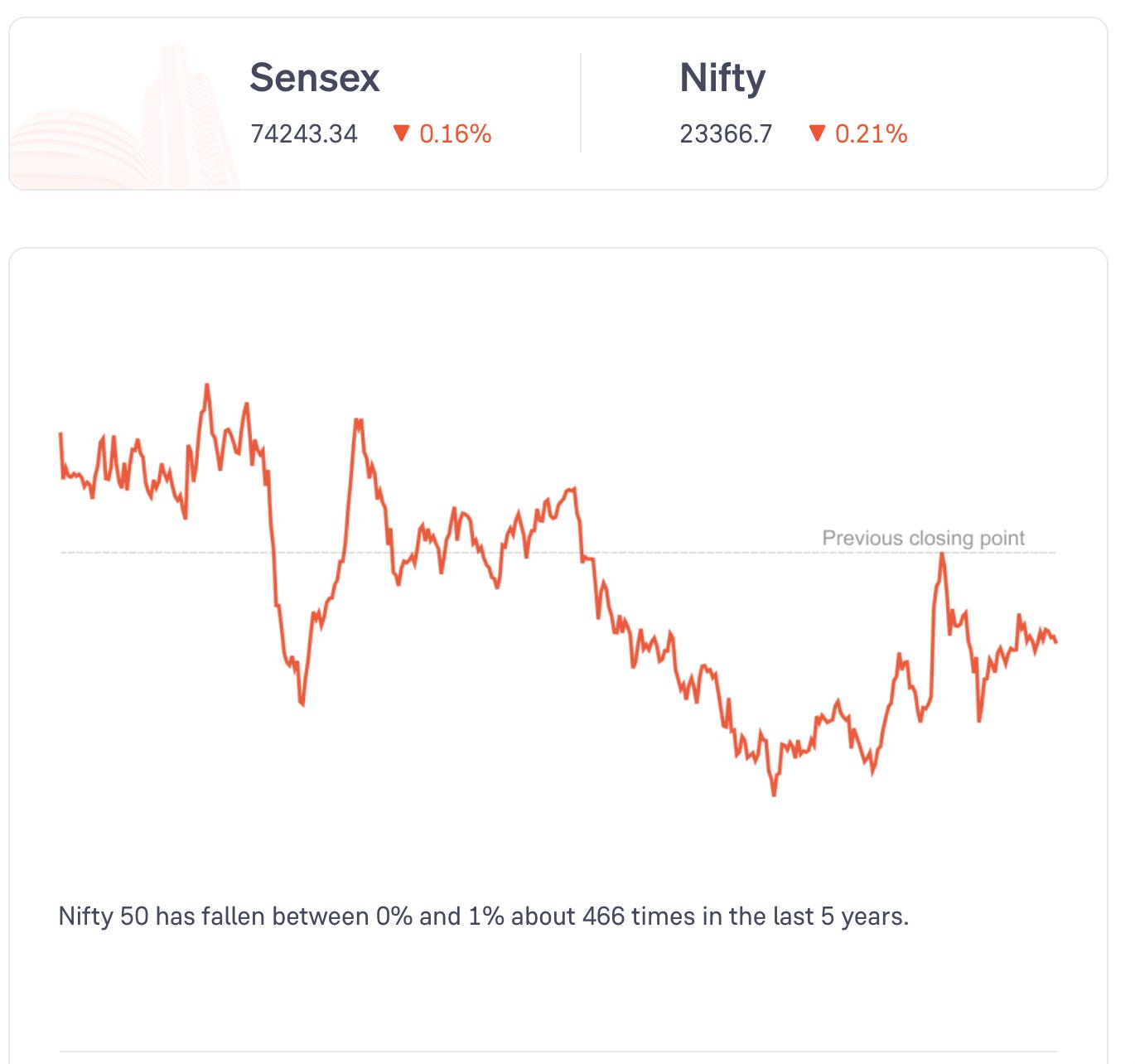
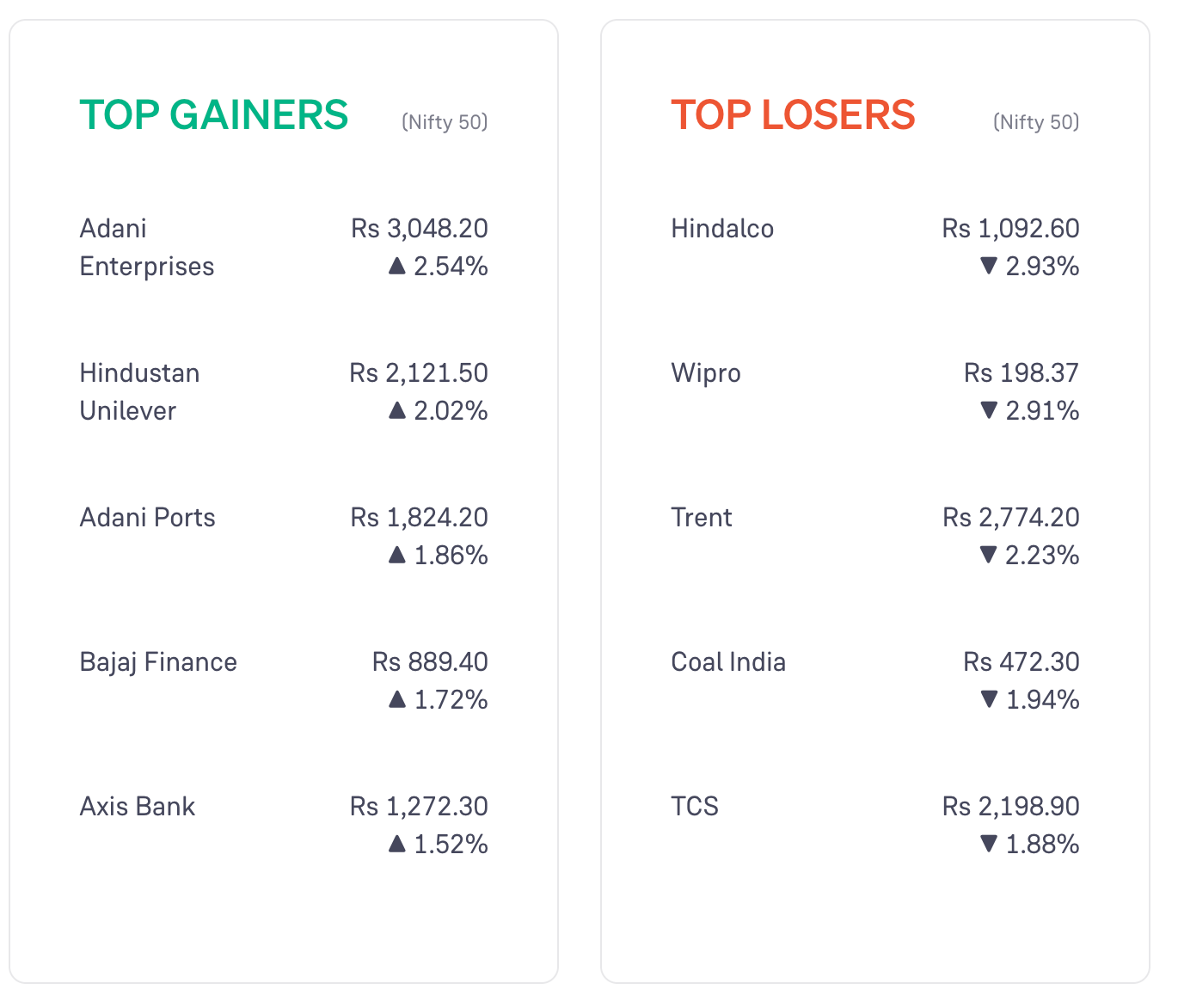
Markets opened above yesterday’s closing point.
Media stocks and healthcare stocks rose the most today. Metal stocks and IT stocks fell the most.
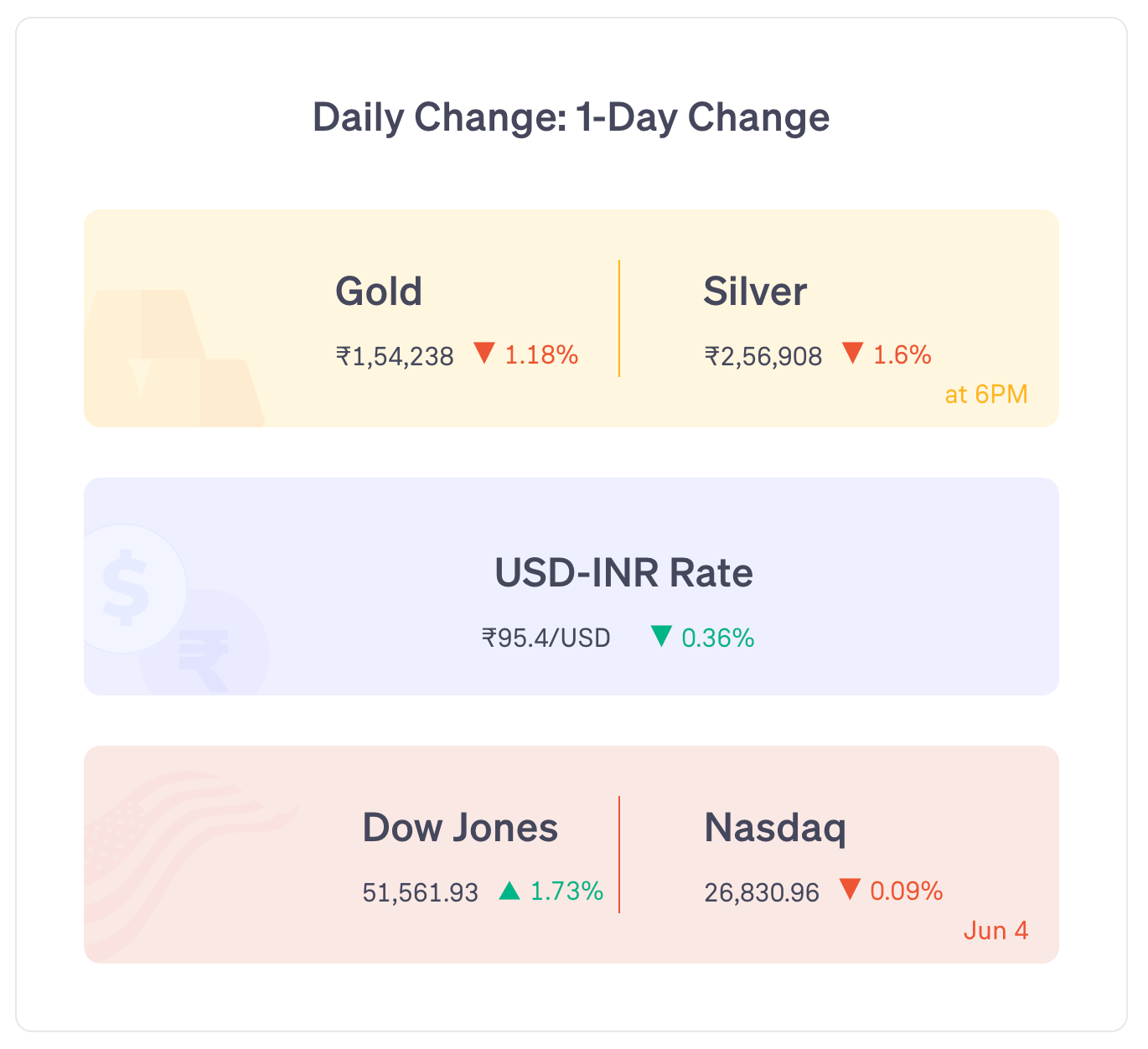
Global markets: Most US markets rose. Asian markets fell. Most European markets rose (as of 6 pm IST).
News
The RBI has kept the repo rate constant at 5.25%, maintaining a neutral policy stance.
India’s real GDP for FY25-26 grew 7.7% year-on-year (vs 7.1% in FY24-25). The GDP grew 7.8% in the Jan-March quarter: Ministry of Statistics and Programme Implementation.
India’s forex reserves rose by $0.94 billion to $682.32 billion in the week that ended on 29 May.
The government has doubled the equity investment cap for individual foreign nationals to 10% and waived income and capital gains taxes on FPI investments in government bonds, effective retrospectively from 1 April. These changes are part of the measures taken to simplify procedures and attract foreign inflows.
CMR Green Technologies IPO was subscribed 127.04 times. Retail subscription: 27.03 times. IPO is closed for subscription.
Stocks Updates
NTPC: signed a supplementary JV agreement with UPRVUNL to increase Meja Stage-II power project capacity from 2x660 MW to 3x800 MW.
Tata Steel: clarified that a fire occurred at its UK subsidiary’s Port Talbot plant on 3 June. No injuries were reported, and the company is assessing the impact.
InterGlobe (IndiGo): will temporarily suspend flights to Langkawi, Krabi, Ho Chi Minh City, Hong Kong, Shanghai and Siem Reap from July to September due to a soft demand environment and elevated operating costs.
Lupin: received USFDA approval for Ranluspec (ranibizumab), an interchangeable biosimilar used to treat multiple eye disorders.
Ambuja Cements: received no-objection letters from BSE and NSE for the proposed merger of Orient Cement Ltd with Ambuja Cements Ltd, subject to remaining statutory and shareholder/creditor approvals.
United Spirits: will close its Hyderabad manufacturing unit by 31 August under its supply chain optimisation programme. The unit contributed around 2% of FY26 revenue.
Word of the Day
Real GDP
It is the total value of all goods and services produced in a country during a specific period, taking into account inflation.
GDP = Gross Domestic product
GDP is a metric that measures a country’s economic activity or size. A rising GDP indicates economic growth, while a falling GDP may signal a slowdown.
Sometimes, GDP can go up just because prices have risen and not because more goods and services are produced in a country.
Real GDP helps us see if the economy is actually growing or if things just cost more. It shows the ‘real’ value of a country’s GDP
Example: If the unadjusted (nominal) GDP grows by 8% but inflation is 3%, the real GDP growth is approximately 5%.
6 Day Course
Theme: use of LLMs in investing
Day 5: Friday
Another word that we’re hearing more and more of is ‘agents’.
In simple language, AI agents or LLM agents are dedicated LLM bots that do one role very well.
To better understand, think about the regular ChatGPT or Gemini experience.
You open a new chat, and then write a query. Example: “tell me about the best books on Indian history”.
Now, you might want something more specific like “make sure these books are written by Indian authors”, or “make sure the book is priced below Rs 1,000”.
So this chat is going to behave a certain way.
But when you start a new thread, you will have to explain all of these things again.
Agents are LLM bots that you can assign a highly specific role to. And then, that agent always behaves in that manner.
Not just behave, it will follow instructions by you.
So you could give long and detailed steps about how it must behave and it will try to follow it.
You can even assign it tools it can use to be able to deliver results (use of speadsheets, data plug-ins, etc)
In finance, many investors are starting to use agents for various applications.
Example: agents can be made as an industry expert, value investing expert, an expert who thinks like Warren Buffett, etc.
LLMs are incredibly powerful at summarising.
Many investors use LLMs to quickly read through large PDFs like quarterly reports.
So, they may upload the PDF to an LLM service like NotebookLM and ask it questions.
Example: they upload this years’ annual report along with the previous years’.
Then, instead of looking for differences, they can ask the LLM a question like “what are the major things that have changed in the last 1 year?”
In fact, many documents can be uploaded together to ask for a combined report taking into account all different factors involved.
Similarly, investors can upload their entire portfolio details (of all stocks, bonds, mutual funds, etc) and ask for regular summaries to keep a close track of what’s happening.
Featured Question
Q. “Why companies pay dividends? Are they bound to pay or its depends on their sole discretion...?”
It is the companies’ sole discretion.
Usually, companies give dividends when they have no use for the money.
This is why you will see fast-growing companies often skip giving dividends. It’s because they are re-investing the entire amount back into the business’s future growth.
Larger companies that cannot use such large amounts tend to keep some portion for future re-investment and return some in the form of dividends.
Dividends are a touchy subject and many companies tend to ensure they are consistent with their dividends to keep investors happy.
They feel not doing so will result in investors losing confidence in them and selling the stocks.
This is why companies that give dividends try to be regular with it and also try to keep their dividend amounts consistent.
This is also why many loss-making companies still give dividends.
They are trying to signal that they are confident that the losses are a temporary bump and they will be profitable in the future.
Dividend paying companies tend to be larger in size but that is not a norm. There are smaller companies that pay dividends too.
The information presented in this post has been compiled and prepared by Groww Invest Tech Pvt Ltd and is intended solely for informational purposes. It is not tailored to any specific investment objectives, financial situations, or needs of any individual investor. The content should not be construed as investment, financial, legal, or tax advice and should not be relied upon as a substitute for professional consultation.
Investing in securities markets involves inherent risks. Investors are advised to carefully review all relevant documents and consider their own risk tolerance before making any investment decisions.
Mutual fund investments are subject to market risks; please read all scheme-related documents carefully. Past performance of financial instruments, schemes, or markets is not indicative of future results.
Groww Invest Tech Pvt Ltd is registered with the Securities and Exchange Board of India (SEBI) under Registration No: INZ000301838, as a Research Analyst under No: INH200008662, as a Depository Participant under No: IN-DP-417-2019, and with the Association of Mutual Funds in India (AMFI) under ARN-111686.
SEBI registration details: View registered name and registration numbers
Research Analyst Disclaimer: View Research Analyst disclaimer
Did you like this edition?
Leave a feedback here!