
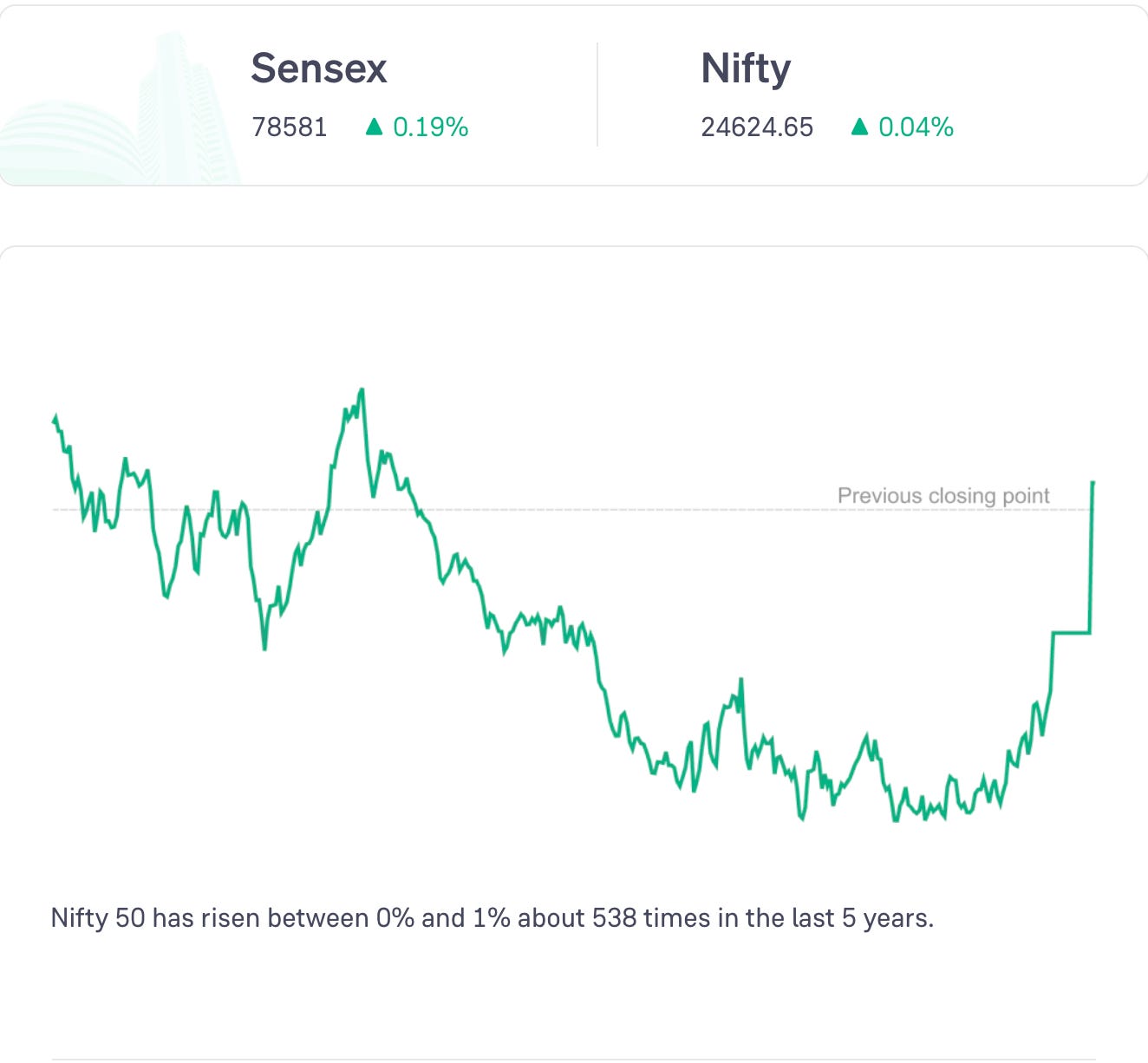
Markets closed slightly higher than yesterday’s closing point. The rise at the end of the day was due to the closing auction system.
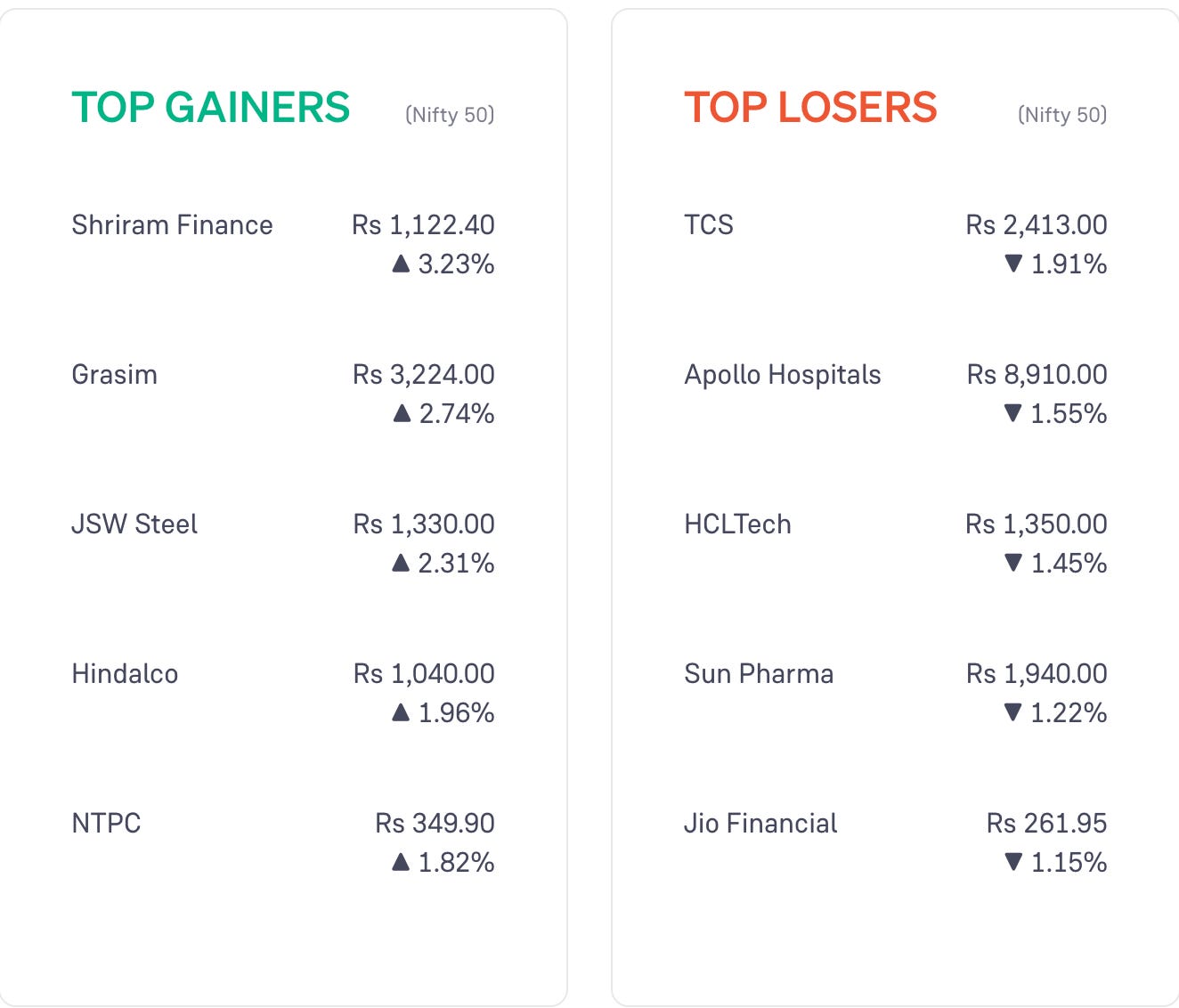
Metal stocks and auto stocks rose the most today. Media stocks and private banks’ stocks fell the most.
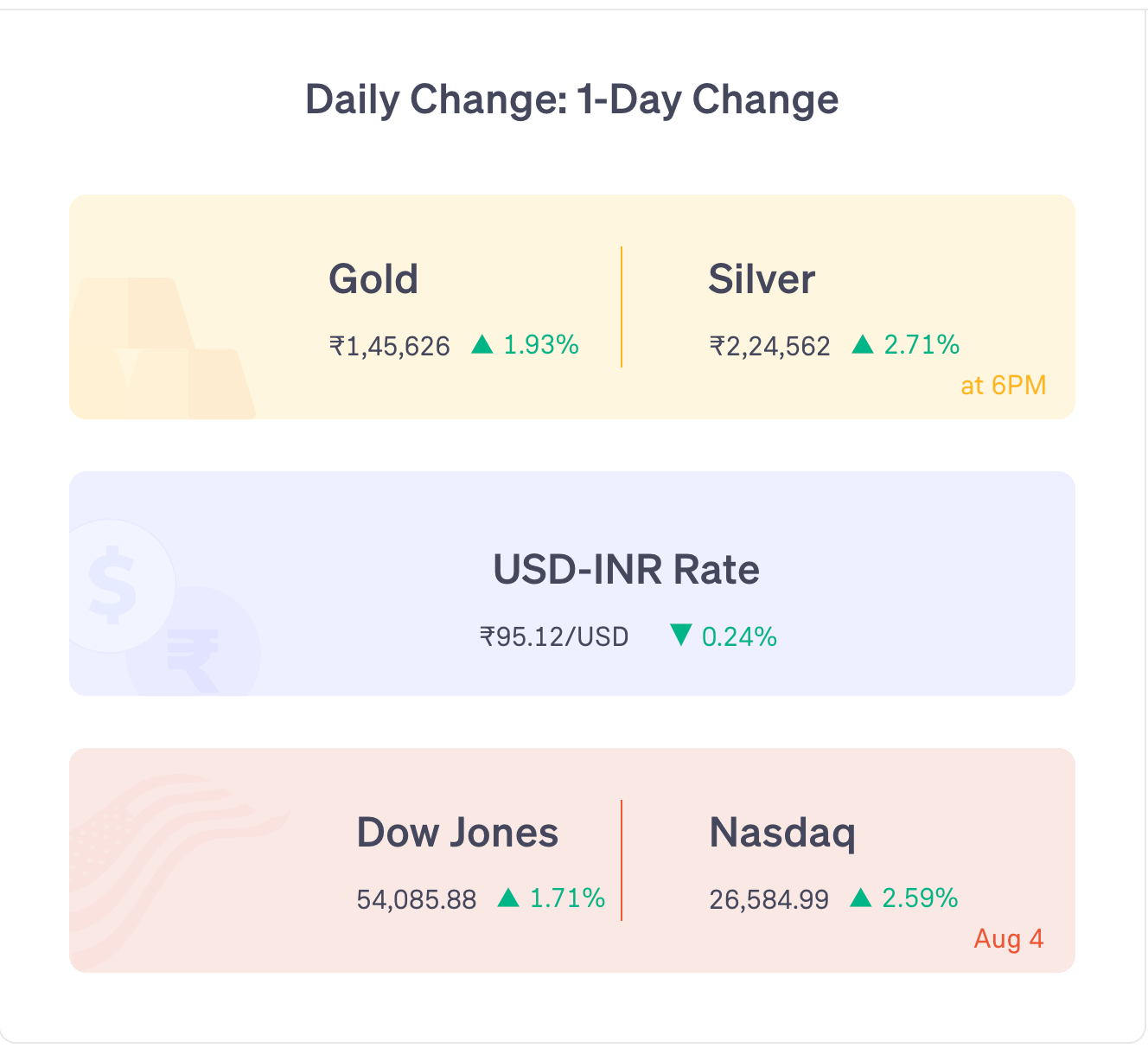
Global markets: US markets rose on Tuesday. Most Asian markets rose on Wednesday. European markets showed a mixed trend (as of 6 pm IST).
News
RBI kept the repo rate unchanged at 5.25% and maintained a ‘neutral’ policy stance.
The government operationalised the Inventory-based Cross-border E-Commerce Export Framework under the Foreign Trade Policy, 2023 for exports of goods manufactured or produced in India.
RBI Governor Sanjay Malhotra said that plastic currency notes will be in circulation from next financial year.
SEBI proposed allowing depository receipts to be issued against units of REITs and InvITs in a consultation paper. This is aimed at attracting foreign inflows.
Manipal Health Enterprises listed at Rs 652 on NSE, a premium of 10.51% over its issue price and closed 12.40% higher by the end of the day.
LIC’s about Rs 31,410 crore OFS was subscribed 1.22 times including the green shoe option. Institutional investors subscribed 1.28 times while retail investors portion was undersubscribed at 0.7 times.
Stocks Updates
ONGC: net profit rose 21.37% year-on-year to Rs 11,898.93 crore in the April-June quarter.
Power Grid: commissioned the transmission system to transfer power from the 20 GW renewable energy zone in Rajasthan under Phase-III Part-H.
TVS Motor: Its subsidiaries approved a scheme to merge STPL Trading and Services Pvt Ltd into Home Credit India Finance Pvt Ltd. Home Credit India Finance Pvt Ltd and TVS Housing Finance Pvt Ltd will then merge into TVS Credit Services Ltd, subject to approvals.
Samvardhana Motherson: subsidiary Samvardhana Motherson Adsys Tech Ltd incorporated Samvardhanan Motherson Adsys Tech Holland Holding B.V. to hold the Motherson Group’s international aerospace businesses.
Cummins India: net profit rose 0.89% year-on-year to Rs 609.30 crore in the April-June quarter.
BSE: net profit rose 62.03% year-on-year to Rs 874.02 crore in the April-June quarter. The board also approved acquiring additional shares in IIBH IFSC Ltd for Rs 50.50 crore, increasing BSE’s direct stake from 3.33% to 20%.
Adani Enterprises: Subsidiary Adani Defence Systems & Technologies Ltd acquired the remaining 44.60% stake in Flight Simulation Solutions Pvt Ltd. Another subsidiary, Adani Airport Holdings Ltd, incorporated AAHL Global IFSC Ltd to operate a Global Treasury Centre under IFSCA regulations.
Marico: net profit rose 25% year-on-year to Rs 630 crore in the April-June quarter.
United Spirits: Received an FSSAI order over allegedly non-compliant labels on certain whisky products made at its third-party unit in Madhya Pradesh.
Auto Updates (July)
Maruti Suzuki: sales stood at 2.41 lakh units. Domestic sales stood at 2 lakh units and exports stood at 30,056 units.
M&M: sales grew 26% year-on-year to 1.03 lakh units. Domestic passenger vehicle sales grew 20% to 60,048 units while commercial vehicle sales grew 23% to 25,204 units.
Tata Motors Passenger: sales grew 59% year-on-year to 63,760 units.
Hyundai Motor: sales stood at 75,360 units including export sales of 21,150 units.
Eicher Motors: sales grew 34% year-on-year to 1.18 lakh units.
TVS Motor: sales grew 38% year-on-year to 6.29 lakh units. EV sales stood at 60,934 units.
Ashok Leyland: sales grew 30% year-on-year to 19,590 units.
Bajaj Auto: sales grew 30% year-on-year to 4.74 lakh units.
Tata Motors: sales grew 37% to 39,641 units.
Word of the Day
Acquisition
It refers to one company taking over another company via share purchase.
Often, acquisitions need not involve taking over a company fully.
Acquiring over 50% of the company is enough to gain operational control over a company as it often means all voting rights are with the acquirer.
This does not work in cases where the voting rights are not even. Some companies have higher voting power shares that allow some key people to have greater voting power than others.
While acquiring, a company might buy shares by paying cash, or by giving shares in itself, or a combination of both.
6 Day Course
Theme: phases of stock markets
Day 3: Wednesday
The next phase is called the bull run.
This phase is also called the expansion, uptrend, rally, or markup phase.
In this phase, a lot of the doubt and worry about the markets reduce significantly.
Stocks rise consistently and markets recover from the previous crash or downturn. They may even touch new all time highs.
This period is marked by euphoria and buying.
Most retail investors are convinced about the recovery and also start putting money in the markets.
This also means that many stocks’ valuations get pushed upwards as more money chases the same stocks.
Investors who had invested in the previous phase would now be sitting on healthy returns.
This phase can sustain for a while, which means, many investors who started investing late in this phase might also be able to see good returns.
————
Featured Question
Q. “Due to RBI's restrictions on Foreign Investments, the Indian ETFs investing in Foreign Stocks have become premium, although the Base Price of the underlying asset has not increased much. Does the same hold good if we buy Mutual Funds that invest in Foreign Stocks, (if any funds are still accepting investments), i.e., if we invest in those MFs, are we also buying them in premium?”
Great question.
Let us understand how ETFs and mutual funds work.
ETFs are traded on the markets. Every time the ETF’s demand goes up, its price goes up.
But for each unit of the ETF, there is supposed to be a corresponding asset behind it.
So, if you buy Rs 3,000 worth of a gold ETF, there is supposed to be Rs 3,000 worth of gold backing those ETF units.
What is a premium in ETFs?
When the price of each unit is greater than the asset it holds, the ETF is said to be trading at a premium.
Example: a unit of a gold ETF costs Rs 500 but each unit is backed by only Rs 450 worth of gold.
So, here Rs 50 is the premium.
ETF companies resolve this by buying additional gold.
So why do we still have ETF premiums then?
That happens when there is no asset to buy. Say investors keep buying ETF units but there is no gold in the market to buy.
In such a case, there will be a premium.
So, if an ETF invests in an international index but fresh investments in the index are paused, premium of the ETF will rise.
Mutual funds do not operate like this.
Mutual fund units are not traded on the markets.
When money is put in a mutual fund, it is considered invested in the underlying asset.
If a mutual fund is not able to invest in that asset, it is common for them to stop accepting fresh money.
So in the case of mutual funds, there are no premiums.
There is one complication here though.
Many mutual funds that invest in foreign assets do it via ETFs.
So the mutual fund would be investing in an ETF investing in a foreign country.
What happens in these cases?
It depends on the fund manager. They may choose to stop accepting fresh investments citing the premiums in ETFs or may continue investing despite the premiums if they feel it is ignorable.
Did you like this edition?
Leave a feedback here!
Thanks