
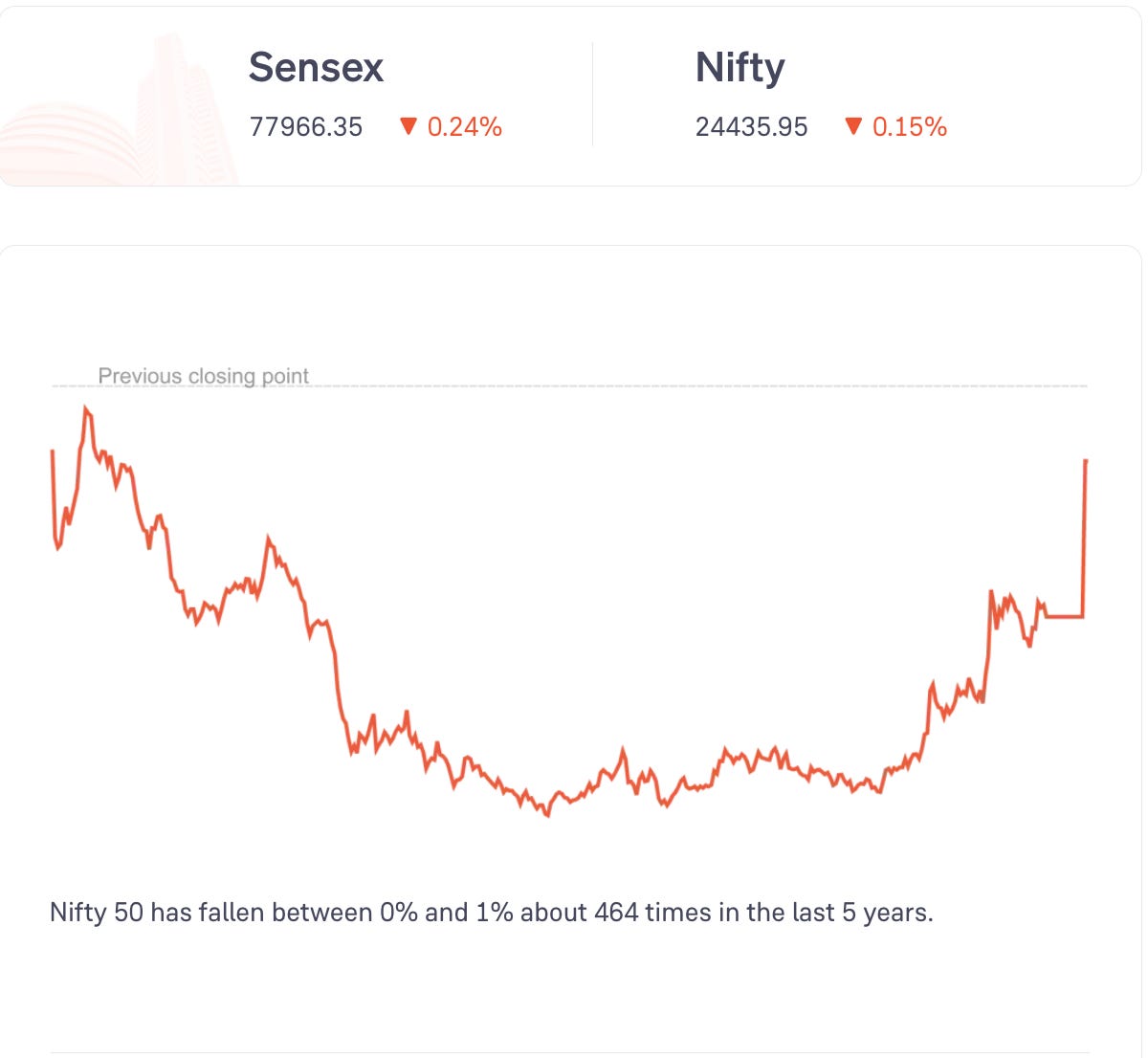
Markets closed lower than yesterday’s closing point.
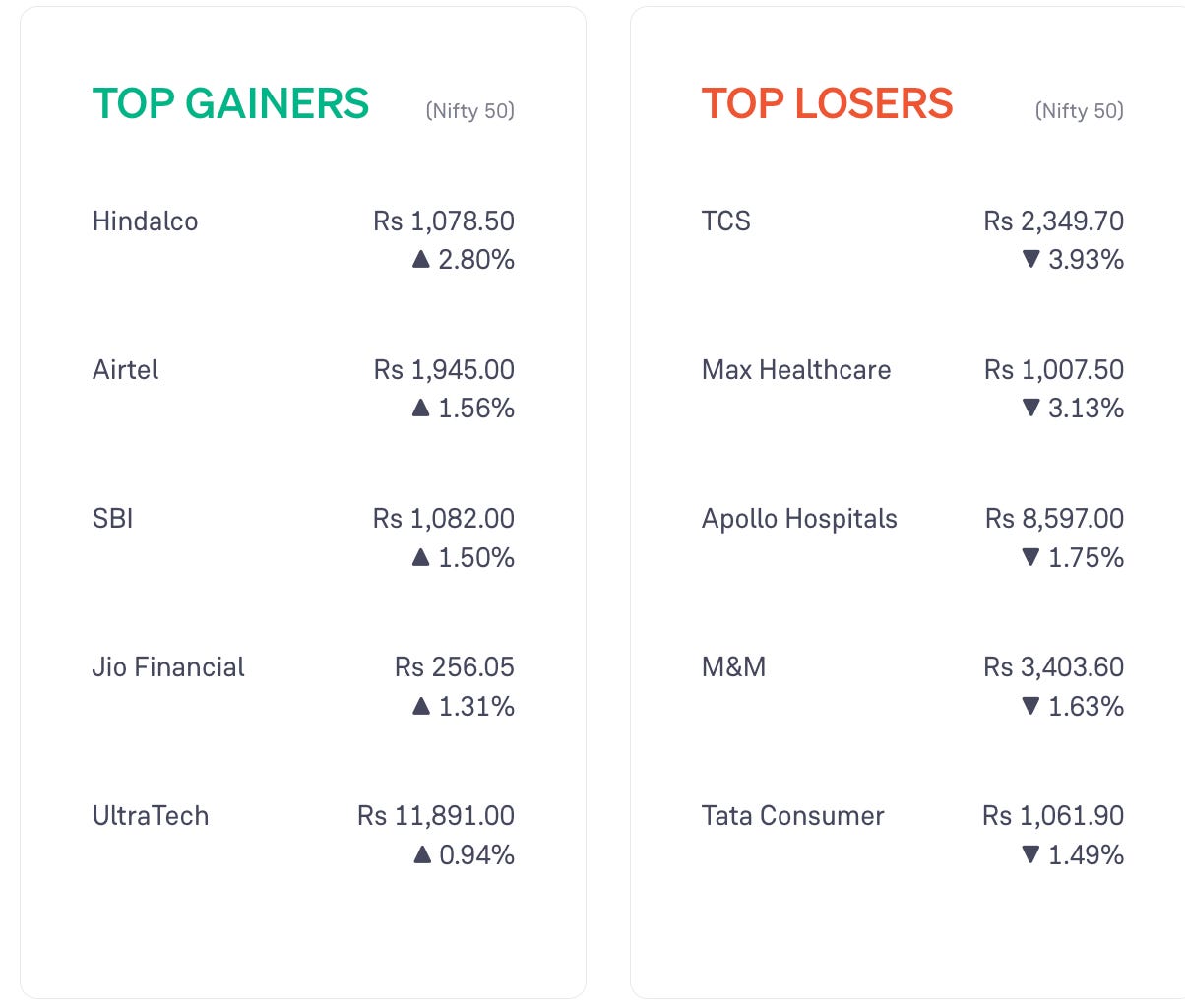
IT stocks and FMCG stocks fell the most today. PSU Bank stocks and media stocks rose the most.
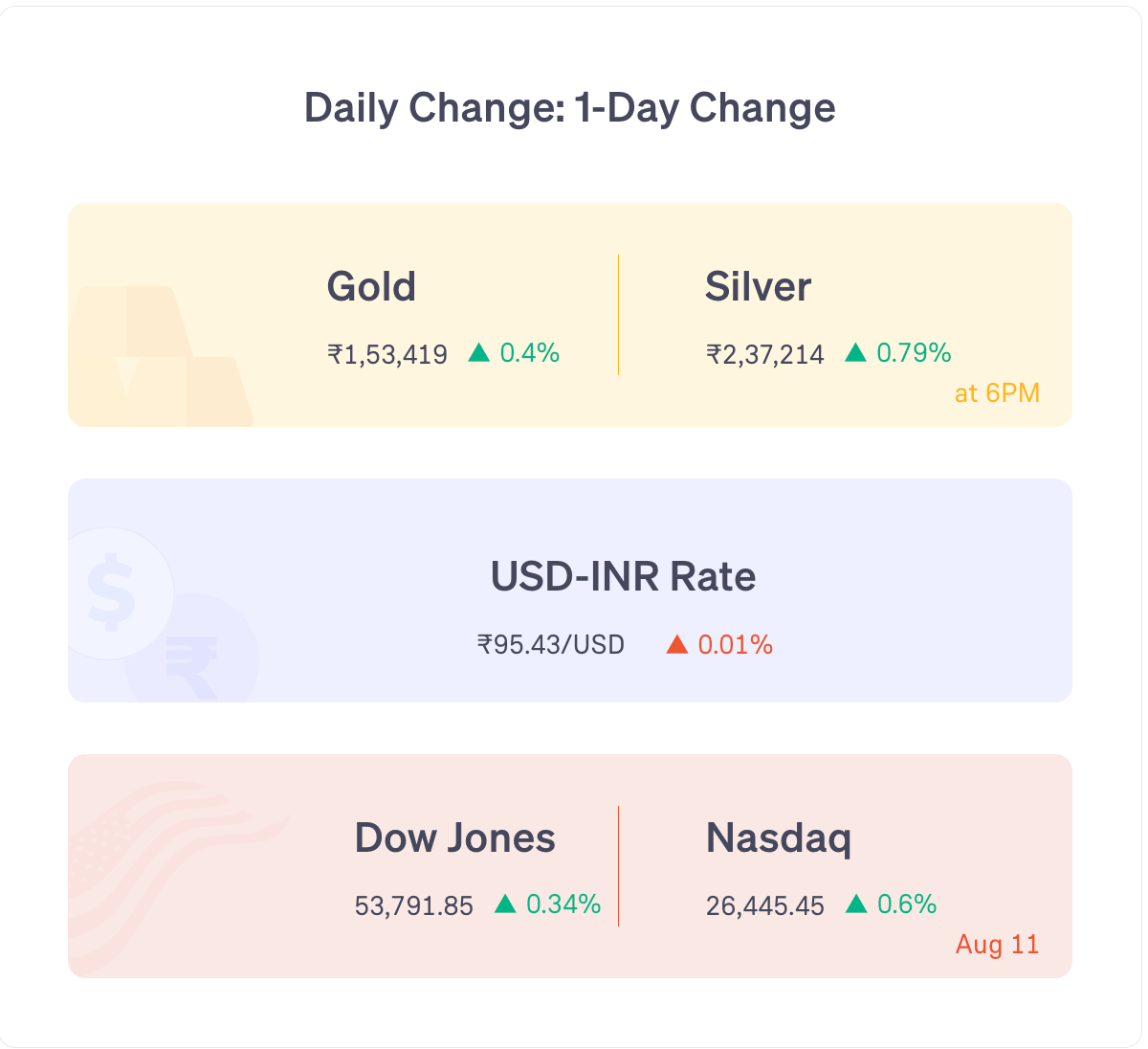
Global markets: US markets fell on Tuesday. Most Asian markets rose on Wednesday. European markets showed a mixed trend (as of 6 pm IST).
News
India’s retail inflation rose 4.45% in July compared to 4.38% in June. Food inflation rose 5.52% in July (vs 5.32% in June).
Net Direct Tax collection rose 23.09% year-on-year to Rs 8.11 lakh crore as of 10 August (compared to Rs 6.59 lakh crore a year ago).
SEBI Chairman said that they have observed no market manipulation under the Closing Auction System yet but data is being monitored continuously; as per media reports.
IPO Corner
Milky Mist’s IPO was subscribed 2.17 times on day 2. Retail subscription: 2.44 times. The IPO will close for subscription on 13 August.
Shiprocket’s IPO was subscribed 0.97 times on day 1. Retail subscription: 3.34 times. IPO will close for subscription on 14 August.
Dhoot Transmission’s IPO was subscribed 74.21 times on day 3. Retail subscription: 8.12 times. IPO closed for subscription.
Molbio Diagnostics’ IPO was subscribed 70.26 times on day 3. Retail subscription: 12.96 times. IPO closed for subscription.
Stocks Updates
SBI: completed a $500 million senior unsecured fixed-rate bond issue with 5-year maturity and 5.25% coupon, via its London branch.
UltraTech: agreed to acquire a 26% stake in Solaris Horizon Energy Pvt Ltd for up to Rs 27.76 crore. The SPV will supply 91 MWp DC/65 MW AC of solar power to UltraTech’s plants in Chhattisgarh.
HAL: net profit rose 14.88% year-on-year to Rs 1,589.68 crore in the April-June quarter.
Coal India: signed a non-binding MoU with ArcelorMittal Nippon Steel India Pvt Ltd to explore use of syngas from a proposed coal gasification facility near AMNS’s Paradip pellet plant.
Grasim: net profit rose 51.07% year-on-year to Rs 2,145.91 crore in the April-June quarter.
Tata Motors: net profit rose 83.25% year-on-year to Rs 2,560 crore in the April-June quarter. The company also acquired an additional 18.1% stake in Freight Tiger for about Rs 96 crore, making Freight Tiger its subsidiary.
JSW Energy: subsidiary JSW Neo Energy Ltd signed a shareholders’ agreement with Bhutan’s Druk Green Power Corporation Ltd to jointly develop the 920 MW Punatsangchhu-III hydro project in Bhutan, with JSW Neo Energy holding a 49% stake in the JV.
Lenskart: net profit rose 269.24% year-on-year to Rs 221.84 crore in the April-June quarter. The board also approved the acquisition of an additional stake in JV, Baofeng Framekart Technology and the setting up of step-down subsidiaries in South Korea and China.
Dixon: is setting up Adivistar Electronics India Pvt Ltd with 51% stake. The company will do OEM manufacturing of electronic devices, including smartphones.
Word of the Day
ISIN
It is a unique identification number given to each stock in the world
ISIN = International Securities Identification Number.
Just like how every person has a unique Aadhaar number in India, every stock (across different countries) is assigned a unique ISIN.
No two companies in the world can have the same ISIN.
Example: US0378331005 is the ISIN for Apple. INE090A01021 is the ISIN for ICICI Bank.
Your stocks details are stored in your demat account using the ISIN of each stock.
ISIN is different from ticker symbols.
Ticker symbols are more useful for trading since they are shortened names of companies that can be read very quickly.
6 Day Course
Theme: micro-cap investing
Day 3: Wednesday
Companies report their numbers for investors to see but how true are the numbers?
Is the company telling the truth about its business, operations, and metrics?
Are the proprietors and the management of the company reliable and trustworthy?
Many companies suffer from poor management and governance which is a huge risk in case of micro-cap companies.
In case of larger companies, scrutiny is greater.
Various investors (institutional as well as individual) are closely tracking and monitoring every aspect of these companies.
The same is not true in case of micro-cap companies.
Scrutiny is lower and investors should invest only if they’re sure of these aspects.
This is why many micro-cap companies’ shares are avoided even though they look good on paper.
————
Featured Question
Q. “There were ample number of companies not listed and doing well. In that case, what is the benefit for companies to list in stock exchange?”
Companies go for an IPO and list on the share markets for two reasons:
- To raise more money
- To allow their older investors and proprietors to sell shares and exit
Often, it is a combination of both these factors.
If both these factors are not relevant, companies need not list themselves.
There are many healthy companies that are working perfectly fine that are not listed.
They do not need extra money to fund their growth or are able to meet that need via loans/debt.
Many family-owned businesses and companies operate like this.
Also, listing on the exchanges requires many extra steps that are recurring like audits, quarterly reports, etc.
Many companies are not able to justify the added work and expense to get the benefits of being listed.
There are a few other reasons too. Companies that are listed often find it easier to raise money via debt, offer ESOPs to employees, etc.
Did you like this edition?
Leave a feedback here!