
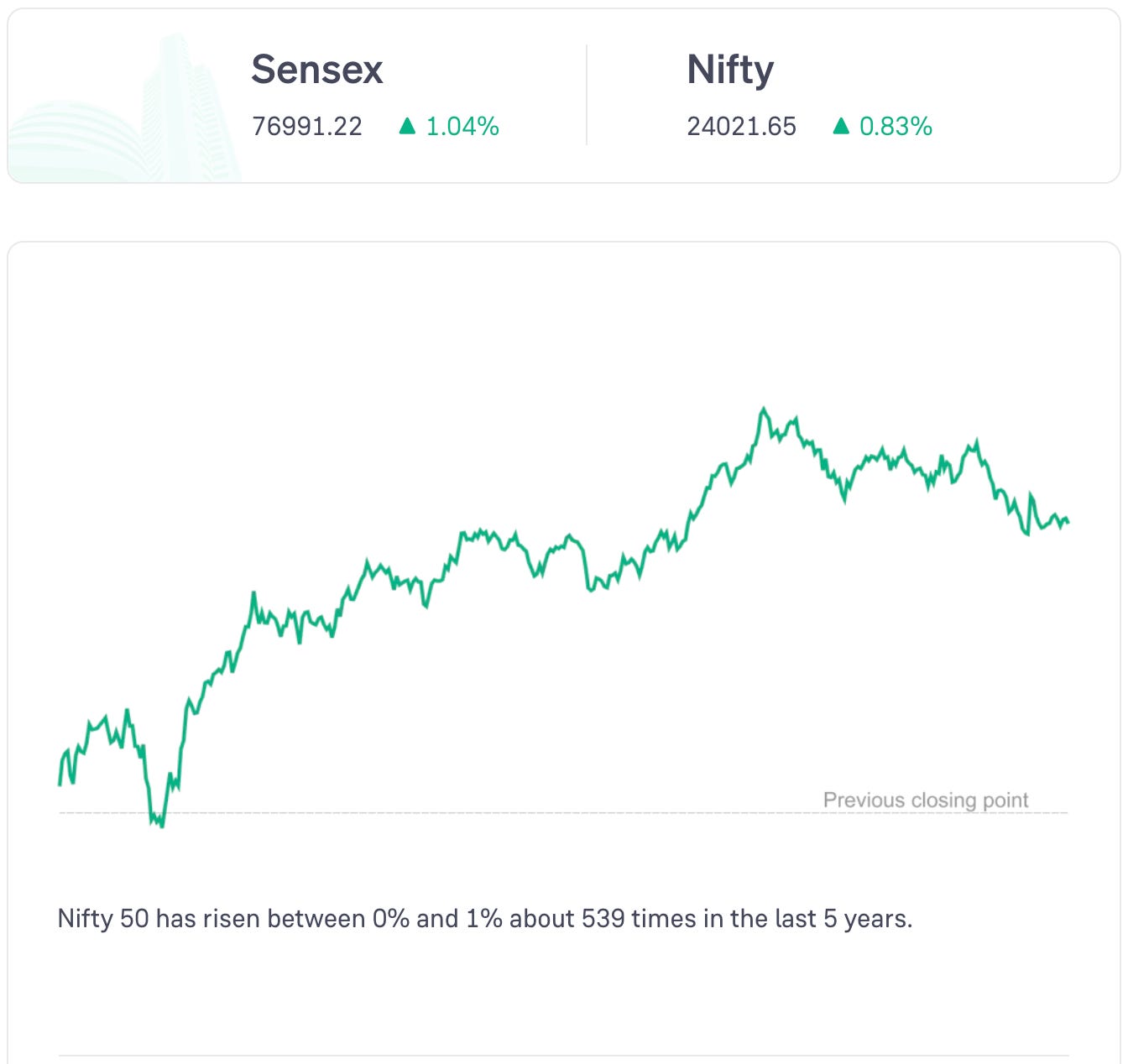
Markets opened above yesterday’s closing point.
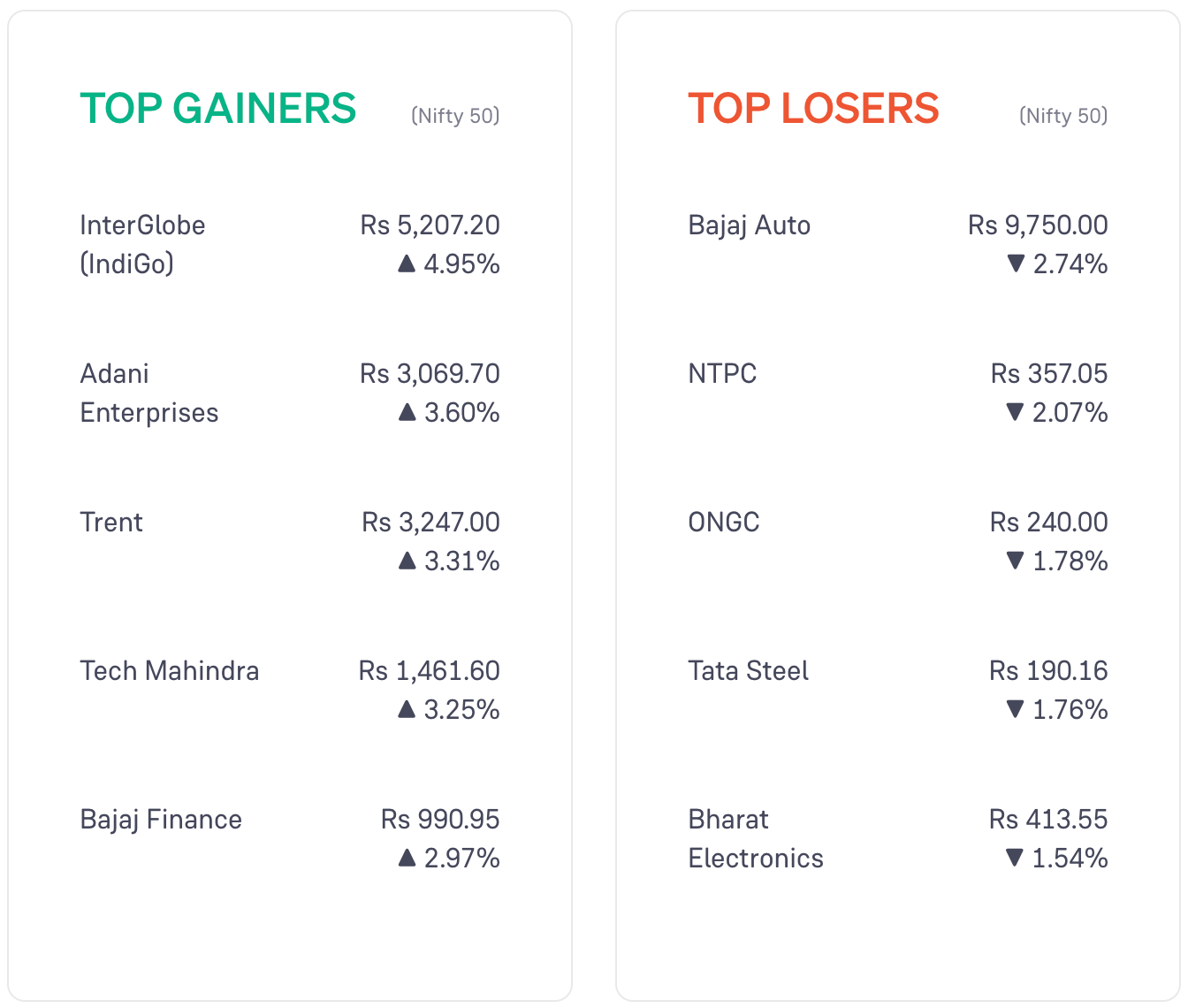
All sectors’ stocks rose today except for the auto stocks and metal stocks. Realty stocks and IT stocks rose the most.
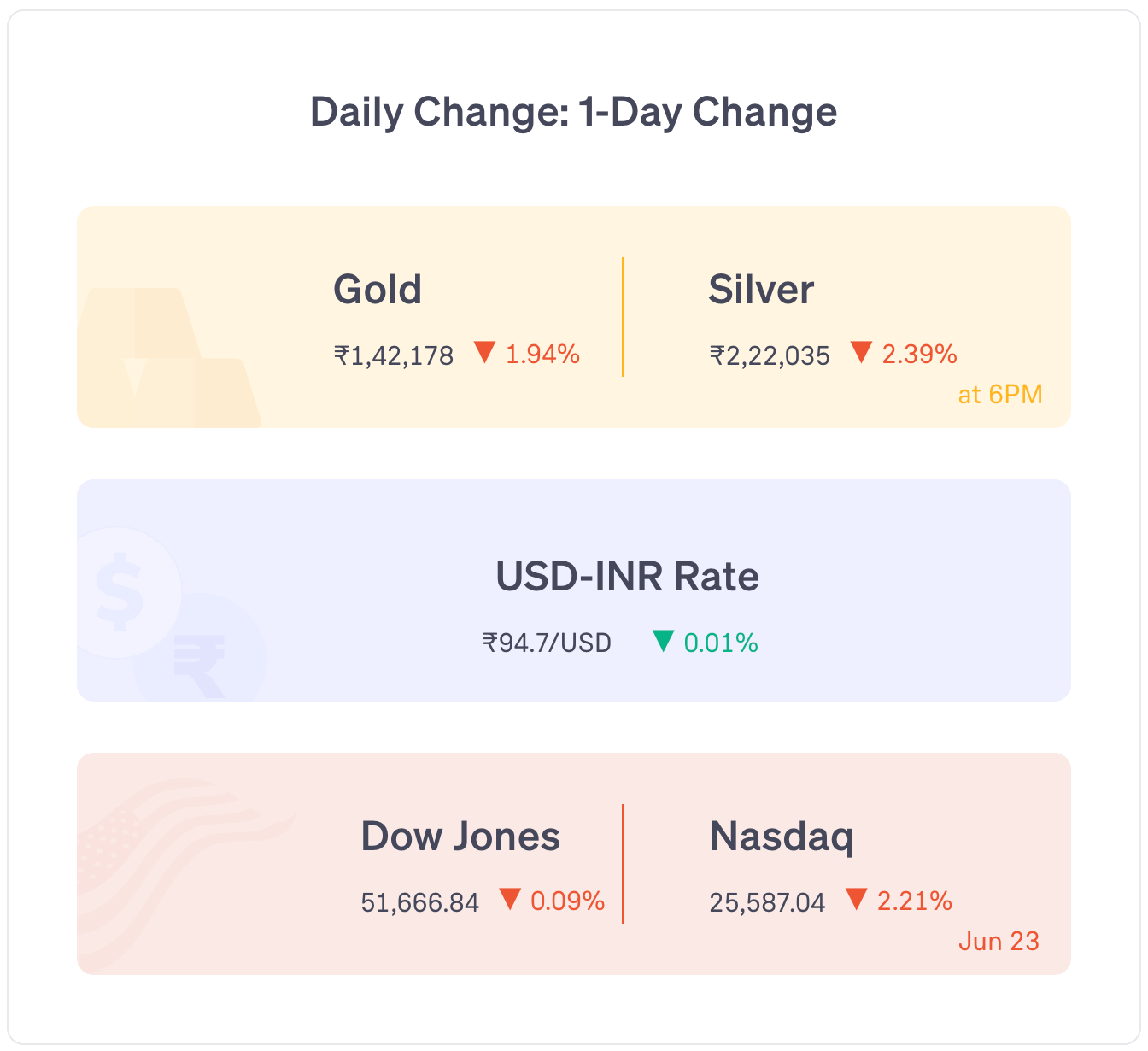
Global markets: US markets fell. Most Asian markets rose. European markets showed a mixed trend (as of 6 pm IST).
News
The government will auction securities worth Rs 28,000 crore on 25 June, including Rs 17,000 crore of 6.68% GS 2040 and Rs 11,000 crore of 7.43% GS 2076.
Ministry of Statistics and Programme Implementation (MoSPI) will launch the Index of Services Production (ISP) in July 2026, a new monthly indicator to track growth in India’s services sector, similar to the Index of Industrial Production (IIP) for manufacturing.
The government has approved 96 road projects worth Rs 211.71 crore in Tripura under PMGSY-IV. The projects will cover 163.9 km.
RBI has proposed draft guidelines requiring banks to strengthen governance and risk management of AI and machine learning models.
Stocks Updates
Bajaj Finance: allotted NCDs worth Rs 2,000.45 crore at a coupon rate of 7.92% through a private placement basis.
IRFC: Ministry of Railways exercised the oversubscription option in its Offer for Sale (OFS), increasing the total offer size from 13.07 crore shares (1.0% stake) to 24.31 crore shares (1.86% stake).
Bajaj Auto: disclosed a ransomware attack that impacted its systems and those of subsidiary Bajaj Auto Technology Ltd. The company said precautionary actions were taken, and the incident was reported to CERT-In.
ABB India: partnered with Kolkata Metro to deploy electrification and motion control solutions across its network.
Vedanta: incorporated wholly owned subsidiary Vedanta Property Platforms Ltd in Mumbai to undertake real estate and related business activities.
Bharat Forge: subsidiary BF Industrial Solutions Ltd completed the acquisition of a 90% stake in RS Aerostructures Ltd (RSAL), making it a step-down subsidiary.
Infosys: partnered with US-based healthcare provider Sentara to scale AI adoption across hospital operations, clinical support and enterprise functions.
Word of the Day
Contract Note
It is an official document that is issued by stockbrokers to their clients
Every time a transaction takes place in the stock market (buying or selling shares), this note is generated.
It contains details such as the stock traded, whether it was bought or sold, the trade time, order number, brokerage charges, and broker information.
Brokers are required to send contract notes for equity and derivatives trades. Contract notes are not issued for mutual fund transactions.
It acts as an important legal record in case of any dispute between an investor and a broker and is proof for all the transactions made on the stock markets.
Most brokers sent contract notes via email in the form of Electronic Contract Notes (ECNs).
6 Day Course
Theme: crucial points in IPO
Day 3: Wednesday
The shares that are sold during an IPO are of two types.
Fresh issue and Offer for Sale (OFS).
In case of a fresh issue, the company is literally creating fresh shares and selling in the IPO.
This means all the money that is raised in the IPO will go directly to the company.
It can use this money for the company’s growth, operations, future expansion, debt clearing, etc.
On the other hand OFS is the sale of existing shares by existing shareholders.
In this case, the money does not go to the company, it goes to the shareholders.
This allows early-stage investors to sell their shares and exit the company.
During IPOs, many companies do a mix of fresh issues and OFS.
Sometimes, all shares are fresh issues and sometimes, all are OFS.
Investors like to keep an eye on this because it can hint about how the company thinks about its own future and what its early investors plan.
Featured Question
Q. “If I have held shares of a company for more than one year and continue buying additional shares over time, and the company later undergoes a demerger resulting in shares of a new company being allotted to me, how is the holding period of the new company’s shares determined for capital gains tax purposes? If I sell those new shares, will the gains be treated as short-term or long-term capital gains?”
The new shares are treated as bought on the original date of purchase.
The tax is calculated based on the original date of purchase, not based on the date of demerger.
If you bought shares multiple times, you will have to calculate the tax for each purchase separately.
Example:
Let’s say you bought 100 shares 3 years ago. Then you bought 50 shares 6 months ago.
On the shares you bought 3 years ago, you will pay a Long Term Capital Gains tax (LTCG tax) since the investment is more than 1 year old.
On the shares you bought 6 months ago, you will pay a Short Term Capital Gains tax (STCG tax) since the investment is less than 1 year old.
Likewise, each share purchase will have to be treated as a separate investment and tax calculated accordingly.
Did you like this edition?
Leave a feedback here!