
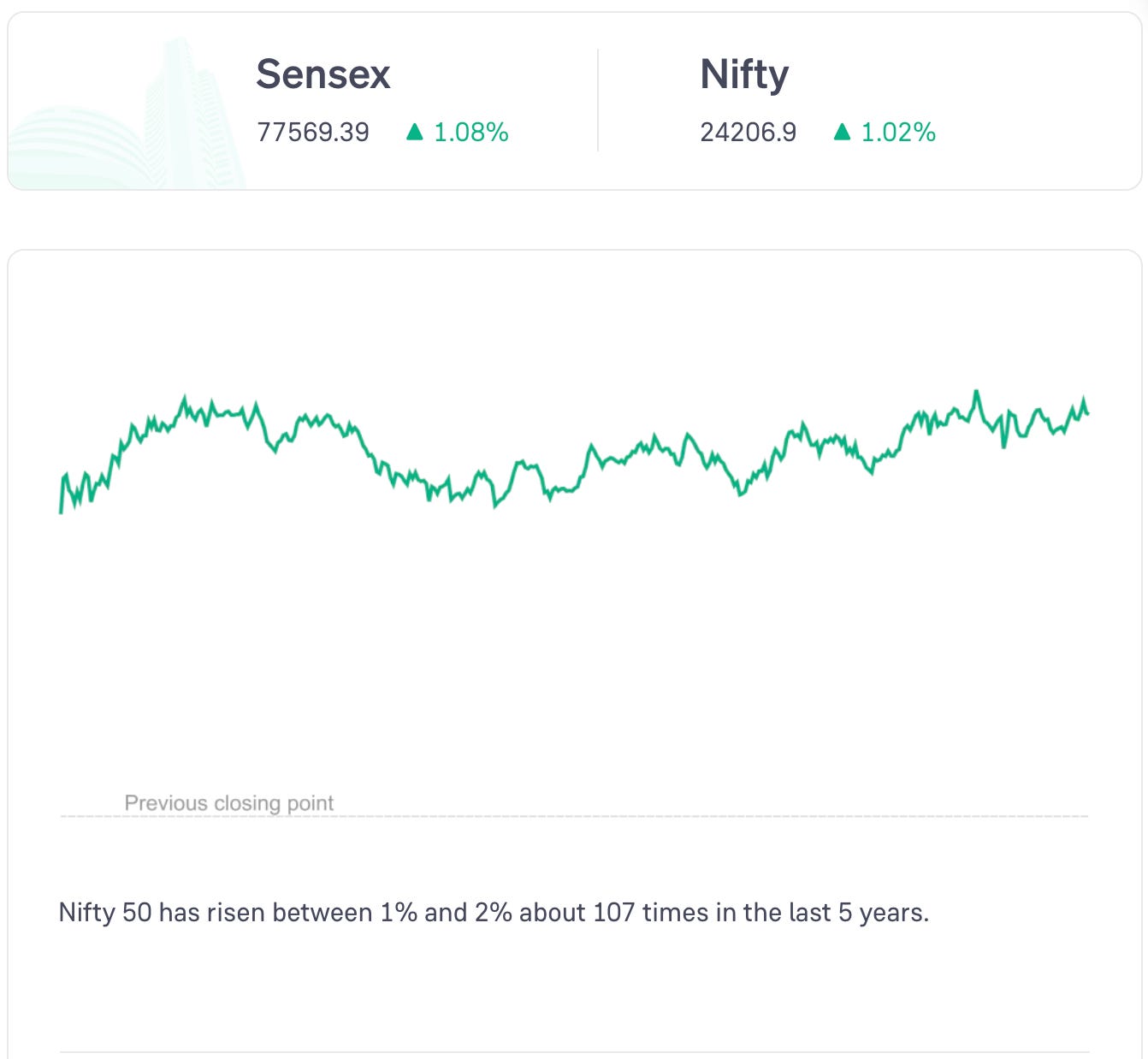
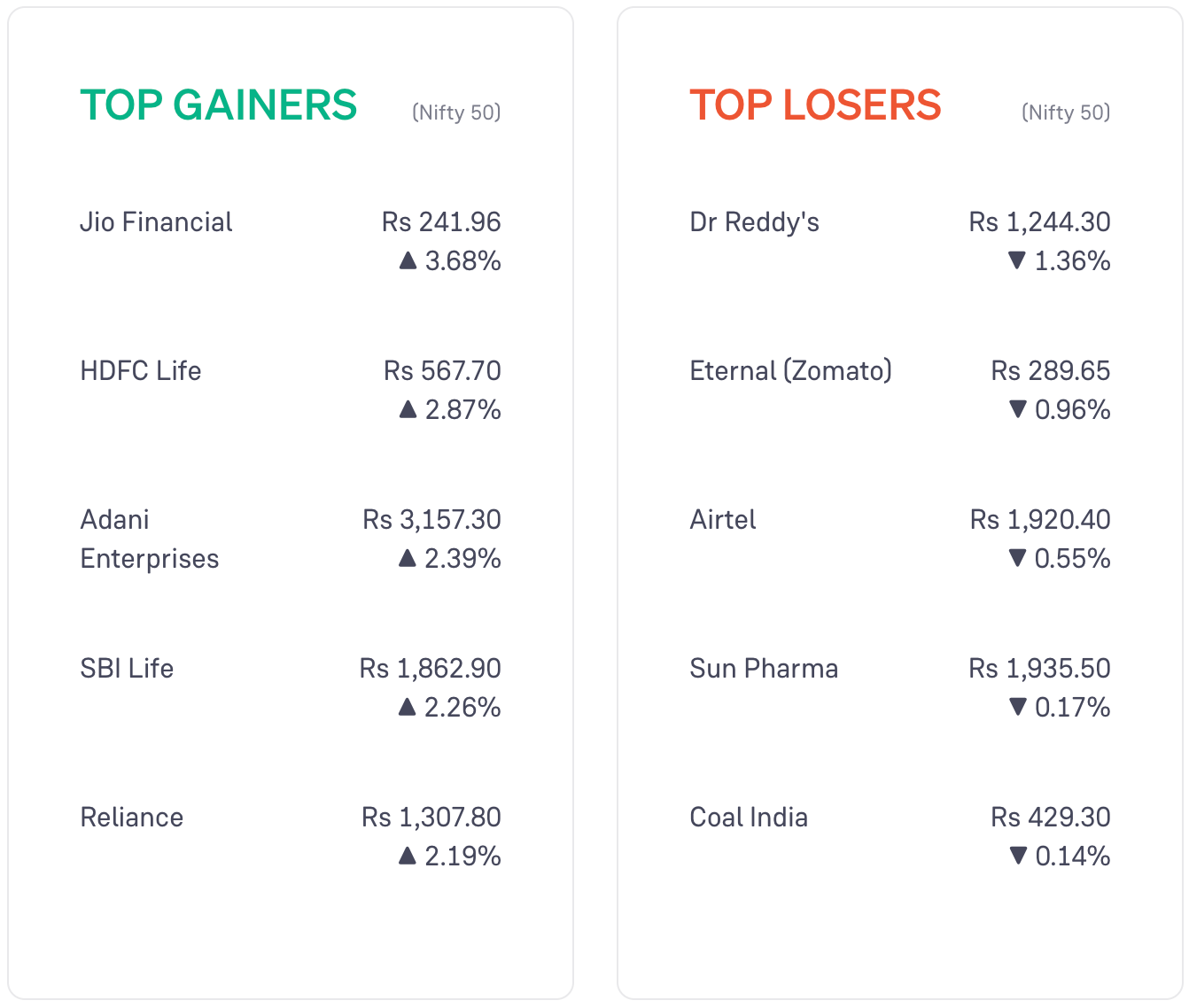
Markets closed above yesterday’s closing point.
All sectors’ stocks rose today except for the IT stocks and auto stocks. Realty stocks and media stocks rose the most.
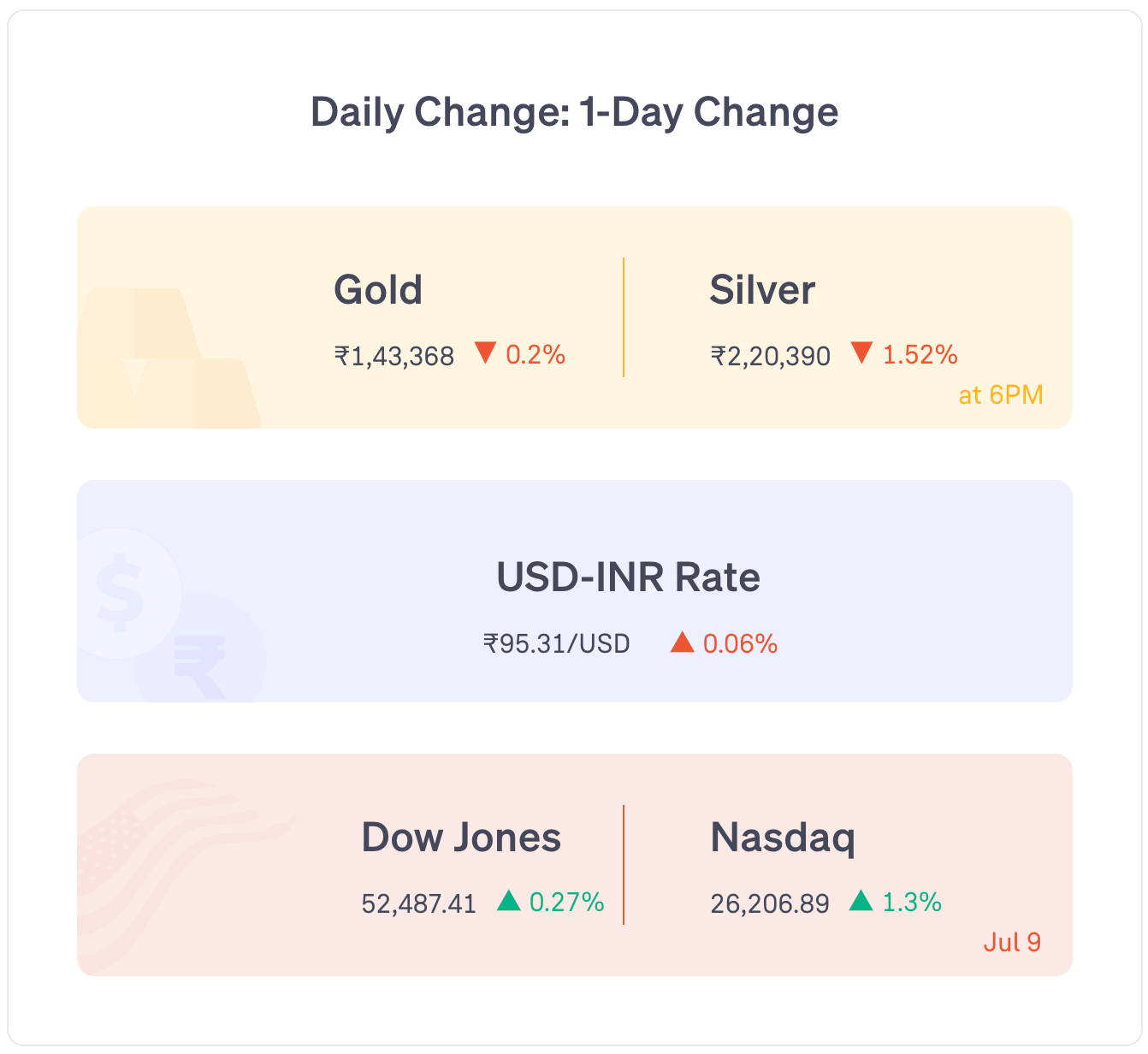
Global markets: Most US markets fell. Asian and European markets showed a mixed trend. (as of 6 pm IST).
News
India’s forex reserves rose by $0.73 billion to $674.19 billion in the week that ended on 3 July.
Equity mutual funds saw a net inflow of Rs 28,973 crore in June (compared to Rs 22,908 crore in May). Debt funds saw a net outflow of Rs 1.09 lakh crore in June (compared to a net outflow of Rs 96,948.51 crore in May): AMFI.
The Indian Railways has approved 2 projects: Rs 175 crore to set up additional maintenance facilities for 250 three-phase electric locomotives at the Raipur Diesel Shed and Rs 206 crore to install the ‘Kavach 4.0’ Automatic Train Protection system across 680 route kilometers of the Northern Railway.
Kusumgar IPO was subscribed 128.85 times. Retail subscription: 26.47 times. IPO is closed for subscription.
Laser Power and Infra IPO has been subscribed 1.00 times. Retail subscription: 0.80 times. IPO closes on 13 July.
Stocks Updates
Adani Enterprises: entered a long-term partnership with France’s Dioxycle to develop low-carbon chemical manufacturing in India.
ONGC: board gave in-principle approval to develop 1.75 MMT Strategic Petroleum Reserves at Mangalore (Phase-I Extension) as a project of national importance.
Power Grid: has been declared the successful bidder for the Krishnagiri REZ Phase-I interstate transmission project, involving 2 new 765/400kV sub-stations in Andhra Pradesh and transmission lines across Andhra Pradesh, Telangana and Karnataka.
InterGlobe (IndiGo): received a warning letter from the DGCA over cargo spillage and SOP deviations related to dangerous goods handling rules.
Solar Industries: step-down subsidiary Solar Overseas Mauritius Ltd incorporated a wholly owned subsidiary, Solar SA Investments (Pty) Ltd, in South Africa as part of an internal group restructuring.
Samvardhana Motherson: will issue a corporate guarantee of up to EUR 63 million for a term loan taken by its wholly-owned subsidiary Motherson Global Investments BV.
Indian Bank: net profit rose 47.45% year-on-year to Rs 3,356.63 crore in the Apr-Jun quarter.
Aurobindo Pharma: step-down subsidiary PT Aurogen Pharma Indonesia incorporated a wholly owned subsidiary, PT Auro Pharm Indonesia, to set up pharmaceutical manufacturing operations in Indonesia.
Word of the Day
In Principle Approval
It is an approval received for the broad plan but not the final plan
After an in-principle approval is given, many detailed clearances and conditions might still need approval.
In-principle approvals show that everything looks okay broadly and that things are on the right track.
6 Day Course
Theme: ROE & ROCE
Day 5: Friday
In companies with no earnings, or loss-making companies, the ROE will not be negative.
This is because earnings are used to calculate the ROE.
ROCE may still be available in such a case since it is possible that a company is not earning profits yet but it is operationally profitable (earnings before interest and tax).
In even earlier stage companies or heavy loss making companies, ROCE may not be available or may be negative.
In case of very early stage companies where the revenues are too low, ROE and ROCE are meaningless even if they can be calculated since small changes can greatly affect the companies numbers.
For healthy companies, ROE and ROCE remain two of the best metrics to judge the efficiency of the business.
Featured Question
Q. “Once a company does IPO in primary market, it gets its money. After that, all stocks trade in secondary market with the company itself not getting any money. Then why do companies care about stock price’s even after they have no money to gain anymore?”
Companies are owned by their shareholders.
Companies’ purpose to exist is to benefit its shareholders.
Shareholders can be of many different types: individual shareholders, company proprietors, senior executives, etc.
So it is in the interest of the shareholders that the company’s share price goes up.
Hence, the company is run to benefit its shareholders. This includes growing its revenues and earnings.
Hence the company is optimising for its share price to go up so its shareholders benefit.
Do note that many times companies benefit directly from rising share prices when they try to raise more money after an IPO via a process called Follow-on Public Offering (FPO).
The information presented in this post has been compiled and prepared by Groww Invest Tech Pvt Ltd and is intended solely for informational purposes. It is not tailored to any specific investment objectives, financial situations, or needs of any individual investor. The content should not be construed as investment, financial, legal, or tax advice and should not be relied upon as a substitute for professional consultation.
Investing in securities markets involves inherent risks. Investors are advised to carefully review all relevant documents and consider their own risk tolerance before making any investment decisions.
Mutual fund investments are subject to market risks; please read all scheme-related documents carefully. Past performance of financial instruments, schemes, or markets is not indicative of future results.
Groww Invest Tech Pvt Ltd is registered with the Securities and Exchange Board of India (SEBI) under Registration No: INZ000301838, as a Research Analyst under No: INH200008662, as a Depository Participant under No: IN-DP-417-2019, and with the Association of Mutual Funds in India (AMFI) under ARN-111686.
SEBI registration details: View registered name and registration numbers
Research Analyst Disclaimer: View Research Analyst disclaimer
Did you like this edition?
Leave a feedback here!