
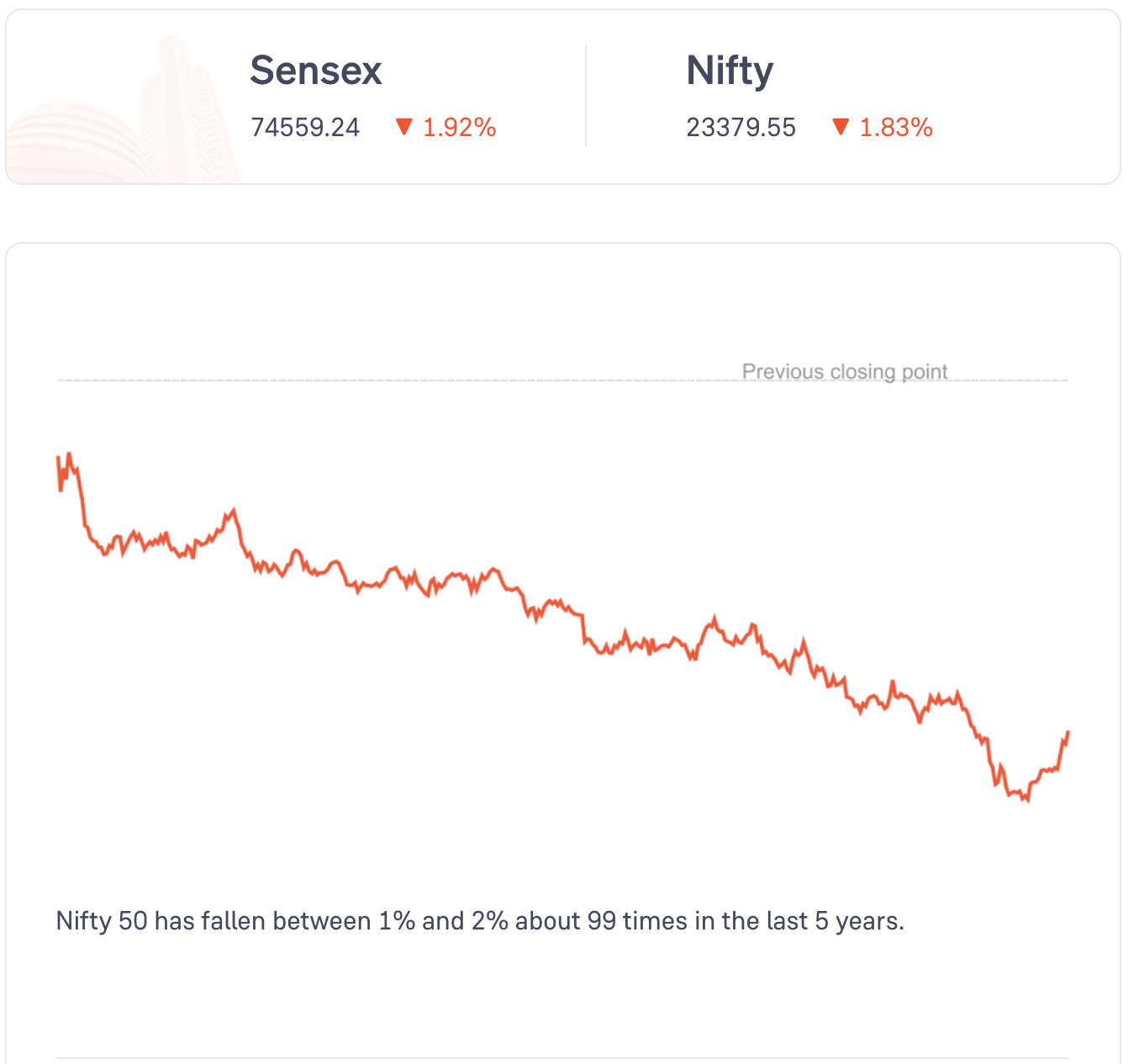
Markets opened significantly below yesterday’s closing point.
Nifty 50 fell throughout the day. The fall can be attributed to negative global sentiments due to the US-Iran conflict and the rising crude oil prices, the fall of the Indian Rupee and a sharp fall in IT stocks.
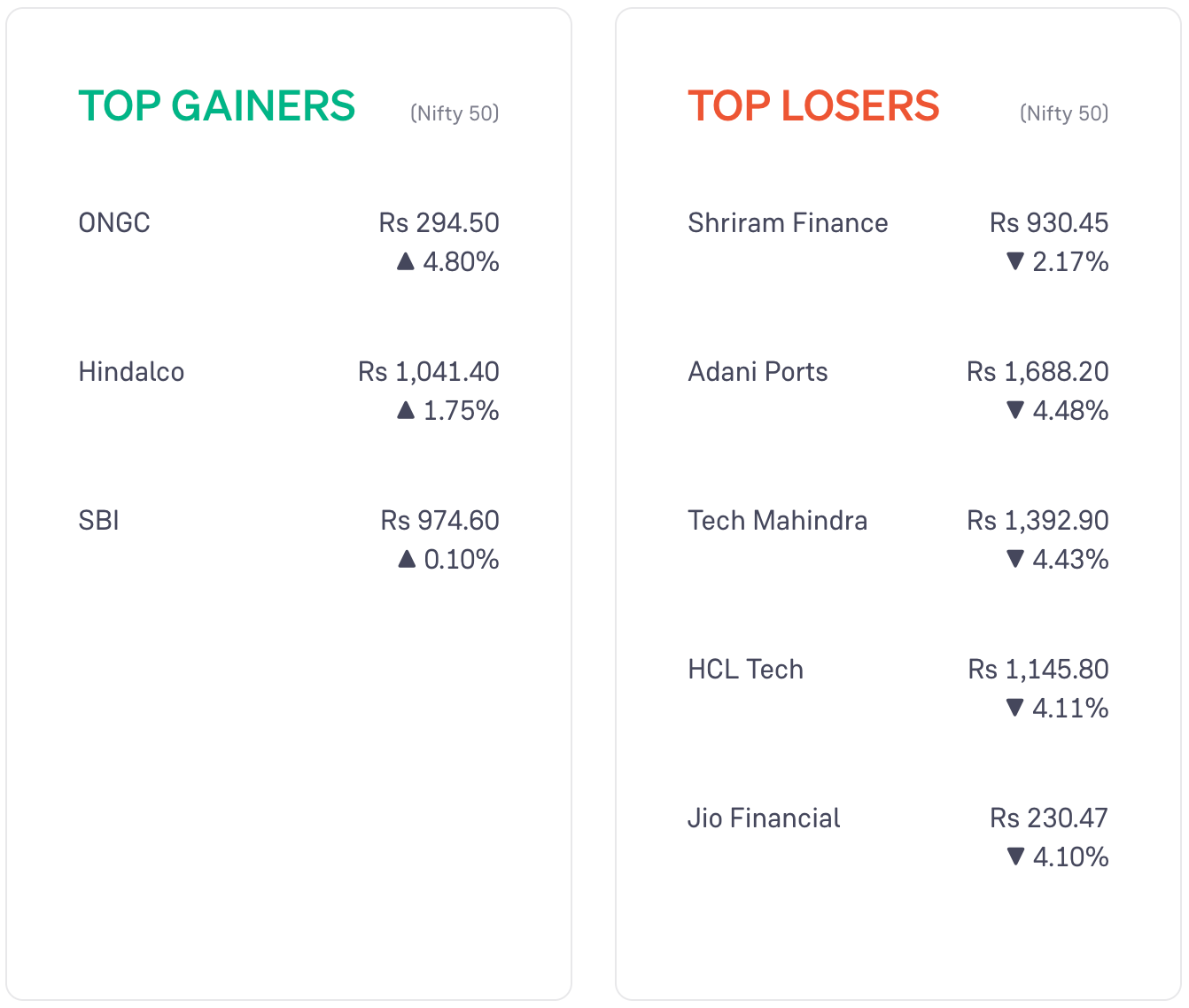
All sectors’ stocks fell today. Realty stocks and IT stocks fell the most.
There are only 3 stocks in the Nifty 50 that rose today. Hence, there are only 3 stocks in the ‘Top Gainers’ section.
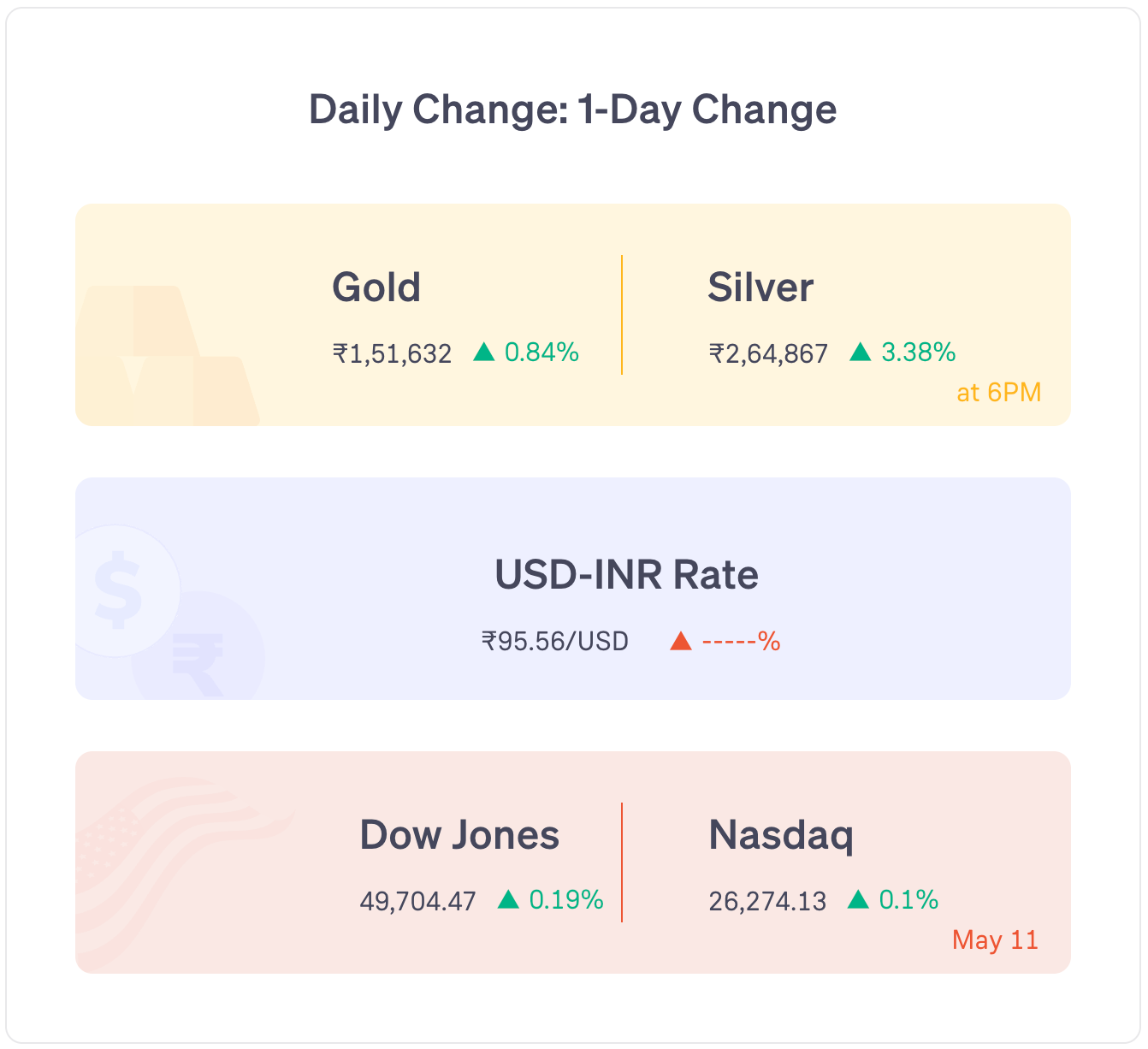
Global markets: US markets closed almost flat. Most Asian markets and European markets fell (as of 6 pm IST).
News
India’s annual inflation rate rose marginally to 3.48% in April (vs 3.40% in March).
The Indian Rupee reached an all-time low, falling beyond Rs 95.5 per USD.
India’s equity mutual funds inflows rose 58% year-on-year to Rs 38,440.20 crore in April (vs an inflow of Rs 40,450 crore in March). Debt funds inflows rose 12.9% to Rs 2.47 lakh crore (vs an outflow of Rs 2.94 lakh crore in March): AMFI
BofA Securities India settled its case with SEBI by paying Rs 58.5 lakh following the alleged insider trading and merchant banking rule violations.
The RBI and the European Central Bank (ECB) have signed an MoU to increase cooperation through regular information exchange and policy dialogue, updating the 2015 framework.
The US annual inflation rate rose to 3.8% in April (vs 3.3% in March).
Stocks Updates
Bajaj Finance: allotted NCDs worth Rs 2,892 crore via private placement. Option I: Rs 1,070.42 crore at 7.77% per annum, maturing 17 April 2029. Option II: Rs 1,822 crore at 8.00% per annum, maturing 12 May 2031.
Adani Ports: company’s marine arm, Astro Offshore, has partnered with Oceaneering International to pursue specialised offshore and subsea opportunities in Europe.
Coal India: wholly owned subsidiary, CIL Solar PV, has been struck off and dissolved by the Ministry of Corporate Affairs.
Hindustan Zinc: signed an MoU with Group Nirmal to set up a zinc wire manufacturing facility in Khankhala, Bhilwara, Rajasthan.
United Spirits: amended share purchase agreement for sale of stake in Royal Challengers Sports Pvt Ltd, with deal value unchanged at Rs 16,660 crore.
Shree Cement: received GST demand order of around Rs 39.2 lakh plus interest and penalty, which it will challenge.
Tata Capital: allotted NCDs worth Rs 765 crore via private placement at a coupon rate of 8%.
Tata Power: net profit fell 4.5% year-on-year to Rs 995.91 crore in the Jan-March quarter. Dividend announced: Rs 2.50 per share, with 23 June as the record date.
Dr Reddy’s: net profit fell 86% year-on-year to Rs 220.9 crore in the Jan-March quarter. Dividend announced: Rs 8 per share, with 10 July as the record date.
Tata Consumer: fixed 25 May as the record date for its Rs 10 dividend.
Indian Hotels: net profit rose 14.8% year-on-year to Rs 599.86 crore in the Jan-March quarter. Dividend announced: Rs 3.25 per share.
Word of the Day
Consumer Price Index (CPI)
It is a measure of inflation of a country.
CPI tracks the change in prices of a fixed basket of goods and services over time.
This basket is representative of the spending habits of an average household.
It includes essentials like food, clothing, and housing, as well as transportation, electricity, healthcare, etc.
CPI reflects the change in cost of living and purchasing power.
The rate at which the cost of this basket changes in a certain period of time is called the inflation rate.
6 Day Course
Theme: making sense of MF returns
Day 2: Tuesday
Mutual fund returns from different categories should not be compared.
Different categories of mutual funds aim towards different goals and therefore have different risk levels associated.
Example: a debt fund with a history of around 8% per annum returns does not aspire to give returns like 15%. Instead, it aims to keep the risk low instead.
So mutual fund returns from the same category should be compared more often.
Within each category (example: mid cap funds), comparisons must be done, but done carefully.
Just because one mutual fund’s recent returns are lower than another’s does not automatically mean it is a lower quality mutual fund.
This is because every mutual fund invests money differently and different investments grow at different times.
This is one reason why only longer term returns must be compared.
Featured Question
Q. “Who takes the money whch bse and nse earns.”
Yes.
All mutual fund returns we see are after expense ratio.
The returns we see are the returns we’d get. The only deduction from it would be taxes (if applicable).
Did you like this edition?
Leave a feedback here!
The answer for featured question is a mismatch with Thursdays Feature qurstion.