

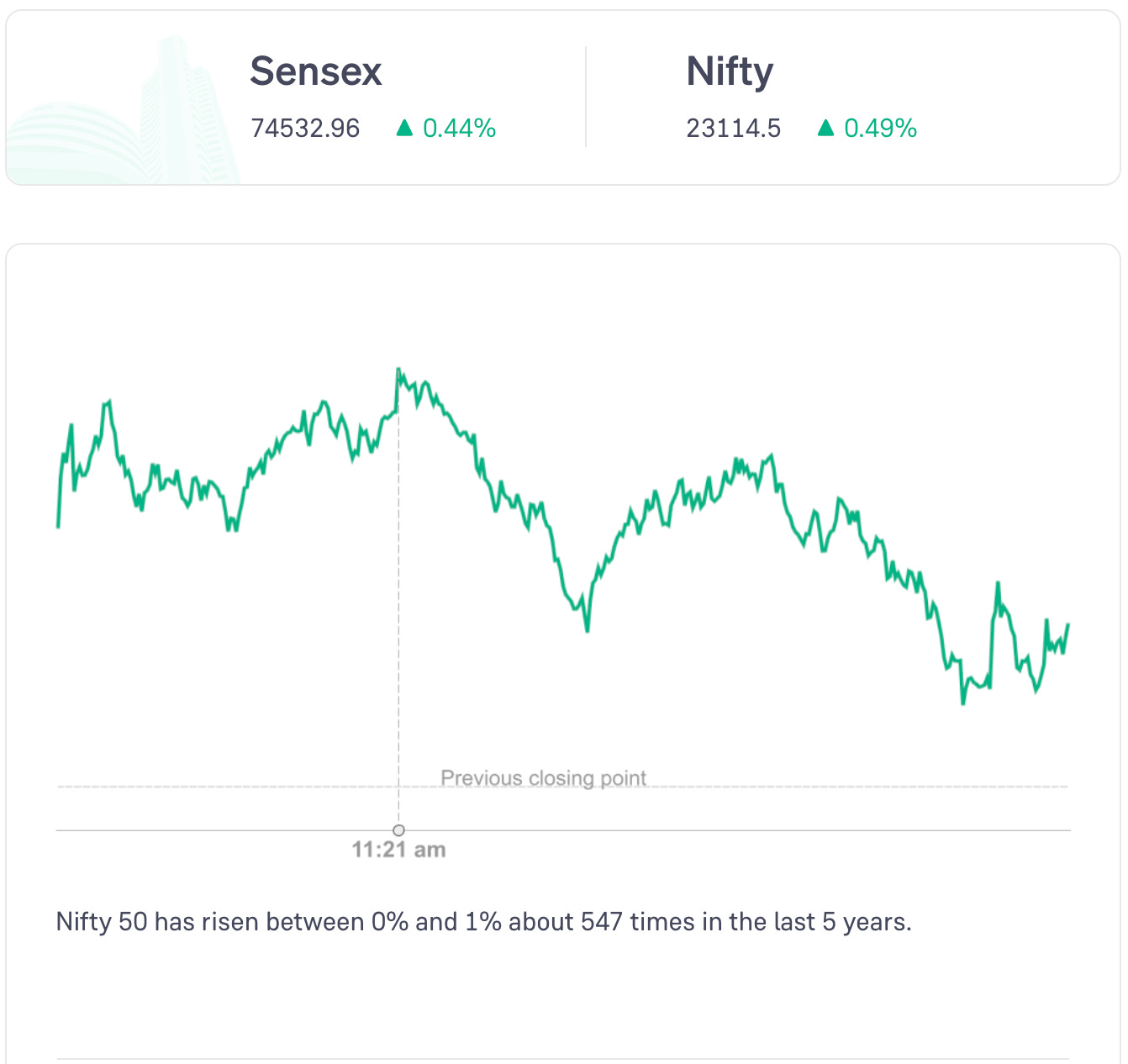
Markets opened above yesterday’s closing point.
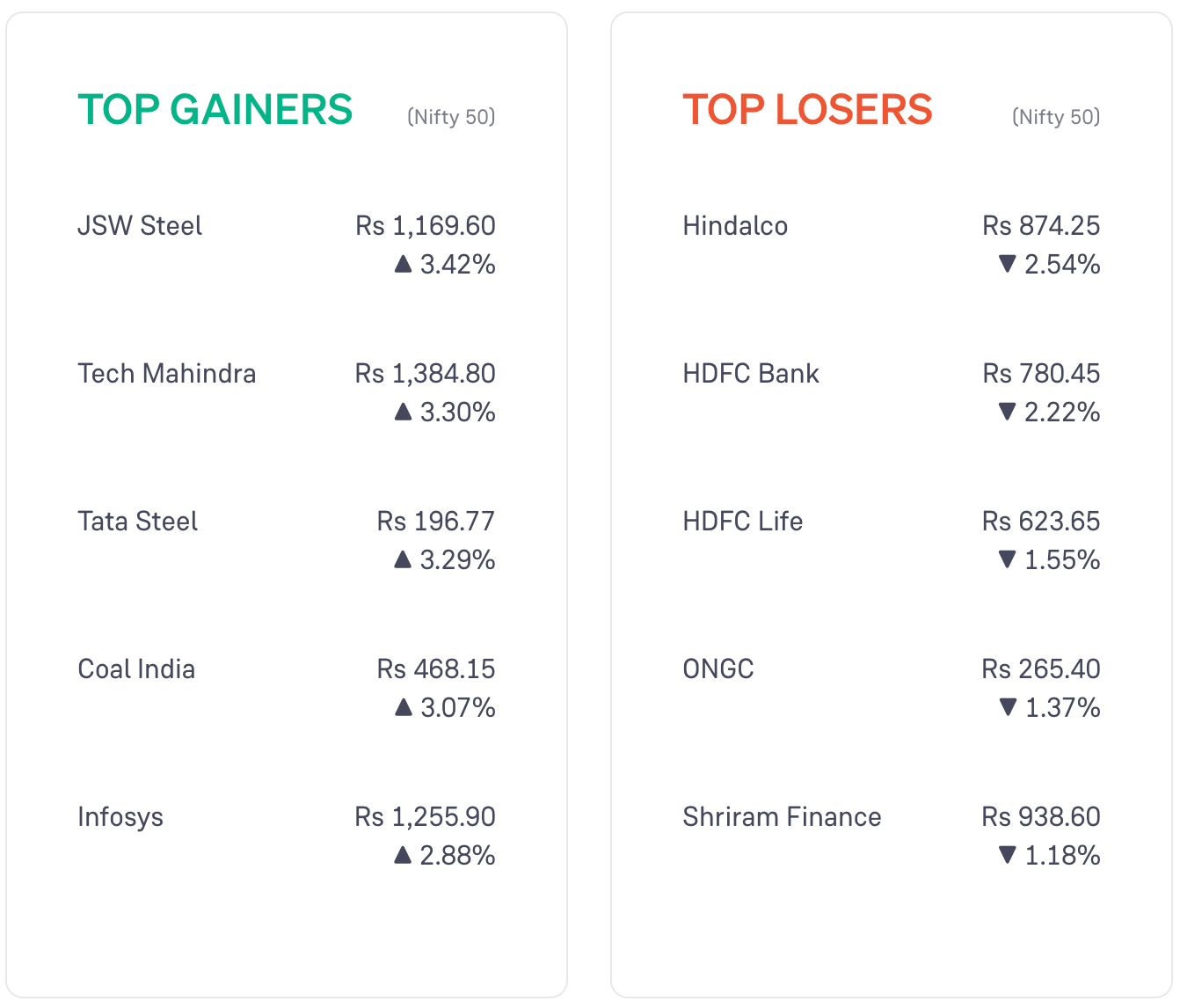
IT stocks and PSU bank stocks rose the most today. Realty stocks and private bank stocks fell the most.
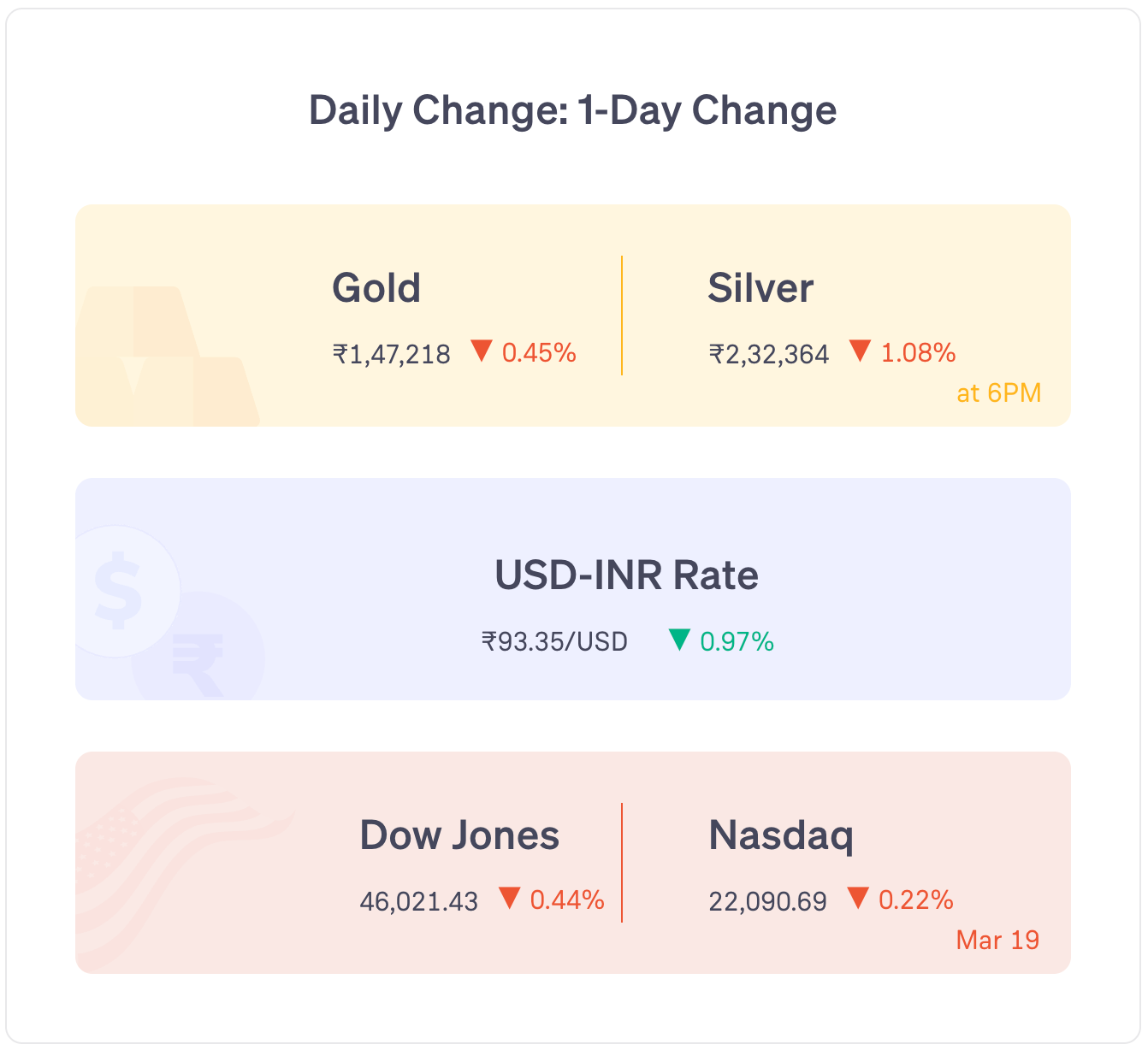
Global markets: US markets and most Asian markets fell. European markets rose (as of 6 pm IST).
News
India’s infrastructure output of core industries grew 2.3% year-on-year in Feb (vs 4.7% in Jan). Cement, steel, fertilizers, coal and electricity grew in output while crude oil, natural gas and petroleum refinery products declined.
The Indian Rupee reached a record low, slipping past the Rs 93 per US$ mark for the first time.
India’s forex reserves fell by $7.05 billion to $709.76 billion in the week that ended on 13 March.
Central Mine Planning and Design Institute Ltd IPO has been subscribed 0.07 times. Retail subscription: 0.10 times. IPO closes on 24 March.
Stocks Updates
SBI: received an income tax demand of Rs 6,337.5 crore for AY 2023-24, which it plans to challenge.
Tata Steel: inaugurated its first scrap-based electric arc furnace in Ludhiana with Rs 3,200 crore of investment and 0.75 MTPA capacity to produce low-carbon steel.
Hindustan Unilever: clarified that it is not considering any divestment of its foods business.
Tata Motors Passenger: will increase prices of its passenger vehicles (non EV) by around 0.5% from 1 April 2026 to offset rising input costs.
Power Grid: board approved the merger of 28 wholly owned subsidiaries into 2 other wholly owned subsidiaries, subject to regulatory approvals. Board also approved investment of Rs 705.30 crore for procurement of cold spare transformers and reactors.
Word of the Day
Free Float
It is the portion of a company’s total shares that is available for trading in the stock market
These are shares held by the public, excluding promoters, government holdings, and other locked-in shares.
A higher free float means the stock is more liquid, meaning buying or selling shares would have less impact on the stock price.
Example: a company has 100 crore shares, with 40 crore held by promoters and government. The remaining 60 crore shares form the free float.
6 Day Course
Theme: AI terms for investors
Day 5: Friday
Fine-tuning: this is the process of taking an LLM model and adapting it for a certain kind of specific task.
This is often done using additional data which is made up of examples of desired and undesired results.
Open source models: many LLM models are actually openly available for anyone to download and run. These are called open source models.
These are getting better day by day and are able to get results surprisingly close to closed proprietary models like those of ChatGPT, Gemini, etc.
Sometimes, these open source models are also better than their closed rivals.
Agentic workflows: yesterday, we spoke about agents or LLMs that have a dedicated function.
Agentic workflows consist of LLM models that are able to carry out multiple steps and even branch out to different types of decisions.
Agentic workflows can work on their own without being started by the prompter. The prompter just needs to set it up to run automatically or at a fixed interval everyday.
Example: find companies that have a PE ratio lower than 20, read their quarterly reports, decide if they are undervalued or overvalued, and let me know.
Featured Question
Q. “I observe that all flexicap MFs are always large cap biased, is it correct and why it is so since variations wrt to name Dinesh Gupta”
Flexi-cap mutual funds are required to invest at least 65% in large cap funds.
But often, they are seen investing a lot more than that in large cap funds.
This is because most flexi cap funds’ managers try to balance stability while also trying to grow fast.
Large cap stocks are more stable, liquid, and tend to fall less during market downturns.
The assumption being made here is that any investor who wants to take more risks will invest in other categories of mutual funds that are riskier and aim to give higher returns.
For example, multi-cap funds are riskier. They must invest at least 25% in large-cap, 25% in mid-cap, and 25% in small-cap stocks.
If someone wants to take even more risk with the aim of getting even higher returns, they can explore investing in mid-cap funds, and small-cap funds.
Did you like this edition?
Leave a feedback here!