
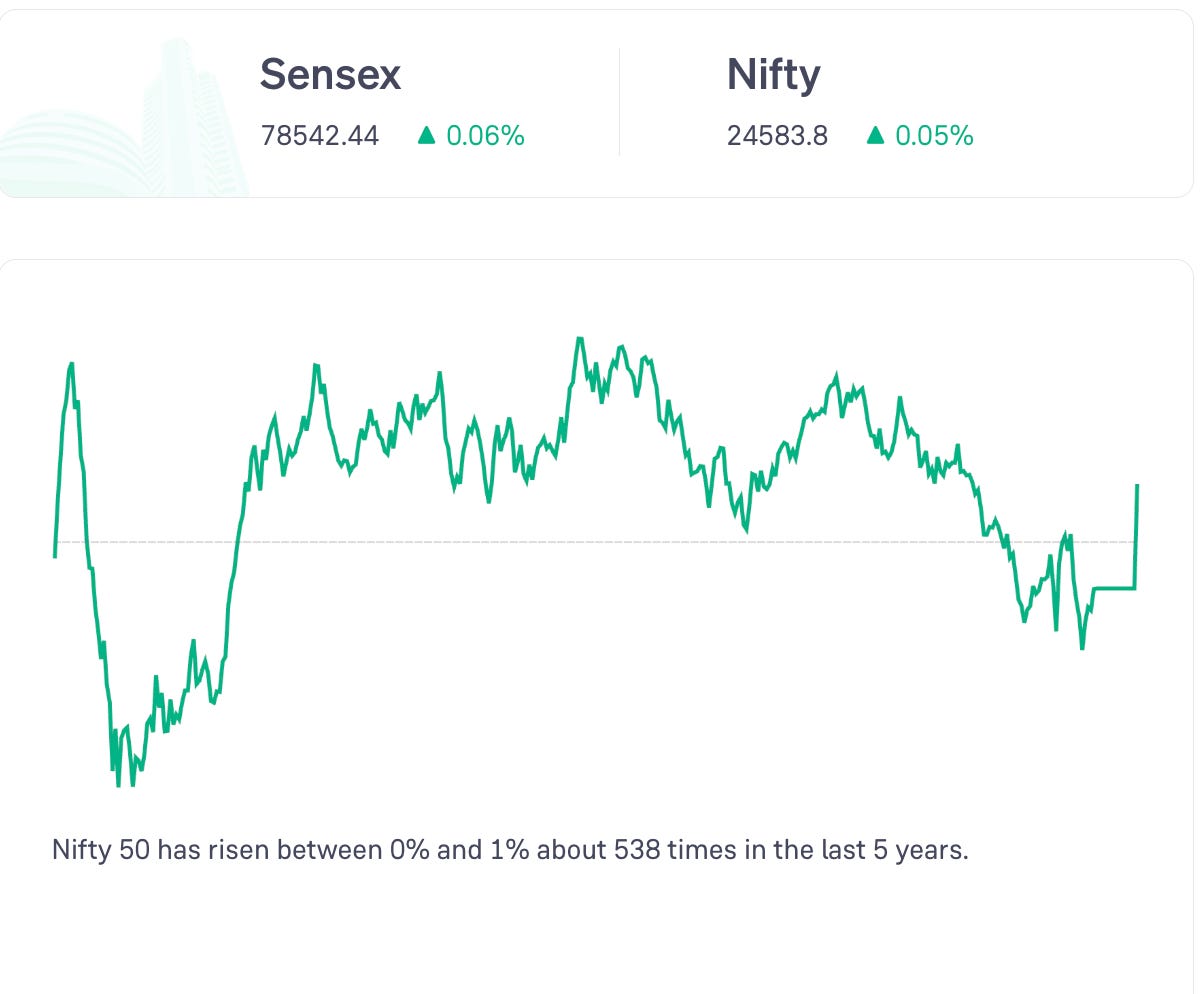
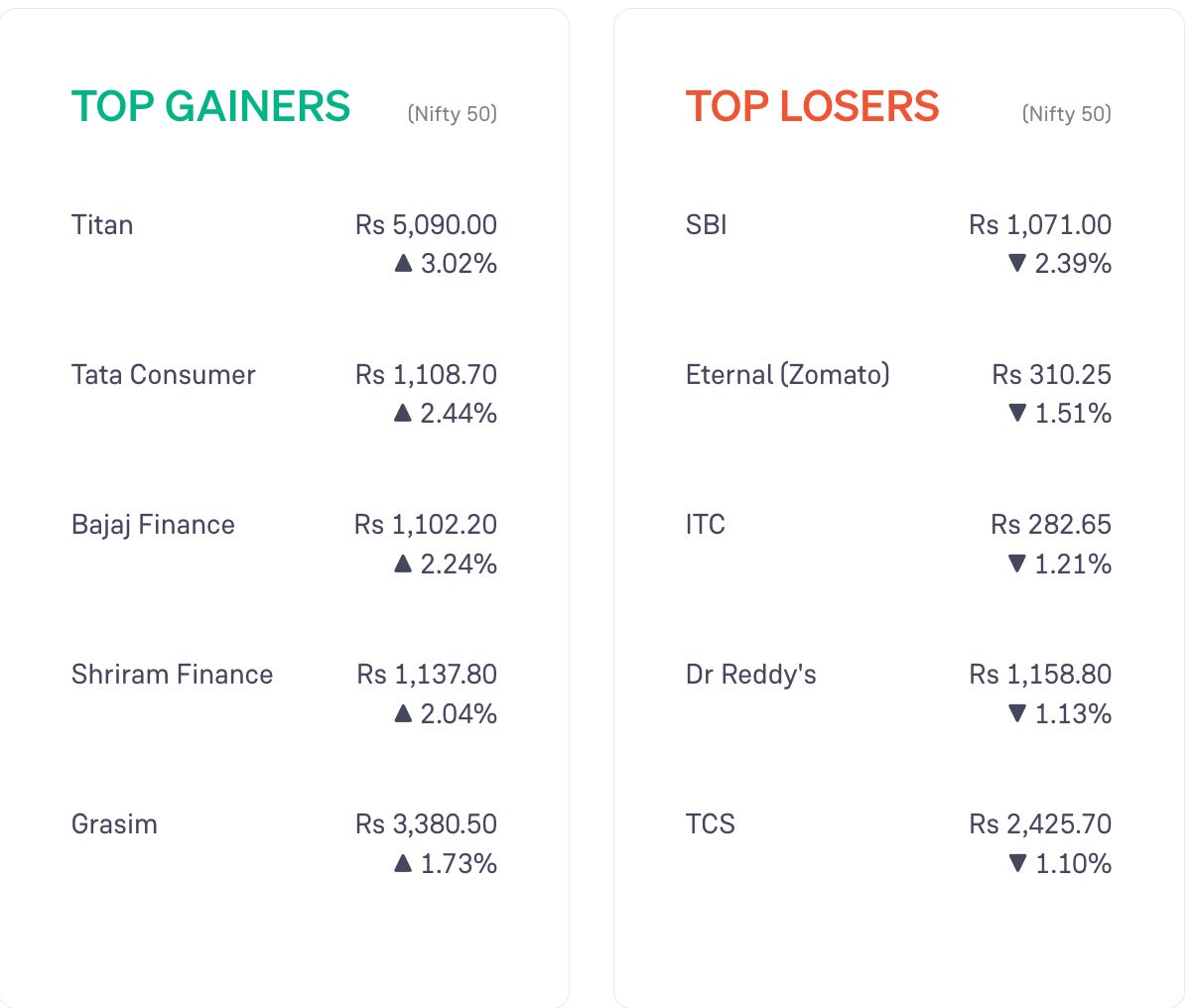
Markets closed higher than Friday’s closing point.
Realty stocks and private bank stocks rose the most today. PSU Bank stocks and oil & gas stocks fell the most.
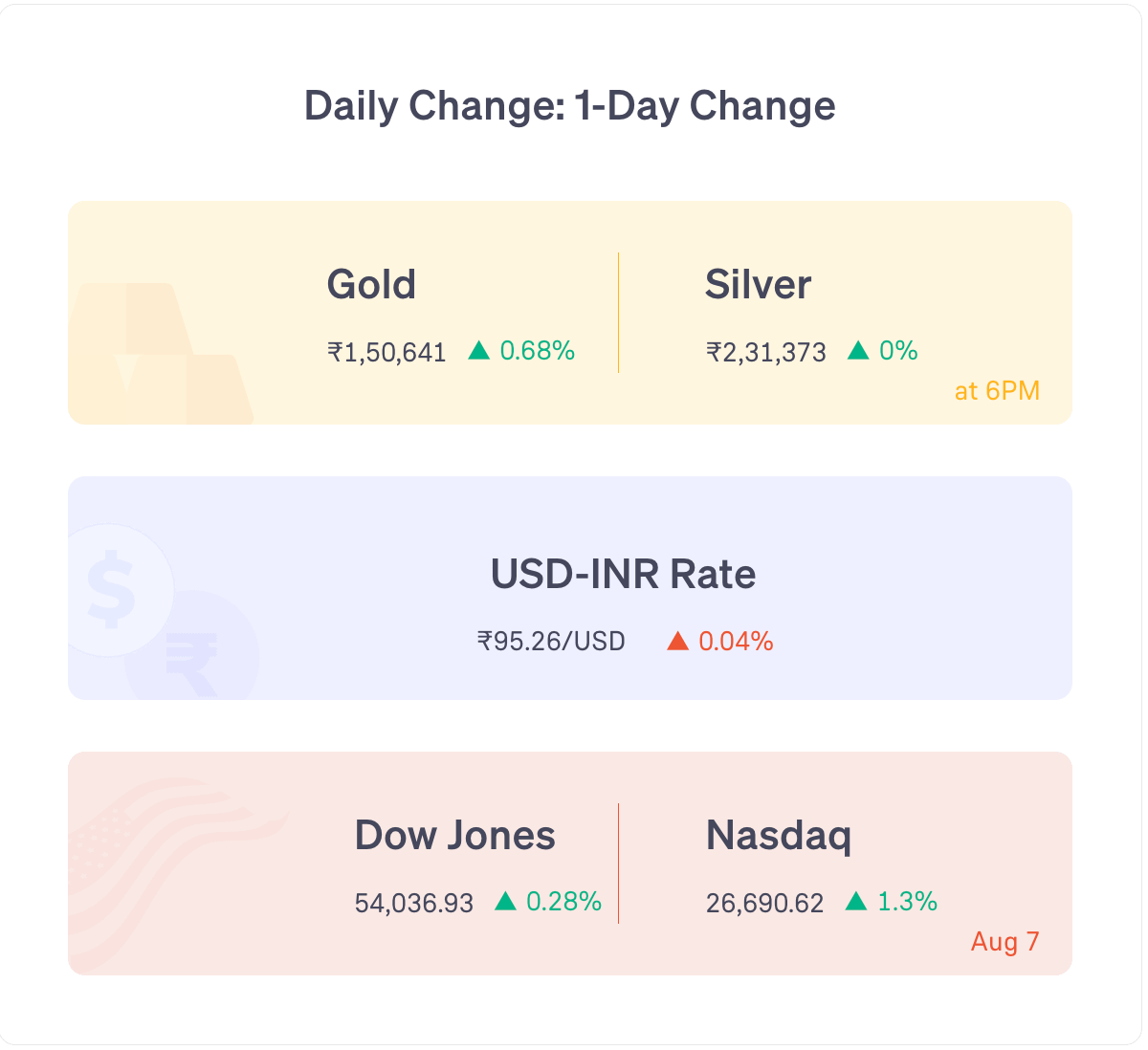
Global markets: US markets rose on Friday. Most Asian markets rose on Monday. European markets showed a mixed trend (as of 6 pm IST).
News
India’s imports of Russian crude oil rose 2.10% month-on-month in volume, with total import value of 5.50 billion euros in July and hit a record high for the second consecutive month.
The government removed physical duty payment challans for exporters to ease compliance burden and save transaction cost, effective on voluntary duty payments from 1 August.
Labour force participation stood at 54.60% in the April-June quarter compared to 55.50% in the previous quarter. The unemployment rate in urban areas was 6.70% (vs 6.60%) and the rural unemployment rate rose to 4.80% from 4.30%.
India’s state fuel retailers revenue loss on sale of LPG narrowed to Rs 188 per cylinder in August from loss of Rs 500 per cylinder in July.
LEAP India IPO was subscribed 0.49 times on day 2. Retail subscription: 0.41 times. IPO will close for subscription on 11 August.
Dhoot Transmission IPO was subscribed 0.63 times. Retail subscription: 0.74 times. IPO will close for subscription on 12 August.
Molbio Diagnostics IPO was subscribed 0.83 times. Retail subscription: 0.77 times. IPO will close for subscription on 12 August.
Stocks Updates
SBI: raised $100 million by issuing floating-rate notes that will mature in July 2029. The interest rate is SOFR plus 100 basis points, and the notes were issued through its London branch.
Bajaj Finance: allotted Rs 1,115 crore of secured NCDs through private placement at a coupon rate of 7.78% per annum. The NCDs mature in November 2029.
Bharat Electronics: received additional orders worth Rs 541 crore since 31 July for communication equipment, electro-optics, ammunition fuzes, CBRN systems, spares and services.
Hindustan Zinc: restrictions placed on the company under a promoter-group loan agreement of up to $80 million have been removed after the loan was repaid and the agreement was cancelled.
TVS Motor: allotted Rs 1,000 crore of unsecured NCDs through private placement at a coupon rate of 7.28% per annum. The NCDs have a 39-month tenure and mature in November 2029.
Lupin: received USFDA approval for Sodium Zirconium Cyclosilicate for Oral Suspension, used to treat hyperkalemia in adults. The reference drug Lokelma had estimated annual US sales of $568 million.
Airtel: partnered with ITI Ltd to offer connectivity, data centres, sovereign cloud, IoT, AI and cybersecurity services. The companies did not disclose the deal value or its financial impact.
Vodafone Idea (Vi): net loss reduced to Rs 3,754 crore in the April-June quarter from Rs 6,608 crore a year ago. The quarter included a net exceptional gain of Rs 1,611 crore, primarily from remeasurement of settlement assets.
Lloyd Metals: net profit rose 164.87% year-on-year to Rs 1,726.59 crore in the April-June quarter. The board also approved investment of up to Rs 625 crore in subsidiary Thriveni Earthmovers and Infra Pvt Ltd and acquisition of at least 26% stake in renewable-energy projects.
Bharat Forge: reported a net loss of Rs 89.73 crore in the April-June quarter, compared with a net profit of Rs 283.68 crore a year ago. The loss included Rs 358.01 crore of exceptional expenses, mainly related to restructuring its German subsidiary. The board also approved raising up to Rs 2,500 crore and setting up a semiconductor-related subsidiary in Malaysia.
Word of the Day
Line of Credit
It is an arrangement between a lender and a borrower which allows the borrower to take a loan and repay multiple times.
This arrangement has a pre-approved borrowing limit.
As long as the borrowed amount is below that limit, the loan is given without extra approvals.
Interest is charged only on the amount borrowed.
For example, many businesses maintain lines of credit with lenders for their operations.
Another example is a credit card.
Credit card holders are technically borrowing money from the bank.
As long as they are within the credit limit, they get the amount instantly and must pay back by the end of the month (usually).
6 Day Course
Theme: micro-cap investing
Day 1: Monday
By now, investors have become familiar with the 3 main categories of stocks based on size or their market cap:
Large-cap: 100 biggest companies
Mid-cap: next 150 biggest companies
Small-cap: the remaining 250 companies
That’s a total of 500 companies’ stocks. What’s beyond that?
Technically, they are also small-cap. But the small-cap companies index includes only 250.
So unofficially, companies that are beyond the biggest 500 companies are called micro-cap.
Some investors also consider companies beyond the 750 biggest companies to be nano-cap.
For reference, there are about 2,700 companies listed on the National Stock Exchange (NSE).
The number of companies listed on the Bombay Stock Exchange (BSE) is even higher — roughly 5,600 companies.
————
What If
Over the last few years, sanctions have become more common in global politics.
But how they affect our markets is rarely clear when the news about sanctions break out.
When that happens, it might look severe on day one, but the real impact depends on how countries and companies respond. What initially feels like a major global shock can sometimes end up having a much smaller, or very different, impact over the following weeks.
In today’s What If, we looked at major sanction events and tried to understand how they affected markets and what they could have meant for investors.
Did you like this edition?
Leave a feedback here!