

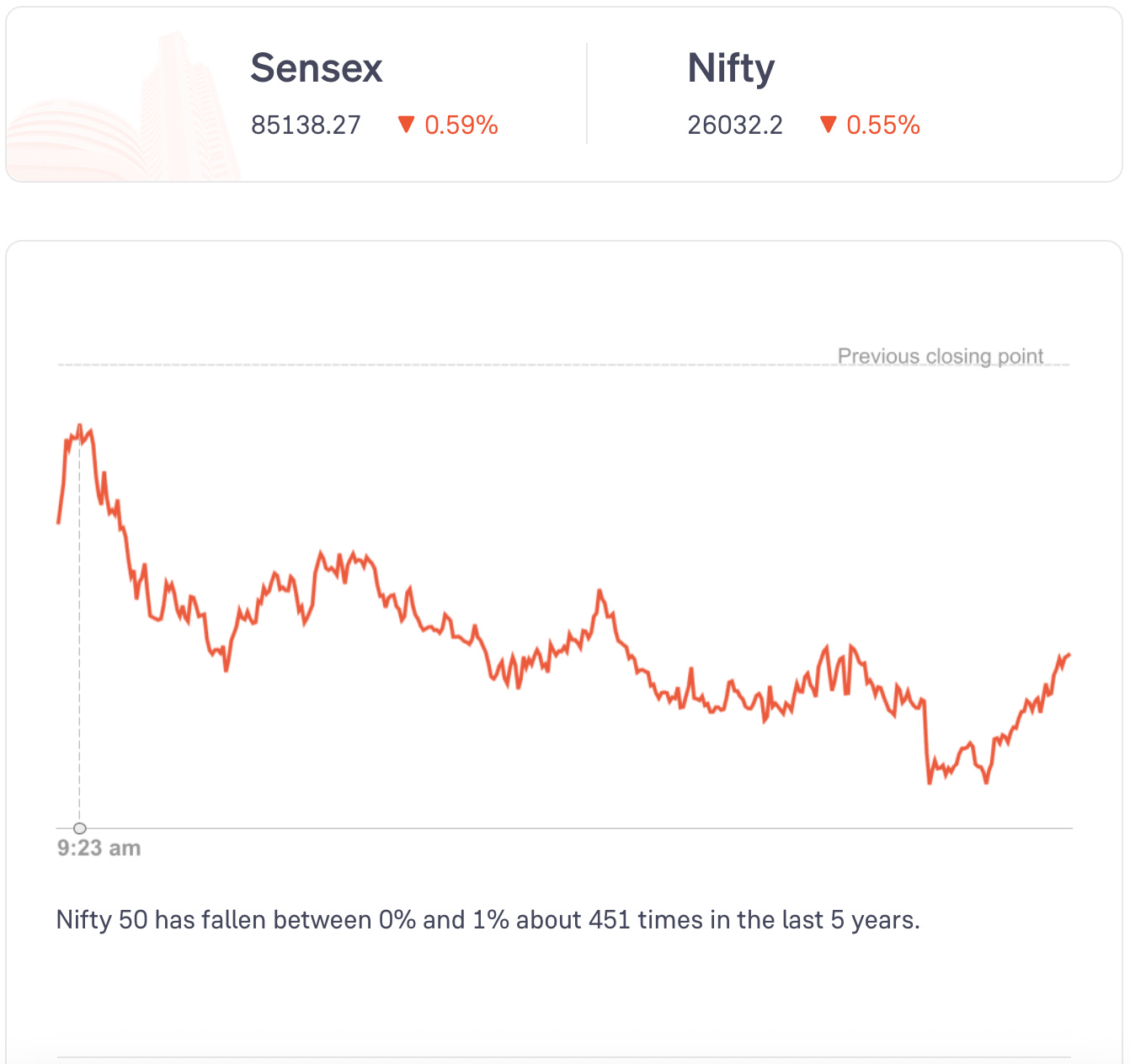
Markets opened below yesterday’s closing point.
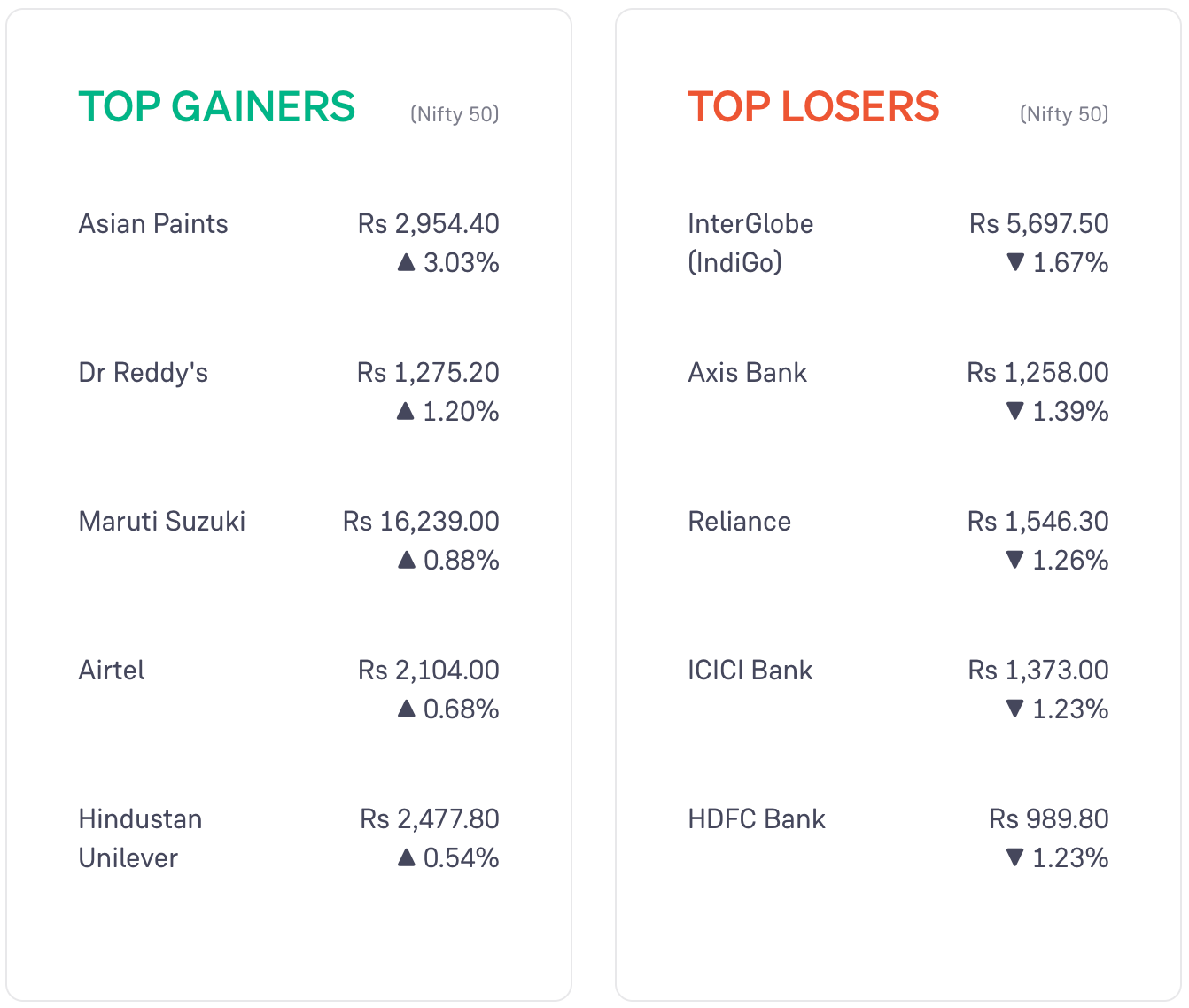
All sectors’ stocks fell today except for the pharma stocks. Chemicals stocks and private bank stocks fell the most.
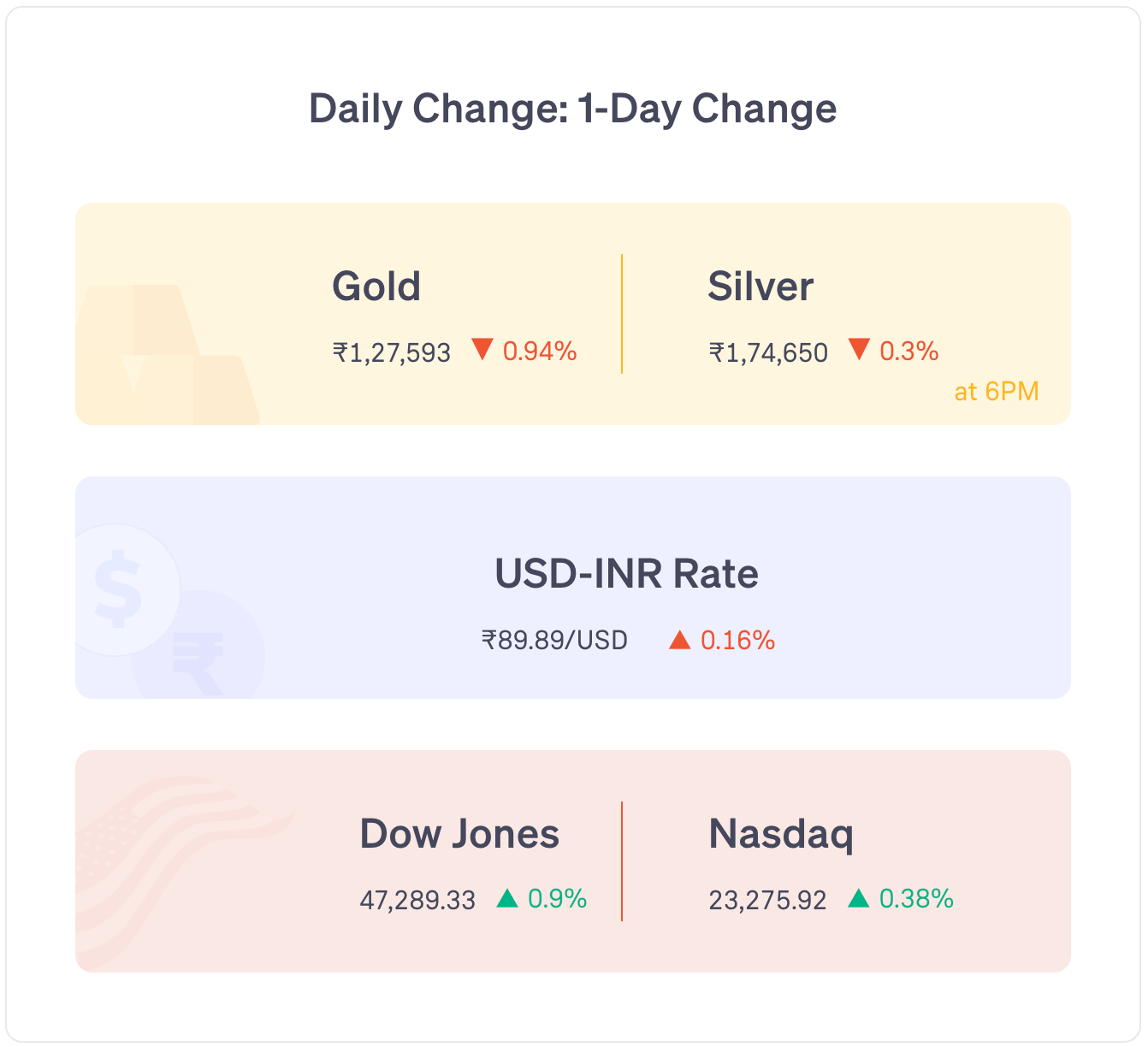
Global markets: US markets fell. Most Asian markets and most European markets rose (as of 6 pm IST).
News
SEBI amended rules to let investors gift or transfer mutual fund units of both demat and SOA-based units to make gifting more tax‑efficient.
The central government ordered all smartphone manufacturers to pre-install the Sanchar Saathi app on all mobile handsets sold or imported for use in India with compliance required within 120 days: Department of Telecommunications
ICICI Prudential AMC received SEBI’s approval for an IPO.
Stocks Updates
IRFC: signed an agreement with Sumitomo Mitsui Banking Corp to raise a $300 million overseas loan.
Nestle: received a GST order demanding Rs 8.28 crore in tax plus interest and penalty for 2018-23, which the company plans to challenge.
Adani Enterprises: company subsidiary, AdaniConneX, has completed its 100% acquisition of Trade Castle Tech Park, making it a step-down joint venture.
Bajaj Auto: received a GST order demanding Rs 34.74 crore tax plus penalty for alleged misclassification of spare parts, which the company will challenge. A company subsidiary, BACL, allotted Rs 500 crore worth of non-convertible debentures.
InterGlobe (IndiGo): received a GST order of Rs 117.53 crore penalty for denied input tax credit, which the company plans to challenge.
Reliance: completed the merger of its subsidiary, Star Television Productions Ltd (STPL), with its another subsidiary, Jiostar.
Wipro: completed its acquisition of HARMAN’s DTS (Digital Transformation Solutions) unit and also merged Wipro Digital Inc. with Harman Connected Services to streamline its group structure.
Auto Updates
Maruti Suzuki: sales stood at 2.29 lakh units. Domestic sales stood at 1.83 lakh units and exports stood at 46,057 units.
M&M: sales grew 19% year-on-year to 92,670 units. Domestic passenger vehicle sales grew 22% year-on-year to 56,336 units while commercial vehicle sales grew 17% year-on-year to 24,843 units.
Tata Motors Passenger: sales grew 25.6% year-on-year to 59,199 units.
Hyundai Motor: sales grew 9.1% year-on-year to 66,840 units including export sales of 16,500 units.
Eicher Motors: sales grew 22% year-on-year to 1.01 lakh units. Exports grew 2% year-on-year.
TVS Motor: sales grew 30% year-on-year to 5.19 lakh units. EV sales grew 46% year-on-year to 38,307 units.
Ashok Leyland: sales grew 29% year-on-year to 18,272 units.
Escorts Kubota: sales grew 17.9% year-on-year to 10,580 units. Exports grew 87.7% year-on-year.
Bajaj Auto: sales grew 8% year-on-year to 4.53 lakh units.
Word of the Day
Discounting
It tells how much a future amount of money is worth today
Money today is more valuable than the same amount in the future.
This is because you can invest the money you have today and earn returns. Also prices may go up in the future (inflation), so the same amount of money will buy less.
Discounting helps investors decide if an investment is worth it by comparing future returns in today’s terms.
6 Day Course
Theme: understanding PE ratio
Day 2: Tuesday
Why is it that a high PE ratio is generally considered bad?
Because it means you’re paying a higher price for something.
Think of it like this: say you are buying rice from a wholesaler at Rs 30 per kg. The market price is Rs 35.
So you will be able to make Rs 5 per kg profit.
But if you buy the same rice at Rs 34 and sell at Rs 35, you will make only Rs 1 per kg as profit.
PE ratio is used to indicate how high or low the price of a stock is compared to what it is capable of earning (earnings per share).
By that measure a lower PE seems better. But only to some extent.
Let’s say a wholesaler has some rotting rice available to buy at only Rs 10 per kg. Would you buy it? Obviously no.
Similarly, stocks with extremely low PE ratios may be stocks with fundamental problems — something wrong with the company, its management, its business model, etc.
Featured Questions
Q. “Who will fix the Indian currency vs usd and all the currencies up and down what basis it’s fixed”It tells how much a future amount of money is worth today
It depends on supply and demand for the currency.
Let’s say you are going to Europe for a holiday. To spend on hotels and food there, you need the local currency.
So, you try to get some Euros. Since you are trying to give someone Indian Rupees, and get Euros in exchange, you are effectively buying Euros by spending Indian Rupees.
When your holiday is over and you’re returning back to India, you might have some Euros left.
So you try to buy Indian Rupees using those Euros.
Such transactions are always happening on a massive scale. Many parties are buying/selling currencies based on their requirements.
The overall demand and supply of currencies determines the cost of each currency, which is basically the exchange rate.
When demand for a currency goes up, its price also goes up.
Example: when more people are trying to buy Euros, you will have to spend more money to get 1 Euro. The opposite happens when the demand is lower — you will spend less money to buy 1 Euro.
The factors that determine the supply and demand of currencies are many.
Importers and exporters are some of the biggest reasons behind the demand and supply of currencies.
Example: if more Indian importers are trying to import cheese from Europe, the demand for Euro will go up so they will have to spend more Indian Rupees per Euro.
Example: if a European company tries to set up a factory in India, it will have to spend money in India, so it will try to buy more Indian Rupees. This will cause the price of Indian Rupees to go up in Euros.
Like importers and exporters, there are many categories of big currency buyers and sellers: investors, corporate companies, travellers, remittances, central banks, etc.
Most currency exchange rates that you see go up and down daily work like this. Eg, INR-USD, EUR-USD, GBP-USD, INR-AED, etc.
Some exchange rates are fixed by the central bank. These are called pegged currencies.
In such cases, the central bank of a country declares that their currency is linked directly to another currency.
Examples:
Hong Kong Dollar is pegged to US Dollar (around 7.8 HKD = 1 USD)
Saudi Riyal is pegged to USD (3.75 SAR = 1 USD)
Bhutan’s currency is pegged to Indian Rupee (1 BTN = 1 INR)
Nepalese Rupees is pegged to Indian Rupee (1.6 NPR = 1 INR)
Did you like this edition?
Leave a feedback here!