
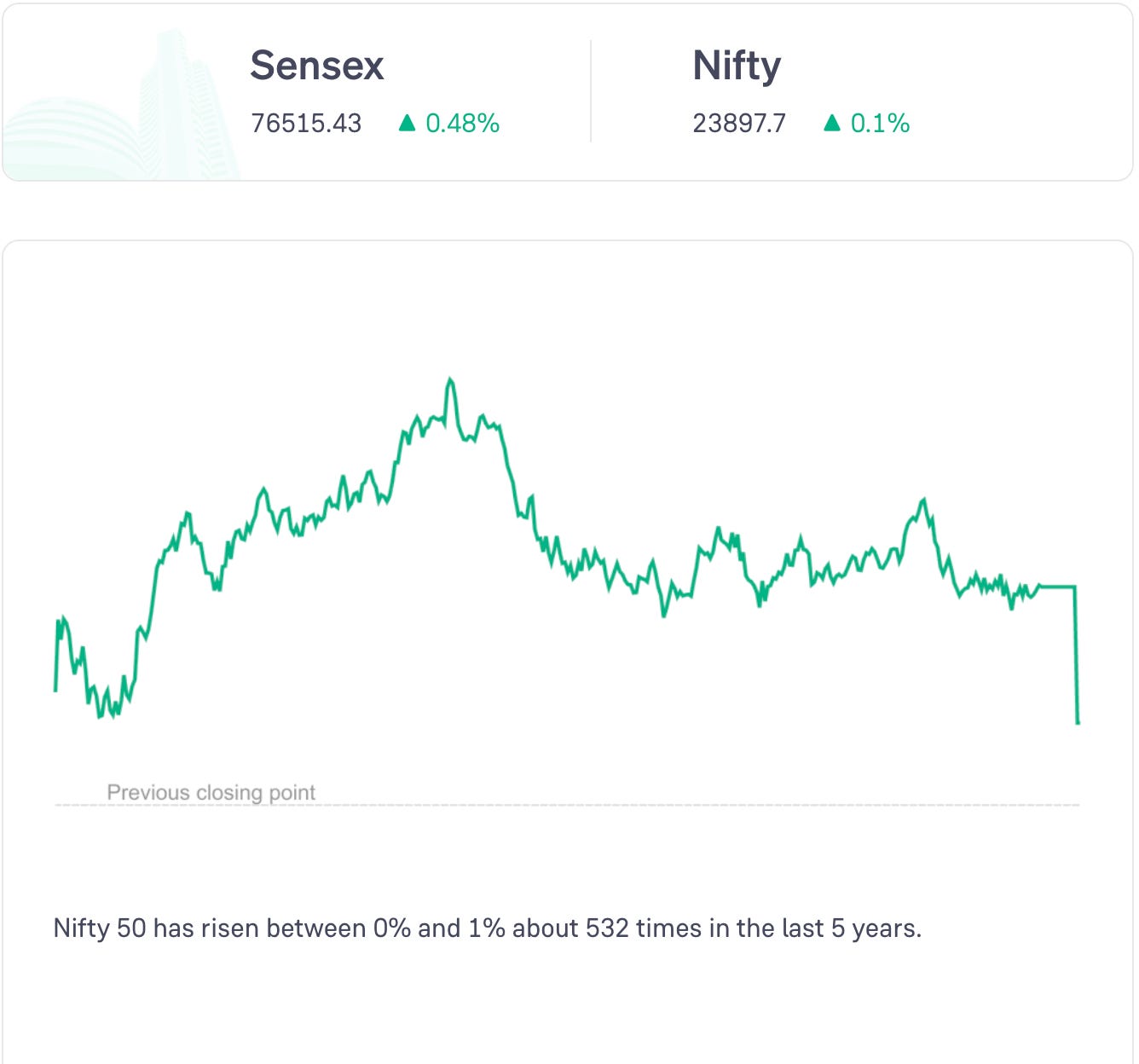
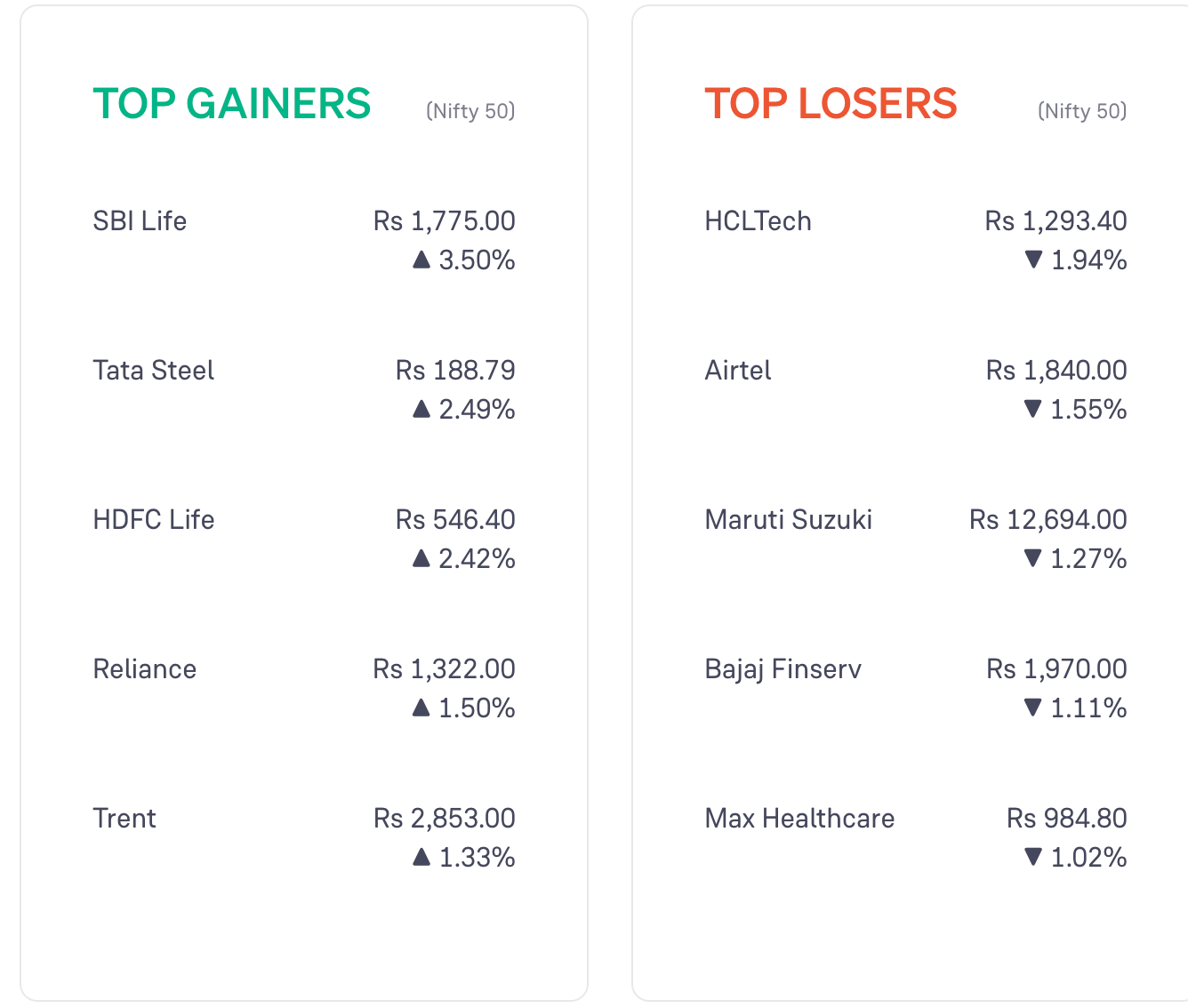
Markets closed higher compared to yesterday’s closing point.
The rise after 4 days of continuous selling in the markets may have been due to positive global sentiment after the US Federal Reserve Governor’s comments on interest rates.
Metal stocks and cement stocks rose the most today. Realty stocks and healthcare stocks fell the most.
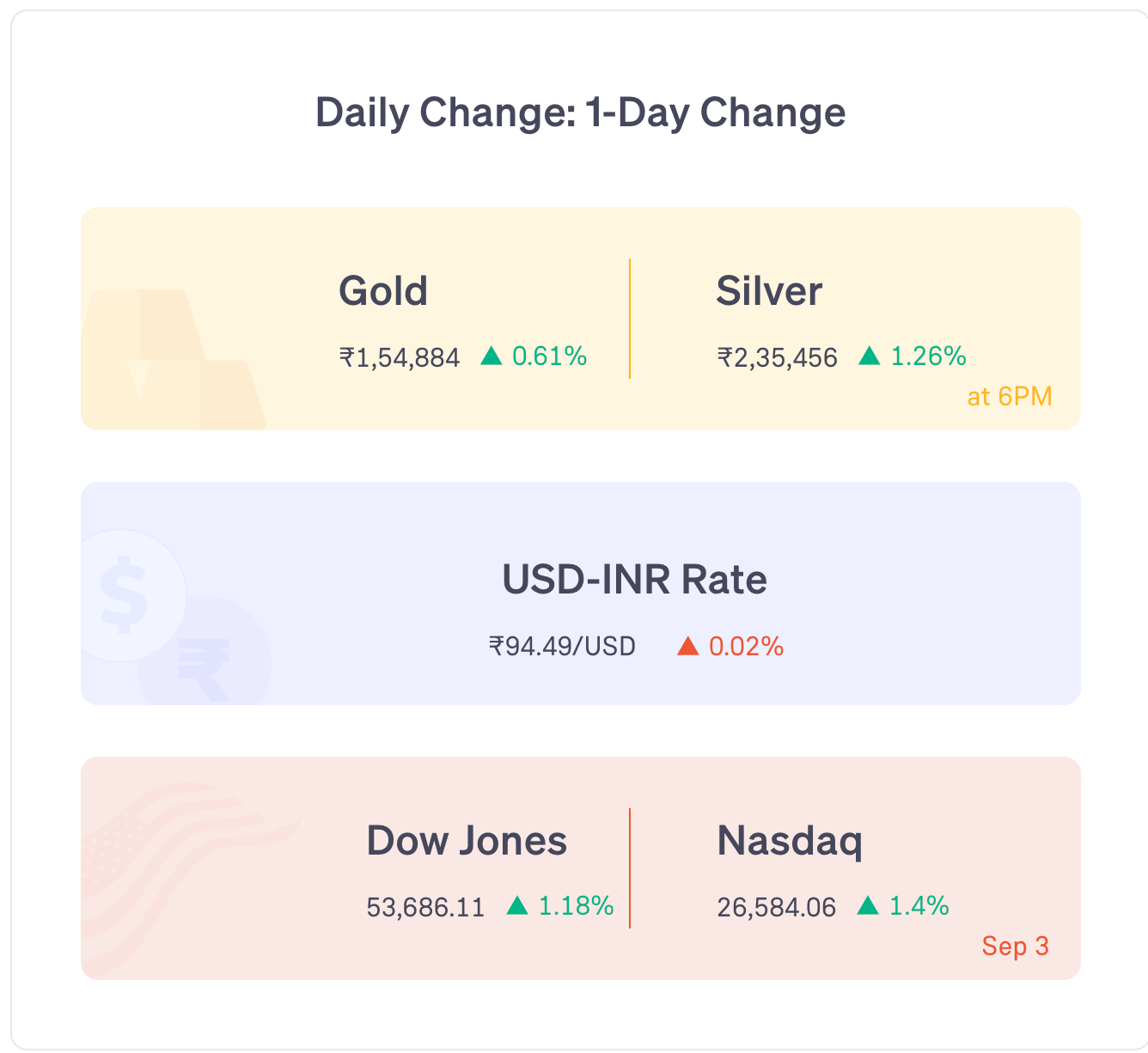
Global markets: US markets rose on Thursday. Most Asian markets rose on Friday. European markets showed a mixed trend (as of 6 pm IST).
News
India’s forex reserves rose $11.47 billion to $740.80 billion in the week ended 28 August.
National Stock Exchange (NSE) along with 3 other companies received SEBI approval for their IPOs.
SEBI will review the methodology used to determine settlement price for derivative contracts in the Closing Auction Session (CAS), following feedback from market participants.
ESDS Software Solution listed at Rs 757, a premium of 76.46% over its issue price and closed 111.75% higher.
Stock Updates
ICICI Bank: issued $500 million of bonds in international markets under the bank’s $7.5 billion Global Medium Term Note Programme.
Adani Ports: is setting up a dedicated empty-container yard at Mundra Port for storage, maintenance, inspection and movement of empty containers.
UltraTech: launched its Ultravolt wires and cables brand following an investment of about Rs 1,800 crore.
Pidilite: step-down wholly owned subsidiary Nina Percept (Bangladesh) Pvt Ltd was voluntarily liquidated.
CG Power: began production at its new transformer plant in Sehore, Madhya Pradesh. The Rs 792 crore expansion will raise the transformer capacity by 60%.
Canara Bank: decided to repay Rs 4,000 crore of bonds between October 2026 and March 2027, subject to approvals.
Cipla: secured exclusive US rights to sell Qilu Pharmaceutical’s proposed pembrolizumab biosimilar (a version of cancer drug Keytruda) in the US, subject to regulatory approval.
Lupin: received USFDA approval for Modafinil tablets, used to treat excessive sleepiness. The original drug had estimated annual US sales of $70.7 million.
Word of the Day
MSCI Global Index
It is an index maintained by MSCI that is made up of large and mid cap stocks
This index is “global” in nature because these stocks are from over 45 countries, including developed and developing countries.
Index funds that are based on this index invest according to it.
When a stock gets added to the MSCI global index, money flows into the stock thanks to investments from index funds and ETFs.
The opposite happens when a stock gets removed from the index.
6 Day Course
Theme: quarterly reports
Day 5: Friday
Contrarian investing: this strategy involves taking a bet against the commonly held beliefs in the markets.
For example, let’s say there’s a sector or company that is being avoided by most investors, a contrarian investor might invest in that stock or sector.
Such investors do not blindly go against a commonly held belief.
They do their research and validate their beliefs (that the stock or sector will turn around).
Small, micro-cap investing: many investors specialise in investing in very small companies.
This may involve following a very different approach from that of choosing larger stocks.
For example, they might be more tolerant of debt, volatility, lack of consistency, lower transparency, etc.
This style of investing is definitely more risky.
We have covered some of the main investment strategies. There are a few more that are less commonly used.
————
Featured Question
Q. “At every rate and every company a buyer and seller are available, how and why it’s possible?”
You are probably looking at a big company’s stock.
What you are describing is not always true for all stocks.
In the case of heavily traded large companies’ stocks, there are many buyers and sellers with different goals and beliefs.
Thus, the chance of finding a buyer/seller that matches your price requirements is high.
In case of smaller stocks, the number of buyers and sellers is lower. The chance of getting a perfect trade quickly is therefore lower.
In fact, during difficult periods, buyers/sellers can vanish, also leading to trades not taking place.
This state is described as the stock being illiquid.
It happens with smaller stocks more often. It is extremely rare in case of large stocks but not impossible.
The information presented in this post has been compiled and prepared by Groww Invest Tech Pvt Ltd and is intended solely for informational purposes. It is not tailored to any specific investment objectives, financial situations, or needs of any individual investor. The content should not be construed as investment, financial, legal, or tax advice and should not be relied upon as a substitute for professional consultation.
Investing in securities markets involves inherent risks. Investors are advised to carefully review all relevant documents and consider their own risk tolerance before making any investment decisions.
Mutual fund investments are subject to market risks; please read all scheme-related documents carefully. Past performance of financial instruments, schemes, or markets is not indicative of future results.
Groww Invest Tech Pvt Ltd is registered with the Securities and Exchange Board of India (SEBI) under Registration No: INZ000301838, as a Research Analyst under No: INH200008662, as a Depository Participant under No: IN-DP-417-2019, and with the Association of Mutual Funds in India (AMFI) under ARN-111686.
SEBI registration details: View registered name and registration numbers
Research Analyst Disclaimer: View Research Analyst disclaimer
Did you like this edition?
Leave a feedback here!