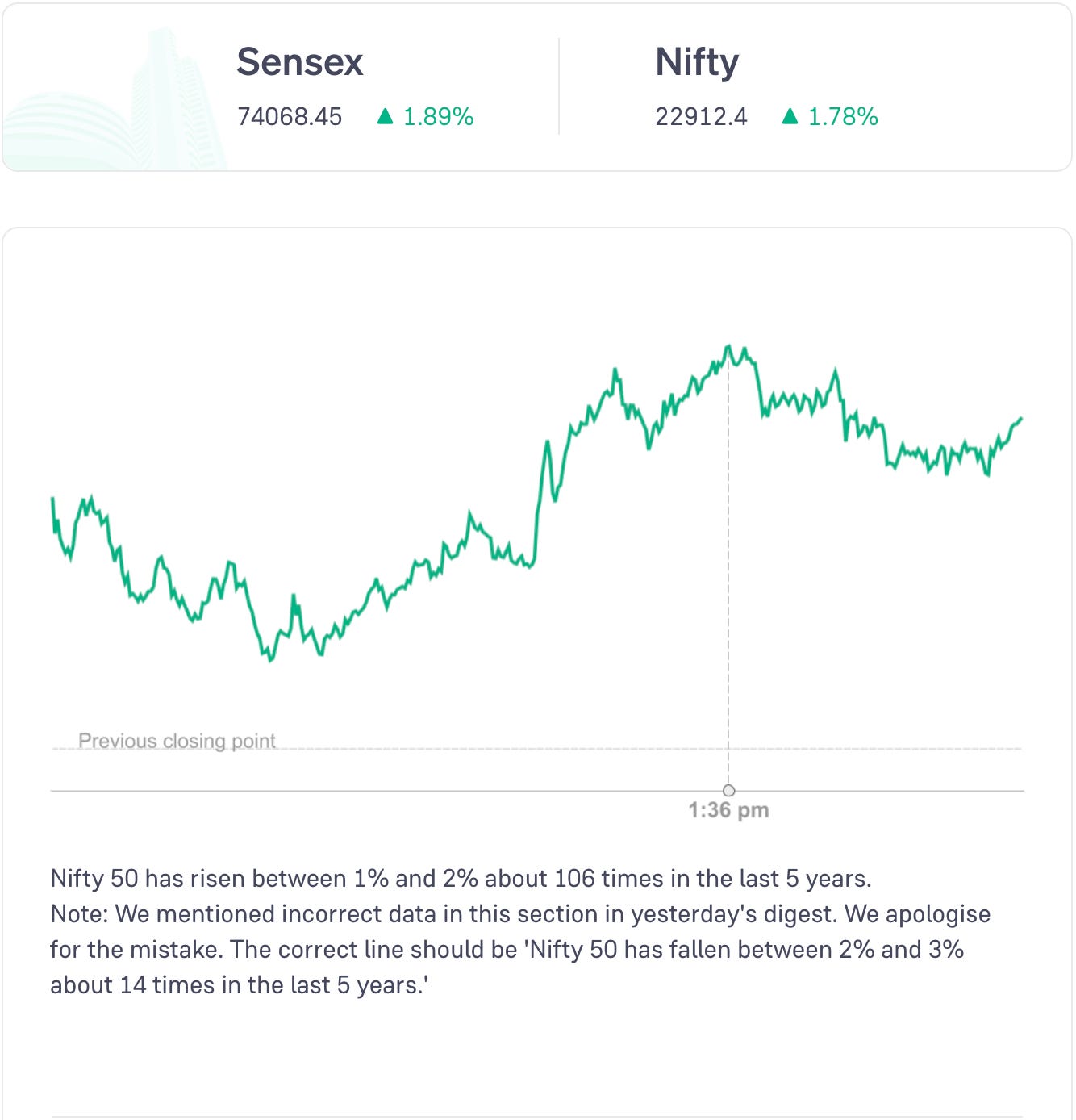
Markets opened above yesterday’s closing point.
Nifty 50 opened higher and closed in the green. This was mainly due to positive global sentiments driven by hopes of de-escalation in the Middle East after positive US-Iran talks.
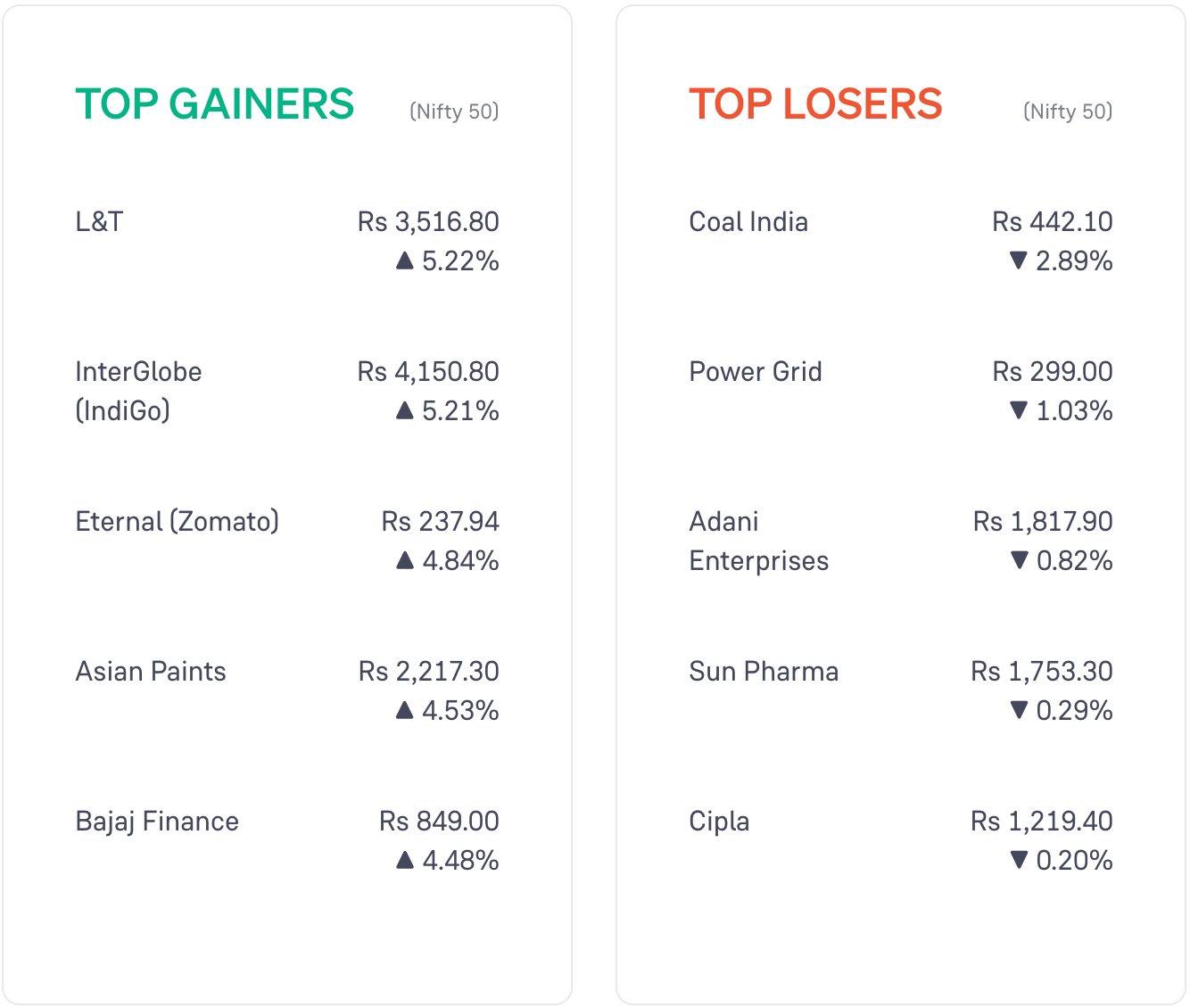
All sectors’ stocks rose today. Media stocks and private bank stocks rose the most.
Global markets: US markets rose. Most Asian markets and most European markets rose (as of 6 pm IST).
News
India’s composite PMI (manufacturing + services) fell to almost a 3 year low of 56.5 in March (vs 58.9 in Feb) as per preliminary estimates. Manufacturing PMI fell to 53.8 (vs 56.9 in Feb). Services PMI fell to 57.2 (vs 58.1 in Feb). This means economic activity grew significantly less in March than in Feb.
SEBI has proposed introducing Gift Cards or Prepaid Payment Instruments (PPIs) for mutual fund investments, allowing a purchaser to gift these instruments, which recipients can use to subscribe to mutual fund units.
Powerica IPO has been subscribed 0.01 times. Retail subscription: 0.02 times. IPO closes on 27 March.
Central Mine Planning and Design Institute Ltd IPO was subscribed 0.92 times. Retail subscription: 0.32 times. IPO is closed for subscription.
Stocks Updates
TVS Motor: declared an interim dividend of Rs 12 per share, with 31 March as the record date.
IRFC: signed a Rs 12,842 crore loan agreement to refinance Hindustan Urvarak and Rasayan Ltd’s debt.
BPCL: commissioned a 2G bioethanol plant at Bargarh and its JV with Sembcorp secured a 10,000 TPA green hydrogen supply contract from Numaligarh Refinery.
Maruti Suzuki: approved a Rs 10,189 crore investment to add 2.5 lakh units annual capacity at its Gujarat plant by 2029.
Waaree Energies: approved increasing its stake in Waaree Transpower to 75.1% and a Rs 3,900 crore capex for a glass manufacturing plant.
Adani Enterprises: completed acquisition of the remaining stake, via a company subsidiary, in IANS India for Rs 4.7 crore, making it a wholly owned subsidiary.
HDFC Life: received a tax demand order of Rs 172 crore for AY23-24, which it plans to challenge.
NTPC Green: signed an MoU with ‘Nxtra Data’ to develop renewable energy projects for supplying power to data centers across India.
Tata Consumer: received a rectification order deleting its earlier Rs 269 crore tax demand.
Word of the Day
Asset Management Company (AMC)
It is a company that manages investments on behalf of investors
AMCs pool money from individuals and institutions into funds like mutual funds or ETFs.
They decide where to invest in stocks, bonds, or other assets to meet the fund’s objectives.
Investors earn returns based on the performance of the AMC’s managed funds.
AMCs make money by charging a fee, usually a small percentage of the total assets they manage.
Examples: mutual fund companies, PMS, venture capital, hedge funds.
6 Day Course
Theme: biggest crude oil price spikes
Day 2: Tuesday
After the 1973 Oil Crisis, the next biggest shock was that of 1979.
And this one was because of a regime change in Iran.
Until 1979, the rulers of Iran were supported and endorsed by the western nations, especially the USA.
In the Iranian revolution of 1979, the existing regime was replaced by a new regime led by Khomeini.
This period was a very turbulent time in the country’s economy. It led to a massive fall in oil production.
Hoarding on to oil was also common and further worsened the shortage.
Back then, Iran was the 2nd biggest producer of crude oil in the world.
The drop in production due to unrest caused global crude oil prices to increase by about 200%.
Featured Question
Q. “How does price movement in an ETF work during open market, I mean for a stock price moves according to buy/sell bids, how does that work for ETF units since it tracks a different asset or indice?”
The price of ETF units depend on the demand and supply of those units only.
They do not directly depend on the demand and supply of the shares underlying.
But what ends up happening is that the market maker of the ETF is constantly creating or destroying ETF units based on the price of each unit and the underlying shares’ prices.
This is why the ETF unit price and the shares’ price move in tandem most of the time.
This can be a little complicated to understand. If you’re interested to know more about it, read about the role market makers play in ETF unit pricing.