

Mel Fisher was fighting a case against the government.
He insisted what he had was his to keep.
It was not the government’s.
The government argued back. It was not his.
The fight lasted 9 years, and took 111 hearings.
Mel Fisher kept relentlessly fighting the case while also keeping alive his mission: find Atocha.
History of Atocha
In the 1500s, European ships were wandering across the world in search of spices, metals, and just about any exotic item they didn’t have in Europe.
For example, India was one of the biggest hubs for spices.
Around that time, the Europeans had discovered North and South America.
This worked well as these ships often returned to their European homes loaded with items.
These trips would take a couple of months at the least. They carried enough supplies to last them long enough.
In 1622, a Spanish ship called Atocha set sail from the port of Havana (Cuba). This was one of many exploration ships from Spain that had been sent on an exploratory voyage.
They carried just about every item that was frequently traded on that route. Coffee, spices, cocoa seeds, dyes, and other such supplies.
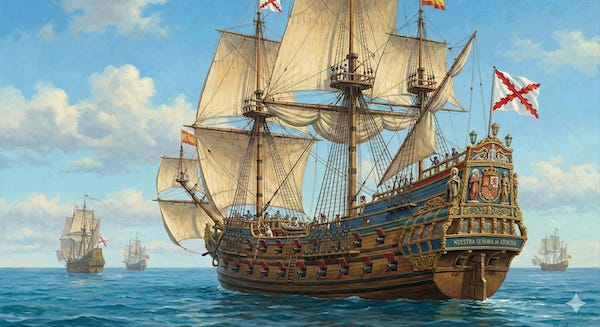
However, the value of these items was minuscule in front of the metals the ship carried: about 40 tons of gold, silver, copper, and gems.
Only a few kilometers into the journey, a terrible storm hit and 8 of these exploratory ships sank to the bottom of the ocean.
20 ships survived and they fled back to Havana.
The surviving crew sent the message across to Spain.
The Spanish sent for salvage ships tasked with recovering the items lying at the bottom of the ocean.
They used trawlers, hooks, and even slave-divers. The stakes were so high, they offered to free slaves who found something at the bottom.
The desperate attempts paid off, somewhat. The team managed to recover some precious silver. About 350 silver bars and a few others were salvaged. These had been in another ship that was a part of the same group of ships.
The items aboard Atocha remained buried under the sea.
And that was that — for ~350 years.
Mel Fisher
Mel Fisher was a chicken farmer and carpenter in the USA. During World War 2, he was posted in Europe.
While he was in Europe, Mel fell in love with diving.
When the war ended, he returned to the USA. To pursue his new hobby, he decided to buy scuba diving gear for himself.
Scuba diving gear was a novelty and rarity back then.
The oxygen tank emptied after a dive and he realised he had nowhere to recharge the tank. He decided to build a setup for himself.
This started an entirely new business for Mel Fisher.
He was in the business of scuba diving. That included taking tourists on their first dive, certifying other divers, aiding in underwater movie shoots, etc.
And then, someone reached out to him.
The Hunt
In 1963, a man named Kip Wagner approached Mel.
Kip, a treasure hunter, had been finding gold coins on the beach in Florida. He knew the story about the sunk ships and believed there was a lot more gold to be found at the ships’ sinking site.
Mel being a diving expert was a perfect candidate for the job. They signed a contract.
For a little less than a year (360 days), they searched the seas and found only abandoned fishing gear and military ware.
Then, they switched strategies.
Mel was using a boat with a strong water pump attached. The idea was to push clear water from the surface to the bottom of the seas so they could see better.
These pumps were strong and they often ended up pushing the sand on the bottom too.
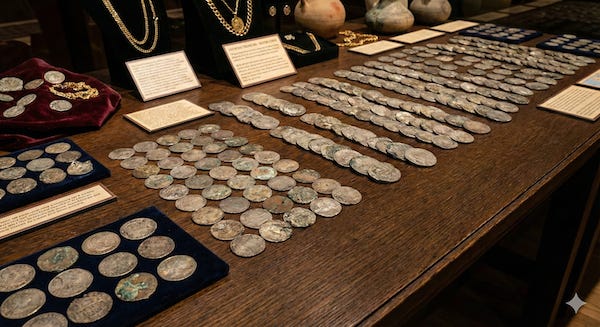
On the 361st day, the boat pushed aside some sand and over 1,000 gold coins became visible.
Back in 1964, the find was valued at $3.5 million.
This treasure had completely enamored Mel Fisher. The idea of treasure hunting seemed too lucrative to give up on.
Some more research led him to completely change his life.
In 1969, he moved home to Florida to start work on this new project.
He had heard of Atocha but knew very little about it. He reached out to a historian to try and determine a rough location of where Atocha had sunk.
After some lengthy research, Mel determined that everyone had been looking at the wrong location.
He felt it was further west of where everyone else was looking.
Within 3 months of searching, he found a 15-feet anchor that looked like it could belong to Atocha.
Mel Fisher was convinced that he was on the right track.
But that was his belief. The rest of the world was not that convinced yet. In 1973, they found 3 silver bars. Mel brought these back and asked for the writings on the bars to be verified.
They matched.
Mel was certain he was looking for the shipwreck in the right location.
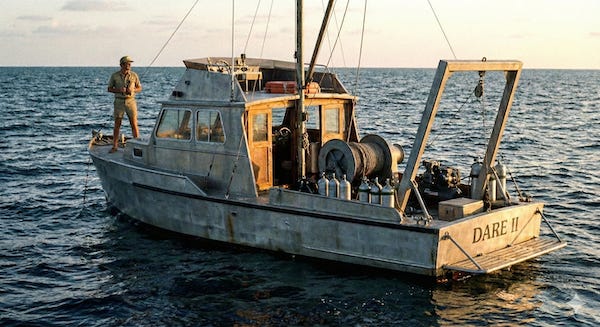
Every now and then, he would find a small hint — a coin, one bar, a gem — that would reaffirm his belief. He used those treasures to continue to fund his expedition.
In 1975, his son found cannons at the bottom of the sea. He tried to pull them out of the water.
Unfortunately, the boat capsized.
One of Mel’s sons and his son’s wife along with a crew member lost their lives.
Mel suffered a huge setback from this accident. But he decided to continue the search with determination.
Discovery & Aftermath
Mel’s discovery was an ongoing process. He would search, find some traces, collect the treasures he found, and continue searching.
About this time, Mel faced a mammoth challenge. The US government and various other state bodies.
According to them, the treasures that Mel had found up until this point were found in US waters. Hence, the treasures belonged to the government, not to Mel.
Mel did not want to stop the treasure hunt. But he also did not want to lose all that he had already found.
He went to court contesting the decision.
The legal fight lasted a total of 9 years.
In 1982, the lines for what was international waters and what was within US boundaries were redrawn.
According to that new line, the location where Mel found the silver bars were in international waters, not in the US.
This made his case stronger.
He went right up to the US Supreme Court.
After 111 hearings over 9 years, the courts ruled that Mel had 100% rights to his discovered treasures. The government’s claim was dropped.
The search meanwhile continued.
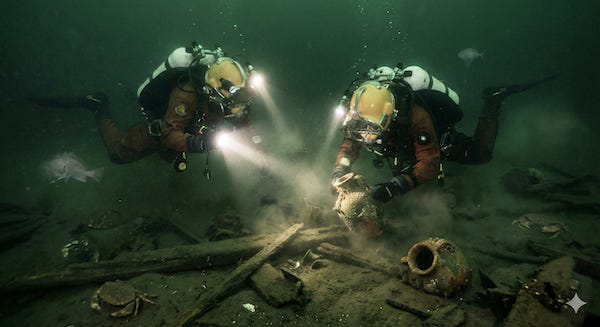
In 1985, around 10 years after his son’s death, Mel’s team hit treasure.
That’s 16 years after he first started the hunt.
40 tons of silver, 125 bars of gold, over 1 lakh precious stones, silver cutlery — back then it all totalled about $450 million.
Present
The Atocha treasure was the richest ship recovery ever made.
The tale has some interesting lessons for people fighting against the odds.
Some endeavours start giving results sooner and more frequently. Those may be deemed less risky.
While others are far more risky. They require patience and dedication. They require tenacity and the ability to stay afloat when everything is sinking.
Usually, such endeavours are worth pursuing only if the end-goal has a reward big enough.
And of course we must understand that high-risk also means that despite all the efforts and costs, the reward might be a big zero.
Mel Fisher had struck big money early on, his first treasure find. He used these funds to support his quest for decades. Had it not been for that, he probably wouldn’t have been able to continue his search for years on end without any big find.
Going all in requires immense sacrifice while facing uncertainty. Often, going all in is a horrible strategy.
Mel kept finding smaller treasures. That helped fund his expeditions. Without that, maybe he wouldn’t have continued.
Also, it is an excellent lesson in survivorship bias.
We talk about Mel Fisher because he sacrificed so much and struck success.
We barely ever hear about those who spent decades pursuing something big and never succeeded.
By the way, Mel Fisher’s family believes that the treasure that they found at the Atocha’s site was only a part of the total haul.
According to them, there’s a lot more silver left to be found. It’s just that the centuries old shipwreck has been scattered across different parts of the sea floor.
They’re still searching for more — long after Mel passed away.
Quick Takes
+ China’s GDP grew 5% year-on-year in 2025. In the Oct-Dec quarter, growth slowed down to 4.5% (vs 4.8% in the previous quarter).
+ SEBI’s revised mutual fund regulations introducing a Base Expense Ratio (BER), lowering expense ratio caps, etc which were approved in Dec 2025, will come into effect on 1 April 2026.
+ The RBI has pointed out priority sector lending (PSL) compliance issues at HDFC Bank and ICICI Bank, and has asked them to keep aside extra provisions to align with the norms.
+ Bharat Coking Coal IPO listed on the stock exchanges at a premium of 95.65% over the issue price and closed 76.43% up at the end of the day.
+ US President Trump threatened to impose tariffs on 8 European countries from 1 Feb unless they agree to support the ‘complete and total purchase’ of Greenland by the US. If a deal is not reached, Trump plans to raise the tariffs.
+ India’s infrastructure output of core sectors grew 3.7% year-on-year in Dec (vs 2.1% in Nov). Coal, fertilisers, steel, cement and electricity sectors saw a growth. Crude oil, natural gas and petroleum refinery products saw a decline in output.
+ India and the UAE signed a $3 billion, 10 year LNG supply deal and agreed to boost trade and defence ties.
+ PhonePe received SEBI’s approval for its IPO: as per media reports.
+ The UK’s inflation rate rose to 3.4% year-on-year in Dec (vs 3.2% in Nov).
+ The central government approved the Rs 5000 crore equity support to the Small Industries Development Bank of India (SIDBI) to boost its ability to extend credit to MSMEs.
+ US President Trump expressed optimism in the India-US trade deal, calling it a ‘good deal’.
+ India’s manufacturing PMI rose to 56.8 in Jan (vs 55 in Dec) as per preliminary estimates. Services PMI rose to 59.3 (vs 58 in Dec). Composite PMI (manufacturing + services) rose to 59.5 (vs 57.8 in Dec). This means economic activity grew more in Jan than in Dec.
+ India’s forex reserves rose by $14.17 billion to $701.36 billion in the week that ended on 16 Jan.
The information contained in this Groww Digest is purely for knowledge. This Groww Digest does not contain any recommendations or advice.
Team Groww Digest