

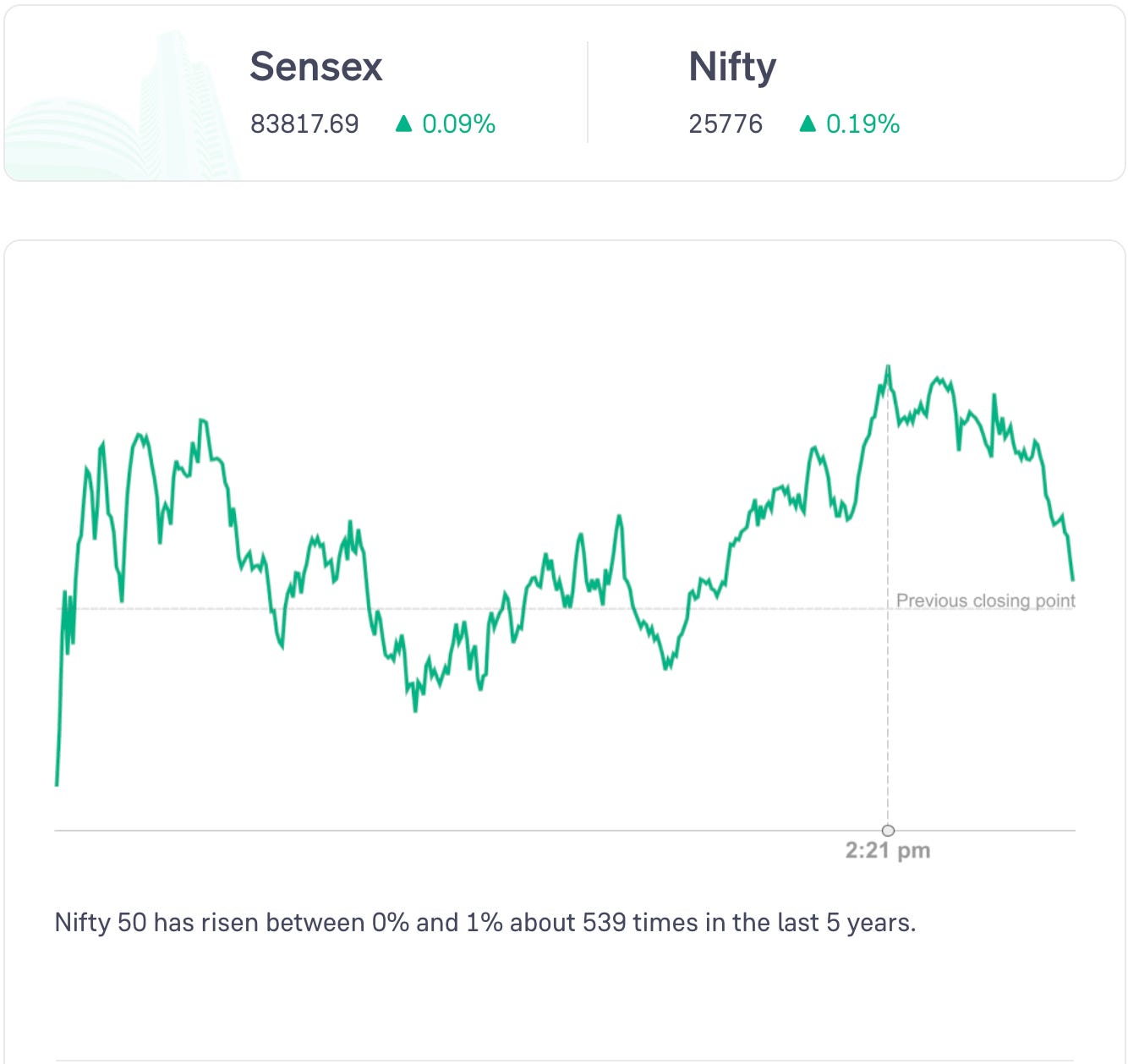
Markets opened below yesterday’s closing point.
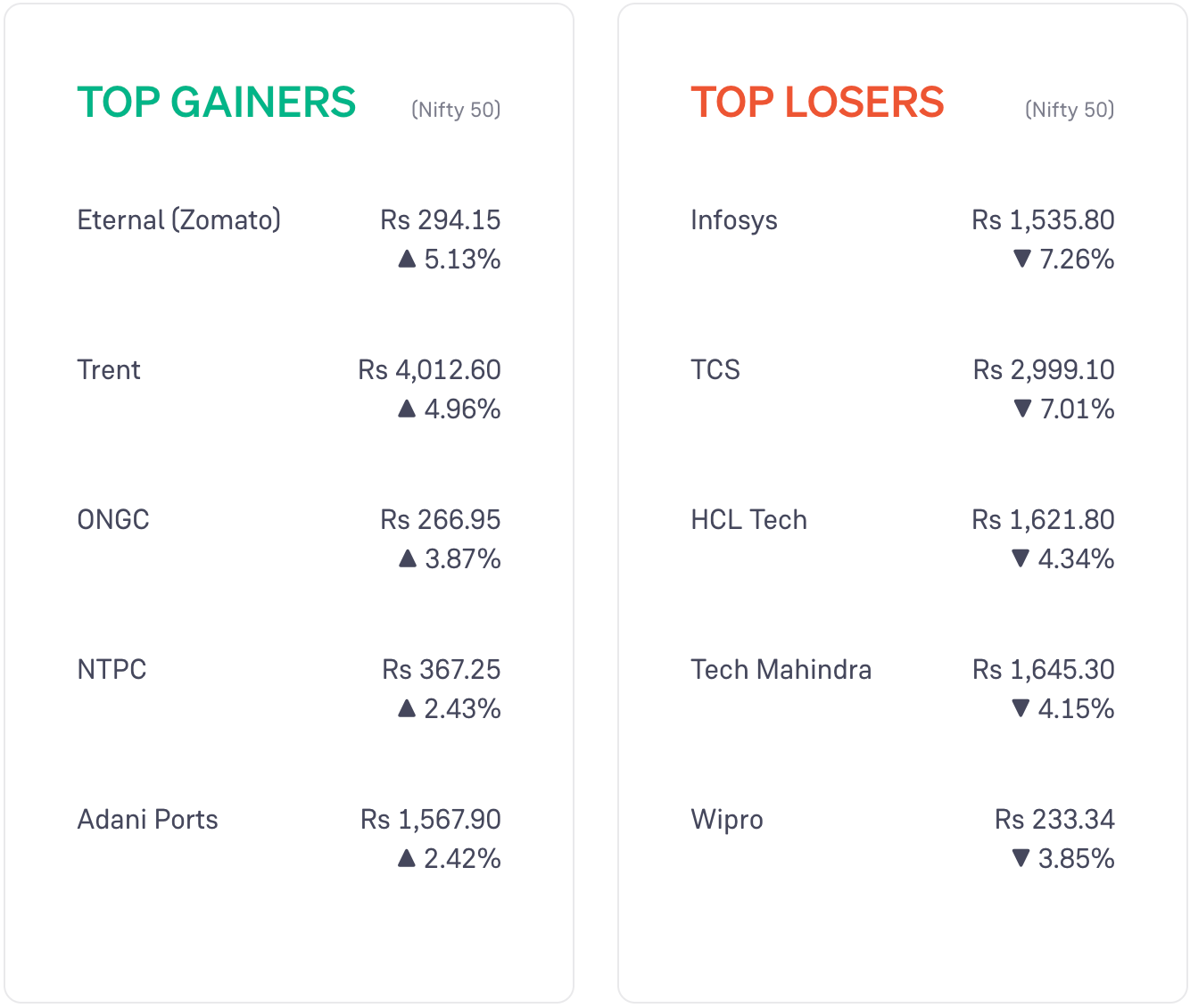
Consumer durables stocks and oil and gas stocks rose the most. IT stocks and pharma stocks fell the most.
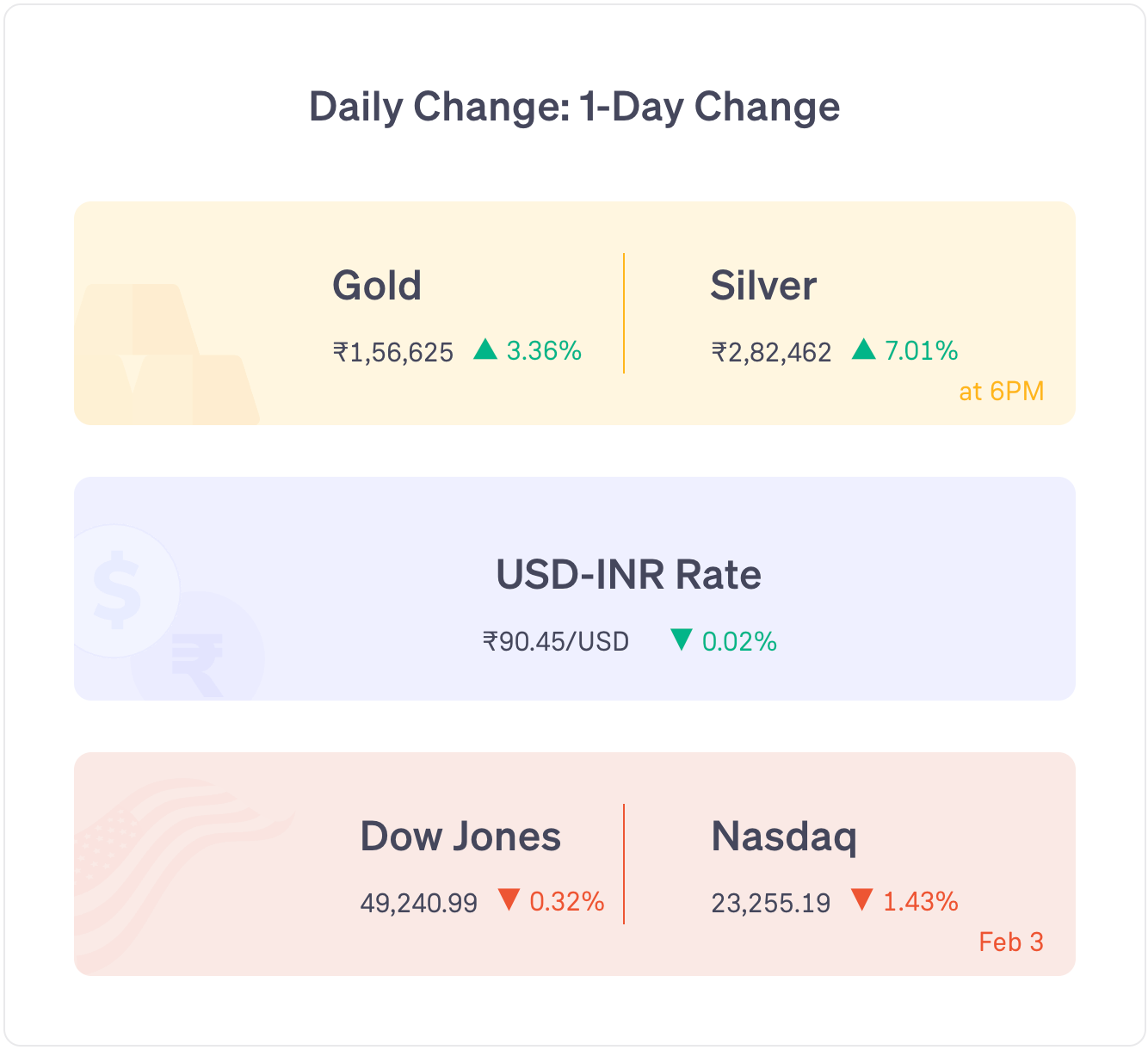
Global markets: US markets fell. Most Asian markets and most European markets rose (as of 6 pm IST).
News
India’s composite PMI (manufacturing + services) rose to 58.4 in Jan (vs 57.8 in Dec). Services PMI rose to 58.5 (vs 58 in Dec). This means economic activity grew more in Jan than in Dec.
SEBI has proposed to update the ‘fit and proper person’ rules (which check integrity, competence, and financial track records) for market intermediaries, to make them clearer, fairer, and reduce automatic disqualifications.
Stocks Updates
Coal India: approved setting up a holding company in Chile for critical minerals, investing Rs 3,189 crore in its coal gasification JV (BCGCL), and forming JVs with DVC (Rs 3,133 crore equity infusion for power projects) and UPRVUNL (51% stake) for renewable energy projects.
Power Finance Corp: transferred 2 transmission SPVs, ‘SR & ER Power Transmission’ and ‘Morena I SEZ Transmission’, to Power Grid and Enerica Infra respectively for around Rs 42 crore combined total.
BHEL: received a letter of intent from Hindalco for a Rs 1,200 crore to Rs 1,500 crore to supply two 150 MW Boiler-Turbine-Generator packages for Aditya Aluminium’s Odisha expansion project.
NTPC: declared commercial operation of 125 MW from the Bhadla Solar PV project in Phalodi, Rajasthan.
Torrent Pharma: completed the acquisition of JB Chemicals stake, raising it to 48.8%.
IRFC: signed a 3-party MoU with ‘V.O. Chidambaranar Port Authority’ and ‘Sagarmala Finance’ to jointly finance the Outer Harbour project at Tuticorin Port and other multimodal infrastructure projects.
Bajaj Finserv: net profit fell 0.1% year-on-year to Rs 2,229 crore in the Oct-Dec quarter.
Trent: net profit rose 3% year-on-year to Rs 513 crore in the Oct-Dec quarter.
Bajaj Holdings: net profit rose 15% year-on-year to Rs 2,016 crore in the Oct-Dec quarter.
Tata Power: net profit fell 25% year-on-year to Rs 772 crore in the Oct-Dec quarter.
Cummins India: net profit rose 33% year-on-year to Rs 945 crore in the Oct-Dec quarter.
Auto Updates (Jan)
Maruti Suzuki: sales stood at 2.37 lakh units. Domestic sales stood at 1.78 lakh units and exports stood at 51,020 units.
M&M: sales grew 24% year-on-year to 1.04 lakh units. Domestic passenger vehicle sales grew 25% to 63,510 units while commercial vehicle sales grew 22% to 27,656 units.
Tata Motors Passenger: sales grew 47.1% year-on-year to 71,066 units.
Hyundai Motor: sales grew 9.5% year-on-year to 59,107 units including export sales of 14,030 units.
Eicher Motors: sales grew 14% year-on-year to 1.04 lakh units. Exports rose 5% to 10,541 units.
TVS Motor: sales grew 29% year-on-year to 5.12 lakh units. EV sales grew 50% to 37,756 units.
Ashok Leyland: sales grew 27% year-on-year to 21,920 units.
Escorts Kubota: sales grew 46.9% year-on-year to 9,799 units. Exports grew 8.3% to 662 units.
Bajaj Auto: sales grew 25% year-on-year to 4.77 lakh units.
Word of the Day
Purchasing Managers’ Index (PMI)
It is a monthly indicator of business activity in an economy.
It’s based on surveys of purchasing managers in manufacturing and services, and tracks metrics like new orders, production, jobs, and input costs.
- A PMI above 50 means activity is expanding
- A PMI below 50 means activity is contracting
- A PMI of 50 means business activity is unchanged
PMI shows the direction of activity, not how much it changed.
6 Day Course
Theme: common ways to cook books
Day 3: Wednesday
When earnings cannot be ‘managed’ some companies choose to reduce their costs.
There are a few ways of doing this.
One is using depreciation.
Companies use many items for multiple years. For example, some companies use machines that will last 10 years.
So the depreciation of the machine’s value is spread out over 10 years. Now, if a company simply changes this 10 year life to 12 or 15 years, the annual depreciation cost reduces.
Then, the company can show reduced costs per annum.
Another trick is to change estimates.
Companies also invest the money they have in different assets. They can state that they expect their investment to give a slightly higher return.
Since this is an estimate, it does not need to be absolutely accurate.
If the return later turns out to be lower than estimates, they can simply state that they over-estimated a bit.
Featured Question
Q. “If we invest in a large cap stock like Reliance industries or Airtel for 5-6 years, it is nearly guaranteed that it will not give me negative returns or will give a very good return of atleast 10-12% p.a. plus dividends. Then why a person invest in debt mutual fund for 6-7% return p.a”
No company’s shares are guaranteed to give high returns.
Even the biggest and best of companies can falter.
Investors have to understand this risk and invest. If you look at the histories of many major companies, you can easily see long periods when the stock gave very low returns.
This is why stocks are considered riskier. They can give better returns, but they can also not give returns or give negative returns.
In comparison, debt mutual funds (mutual funds that invest in many bonds) tend to offer more stable returns.
Yes, they are also not risk-free.
But they can be considered much lower risk than individual stocks investments.
So to answer your question in short, people choose debt funds because they are much lower risk than individual stocks investments.
They are willing to settle for lower returns in return for stability and low-risk.
Did you like this edition?
Leave a feedback here!