

Max Steineke had hurried to San Francisco.
The oil company, Socal, wanted answers.
Max was the chief geologist working in the petroleum company.
In 1938, the US economy was in the middle of the Great Depression. Everybody had to be tight with money and the pressure was felt by Socal executives also.
Socal or Standard Oil Company of California was feeling the pressure too.
Max was not known to be a reckless risk taker. He was a careful and measured person.
On this occasion, knowing all he knew, he had decided to take the risk — he would defend himself and fight for oil exploration to continue.
1933
It started 5 years earlier, in 1933.
Socal had struck a deal with the King of Saudi Arabia and could start exploring for oil.
Socal had discovered oil in nearby Bahrain a year earlier. Early reports and estimates suggested the oil basin was quite large and that oil might be found under Saudi as well.
Discussions had lasted a few months and once the terms were finalized, Socal could start exploration.
Within 5 days of arriving, the geologists identified a few limestone hills the formation of which resembled the location where they had found oil in Bahrain.
This was named the Dammam Dome.
With the dome found, they established their offices in Saudi Arabia, to start serious exploration.
Almost immediately, the team encountered all kinds of problems.
American geologists, engineers, and staff were not used to working in the harsh and hot desert. The heat drained them fast. Their trucks would often get stuck in the loose sandy surface. Local taxes and exemptions led to conflicts. Language was a barrier.
The list was long. But the prize was too tempting to stop.
To better survey the area, they flew planes over the region and took pictures. Then, with all data collected, they went to Lebanon for a summer vacation where they finally made up their minds.
After lots of surveying, they were sure — they must drill oil wells.
Wells
About a year and a half after arriving, they started drilling the first oil well in 1935.
After crossing the 1,700 feet mark, promising signs started being seen. Some gas and some oil flow were detected.
Not commercial success, but there were clear signs that they were onto something. They pushed further.
At around 2,200 feet, a strong gas flow pushed out, damaging the equipment and causing the well walls to cave at some portions.
Panicking, the geologists and engineers decided to plug the well with mud and cement. Later, they sourced better equipment and pushed past 3,000 feet.
The well continued to be an operational nightmare, costing more money to manage than it yielded. They decided to shut it off in 1937, treating it as a gas well.
Dammam Well 1 was a failure.
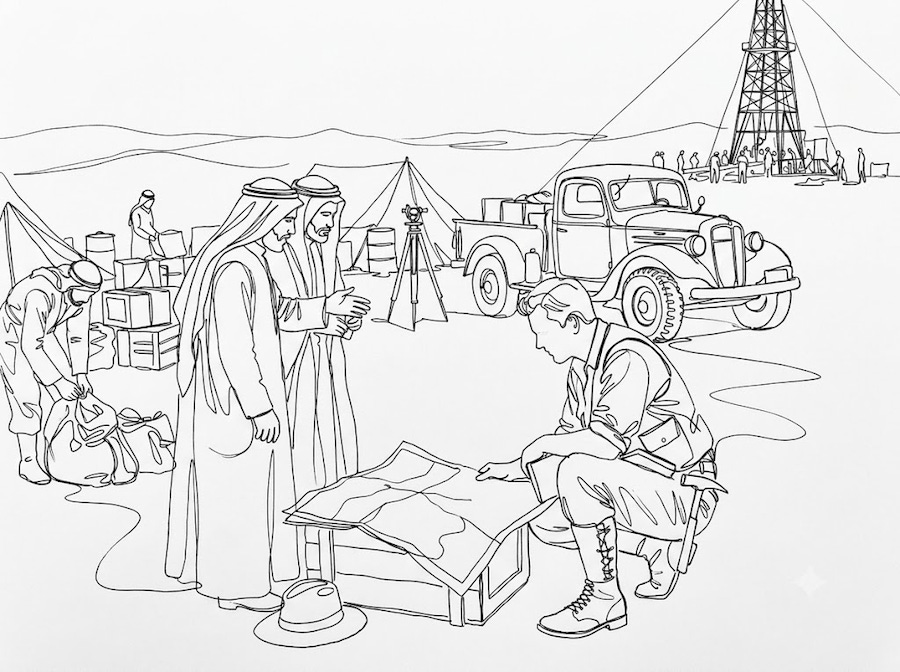
The drilling of the 2nd well was started in 1936.
After drilling beyond 2,000 feet, the well started producing commercially viable amounts of oil. The volume of oil was enough to send waves of excitement across to Socal’s California headquarters.
They commissioned the building of a permanent base with staff quarters and also, digging more wells.
The news died off soon. Well 2 started producing more water than oil — it was flooded with groundwater.
It wasn’t as good as they had thought it would be.
Still, Dammam Well 2 gave hope that there was oil.
The 3rd well turned out to be a dud. Not enough oil to be commercially viable.
On to the next well — the 4th well. That turned out to be completely dry. It was a massive hit to the oil explorers’ morale.
Doubts about having misjudged the presence of oil started surfacing.
Drilling of the wells continued. The 5th well was exactly like the 4th — dry.
Well 6 yielded some oil, but again, not enough.
The drilling of the 7th well started some time in 1936. The chief geologist Max Steineke had noticed a pattern in the digging of the previous wells.
They were all dry or yielded too much water at a certain depth, which is when the drilling was stopped.
Well 7 was proving to be an even bigger nightmare. They had pushed further ahead to more than 3,300 feet and gotten no oil or water. It was dry.
Under Max’s leadership, they continued. At 3,600 feet, a small quantity of oil was found. They pushed further.
At about 4,500 feet, a massive gas blowout took place. The crew struggled to fight it and somehow managed to plug it. No oil was found.
Max Defends His Thesis
Over the roughly 5 years they had been there, the entire oil exploration exercise had turned out to be a money pit. It yielded nothing.
And Socal’s executives were getting anxious.
Max Steineke was called to San Francisco.
The executives wanted to know if it made sense to continue pouring millions of dollars into wells that didn’t yield any oil.
Max explained his thinking on maps. He wanted to continue drilling.
The executives were not convinced, so Max continued making his case.
He was still in San Francisco on 4th March 1938 when news came in that well number 7 had hit oil and was producing enough oil to be commercially viable. This was at a depth greater than 4,700 feet.
Excitement was back on the floor.
Past experience from the previous wells had taught them not to get excited too soon.
A few weeks passed. The oil flow remained steady and consistent. Dammam Well 7 was a success.
It was later renamed the Well of Prosperity.
It produced oil till 1982 — a 45 year run. Over 32 million barrels of oil.
Based on his knowledge, some of the earlier failed wells were also deepened. They also yielded oil and became commercially viable.
Thesis
Investing, too, works somewhat like this.
Nobody has all the knowledge. There’s an idea — a thesis. The thesis is based on as many real-world facts and knowledge as possible.
Then, the thesis is tested in the real world. Multiple bets are placed that align with the thesis.
Some of the bets pay off, some don’t.
We see this in business and investing almost every day. Single bets are a rarity. Multiple bets are the norm.
Take the case of Warren Buffett and Japanese trading houses.
Some time in 2020, Warren Buffett developed the thesis that Japanese trading houses were some of the most diversified companies in the world with operations spanning 60-90 countries.
They were well run and professionally managed. And they appeared to be available at cheap valuations.
Instead of choosing the best of the lot, he simply invested in all 5 of the biggest trading houses acquiring more than 5% (each) of their stake.
Over time, he has increased his stake.
He has invested similarly in the past — with airline stocks and newspaper stocks among others.
Institutional investor Blackstone did something similar.
After the 2008 recession, home prices had hit rock bottom. But people didn’t have the money to buy homes despite them being cheap.
Their thesis was this: house prices were cheap. But people would be renting for a long time. So, good time to be a homeowner.
Blackstone started buying homes in 2012. It didn’t bother inspecting individual homes.
By the time they were done, they had bought a total of around 48,000 homes.
The company that they used to buy these homes, Invitation Homes, listed on the stock markets in 2017, giving them a fat profit.
Another good example of this comes from the world of startup investing.
SoftBank’s thesis was that ride-hailing was going to be the way many commuters moved around town.
Instead of trying to find the best ride-hailing company to put their money in, they just tried to buy a stake in many startups in the space, across different countries.
SoftBank was an investor in Uber, Ola, Didi (China), Grab (SE Asia), 99 (Brazil), etc.
Distribution of Returns
The thing about having a thesis is that it is necessary to understand the nature of the winners and losers.
It is necessary to understand where the returns are going to come from — and what can hurt them.
Some kinds of portfolios have few winners and mostly losers. But the winners are so big that the losers don’t matter.
Some kinds of portfolios have an even number of winners and losers. The profits aren’t super big, but neither are the losses.
Some portfolios have most of the gains coming from most of their investments. There are only a small number of losses. The profits are low but consistent and the losses are tiny.
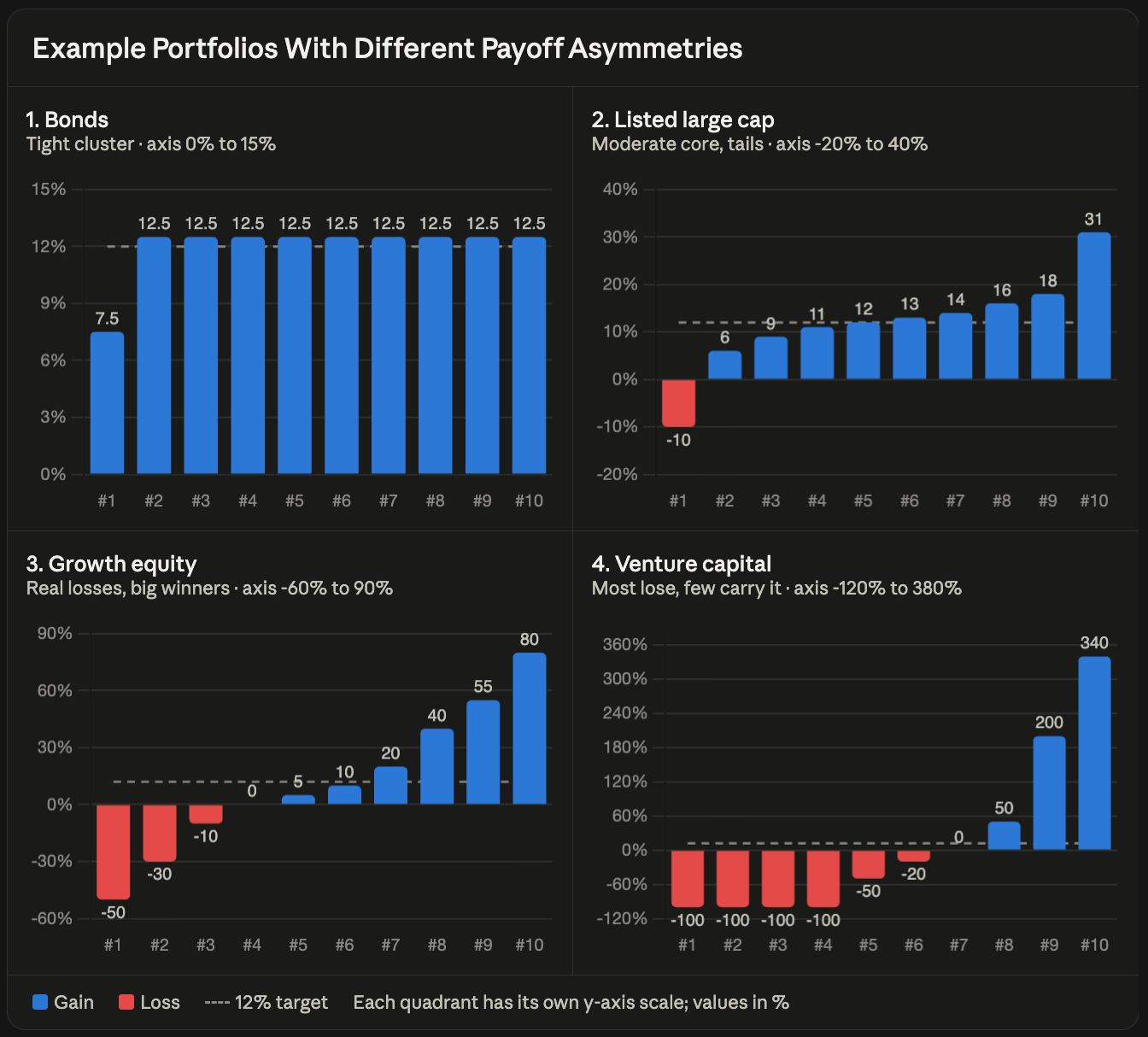
If you look at share market investing funds, many of them have portfolios that are far less asymmetric. More winners, fewer losers.
Bond investors tend to have more wins and fewer losses in their portfolios.
Investors use many checks and filters to keep their investments in line.
This method is one such check.
The central idea is that you could be right about an idea, but end up with the wrong investment.
So, place more bets while sticking to the idea.
Quick Takes
+The government will launch the 1st Fleet Support Ship (FSS-1) and lay the foundation for FSS-5, along with other shipbuilding infrastructure on 06 Oct in Visakhapatnam.
+The government approved Rs 10,000 crore for establishment of SME Growth Fund for direct equity investments in small and medium enterprises.
+Indian auto retail sales rose 31.82% year-on-year to 25.37 lakh units in September 2026, as per data from Federation of Automobile Dealers Associations (FADA).
+A special purpose vehicle called Integrated Transport & Logistics Authority was approved by the government to improve research, planning and monitoring in transportation and logistics.
+The government signed a contract with BrahMos Aerospace Private worth Rs 661 crore to procure BrahMos Fire Control System and Launchers for Indian Navy ships.
+RBI raised the repo rate by 25 basis points to 5.5% in the monetary policy; the 1st hike in about 4 years. It also changed its stance to “calibrated tightening” from “neutral” which could indicate more rate hikes.
+The US 30-year bond yield rose to a 24 year high of 5.7041% ahead of the Federal Reserve’s September meeting results.
+Federation of Indian Export Organisations (FIEO) asked for an extension of export credit period to 450 days after the RBI hiked repo rate to support exporters.
+The GST Council approved a series of measures such as removing tax officers’ arrest powers, reducing the general penalty amount, changing input tax credit rules, etc.
+The government said that India’s regulatory framework for satellite communication services is fair and non-discriminatory, after Elon Musk claimed that Starlink’s entry in India was “being blocked by certain oligarchs”.
+RBI officially removed Paytm Payments Bank from the Scheduled Banks list under the RBI Act, following the cancellation of its banking license earlier this year.
+India’s forex reserves fell $12.95 billion to $734.61 billion for the week ended 02 Oct.
+The US suspended Microsoft and 7 other IT companies including Infosys, TCS, Wipro from a key green card programme called PERM (Permanent Labour Certification).
+The government said that the daily coal supplies to the power sector rose 36% from September lows and stock depletion slowed, but stock rebuilding is yet to commence, in response to media reports on power shortage risks.
+FirstCry backed Swara Baby Products received SEBI approval for a Rs 1,000 crore IPO. The IPO will comprise a fresh issue of Rs 500 crore and an offer for sale of Rs 500 crore.
The information contained in this Groww Digest is purely for knowledge. This Groww Digest does not contain any recommendations or advice.
Team Groww Digest